- The paper presents a novel explicit partitioned scheme combining BDF2 and AB2 methods for fluid–poroelastic interaction.
- The method achieves second-order temporal accuracy and optimal spatial convergence under a parabolic CFL constraint.
- Extensive numerical and theoretical analyses confirm the scheme's stability, parallel scalability, and robustness in moving-domain applications.
Second Order Explicit Splitting for Fluid–Poroelastic Structure Interaction
The paper introduces a fully discrete second-order explicit partitioned time-stepping algorithm for the Stokes–Biot system. Robust coupling of incompressible flow (Stokes) and poroelasticity (Biot) via interface transmission conditions remains a major challenge in multiphysics computation, particularly when aiming for modular, parallel algorithms without compromising stability. The scheme integrates BDF2 (second-order backward differentiation) for evolution in the fluid and poroelastic subdomains and AB2 (Adams–Bashforth second-order extrapolation) for interface coupling through a Robin-type reformulation. This approach enables independent and parallel solution of fluid and structure subproblems at each time step, with explicit treatment of interface terms.
A rigorous stability analysis leverages BDF2 energy identities, sharp interface decomposition, and discrete trace inequalities. The scheme's stability is established under a parabolic CFL constraint (Δt≤c∗h2 for mesh size h and constant c∗) to ensure that the explicit interface extrapolation does not destabilize the system. The error estimate is constructed via projection-based framework: a Fortin operator for the fluid and Ritz-type projections for poroelastic variables, quantifying both spatial and temporal discretization defects.
Numerical and theoretical analysis confirms that total errors (fluid velocity, structure velocity, pore pressure, elastic displacement) are bounded as O(hk+Δt2) in energy norms for polynomial degree 1≤k≤3. The decomposition identifies three sources of error: (1) BDF2 temporal discretization, (2) AB2 interface extrapolation, (3) projection defects from the kinematic relation, establishing precise consistency and approximation bounds.
Main Stability and Error Results
The partitioned scheme achieves the following:
- Discrete stability under parabolic CFL: The bulk energy plus half the sum of dissipation terms is controlled solely by the initial energy, modulo constants independent of discretization. The explicit AB2 interface terms are bounded through BDF2 second-difference energies and discrete trace inequalities, crucial for deriving closed stability estimates.
- A priori error bounds: Assuming regularity of the exact solution and second-order accurate initialization, the method attains
nmax∥error variables at tn∥L2≤C(hk+Δt2)
for all bulk variables, and the tangential interface mismatch is similarly controlled.
Numerical convergence studies for manufactured analytical solutions demonstrate second-order accuracy in time and optimal spatial convergence rates, as reported below.
Spatial discretization is performed using Taylor–Hood P2–P1 elements for fluid variables; P2 elements for structure and pore pressure. Manufactured solution tests (see temporal and spatial error tables in the paper) demonstrate the following:
- Temporal convergence: Errors in all bulk variables converge at second order (observed rates ≈2).
- Spatial convergence: Fluid variables exhibit optimal rates consistent with Taylor–Hood theory, poroelastic variables display third-order decay given by the chosen elements, and interface errors behave as predicted by trace theory.
The moving-domain Navier–Stokes–Biot benchmark confirms applicability beyond fixed-domain Stokes–Biot, with pressure fields and interface continuity demonstrating physical fidelity.
Pressure and velocity profiles and structural deformation snapshots are visualized at various time points (see Figures 1–6). These figures validate the method’s ability to capture transient pressure wave propagation, interface dynamics, and coupled deformation with high fidelity.




Figure 1: Snapshots showing the fluid pressure h0 and pore pressure h1 at h2, h3, h4, and h5, demonstrating interface continuity and front propagation.
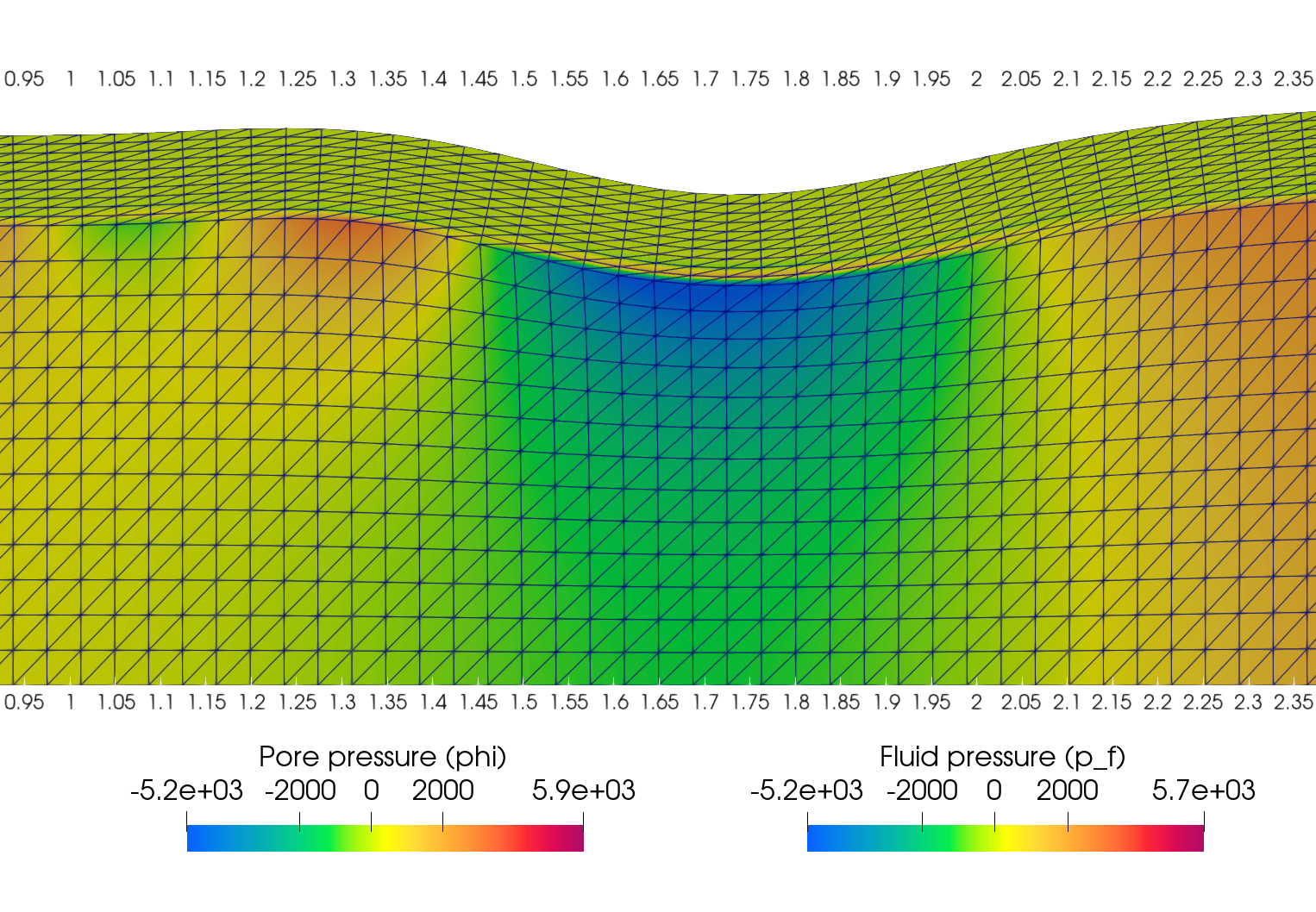
Figure 2: Pressure fields near the fluid–poroelastic interface at h6; interface pressure transmission is continuous across a highly deformed geometry.




Figure 3: Snapshots showing the fluid velocity h7 and poroelastic structure velocity h8 at multiple time points; velocity fields capture the movement of the interface and bulk coupling.
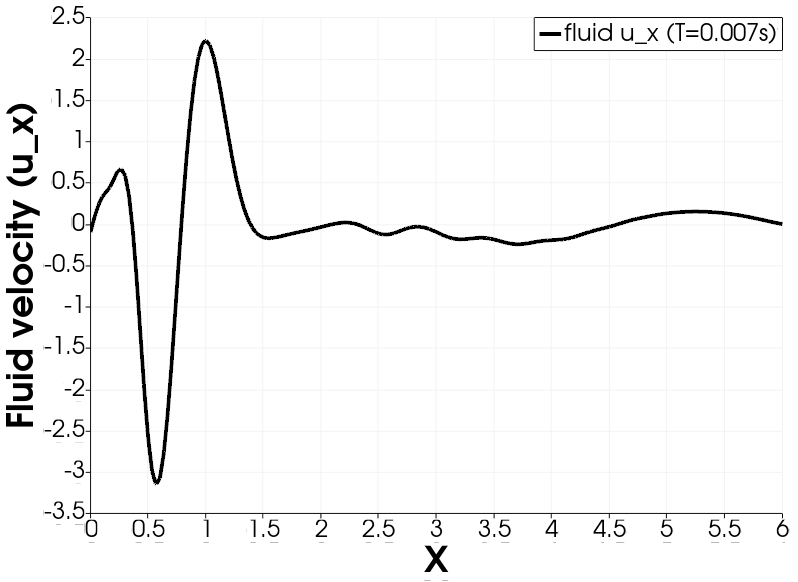
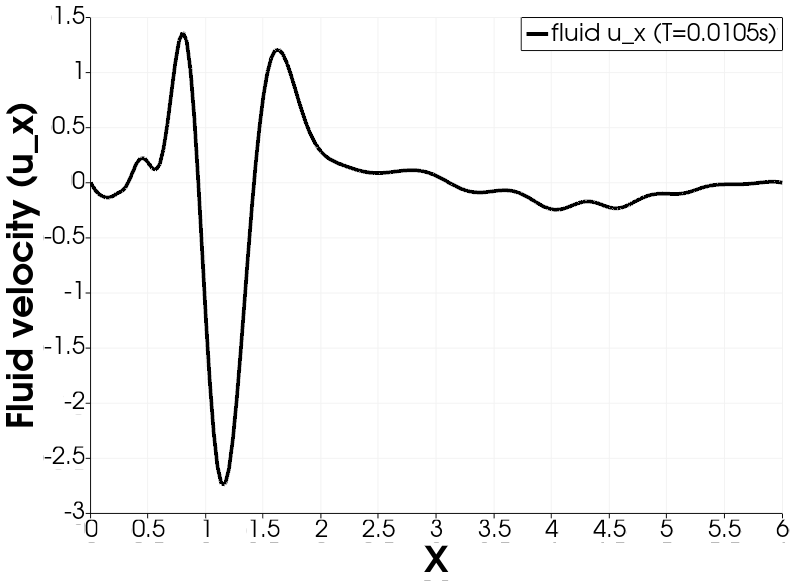
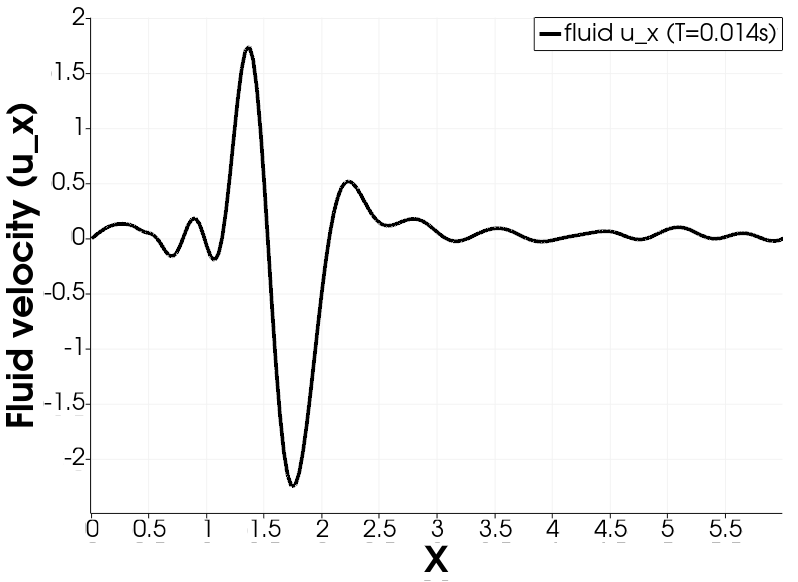
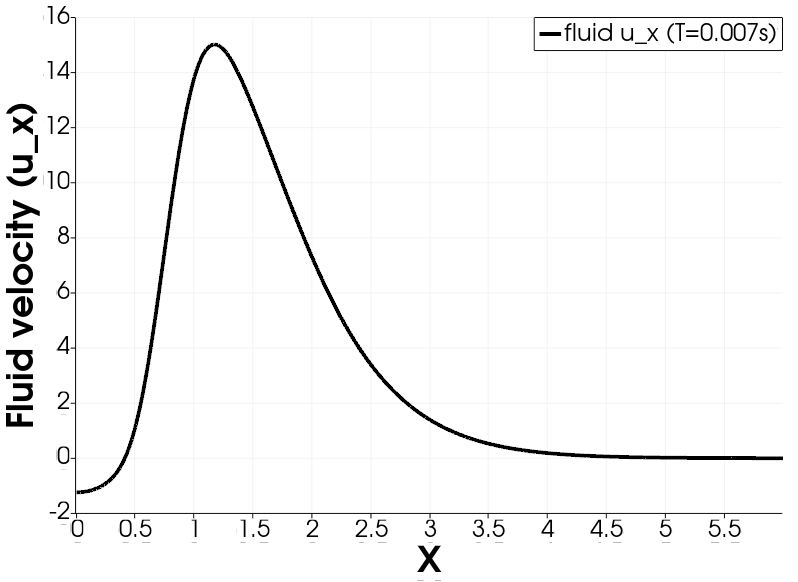
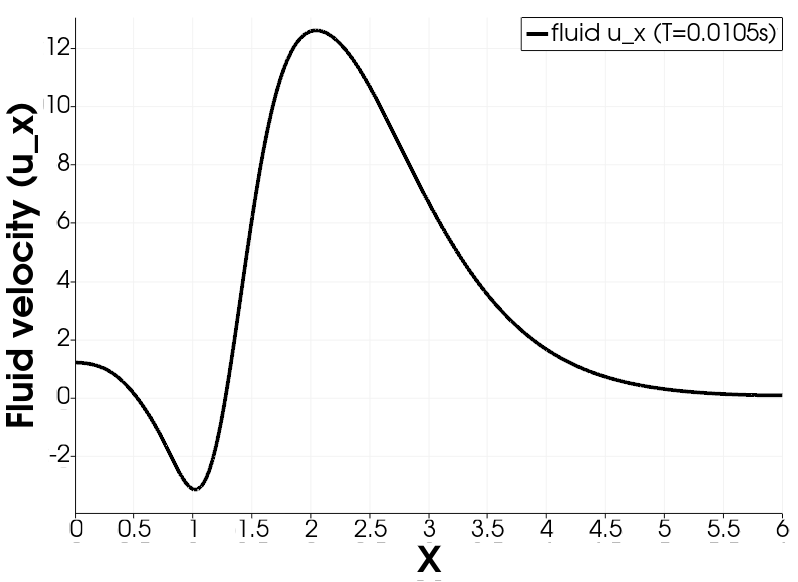
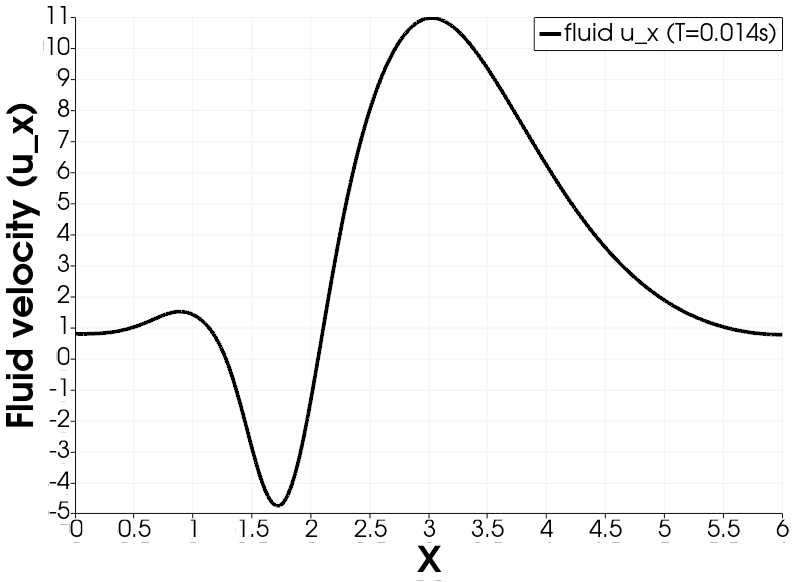
Figure 4: Further snapshots showing fluid velocity evolution; high spatial and temporal fidelity in interface regions.
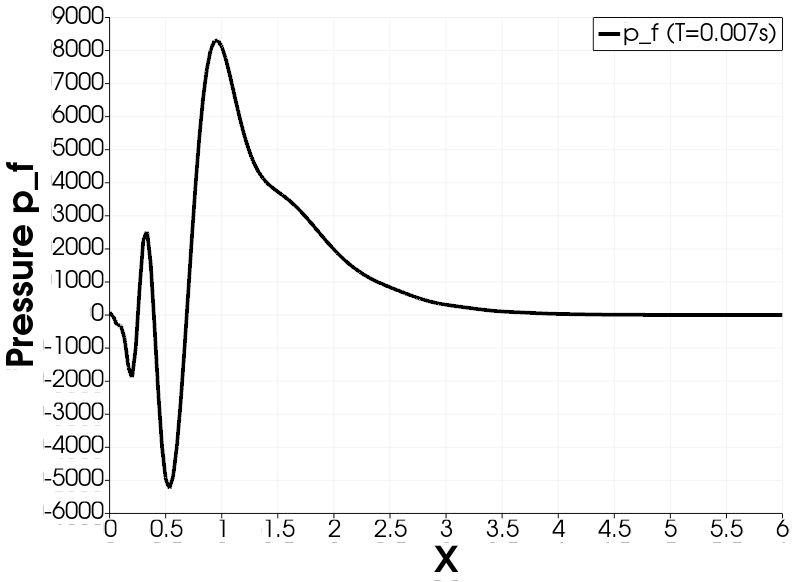
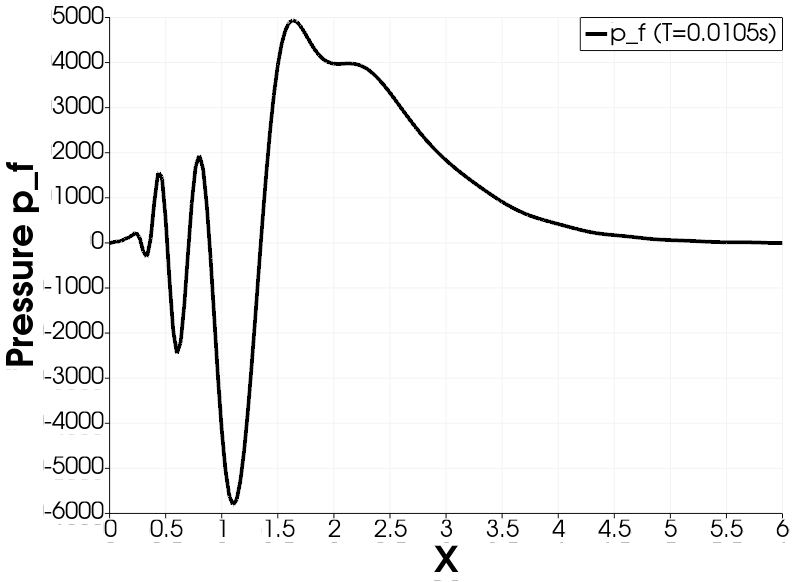
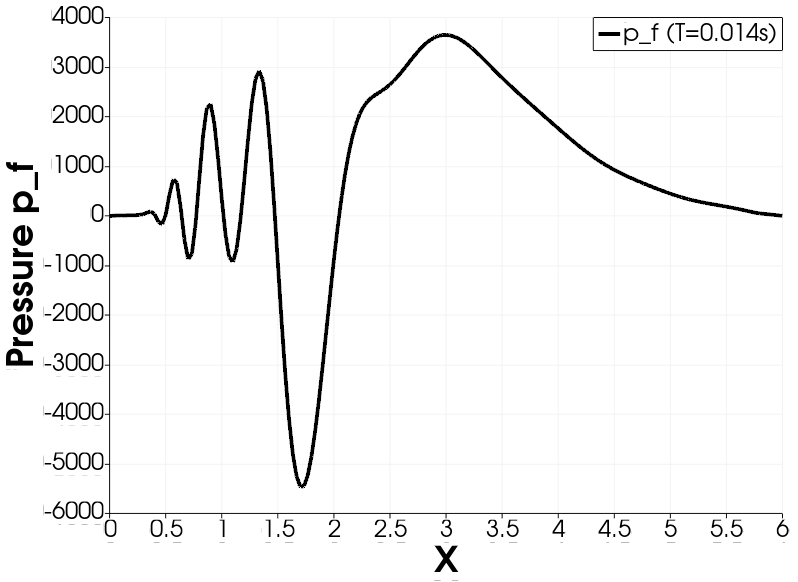
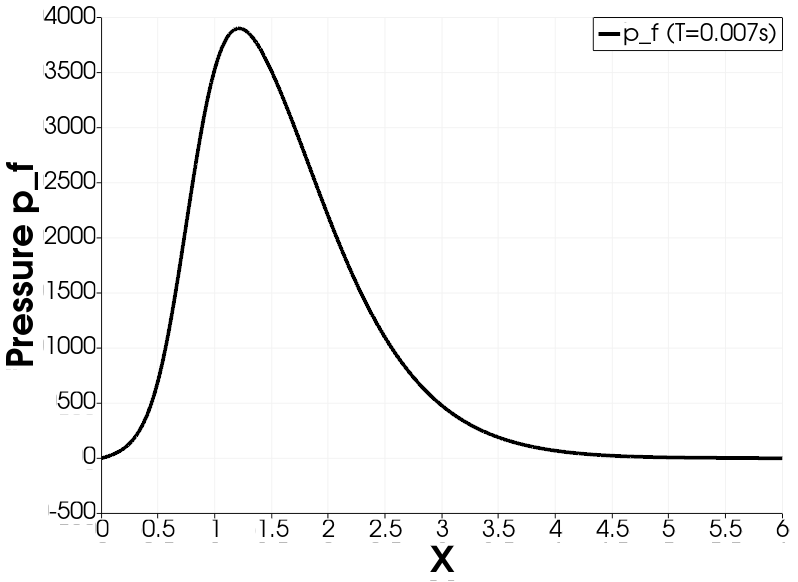
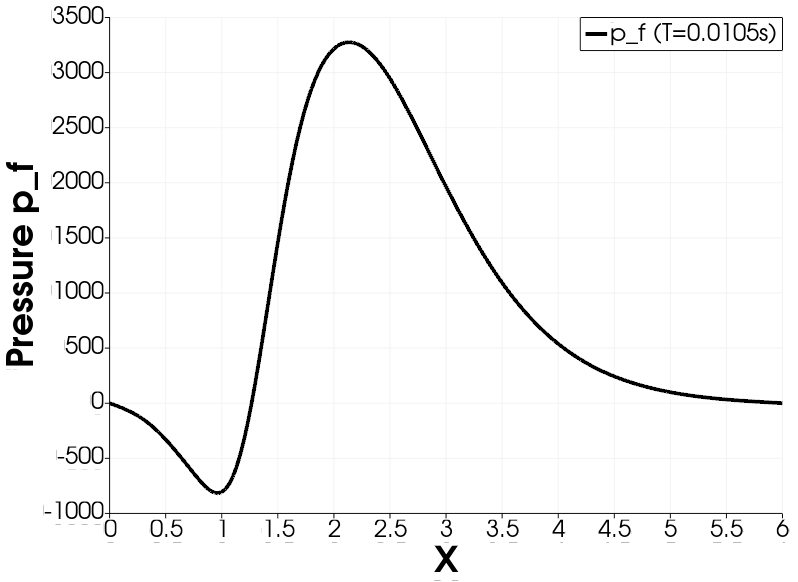
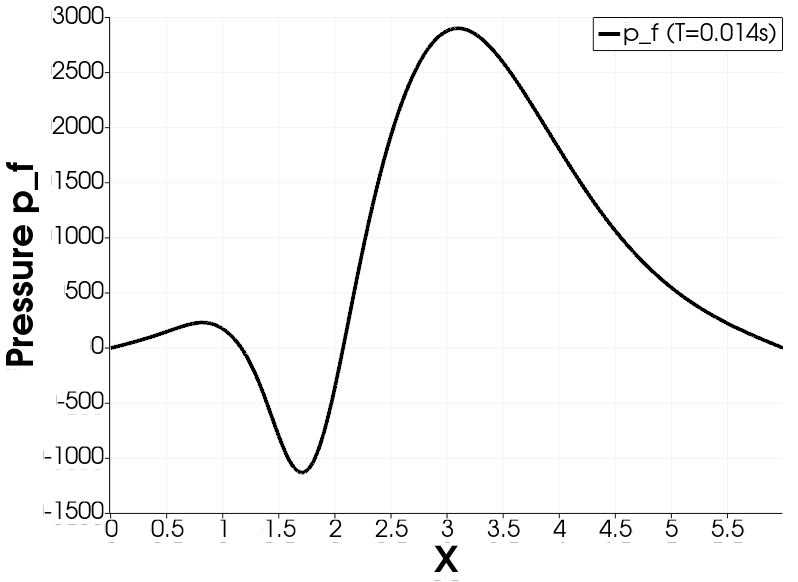
Figure 5: Fluid pressure h9 at fluid–structure interface c∗0 and channel centerline c∗1; interface shock transmission and channel interior dynamics are tracked at sub-millisecond resolution.
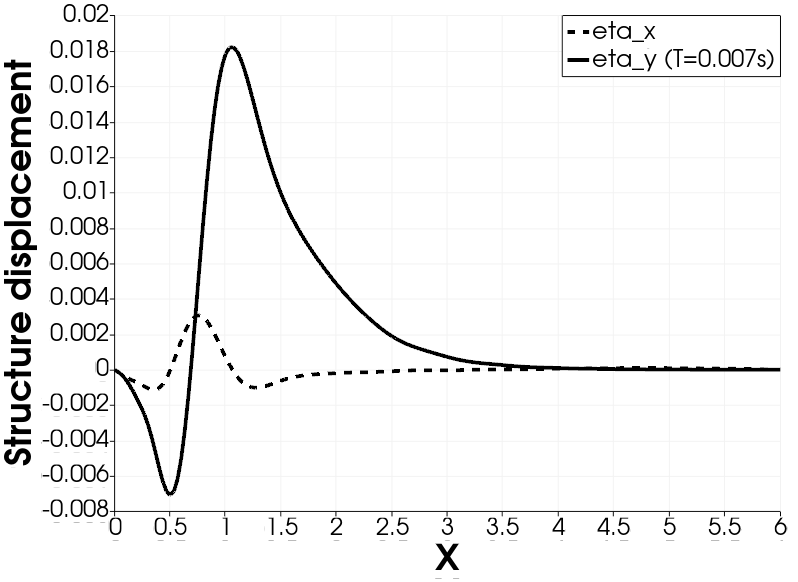
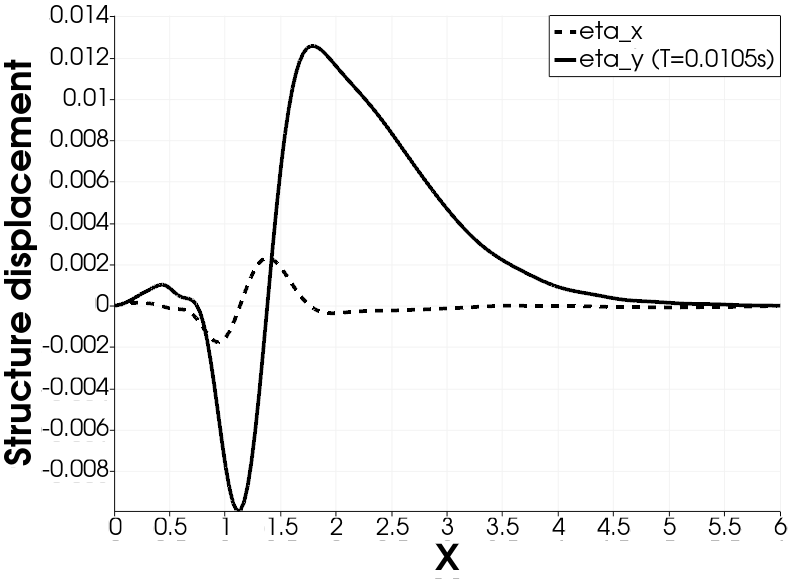
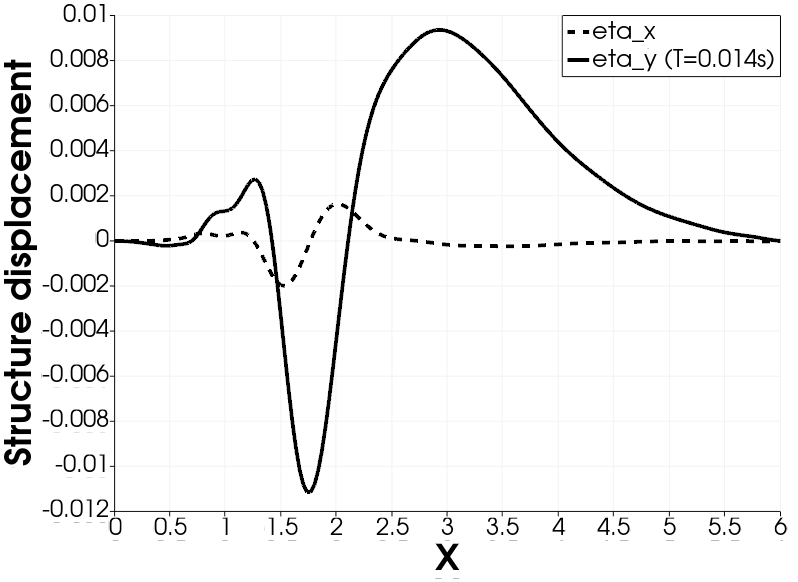
Figure 6: Structure displacement components c∗2 at the interface c∗3 during pulse propagation; structural response is consistent with interface loading.
Theoretical and Practical Implications
The explicit splitting scheme achieves a balance between strong interface coupling and efficient parallel computation by leveraging weak Robin-type interface enforcement. The approach enables modular solver design with provable energy stability, essential for large-scale multiphysics applications. Unlike monolithic solvers (requiring global coupled system solution at each step), or subiteration-based partitioned approaches, this method requires only parallel independent solves per time step, yielding a scalable algorithm.
Strong claims highlighted in the work:
- Provable second-order accuracy in time, optimal spatial order, and discrete stability in partitioned explicit schemes for Stokes–Biot coupling.
- Applicability to moving-domain Navier–Stokes–Biot interaction, suggesting robustness in more general multiphysics FSI settings.
Theoretical extensions considered include relaxing the CFL condition for particular parameter regimes and extending error analysis to nonlinear, moving interfaces, and geometrically nonlinear FSI models.
Future Directions
Areas for further development include:
- Analytical refinement of CFL restrictions with respect to interface coupling parameters and finite element space selection.
- Extension to geometrically nonlinear, moving-domain multiphysics (e.g., fully nonlinear Navier–Stokes–Biot in elastic domains or high-amplitude interface motion).
- Incorporation of more general coupling conditions (e.g., viscoelasticity, heterogeneous interface laws).
- Efficient solver implementation for large-scale parallel architectures, exploiting the decoupled nature of the scheme.
Conclusion
This work establishes a rigorously stable, second-order accurate explicit partitioned scheme for fluid–poroelastic structure interaction, fully justified mathematically and validated numerically for both Stokes–Biot and Navier–Stokes–Biot settings. The algorithm, based on temporal BDF2 and interface AB2 extrapolation via Robin reformulation, is an effective compromise between accuracy, modularity, and parallel scalability. The error estimates are tight and consistent with observed convergence rates, and the practical computational performance is robust even for moving-domain problems. This methodology is anticipated to be broadly applicable to future multiphysics FSI modeling and simulation.