- The paper presents a forcing-informed resolvent analysis framework that leverages basis vectors from nonlinear forcing snapshots to reconcile discrepancies between classical mode predictions and observed flow structures.
- It introduces both fully data-driven and semi-data-driven computational approaches for efficiently extracting physically relevant input-output mode pairs from high-dimensional fluid flow datasets.
- The methodology provides accurate energy amplification gains and spatial energy transfer maps, offering new insights for turbulence diagnostics and effective flow control strategies.
Overview and Motivation
The paper presents a systematic framework for “forcing-informed” (FI) resolvent analysis, targeting the identification of input-output relations in statistically stationary, self-sustained unsteady flows. Classical resolvent analysis, grounded in the linearization of the Navier–Stokes equations about a mean state, provides input-output mode pairs via SVD, but suffers from a critical limitation: it neglects the spatiotemporal structure of nonlinear terms, which act as endogenous forcing and critically sustain nonlinear oscillatory dynamics. This leads to significant discrepancies between SVD-based modes and empirically observed flow field structures, particularly in regions governed by dominant nonlinear amplification mechanisms.
The FI resolvent framework overcomes this deficiency by explicitly informing the resolvent operator with basis vectors learned from the nonlinear forcing term’s snapshots, effectively constraining the input-output search space to physically admissible subspaces. This paradigm enables recovery of response and forcing modes that are consistent with actual flow fields, accompanied by energy amplification gains reflecting real output amplitudes.
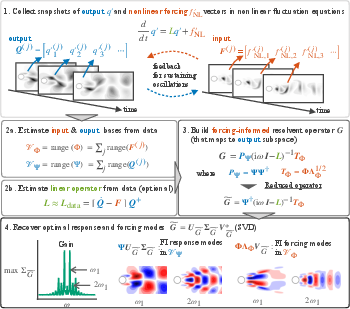
Figure 1: Schematic representation of the FI resolvent workflow illustrating the extraction pipeline: nonlinear forcing snapshots, subspace basis estimation, FI resolvent construction, and SVD-based mode recovery.
Theoretical Foundations
Nonlinear Fluctuation Equations and Feedback Mechanism
Starting from the spatially discretized Navier–Stokes (NS) equations, the authors perform Reynolds decomposition and derive equations for the statistical mean and the zero-mean fluctuation q′(t). Subtracting the Reynolds-averaged equations yields the nonlinear fluctuation equation:
dtdq′=Lq′+fNL′
with fNL′ as the nonlinear forcing term (i.e., feedback), and L as the linearized operator about the mean. Importantly, fNL′ acts as an endogenous driver and attenuator of q′ fluctuations, playing a central role in sustaining oscillatory dynamics.
The time-averaged energy evolution is captured via:
dtdEq′=⟨q′,Lq′⟩+⟨q′,fNL′⟩=0
which embodies the energy balance between linear amplification/attenuation and nonlinear feedback mechanisms.
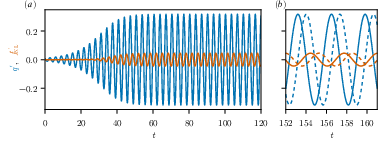
Figure 2: Time trajectories of state and nonlinear forcing vectors q′ and fNL′ for a Stuart-Landau oscillator, exemplifying phase-coherent dynamics.
FI Resolvent Operator Construction
Contrary to conventional resolvent analysis—where SVD is performed on R(ω) with unconstrained white noise forcing—the FI approach learns physically relevant bases for input (forcing) and output subspaces directly from simulation data. SPOD and DMD can be used for basis construction.
This yields a constrained input-output relation:
dtdq′=Lq′+fNL′0
where dtdq′=Lq′+fNL′1 is the projection onto the output basis, and dtdq′=Lq′+fNL′2 comprises the input basis with energy scaling. The FI resolvent operator is thus:
dtdq′=Lq′+fNL′3
SVD on dtdq′=Lq′+fNL′4 produces FI forcing and response modes lying in the empirical bases, with gains correspond to actual output amplitudes.
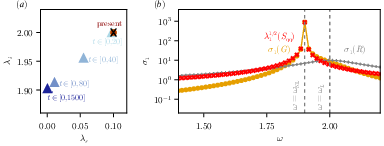
Figure 3: SVD analysis for flows exhibiting nonlinear dynamics, including eigenvalue tracking and gain mapping for harmonic modes.
Numerical Implementation and Methodological Advances
The FI resolvent operator can be computed via two approaches:
- Fully Data-Driven: The linear operator dtdq′=Lq′+fNL′5 is estimated from time-series snapshots using minimization and projected DMD methods, reducing reliance on explicit linearization and enabling application to high-dimensional simulation data.
- Semi-Data-Driven: If dtdq′=Lq′+fNL′6 is available (e.g., through global stability tools), FI analysis leverages a physics-informed test matrix for rapid randomized sketching—analogous to randomized resolvent analysis but now with energy-based input subspace.
Both strategies yield substantial computational efficiency, dimensionality reduction, and robustness to flow complexity.
Results: Applications in Canonical and Complex Flows
Stuart-Landau Oscillator
FI resolvent correctly recovers underlying linear operator eigenvalues, output gains, and nonlinear frequency of the limit cycle. The classical DMD fails in regimes dominated by nonlinear periodicity. Energy balance between linear amplification and nonlinear feedback is quantitatively satisfied.
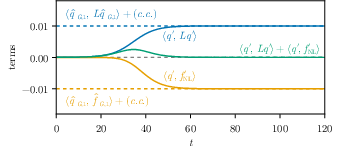
Figure 4: Energy balance between linear and nonlinear contributions during limit cycle oscillations; the FI response and forcing modes reproduce this balance.
Two-Dimensional Cylinder Wake
For a typical dtdq′=Lq′+fNL′7 cylinder flow, FI resolvent analysis at fundamental and harmonic Strouhal numbers (dtdq′=Lq′+fNL′8, dtdq′=Lq′+fNL′9, fNL′0) accurately recovers output gains matching SPOD amplitudes, and both forcing/response modes match actual flow structures where conventional resolvent analysis fails, especially at harmonics.
Notably, FI forcing modes are localized to regions physically associated with feedback (e.g., near the recirculation zone), whereas classical forcing modes are spatially diffuse and incoherent.
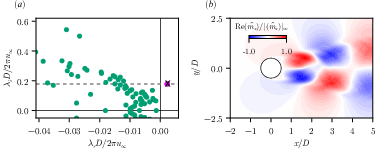
Figure 5: Fully data-driven estimate of the linear operator, including eigenvalues and eigenvector fields matching K{a}rman vortex dynamics.
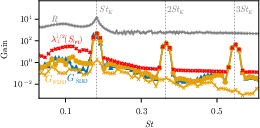
Figure 6: Leading singular values (gains) fNL′1 for FI and conventional resolvent analysis as a function of frequency; FI gains align with physical output energies.
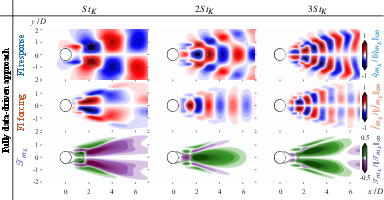
Figure 7: FI response and forcing modes in the 2D cylinder wake, showing spatial coherence and localization in physically relevant regions.
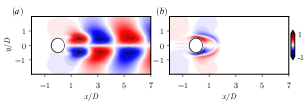
Figure 8: Conventional resolvent response and forcing modes; the forcing mode exhibits nonphysical upstream structures.
Energy transfer maps computed as Hadamard products between FI response and forcing modes reveal where nonlinear energy is injected or attenuated—a critical insight into energy cascade and self-sustaining mechanism.
Transitional Boundary Layer
In a compressible boundary layer DNS under H-type transition, FI analysis captures the evolution of three-dimensional coherent structures and perpendicularly standing ring vortices (PSRV), with FI forcing modes precisely located in regions associated with turbulent breakdown and strong nonlinear feedback.
Gains at harmonics of the primary instability frequency capture both linear and nonlinear amplification mechanisms, and spatial maps of energy transfer elucidate spatial domains responsible for onset and sustenance of turbulence.
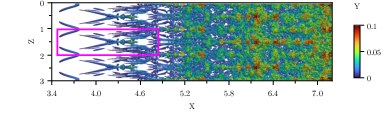
Figure 9: Topview of instantaneous iso-surfaces displaying complex vortex structures during transition.
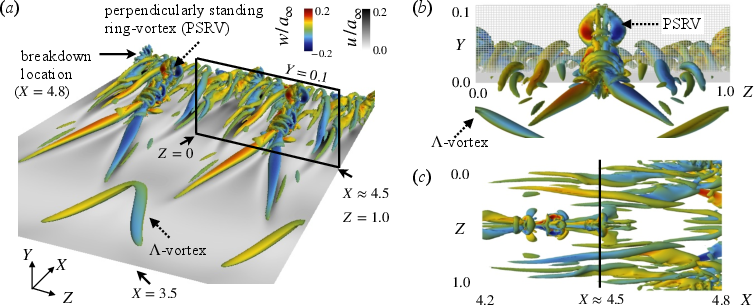
Figure 10: Visualization of late-stage transition and PSRV structures, including spatial coherence for FI modes.
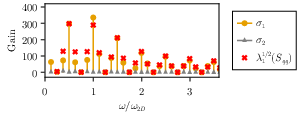
Figure 11: FI resolvent gains vs. frequency, confirming amplitude recovery and energetic separation of dominant modes.
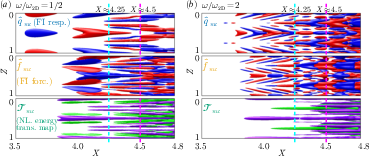
Figure 12: Spatial distributions of response, forcing modes, and energy transfer for representative frequencies in the transitional boundary layer.
Implications and Future Directions
The FI resolvent analysis provides a mathematically rigorous and empirically validated method for constraining input-output analysis to physically realizable subspaces, reconciling discrepancies between classical resolvent predictions and observed nonlinear dynamics. The framework offers:
- Improved interpretability and fidelity—mode pairs represent actual flow oscillations, including those at cross-frequency harmonics dominated by nonlinear energy transfer.
- Access to spatial energy transfer maps that pinpoint regions responsible for sustaining or attenuating fluctuation energy, furnishing valuable diagnostic and control targets.
- Computational efficiency via dimensionality reduction; applicable to high-dimensional datasets from DNS/LES.
- Theoretical integration with modal analysis and state-space control theory, enabling new applications in feedback control and system identification.
The methodology is robust across canonical oscillator models, bluff-body wakes, and transitional boundary layers—systems of acute practical and theoretical significance in fluid mechanics and turbulence research. Future developments may target nonstationary flows (e.g., time-local wavelet kernels [Ballouz2024-wk]), data-driven operator learning (neural operators [Wu2025-eh]), and triadic interaction analysis for advanced energy transfer mapping [Yeung2026-qb, Nakamura2026-ni].
Conclusion
The forcing-informed resolvent framework constitutes a fundamental advancement in input-output analysis for self-sustained unsteady flows. By constraining the analysis to empirically informed subspaces reflecting nonlinear feedback, the method recovers physically consistent response and forcing modes, precisely reproduces output amplitudes, and provides actionable maps of nonlinear energy transfer. The approach bridges the gap between theoretical modal decomposition, practical reduced-order modeling, and empirical flow physics, opening pathways to data-driven control, deeper turbulence diagnostics, and richer understanding of nonlinear fluid dynamics (2606.19731).