- The paper introduces a vectorial spin field method allowing two-point level detection of primordial parity violation, bypassing complex high-order statistics.
- It employs N-body simulations to evaluate mass and density selection criteria, quantifying helical asymmetry and optimizing halo samples for enhanced signal detection.
- Results forecast significant detection improvements in surveys like DESI and KLST, providing a viable framework for symmetry tests in early-universe cosmology.
Enhancing Detection of Primordial Parity Violation in Cosmic Structure via Galaxy Spins
Introduction: Parity Violation and the Large-Scale Structure
The paper "Enhancing the Detection Sensitivity of Primordial Parity Violation using Galaxy Spins" (2606.19709) addresses the challenge of detecting parity violation (PV) in cosmological initial conditions by leveraging the statistical properties of galaxy spin fields. Standard scalar observables require high-order statistics (e.g., four-point functions) to probe PV due to the absence of inherent handedness, complicating both signal interpretation and covariance analysis. The study adopts a vectorial observable: the late-time angular momentum directions of halos, which overcome these limitations, allowing PV signals to be extracted at the two-point level and enabling more robust and independent constraints.
Building on the conceptual framework of tidal torque theory and the recent identification of PV signatures in galaxy spins [Shim_2025], this work optimizes the selection of halo samples to maximize sensitivity, emphasizing environmental and mass-driven properties that preserve primordial information. The paper presents a systematic parametric study using N-body simulations with controlled PV, formulates practical selection methods for observational datasets, and assesses feasibility in the context of current and planned spectroscopic surveys.
Methodology: Simulations, Spin Field Construction, and Helical Asymmetry
The analysis is rooted in dark-matter-only N-body simulations, with two suites: parity-symmetric (PS) and parity-asymmetric (PA), sharing the same matter power spectrum but differing in their symmetry-breaking initial conditions. Halo spin vectors are computed according to the net angular momentum of constituent particles, projected onto a spatial grid.
In Fourier space, the spin field is decomposed into right- and left-helical modes using a projection operator constructed from curl eigenvectors, enabling calculation of their respective auto-spectra. The helical asymmetry parameter χ(k) is defined as:
χ(k)=PRR(k)+PLL(k)PRR(k)−PLL(k)
Signal suppression due to sparse sampling and shot noise is mitigated by rescaling the numerator and denominator, yielding a robust estimator for parity-breaking at the high-density limit.
Mass and Environmental Dependence of Detection Significance
A core result is the empirical evaluation of mass-threshold effects on PV detectability. Higher-mass halos tend to preserve primordial spin alignment but their lower abundance reduces statistical power. The study systematically varies mass cuts and quantifies their impact on both PV amplitude and detection significance, revealing an optimal trade-off at Mhalo≥1011.5h−1M⊙, though 1011h−1M⊙ offers greater enhancement when environmental selection is incorporated.
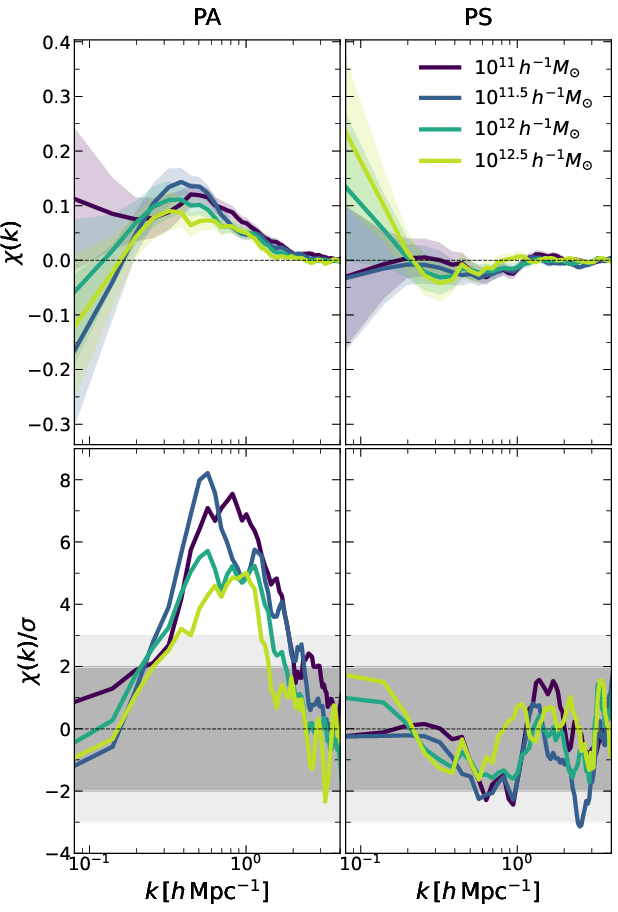
Figure 1: Helical asymmetry power spectra and detection significance for PA and PS simulations as a function of halo mass threshold.
Nonlinear gravitational evolution induces decorrelation between halo spins at formation and at z=0. The key proxy for primordial information retention is the Lagrangian-Eulerian (LE) spin alignment, quantified by cosθLE between initial and final spin directions. Subsamples with stronger LE alignment (θLE<45∘) show a significant (2.7σ) increase in detection significance, encompassing N0 of halos. The signal rapidly degrades as less-aligned halos are included, defining a clear selection threshold for optimum sensitivity.
Mass–Local Density Plane: Operationalizing Halo Selection for Observations
Direct measurement of LE alignment is infeasible in surveys. The paper constructs a mapping between observable proxies—halo mass and local density (smoothed at N1)—and retention of primordial spin alignment. The analysis identifies that halos with higher mass and lower local density exhibit superior LE alignment. By defining a selection boundary in the mass-density plane, the authors achieve an optimal balance between sample size and alignment purity, producing a halo sample yielding a N2 improvement over simple mass cuts and a N3 boost relative to prior studies.
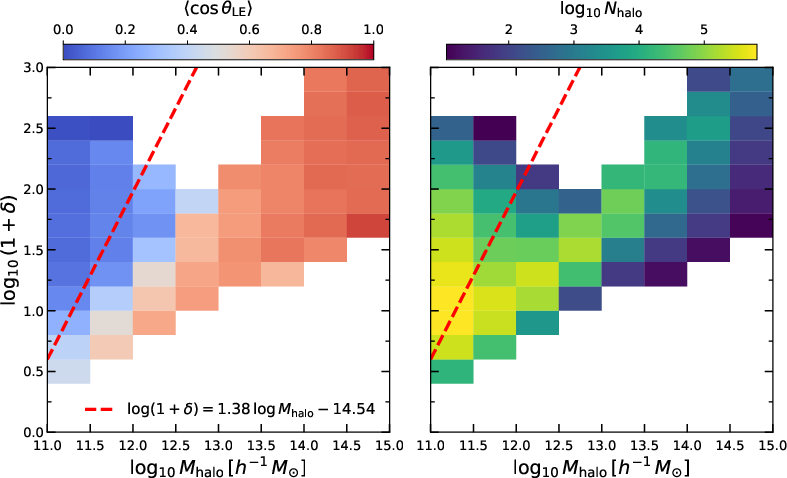
Figure 2: Distribution of mean LE alignment and halo counts in the mass-density plane, delineating the optimal selection criterion.
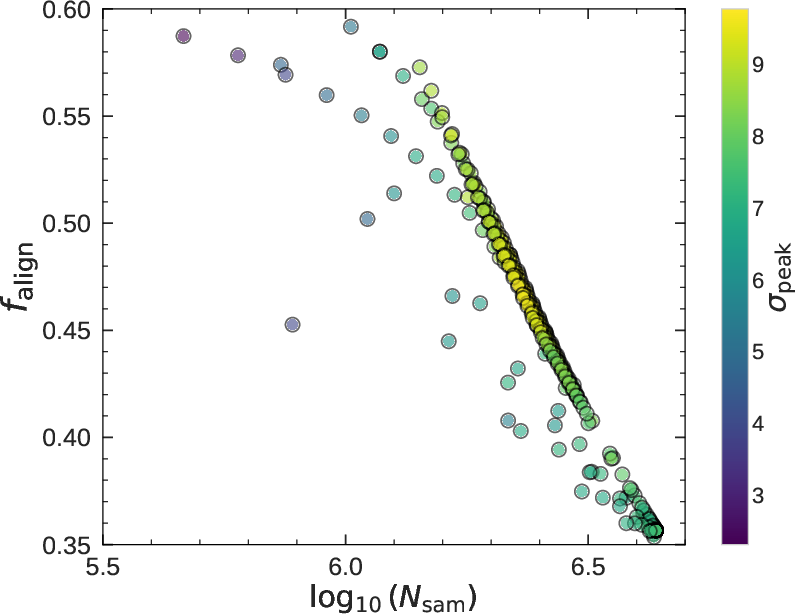
Figure 3: Color-coded peak detection significances as a function of sample size and strong LE alignment fraction across subsamples.
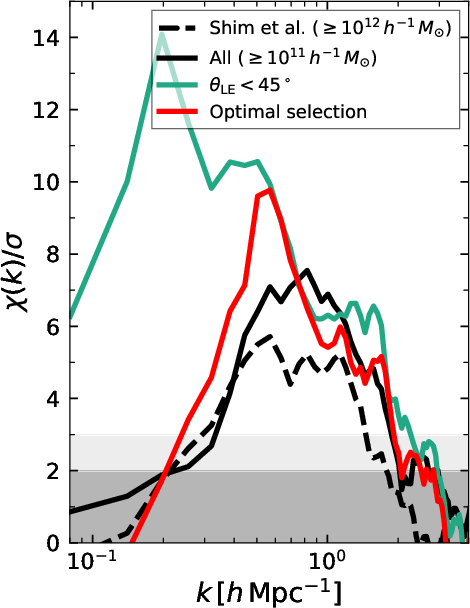
Figure 4: Comparative detection performance, showing successive enhancement as mass threshold and LE alignment criteria are optimized.
Observational Feasibility: Application to Spectroscopic Surveys
Forecasts are provided for DESI BGS Bright and KLST HDS surveys using the SC-SAM semi-analytic galaxy model. Applying the optimized selection strategy, DESI is projected to yield N4 galaxies satisfying selection criteria, with detection significance reaching N5; KLST HDS would deliver approximately N6. Even accounting for spin misalignment and observational uncertainties, these surveys maintain N7 and N8 detection robustness, validating practical implementation of the PV probe.
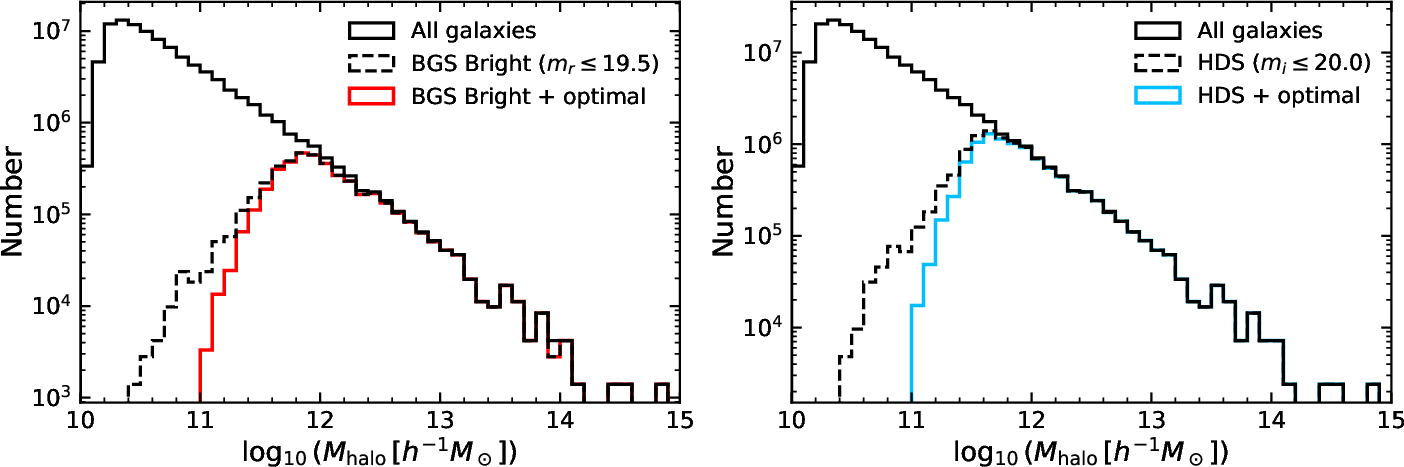
Figure 5: Halo mass distributions and counts of observable galaxies fulfilling PV-sensitive selection criteria for DESI BGS Bright and HDS.
Implications: Cosmological Symmetry Tests and Future Directions
This work provides a systematic protocol for enhancing PV signal detectability in LSS via galaxy spins, offering a complementary alternative to scalar high-order statistics. Optimization via environmental and mass selection is essential for maximizing primordial information retention amid nonlinear evolution.
Further refinement using local tidal environment, beyond just mass and density—as envisaged in the paper—promises additional gains. Given that tidal interactions and mergers drive spin reorientation, direct exploitation of tidal tensor diagnostics may define even purer samples, potentially advancing symmetry tests of inflationary cosmology and the origin of baryogenesis.
The approach yields immediate applicability to current and next-generation surveys, translating simulation-driven criteria into observables, enabling robust constraints on PV and providing crosschecks for systematic errors encountered in scalar analyses. Ultimately, this framework tightly integrates theory, simulation, and survey design, enhancing discovery potential for symmetry-breaking physics in cosmic structure.
Conclusion
The paper demonstrates and quantifies a pathway to significantly improve the sensitivity of primordial parity violation detection using galaxy spin fields, with pragmatically optimized selection strategies and validated observational forecasts. This methodology is poised to transform constraints on early-universe symmetry-breaking, integrating theoretical developments and survey capabilities into a unified statistical probe for cosmological parity violation.