- The paper demonstrates that incorporating a U(1)₍B₋L₎ gauge symmetry unifies smooth SUSY hybrid inflation with non-thermal dark matter production.
- Coupled dynamics yield inflationary observables with a narrow scalar spectral index (nₛ ≃ 0.972–0.974) and a suppressed tensor-to-scalar ratio (r < 1×10⁻⁵) consistent with CMB data.
- Using EFT constraints and Boltzmann equations, the study delineates a viable parameter space that satisfies both dark matter relic abundance and cosmological consistency.
Unified Constraints on Smooth SUSY Hybrid Inflation from U(1)B−L Dark Matter
Model Architecture and Theoretical Framework
The paper introduces a supersymmetric extension of the Standard Model via the U(1)B−L gauge group to synthesize inflationary dynamics and non-thermal dark matter production. The construction embeds smooth hybrid inflation in supergravity, stabilizing higher-order corrections through a non-minimal Kähler potential. Three scalar fields are pivotal: the inflaton σ, the auxiliary field ζ terminating inflation, and the singlet mediator η, which transfers energy during reheating. Dark matter is instantiated as an inert scalar stabilized by a Z2 symmetry, and produced non-thermally in the post-inflation epoch, establishing a direct interaction channel between early universe inflation and dark matter phenomenology.
A salient feature is the effective reduction to a single-field inflationary trajectory. Orthogonal directions in field space are strongly stabilized due to ζ's large mass, ensuring decoupling from inflationary dynamics. Energy transfer from σ to η mediates dark matter genesis, implemented via η-mediated processes, as illustrated by the scattering hierarchy U(1)B−L0.
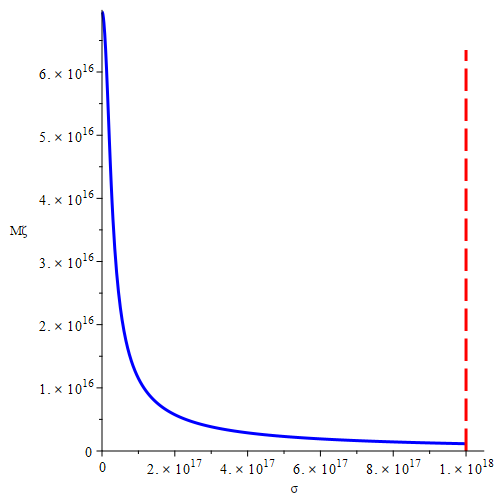
Figure 1: Auxiliary field mass U(1)B−L1 versus inflaton field U(1)B−L2; the mass remains within the cutoff scale, ensuring EFT validity throughout inflation.
Scalar Sector, Interactions, and EFT Consistency
The scalar potential comprises terms that permit both direct and mediated interactions between inflaton and dark matter sectors. Supersymmetric vacuum structure, field-dependent mass hierarchies, and Kähler corrections dictate the viable inflationary regime. Benchmark parameters typical for slow-roll inflation and dark matter masses (U(1)B−L3) are meticulously chosen to guarantee consistency and enforce coupling-induced correlations between the inflationary and dark sectors.
EFT validity is stringently imposed by restricting the mass scales (U(1)B−L4, U(1)B−L5) below the Planck cutoff, as visualized in Figure 1. The auxiliary field U(1)B−L6 displays a nontrivial mass evolution, occasionally forming a localized super-cutoff peak, correlating dark matter production with constraints from effective field theory. This dual role introduces a selection principle on the inflationary trajectory, dynamically restricting parameter space to regions maintaining theoretical consistency.
Coupling Effects and Parameter Space Reduction
The requirement to match the observed dark matter relic abundance imposes strong constraints on inflationary parameters. The scalar spectral index is narrowed to U(1)B−L7, and tensor-to-scalar ratio U(1)B−L8 is suppressed (U(1)B−L9), in line with current CMB bounds. Coupling between inflaton and dark matter minimally impacts background evolution (field values, end of inflation), but generates observable features in primordial perturbation spectra—particularly in gravitational waves and small shifts in σ0. As a result, dark matter constraints significantly reduce the allowed parameter space for inflation (see Figures 2–5 for density and temperature evolution).
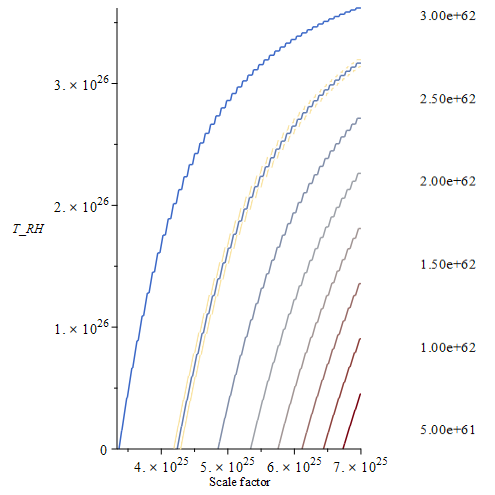
Figure 2: Reheating temperature vs scale factor, showing the evolution of co-moving density with universe expansion.
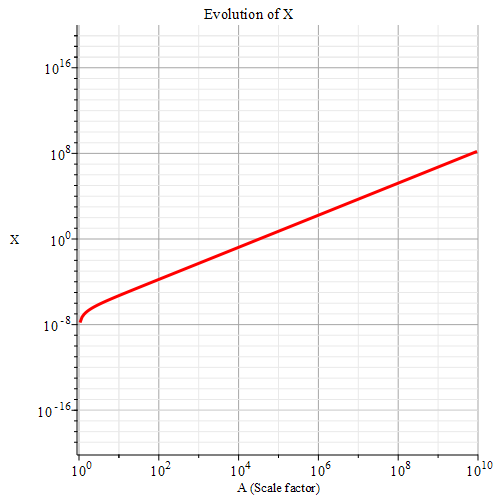
Figure 3: Evolution of dark matter density as a function of the scale factor, evidencing non-thermal production via reheating.
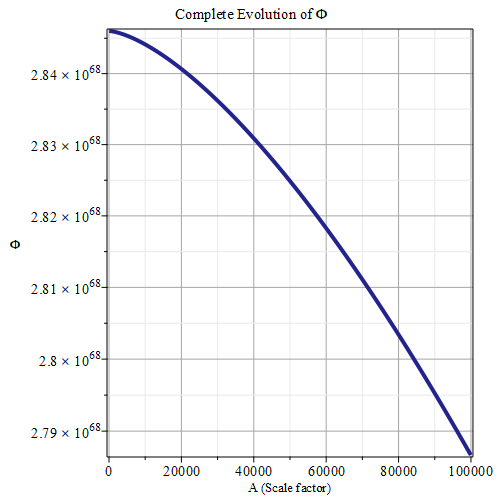
Figure 4: Evolution of inflaton energy σ1 vs scale factor, demonstrating strong stabilization of orthogonal fields and single-field inflation.
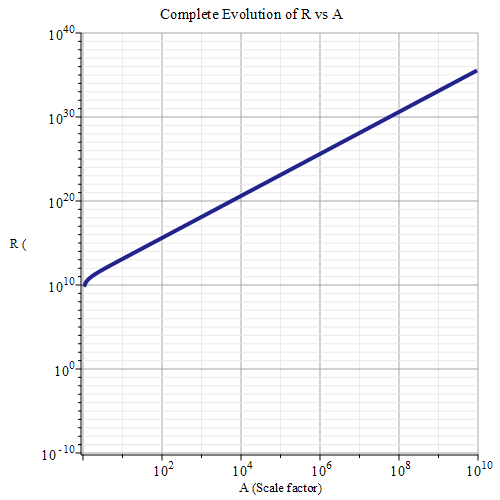
Figure 5: Radiation density σ2 vs scale factor, quantifying reheating and energy transfer dynamics.
Boltzmann Equations, Relic Abundance, and Viable Regions
The relic abundance computation is performed via Boltzmann equations, integrating reheating dynamics and dark matter production rates. Initial conditions are fixed consistently with inflationary scale, and parameter space is scanned to identify regions compatible with the observed σ3. The mass and reheating temperature correlation are illustrated in Figure 6, highlighting viable domains for σ4 and dark matter masses up to σ5TeV scale.
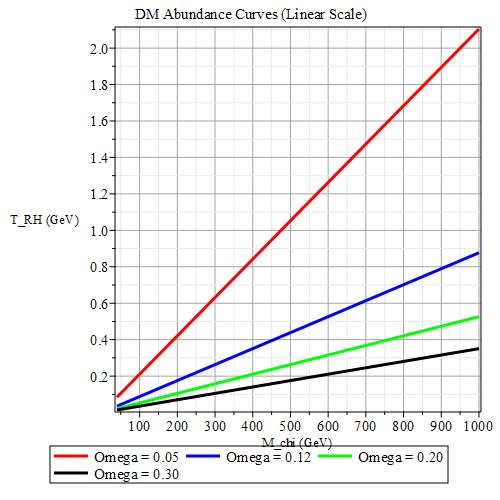
Figure 6: σ6 vs dark matter mass, with reheating temperature variation; the viable parameter region satisfies relic abundance constraints.
Sensitivity of Cosmological Observables and Future Directions
The intricate interplay between dark matter couplings (notably σ7) and inflationary observables presents a scenario wherein phenomenological and theoretical constraints intertwine. The parameter scan reveals strong numerical results: the allowed inflationary trajectories remain strictly within EFT validity, driven by dark matter requirements. Coupling-induced modulation of tensor and scalar perturbations opens prospects for future gravitational wave detection as a probe of early universe physics.
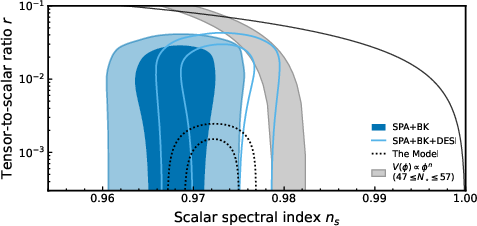
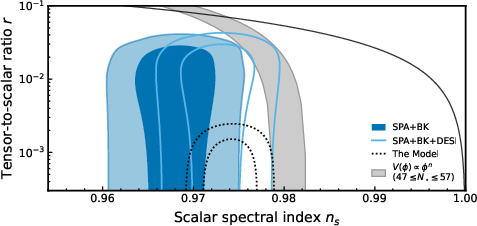
Figure 7: Cosmological observables as a function of inflaton–dark matter coupling σ8, revealing sensitivity in spectral index and tensor ratio.
Conclusion
The study offers a unified supersymmetric σ9 framework where non-thermal dark matter production constrains smooth hybrid inflation. The phenomenological requirement for the correct relic abundance reduces the viable parameter space and enforces effective field theory consistency. Inflationary background remains robust, but primordial perturbation spectra are sensitive to dark matter couplings. These results underscore the necessity of coherent inflation–dark matter models and provide theoretical avenues for future cosmological tests through precision measurements of gravitational waves and spectral indices.