- The paper demonstrates that reducing the symbol interval (δ) enhances spectral efficiency until a pulse-dependent threshold is reached, balancing ISI and PA constraints.
- The methodology integrates MIMO spatial multiplexing with FTN precoding and tailored LDPC coding, achieving up to 0.7 dB SNR gains over conventional systems.
- The work highlights practical challenges such as receiver complexity, finite blocklength issues, and spectrum management, guiding next-generation wireless design.
Comprehensive Analysis of "Pushing the Limits: Unlocking the Potential of Faster-than-Nyquist Signaling"
Introduction and Context
The paper "Pushing the Limits: Unlocking the Potential of Faster-than-Nyquist Signaling" (2606.19226) delivers a rigorous evaluation of Faster-than-Nyquist (FTN) signaling, systematically dissecting its information-theoretic foundations, practical deployment obstacles, and integration in emerging wireless scenarios such as MIMO, HRLLC, and ISAC. The authors focus on the core principle of FTN—intentional violation of the Nyquist criterion to enable denser symbol packing—resulting in deliberate ISI to enhance spectral efficiency beyond conventional limits.
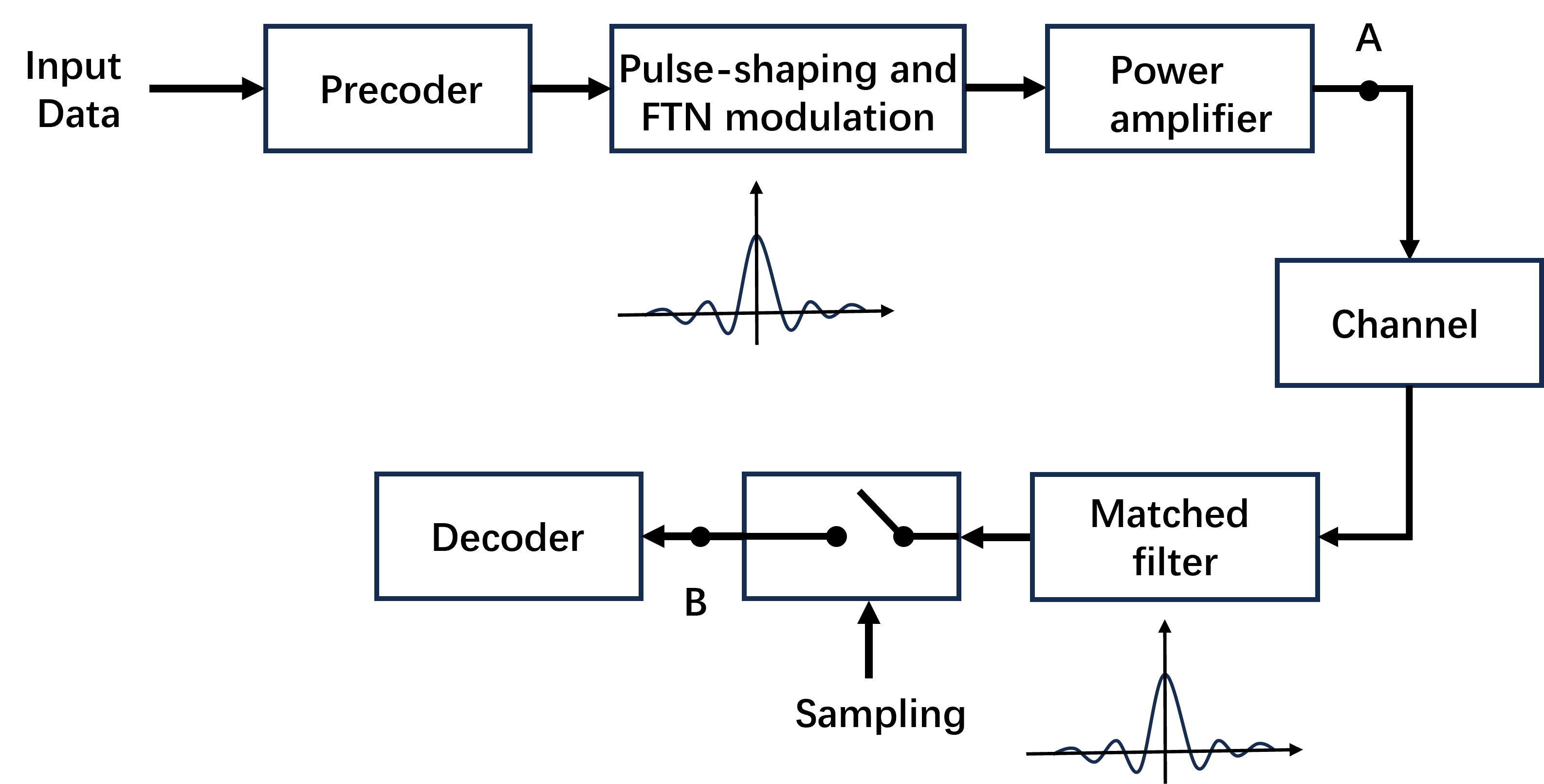
Figure 1: System model for FTN transmission illustrating the channel, transmitter, and receiver architecture.
The FTN signaling paradigm enables temporal packing by reducing the symbol interval via an acceleration factor δ<1, thereby increasing the signaling rate and spectral efficiency. The analytical treatment hinges on two SNR definitions: fixed transmit SNR (SNRtx) and fixed receive SNR (SNRrx), both of which impact achievable rates and the PA back-off requirements.
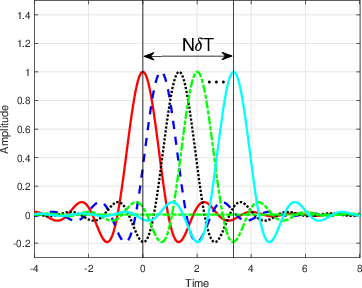
Figure 2: ISI manifestation in FTN; N symbols with T=1, δ=0.8, RRC pulses (β=0.25) induce strong temporal overlap.
Crucially, the capacity results demonstrate that for fixed SNRtx, capacity improves with decreasing δ, until a pulse-shape-dependent threshold δth is reached, beyond which further acceleration yields no additional benefits due to excessive ISI. For fixed SNRrx, capacity continues to increase as SNRtx0 decreases, but at a practical cost—demanding higher transmit power to preserve symbol energy and Euclidean distances.
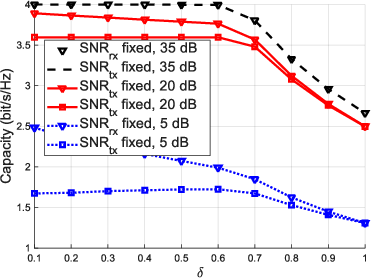
Figure 3: Constrained capacity vs SNRtx1 for optimal power allocation in a SNRtx2 MIMO system with QPSK and varying SNRs.
Further, the integration of MIMO and FTN (MIMO-FTN) leverages spatial multiplexing alongside temporal packing. Water-filling across MIMO eigenchannels followed by FTN precoding yields maximum spectral efficiency, as validated in new constrained capacity results with QPSK signaling. Optimal spatial power allocation is shown to have a more substantial effect than frequency-domain precoding, which mitigates ISI, thereby establishing design guidelines for low-complexity MIMO-FTN implementations.
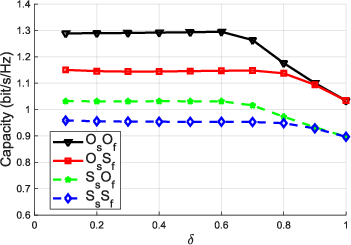
Figure 4: Capacity vs SNRtx3 for four power allocation schemes, highlighting the dominant benefit from optimal spatial allocation.
IAPR Analysis and Transmitter Design Implications
FTN’s increased symbol overlap exacerbates the instantaneous-to-average power ratio (IAPR), imposing stringent PA back-off requirements. The outage probability is characterized as the likelihood that the instantaneous power surpasses a given threshold. The analysis reveals that increasing modulation order (e.g., QAM) influences IAPR more than reducing SNRtx4, especially in the SNRtx5-fixed regime.
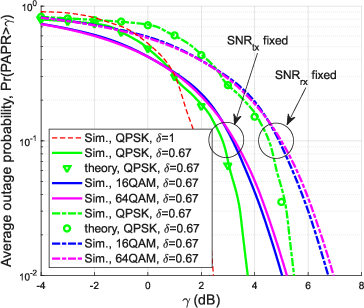
Figure 5: Average outage probability vs SNRtx6 for single-antenna FTN with uniform power allocation, showcasing theoretical and simulated curves.
The findings highlight the balancing act between spectral efficiency gains and nonlinear PA penalties, emphasizing that FTN acceleration must be judiciously chosen based on the SNR operational regime, modulation order, and pulse shape.
Channel coding in FTN systems seeks to address the ISI challenge by improving codeword Euclidean distances, often deploying iterative detection and decoding (Turbo equalization). Tailored LDPC codes, procured via masking of 5G base matrices, demonstrate marked improvements in decoding thresholds and error rates.
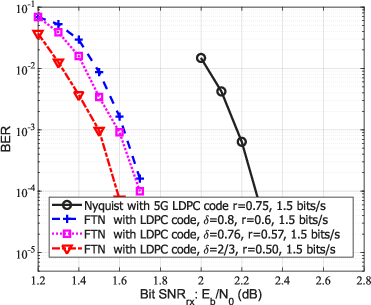
Figure 6: Error performance of coded FTN vs coded Nyquist systems, matched for spectral efficiency; FTN achieves SNRtx7 dB SNR gain.
The numerical results are notable: for comparable spectral efficiency and codeword length, FTN systems with optimized LDPC codes yield SNR gains up to SNRtx8 dB over Nyquist systems. Smaller SNRtx9 leverages lower-rate codes for further error performance improvements, underscoring FTN's practical merit in coded settings.
Practical Constraints and Deployment Challenges
FTN deployment faces multiple implementation challenges:
- Receiver Complexity: As SNRrx0 decreases, ISI depth grows; sequence-based detection (MLSE/BCJR) exhibits exponential complexity growth. Reduced-memory or LMMSE equalization, FFT-based processing, and receiver iteration control are essential for real-time applications.
- Finite-blocklength Regime: FTN maintains high spectral efficiency with significantly shorter blocklengths compared to Nyquist signaling, advantageous for HRLLC scenarios. However, latency gains depend on decoding/iteration overhead.
- Spectrum Broadening and Interference: FTN exploits excess bandwidth from smoother pulses, but spectral tails introduce inter-band interference. Precoding may amplify spectral ripples, demanding careful spectrum management and multi-user coexistence strategies.
- Hardware Feasibility: Prototyping efforts validate FTN's practical viability, reporting high spectral efficiency and compression ratios in visible light and fiber transmission, and demonstrating FTN integration in FFT/IFFT-based hardware architectures.
Application Scenarios and Future Research Trajectories
The paper delineates compelling application avenues for FTN:
- OFDM-based 5G/6G Systems: FTN can be naturally embedded into OFDM by modifying sample intervals and symbol packing, minimizing interference and enabling compatibility with standard OFDM receivers.
- Integrated Sensing and Communication (ISAC): FTN’s spectral efficiency assists in offsetting rate losses from sensing operations. Sensing accuracy is sensitive to PA-induced distortion; waveform optimization must consider IAPR constraints.
- Delay-Doppler Domain (OTFS): FTN extends to the DD domain, increasing symbol density at the cost of stronger cross-symbol interference—equalization complexity rises commensurately.
- Satellite Communications: Power-constrained satellite links benefit from FTN, as it emulates high-order modulation performance without corresponding energy increase, provided SNRrx1 is fixed.
Conclusion
The paper constitutes a comprehensive technical evaluation of FTN signaling, elucidating its theoretical and practical boundaries. It demonstrates that FTN offers notable spectral efficiency gains, especially in power or bandwidth-constrained regimes. The assessment of SNR regimes, IAPR penalty, coding gains, receiver complexity, and spectrum management provides granular guidance for system designers. FTN is positioned as a robust candidate for next-generation wireless systems, particularly HRLLC, ISAC, and satellite applications, contingent upon ongoing advances in low-complexity detection, coding, and hardware-aware waveform design.