- The paper introduces a closed-loop, multi-agent system integrating MLFF feedback to autonomously discover reliable adsorption configurations on heterogeneous catalysts.
- It employs Planner, Validator, Executor, Analyzer, and Summarizer modules to iteratively diagnose and correct errors, significantly reducing computational expense versus enumeration baselines.
- The framework achieves near-perfect search reliability and improved energy accuracy compared to open-loop methods, validated by DFT benchmarks on AA20 and OCD-GMAE62 datasets.
AdsMind: Physics-Grounded Closed-Loop Multi-Agent Discovery for Adsorption Configurations
Framework Overview
AdsMind introduces a closed-loop, multi-agent system for the autonomous discovery of stable adsorption configurations on heterogeneous catalytic surfaces. Contrasting traditional open-loop LLM approaches, AdsMind integrates iterative MLFF-based relaxation feedback, enabling error detection, diagnosis, and correction. The agent architecture comprises Planner, Validator, Executor, Analyzer, and Summarizer modules. Benchmarked on AA20 and OCD-GMAE62 datasets utilizing four distinct LLM backends and the MACE-MP-0 force field, AdsMind achieves near-perfect search reliability, strong backend concordance, and substantially reduced computational expense compared to enumeration baselines.
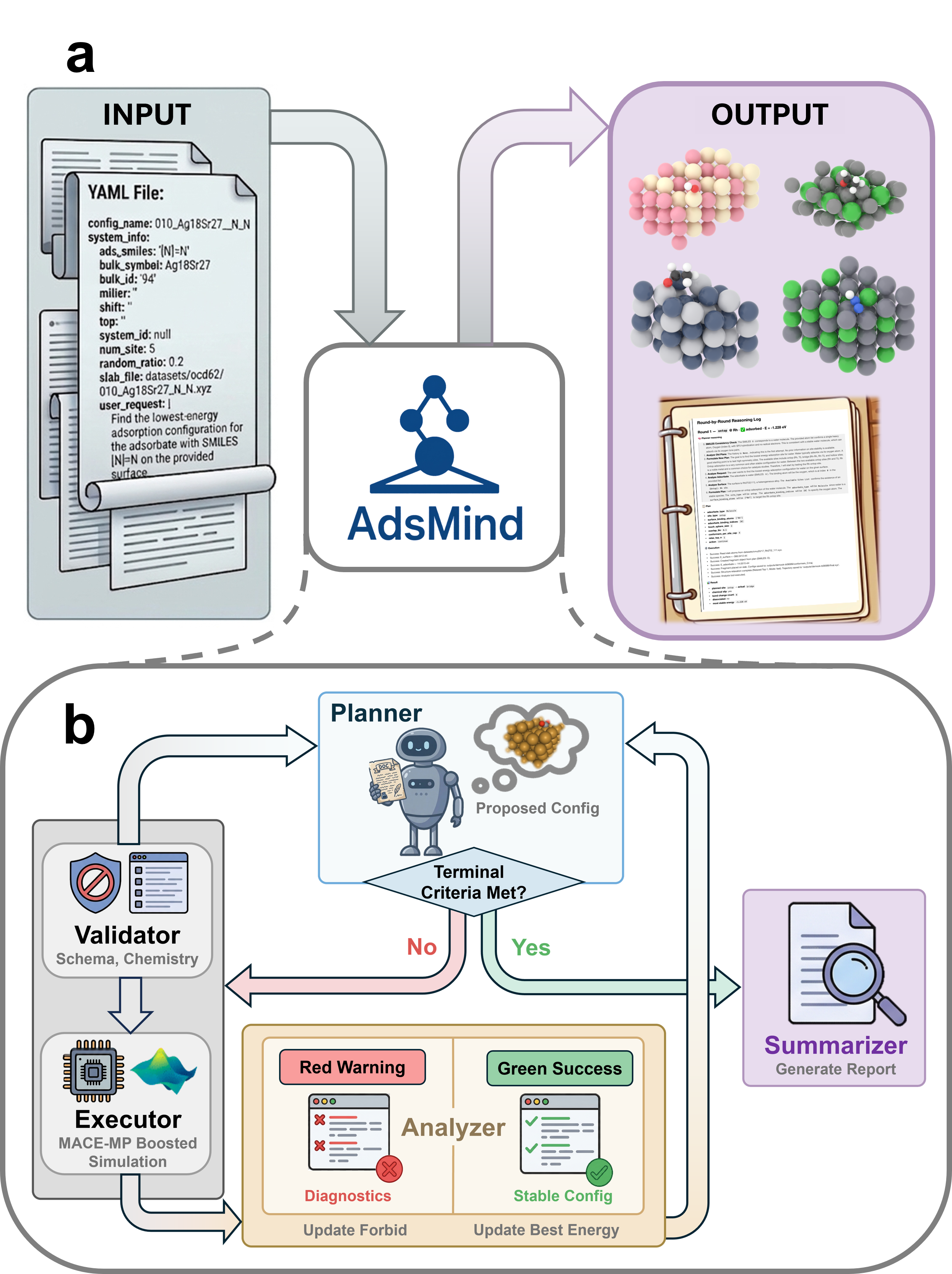
Figure 1: Schematic of AdsMind’s input modality, datasets (AA20, OCD-GMAE62), and agent loop—Planner, Validator, Executor, Analyzer, Summarizer.
Methodology
Closed-Loop Agent Design
The Planner module generates structured adsorption hypotheses, which are validated for chemical and geometric consistency prior to simulation. Three feedback mechanisms—Chemical Slip detection, FORBID directive for failed motifs, and TERMINATE for convergence—instigate iterative self-correction. Executor converts symbolic hypotheses to atomic coordinates and performs structural relaxation via MLFF (MACE-MP-0/BFGS, fmax=0.10 eV/Å; max 200 steps). Relaxed structures are parsed by Analyzer, which quantifies bond integrity and conformational slips, feeding back detailed diagnostics. Summarizer reports state, convergence, and per-iteration diagnostics.
Benchmarks, Baselines, and Validation
AdsMind is evaluated against open-loop LLM (Adsorb-Agent) and heuristic enumeration under fixed MLFF protocol, isolating search-strategy contributions. DFT-grounded validation is provided via VASP/PBE calculations on representative AA20 cases to quantify physical fidelity and adsorption-energy sign correctness.
DFT Comparison
DFT reference calculations on six AA20 cases demonstrate that AdsMind consistently preserves adsorption-energy sign and achieves closer quantitative agreement than open-loop Adsorb-Agent, which exhibits qualitative sign failures for molecular adsorbates and maximum deviations exceeding 3.5 eV (Figure 2). AdsMind’s mean absolute error versus DFT in this subset is 1.55 eV (Adsorb-Agent: 1.84 eV); no sign mismatches are observed for any tested AdsMind configuration, a critical factor for selection workflows predicated on the energy sign.
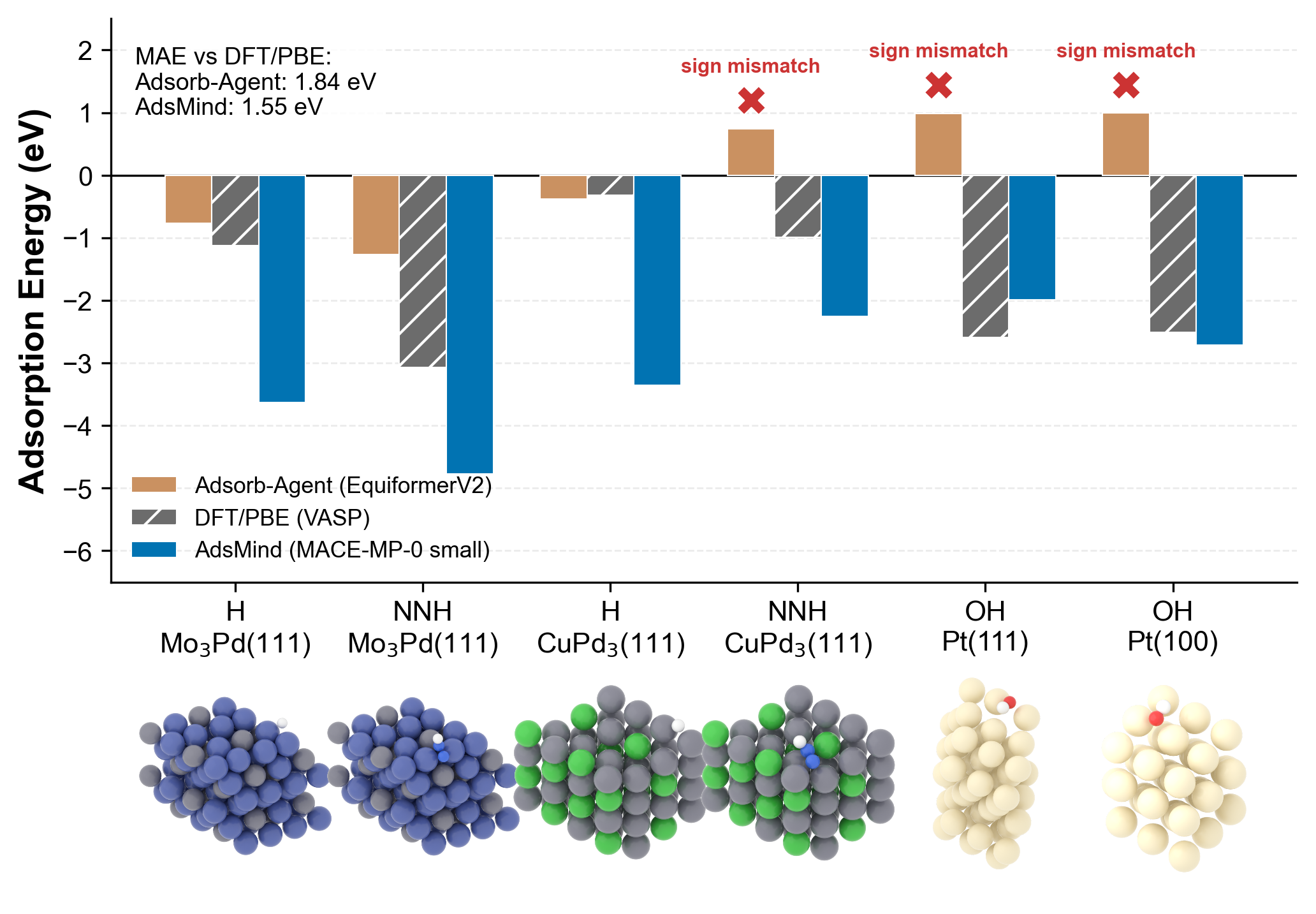
Figure 2: Adsorption energies (eV) for AdsMind, Adsorb-Agent (EquiformerV2), and DFT/PBE across six AA20 systems; sign preservation is exclusive to AdsMind.
AA20 Benchmark Analysis
Closed-loop mechanisms yield an order-of-magnitude reduction in MLFF relaxations per case (~4.11 vs. 56+ for enumeration), with Full AdsMind protocol reaching 100% success rate and significant improvements in energy accuracy and backend robustness. Ablation studies reveal the 1-Shot (open-loop) penalty—only 47.9% of its valid runs fall within 0.05 eV of Full, and cross-backend energy range is notably higher (0.473 eV for 1-Shot vs. 0.158 eV for Full). Iteration-level convergence typically completes within the first few feedback cycles.
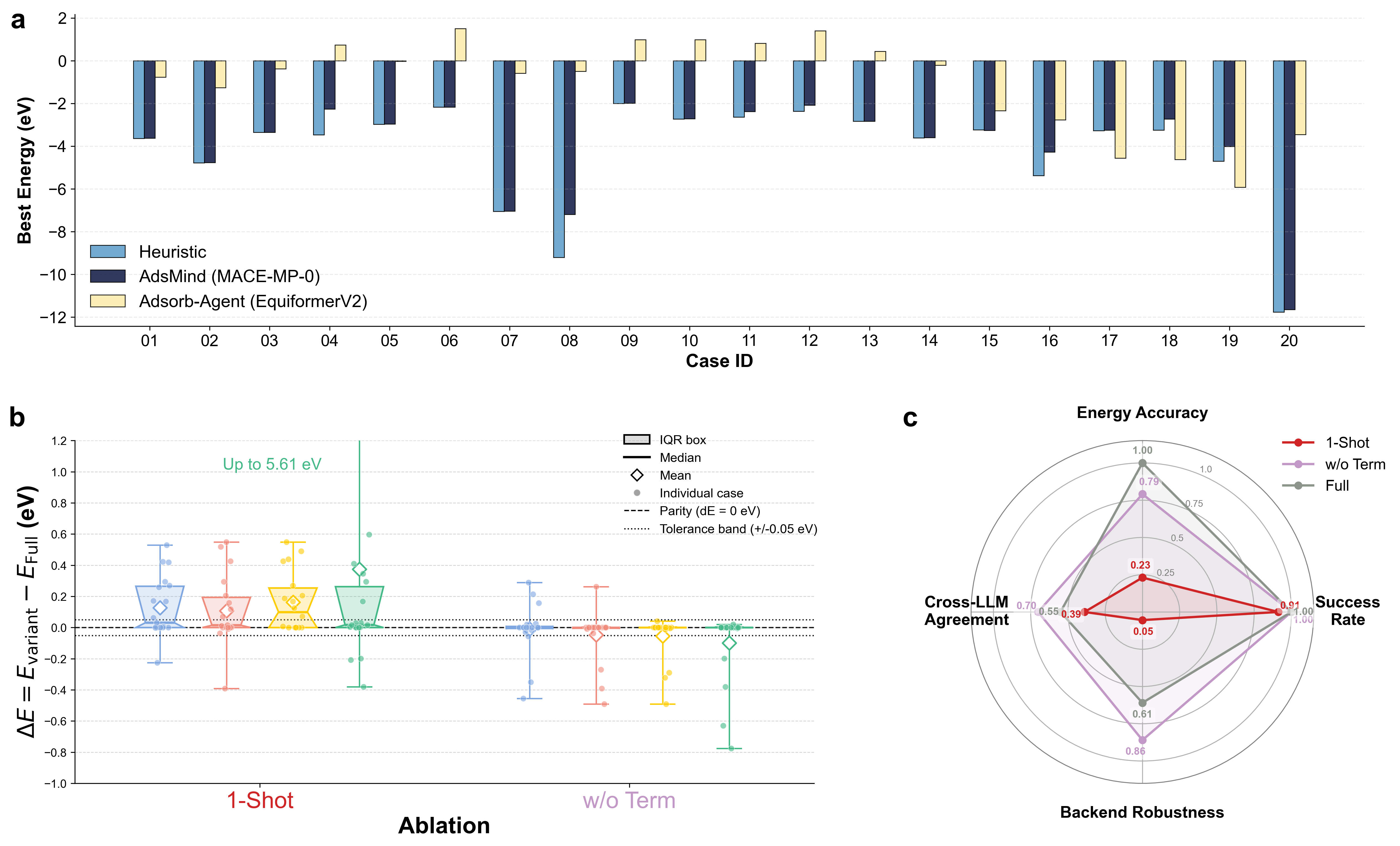
Figure 3: Distribution of best energies for AdsMind, Adsorb-Agent, and heuristic baseline across AA20; Full shows compressed energy spread and improved chemical validity.
AdsMind corrects frequent geometric slip events in open-loop LLM output: slip rates range from 61.5–76.9% (intermetallic surfaces, Figure 4b) under 1-Shot, highlighting systematic fragility in single-pass site assignment.
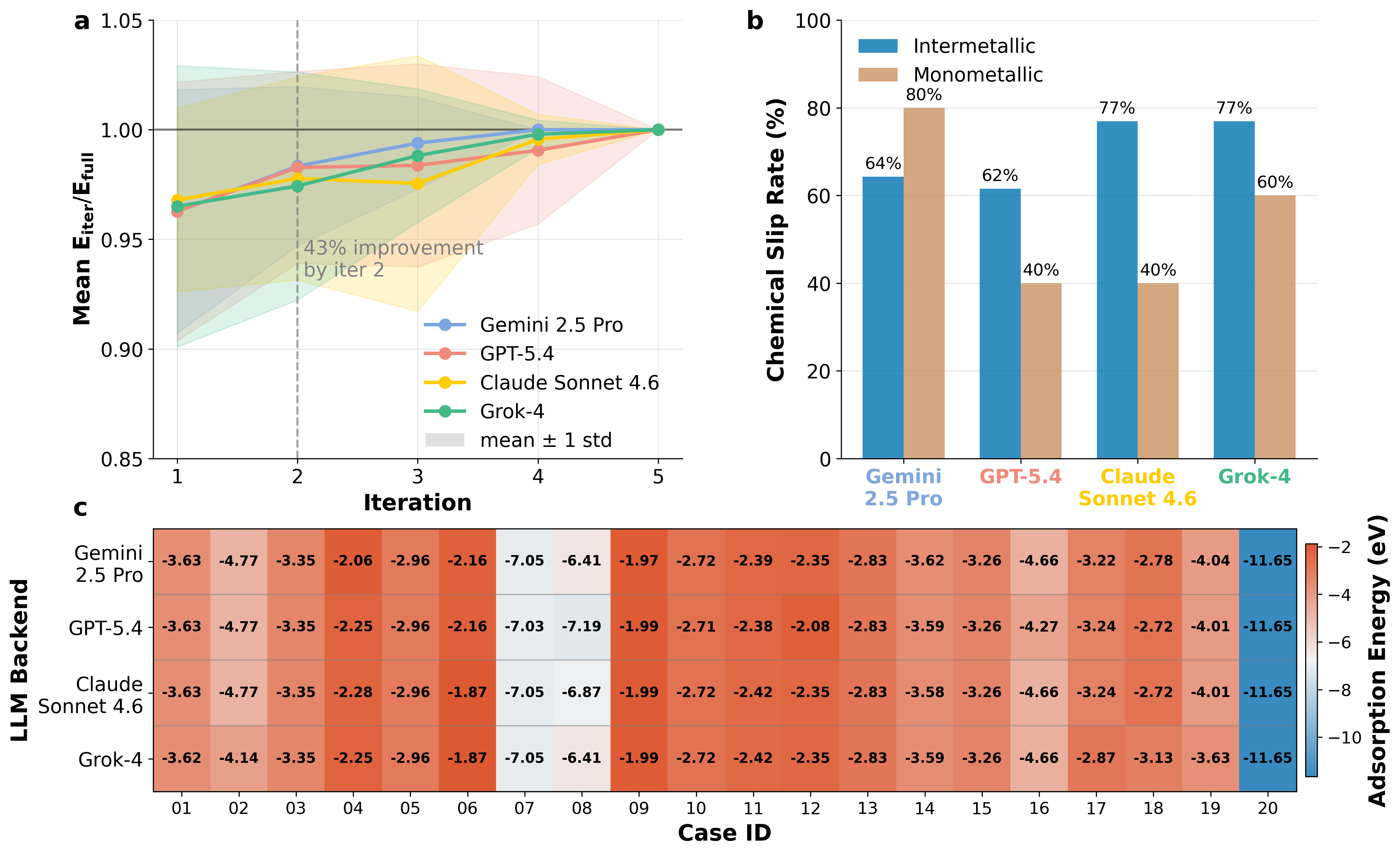
Figure 4: (a) Convergence curve for AdsMind iterations; (b) Slip analysis—fraction of non-dissociated attempts where intended and actual binding sites differ; (c) Cross-backend heatmap for Full.
Generalization to OCD-GMAE62
Evaluated on 62 diverse surface–adsorbate pairs, AdsMind retains high reliability (98.8% success rate for Full, 89.5% for 1-Shot), with a mean paired energy penalty for 1-Shot of +0.329 eV relative to Full. Cross-backend dispersion is similarly abated (mean range 0.183 eV for Full, 0.316 eV for 1-Shot). Iterative feedback is most advantageous for complex adsorbates and surface chemistry; the trade-off between reliability and exploration breadth is evident, with rare cases of over-pruning observed in backend-dependent contexts.
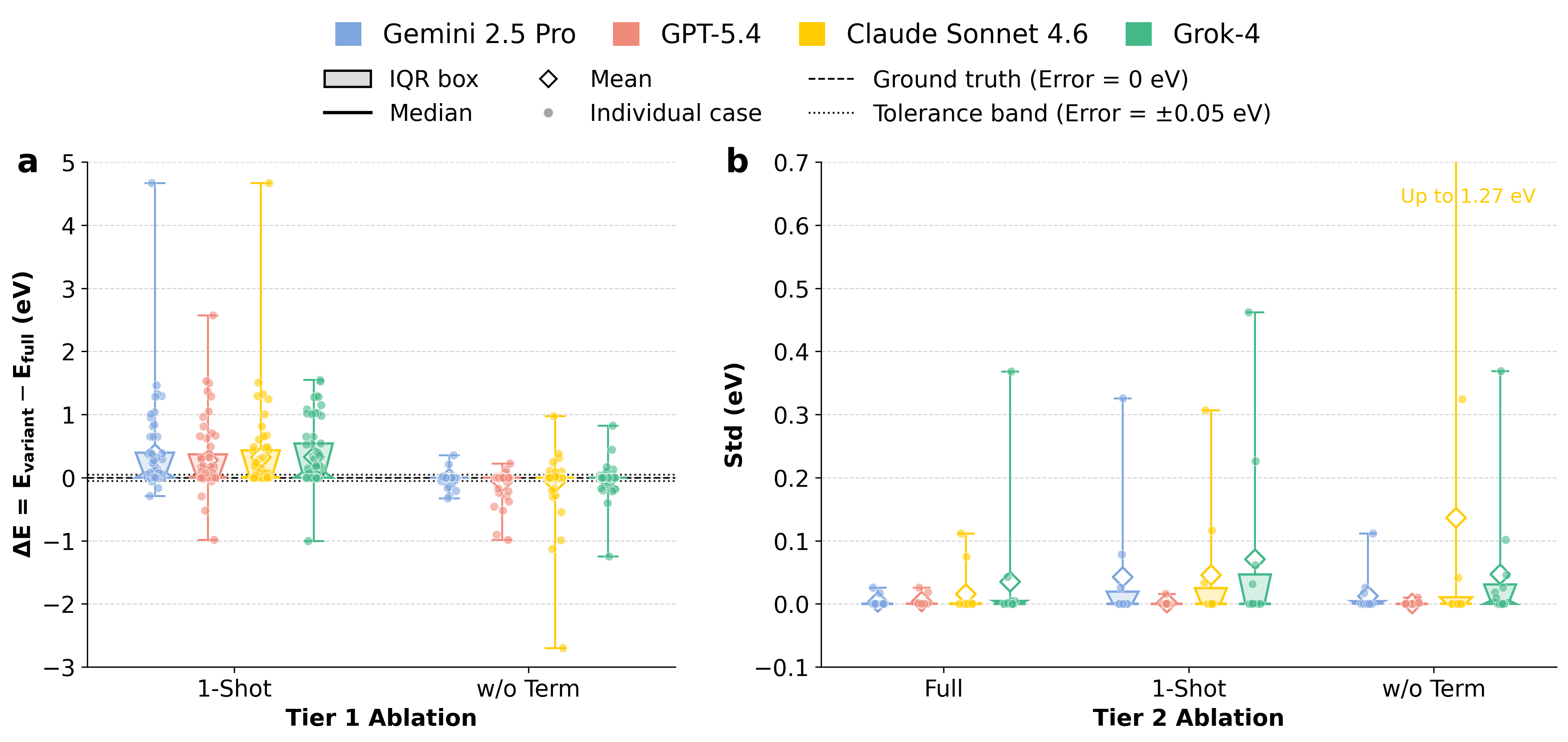
Figure 5: (a) Energy difference ΔE for ablation variants on OCD-GMAE62; (b) Run-to-run stability audit—repeatability is strongest for closed-loop Full.
Theoretical and Practical Implications
AdsMind’s iterative, feedback-conditioned framework advances autonomous chemical discovery by ensuring self-correction and interpretability in adsorption-search pipelines. The integration of Chemical Slip diagnostics provides a mechanism to monitor and adapt to geometric and chemical failures, closing the gap between symbolic hypothesis generation and physical realization. Backend independence and minimal MLFF requirements position AdsMind for scalable, reproducible deployment in high-throughput workflows. However, the trade-off between reliability and global exploration remains: FORBID and rapid termination can suppress low-energy basins, especially for complex systems.
Practically, AdsMind offers robust, interpretable catalysis-screening for large surface libraries, facilitating MLFF-driven high-throughput search with minimal DFT validation overhead. Theoretically, its architecture is extensible to defected surfaces, co-adsorption, solvation, and electrochemical scenarios, given appropriate MLFF and schema augmentations. Persistent cross-case memory and adaptive constraint relaxation represent open research directions for further reliability and exploration improvements.
Conclusion
AdsMind operationalizes a closed-loop, multi-agent system integrating LLM planning and MLFF structural feedback, facilitating self-correcting discovery of adsorption configurations with strong success rates, backend robustness, and interpretability. The combination of feedback-conditioned replanning, geometric diagnostics, and minimal computational budget delivers practical and theoretical advances for autonomous catalysis workflows. Extensions to broader chemical environments and relaxation of architectural constraints constitute promising future avenues.