- The paper introduces the Ray Antenna Array (RAA) to overcome traditional ULA limitations by employing multiple sULAs with dynamic ray selection for uniform angular resolution.
- Methodology involves an alternating optimization algorithm that jointly maximizes UE SINR and sensing SNR by solving convex subproblems and optimizing ray selection.
- Simulation results validate that RAA delivers superior sensing and communication performance with higher directional gain and scalable, cost-effective design compared to ULA.
Ray Antenna Array Enhanced Low-Altitude ISAC: System, Analysis, and Optimization
Motivation and Architectural Contributions
The proliferation of low-altitude aerial vehicles for applications such as logistics, urban mobility, and 3D mapping imposes stringent requirements on reliable sensing and communications. Traditional antenna arrays (e.g., ULA) confront several limitations: hardware costs scale prohibitively with aperture size, phase shifter complexity escalates with XL-MIMO deployments, and angular coverage deteriorates, especially for targets directly above base stations. These constraints are acute in emerging 6G ISAC scenarios, where unified sensing and communication are expected from ground infrastructure.
This paper introduces and rigorously analyzes the Ray Antenna Array (RAA) architecture as a scalable, cost-effective solution for low-altitude ISAC. RAA comprises multiple ray-arranged simple ULAs (sULAs) directly interconnected without phase shifters, exploiting low-cost switches (Ray Selection Network, RSN) for dynamic ray selection. Each sULA covers a defined small angular span, enabling the use of directional antenna elements with high gain and narrow beamwidth, thus achieving uniform angular resolution and eliminating coverage holes above the BS. The RAA architecture is proven to circumvent the trade-offs imposed by conventional arrays, supporting high-resolution, cost-efficient sensing and communication.
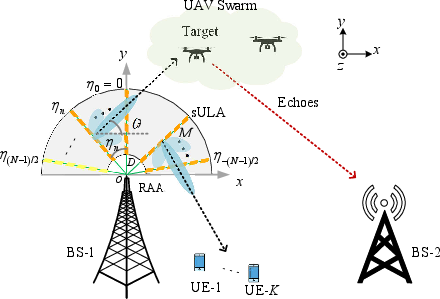
Figure 1: Illustration of the RAA-based low-altitude ISAC system, depicting BS-1 equipped with RAA communicating with ground UEs and sensing aerial targets in coordination with BS-2.
The considered system includes a BS equipped with RAA, communicating with K single-antenna UEs and simultaneously sensing aerial targets via bi-static radar (cooperating with BS-2). The RAA consists of N sULAs, each with M elements, oriented symmetrically with respect to the y-axis. For scalable deployment, physical spacing and orientation are optimized to minimize mutual coupling and guarantee coverage.
Key signals and channels:
- Downlink Channel: Each UE receives a composite channel summing responses from all sULAs, incorporating path losses and steering specific to each AoD.
- Sensing Channel: BS-1’s transmit signals (known to BS-2) illuminate aerial targets; echoes are processed to estimate target properties.
Ray selection is enforced via a binary matrix U, dynamically choosing sULAs for activation, while digital beamforming is executed with W. The optimization problem jointly maximizes minimum UE SINR (communication), under transmit power constraint and guaranteeing the sensing SNR exceeds a threshold γth (coverage). The formulation is non-convex due to binary coupling and quadratic/fractional constraints, necessitating advanced algorithmic treatment.
Analytical Sensing Gains and Design Insights
A critical theoretical contribution is the closed-form analysis of RAA’s sensing SNR performance. The main findings:
- Orientation-dependent Energy Focusing: Each sULA amplifies transmit power by M times at its boresight, purely through antenna arrangement (no phase shifter).
- Uniform Angular Resolution: The half-mainlobe beamwidth △θ=arcsin(2/M) remains invariant over all directions, resulting in consistent coverage and no degradation, unlike ULA.
- Directional Antenna Elements: By assigning each sULA a narrow 3dB beamwidth, high gain is achieved without requiring wide coverage from a single element, maximally leveraging spatial DoF.
Worst-case and best-case SNR expressions are derived as functions of antenna gain, orientation mismatch, and steering. The design constraint ensures worst-case SNR always exceeds γth, and the element patterns are tailored such that their 3dB beamwidth matches RAA’s angular resolution.
Alternating Optimization Algorithm
To solve the joint ray selection and beamforming design, the paper proposes an alternating optimization algorithm:
- Beamforming Step: For a fixed ray selection matrix, a convex subproblem is solved using SOC reformulation and SCA (successive convex approximation) for sensing SNR.
- Ray Selection Step: For fixed beamforming, combinatorial search identifies the optimal ray selection yielding maximal minimum SINR subject to sensing constraints.
This iterative scheme converges to efficient joint solutions, enabling practical implementation with standard convex solvers and limited exhaustive search due to structural constraints.
Comparative Analysis: RAA vs. ULA
The sensing performance of RAA is contrasted against conventional ULA under both omnidirectional and directional antenna regimes:
- ULA requires wide 3dB beamwidth to guarantee edge coverage, diluting peak gain.
- RAA requires only narrow beamwidth for each sULA, concentrating gain and yielding superior SNR for all target angles.
This analysis leads to a quantifiable statement: With the same total antenna gain budget, RAA attains much higher peak gain (N0), as the required ULA beamwidth (N1) far exceeds that of RAA (N2).
Numerical Results
Simulation results substantiate the analytical claims. Parameters are set to realistic values (N3, N4, N5, N6), with identical total antenna gain.
- Sensing SNR Maps: RAA achieves robustly higher SNR across the coverage area, particularly for off-boresight directions (edge of region), where ULA suffers substantial loss.
- Algorithm Convergence: The alternating optimization algorithm efficiently converges, with minimum SINR degrading gracefully as sensing SNR constraints tighten.
- ISAC Trade-off: RAA outperforms ULA in maintaining communication quality while sustaining higher sensing SNR, owing to the directional gain advantage.
Conclusion
This paper presents a comprehensive and rigorous analysis of RAA architecture for low-altitude ISAC, integrating system modeling, performance analysis, and algorithmic optimization. The RAA achieves uniform angular resolution, eliminates coverage holes inherent in traditional arrays, and leverages high-gain directional elements for enhanced sensing and communication. The proposed alternating optimization algorithm effectively addresses the non-convex joint design problem. Comparative and simulation results confirm that RAA provides a cost-effective, scalable, and high-performance solution for future 6G low-altitude ISAC systems. Theoretical implications extend to the design of spatially diverse architectures for XL-MIMO and emergent multi-function wireless platforms, while practical deployments will benefit from hardware scalability and robust coverage in complex environments.
Future developments will likely focus on extension to multi-target sensing, distributed ISAC architectures, and adaptive ray selection strategies, further harnessing the spatial degrees of freedom and cost savings enabled by RAA.