Extreme mid-infrared field enhancement and anapoles in high-index plasmonic metamaterials
Abstract: High-refractive-index materials underpin a wide range of optical technologies, including communications, imaging, lasers, and integrated photonic systems. Here, we demonstrate a self-assembled metamaterial platform based on gold nanoparticle aggregates with nanometer-scale gaps exhibit remarkably high effective refractive indices exceeding 15 in the mid-infrared regime, while simultaneously producing gap-field enhancements of at least two-orders of magnitude. This combination of high refractive index and extreme field enhancement enables exceptionally strong light-matter interactions. We demonstrate this by designing a compact high-index metamaterial device supporting an anapole, which further enhances the nanogap field. By placing quantum emitters with terahertz transitions inside the plasmonic gaps, we show a stimulated-emission response enhanced by at least three orders of magnitude, highlighting applications in non-linear optics, frequency up-conversion and vibrational strong coupling.
Paper Prompts
Sign up for free to create and run prompts on this paper.
Top Community Prompts
Explain it Like I'm 14
Overview
This paper shows a new way to make tiny structures that control light very strongly, especially in the mid‑infrared (MIR) part of the spectrum (light with wavelengths longer than what our eyes can see). The team builds “metamaterials” by letting gold nanoparticles pack themselves together, leaving ultra‑thin gaps between them—only about a billionth of a meter wide. These gaps act like super‑tight spaces that squeeze and boost light. Together, the packed particles make a material that “slows” light a lot (high refractive index) and concentrates it massively (strong field enhancement). They then shape this material into a small disk that supports a special, quiet kind of light pattern called an anapole, which traps light inside without leaking much out. Finally, they show how placing molecules or tiny light sources inside the gaps can make light emission much stronger.
What questions did the researchers ask?
They set out to find simple, scalable ways to:
- Create materials with a very high refractive index in the MIR, so light slows down a lot inside them.
- Greatly increase the strength of light in tiny spaces (field enhancement) at the same time.
- Use that combination to trap light inside a small device (an anapole resonator) and boost how strongly light interacts with molecules placed in the gaps.
- Show that this can make processes like light emission, frequency conversion, and vibrational effects much stronger and more efficient.
How did they do it?
Think of the approach like building a city of gold “buildings” (nanoparticles, tens of nanometers wide) packed very closely with narrow “alleys” (nanogaps ~1 nm). Here’s the idea in everyday terms:
- High refractive index: A material with a high refractive index slows light inside it. The authors engineer this by packing many gold particles so that, as a whole, the structure behaves like a material where light travels much more slowly.
- Field enhancement: When light tries to pass through the ultra‑thin gaps between particles, it gets squeezed—like water forced through a tiny nozzle—making the electric field much stronger in the gap.
- Anapole: They shape the metamaterial into a small disk. Inside, certain light waves interfere so that they cancel their radiation to the outside (it doesn’t shine much), but add up strongly on the inside. This “quiet” state is called an anapole: strong inside, weak outside.
- Design and testing: They use computer simulations to:
- Vary particle size, gap size, shape (spheres, cubes, and sliced cubes), and number of layers to tune the effect.
- Calculate the effective refractive index and how much the fields are boosted in the gaps.
- Model how molecules inside the gaps absorb and emit light, using a simple “four‑level” picture where pumping moves molecules up in energy and they can be stimulated to emit light down to lower levels.
In short, they combine smart geometry with simulations to get both slow light and squeezed light in one device, then test how that affects molecules inside.
What did they find, and why is it important?
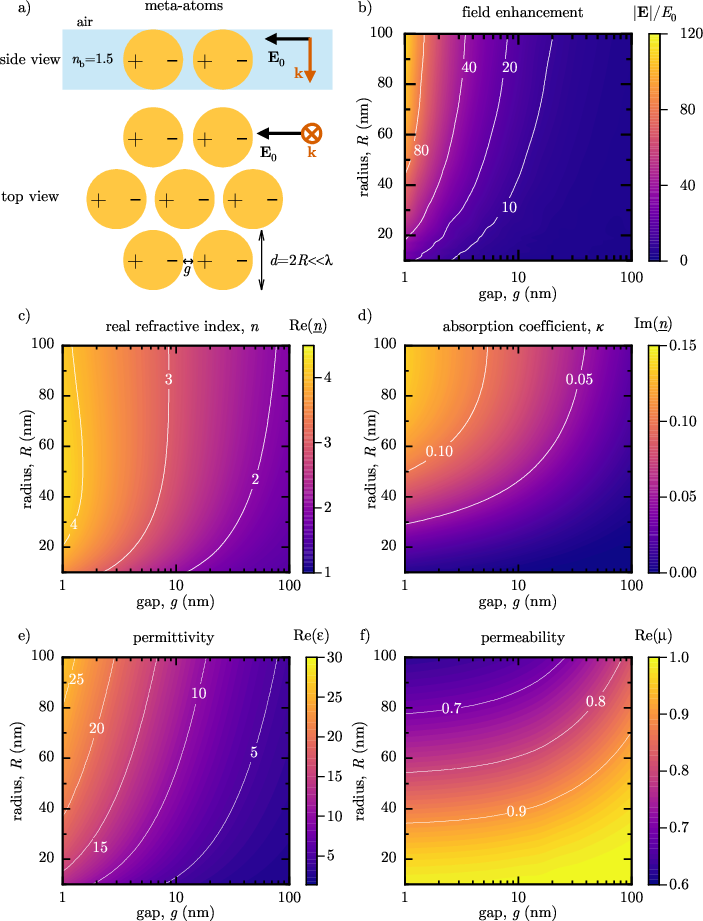
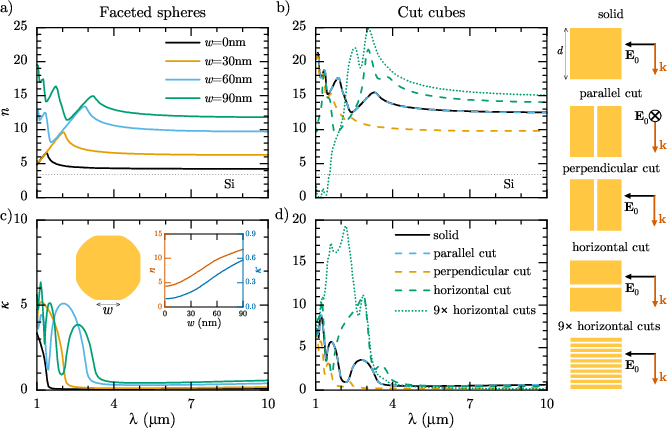
- Very high refractive index in the MIR: Their self‑assembled gold‑nanoparticle metamaterials reach effective refractive indices above 15 in the mid‑infrared, and can even approach about 25 near the near‑infrared. For comparison, common glass is around 1.5. High index helps trap and guide light in very small devices.
- Huge field enhancement: The electric field inside the nanogaps is boosted by 100× or more. When combined with the anapole in a small disk, the boost becomes even stronger—intensity increases of up to about 100,000× are possible.
- Tunable and scalable: You can tune the effect by changing particle size, gap size, shape (adding facets, using cubes), stacking multiple layers, or slicing cubes into thin layers to reduce unwanted magnetic effects. These are compatible with bottom‑up self‑assembly, which is faster and cheaper than many top‑down nanofabrication methods.
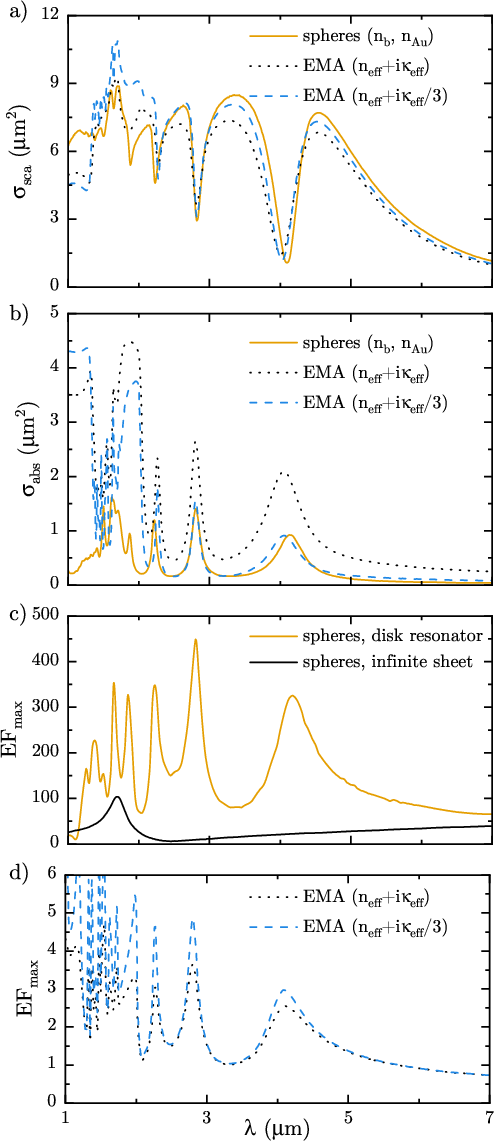
- Anapole resonator works: A compact disk made from two layers of these aggregates supports an anapole that concentrates light in the center while staying “quiet” outside. This stacks the nanogap boost and the anapole boost.
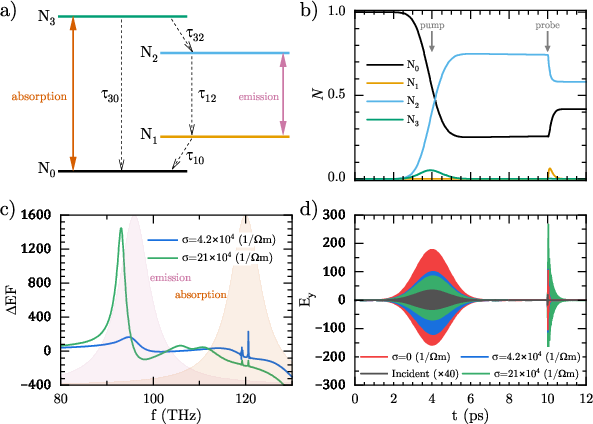
- Stronger light–matter interaction: Placing molecules (or other quantum emitters) with MIR transitions inside the gaps and pumping them leads to much stronger stimulated emission—enhanced by at least 1,000× in their modeling.
Why this matters: The mid‑infrared is crucial for sensing molecules (many vibrate and absorb there), for thermal imaging, and for compact photonic devices. Getting both high index and huge field enhancement together is rare and powerful—it means small devices can do big optical jobs.
What could this lead to?
This research points to practical, compact, and scalable devices that:
- Detect tiny amounts of chemicals or biomolecules by amplifying their vibrational signals in the MIR.
- Enable more efficient nonlinear optics and frequency up‑conversion, turning low‑energy infrared light into higher‑energy light that’s easier to detect.
- Strengthen vibrational coupling for chemistry and materials science, potentially controlling reactions or energy flow at the molecular level.
- Build small, efficient MIR light sources or amplifiers by boosting stimulated emission in ultra‑tiny gaps.
In simple terms: by cleverly packing gold nanoparticles and shaping the result, the authors create a material that super‑slows and super‑squeezes light at the same time. This traps light in tiny spaces and makes it interact with molecules much more strongly—opening doors to better sensors, new mini‑lasers, and more powerful optical chips in the infrared.
Knowledge Gaps
Knowledge gaps, limitations, and open questions
The paper presents a primarily computational study. The following unresolved issues highlight what is missing, uncertain, or left unexplored, and can guide concrete next steps:
- Experimental validation is absent: no ellipsometry, interferometry, or near-field (s-SNOM/AFM-IR) measurements confirming the reported MIR effective index (n>15), loss (κ), or nanogap field enhancements.
- Effective-medium validity is not rigorously established: no quantitative ka, spatial-dispersion, or thickness/angle-dependent tests to bound the homogenization regime for the reported unit-cell sizes and wavelengths.
- Magnetic response retrieval may be non-unique/spurious: μ<1 (diamagnetism) is inferred from single-angle S-parameter inversion without multi-angle retrieval or spatial-dispersion/bianisotropy checks that can generate artificial μ in plasmonic composites.
- Tensor anisotropy is not characterized: high-index “cut/stacked” designs are highly anisotropic, yet only a scalar n is reported; full ε and μ tensors vs. frequency/angle/polarization are needed (including potential hyperbolic behavior).
- Boundary/edge effects in finite resonators are unresolved: the finite cylinder deviates from the infinite-layer effective parameters, and matching the spectrum requires ad hoc loss reduction (κ/3); a systematic boundary-layer or nonlocal effective-medium correction is missing.
- Quantum and nonlocal effects in ~1 nm gaps are ignored: hydrodynamic nonlocality, charge transfer plasmon formation, and tunneling are not included (no Quantum Corrected Model), risking overestimation of EF, ε, μ, and underestimation of loss at sub-nm separations.
- Mesh resolution limits near-field accuracy: the inhomogeneous disk uses ≥10 nm element size (Methods), incompatible with resolving 1 nm gaps; reported in-gap field enhancements for the inhomogeneous device are therefore not numerically converged.
- Material optical constants and damping are idealized: bulk Drude–Lorentz parameters are used for nanoscale, likely polycrystalline Au with enhanced surface and grain-boundary scattering; sensitivity analysis to increased damping and MIR interband tails is missing.
- Host medium losses in the MIR are neglected: a lossless n_b=1.5 is assumed, but typical ligands/polymers absorb in the MIR; the impact on κ, EF, and anapole Q is not quantified.
- Thermal and photothermal stability is unaddressed: ohmic heating in Au at MIR intensities, temperature-dependent optical constants, ligand desorption, nanogap creep, and device damage thresholds are not evaluated.
- Disorder, polydispersity, and fabrication tolerances are not treated: gap size/shape distributions, NP size/facet variability, and random packing (vs. ideal lattices) could degrade n, EF, and anapole conditions; no robustness analysis is provided.
- Fabrication feasibility of “9× horizontal cuts” and controlled alignment is unclear: practical self-assembly routes to sliced cubes with ~1 nm inter-slice gaps and controlled orientation relative to E and k are not demonstrated.
- Angle and polarization dependences are incomplete: device performance is shown for normal incidence; full angular/polarization response (especially for anisotropic designs) and birefringence are not reported.
- Band-structure and Brillouin zone effects are only qualitative: no isofrequency surfaces or dispersion maps validating where homogenization fails and how bandgaps impact effective parameters.
- Anapole identification lacks multipole analysis: scattering minima and field profiles are shown, but no rigorous multipole decomposition (Cartesian/spherical) or quantification of Q, stored energy, and mode volume is provided.
- Coupling efficiency and impedance matching are unquantified: how to launch/extract MIR light into/out of high-index MLagg resonators (free-space, waveguides) and corresponding efficiencies are not analyzed.
- Tunability mechanisms are limited: proposed tuning via geometry stacking/faceting lacks post-fabrication/dynamic control strategies (electro-optic, thermo-optic, mechanical) and associated performance metrics.
- Integration of emitters into ~1 nm gaps is not addressed experimentally: placement/yield, molecular orientation, quenching, photostability, and chemical compatibility with Au nanogap chemistry remain open.
- Emitter–plasmon coupling metrics are missing: LDOS/Purcell factors, radiative vs non-radiative channels, and the impact on emitter lifetimes and quantum yield are not computed.
- Realism of the four-level gain model is uncertain: chosen lifetimes (e.g., τ32=50 fs, τ30/τ12=500 ps) and dephasing (20 fs), and the conductivity-like coupling parameter σ lack mapping to specific molecular/defect systems; corresponding achievable densities and dipole moments are not provided.
- Pump/probe intensities and thresholds are unspecified: required MIR fluences for inversion, stimulated emission, ASE or lasing thresholds, and gain–loss balance in the resonator are not quantified.
- Strong-coupling claims are not demonstrated: no Rabi splitting or coupling rate vs damping analysis is provided to substantiate vibrational strong coupling in these structures.
- Loss mitigation pathways are not developed: the need to reduce κ by ~3× to match spectra is shown without proposing materials/processes (e.g., Ag, alternative plasmonic ceramics, doped semiconductors, cryogenic operation, larger grains) to achieve it.
- Substrate and encapsulation effects are absent: real MIR substrates (e.g., CaF2, Si, SiC) and encapsulants have phonon resonances and dispersion that can alter n, κ, and EF; these interactions are not modeled.
- Maximum attainable EF and saturation limits are unknown: nonlocal smoothing, electron heating, and dielectric breakdown in the host likely cap EF; no assessment of damage or saturation thresholds is given.
- Scalability and uniformity at device scale are not demonstrated: wafer-scale uniformity of 1–2 nm gaps and reproducibility of disk resonators are unproven; process windows and yield are unreported.
- Reliability and aging are not assessed: long-term stability under MIR illumination/thermal cycling and environmental exposure (oxidation/sulfur contamination) is unexamined.
- Generality across materials systems is unexplored: alternatives to Au (e.g., highly doped semiconductors, polar dielectrics in Reststrahlen bands) may reduce loss or increase bandwidth; comparative studies are absent.
- Nonlinear performance metrics are not quantified: despite claims (e.g., Raman, up-conversion), no estimates of effective nonlinear susceptibilities, conversion efficiencies, or saturation powers are provided.
Practical Applications
Immediate Applications
Below are actionable, sector-linked use cases that can be deployed or prototyped with current materials and fabrication capabilities, leveraging the paper’s self-assembled gold nanoparticle aggregates (MLaggs) that deliver high mid‑IR refractive index and extreme nanogap field enhancement.
- Enhanced mid‑IR vibrational spectroscopy substrates (SEIRA/FTIR)
- Sectors: healthcare, pharma, environmental monitoring, analytical instrumentation
- What: Use MLagg films as disposable or reusable “nano‑enhanced” substrates to boost mid‑IR absorption signatures (fingerprint region), increasing sensitivity for trace analytes (e.g., biomarkers in breath, pollutants, solvents, process gases).
- Tools/products/workflows: Drop‑cast/spin‑coat self‑assembled NP aggregates on IR‑transparent windows (CaF2, ZnSe, Si); optional micro‑patterning into micron‑scale disks to invoke anapole field confinement; couple to benchtop FTIR microscopes and quantum‑cascade laser (QCL) sources; provide OEM “MIR enhancement slides” to instrument makers.
- Assumptions/dependencies: Reproducible gap control near ~1–2 nm; stable ligand shells in MIR; host matrix with low MIR absorption; process-compatible with standard IR optics.
- Compact, high‑index MIR resonators for lab experiments (anapole demonstrators)
- Sectors: academia, R&D instrumentation, photonics
- What: Fabricate micron‑scale disks from MLaggs to study non‑radiative anapole resonances with strong internal fields, enabling low‑power nonlinear and strong‑coupling experiments in the MIR.
- Tools/products/workflows: Self‑assembly of NP layers followed by soft lithography or lift‑off to define ~1–10 μm disks; FTIR/QCL excitation; COMSOL‑based design using provided effective parameters; on-chip test coupons for universities and corporate labs.
- Assumptions/dependencies: Disk‑scale patterning available in standard cleanrooms; acceptable optical loss (κ) for targeted effects; uniformity across mm–cm areas sufficient for multiplexed resonators.
- Field‑enhanced near‑IR/short‑wave IR spectroscopy and SERS-adjacent sensing
- Sectors: chemical analysis, security screening, materials science
- What: Exploit the reported large effective index and significant field enhancement extending toward the near‑IR to boost weak vibrational/over‑tone bands and Raman‑adjacent signals in the 1–2.5 μm range.
- Tools/products/workflows: MLagg coatings on NIR windows/fibers; NIR diode or supercontinuum sources; integration with fiber‑coupled spectrometers.
- Assumptions/dependencies: Tunability of aggregate morphology to align enhancement with NIR bands; material stability under NIR illumination; calibration protocols to separate enhancement from baseline drift.
- Rapid prototyping of high‑index MIR building blocks (claddings, FP slabs, filters)
- Sectors: integrated photonics, defense/aerospace, industrial inspection
- What: Use dispersionless high‑n MLagg sheets as claddings and FP mini‑resonators for MIR waveguides, filters, and compact optical elements where conventional dielectrics are bulky or lossy.
- Tools/products/workflows: MLagg deposition on Si/SiO2/SiN platforms; integration with etched MIR waveguides; wafer‑level patterning of slabs for FP filtering; foundry‑style design via effective‑medium parameter libraries.
- Assumptions/dependencies: CMOS‑compatible processing temperatures; adhesion and mechanical robustness; loss management (κ) acceptable for device Q requirements.
- Educational/metrology kits for metamaterial and anapole physics
- Sectors: academia, training, scientific equipment suppliers
- What: Provide ready‑made MLagg films and micro‑disks to teach and verify high‑index homogenization, diamagnetism in aggregates, and anapole modes in the MIR.
- Tools/products/workflows: Standard FTIR/QCL setups; packaged samples with characterization guides; simulation files with parameter sweeps (R, g, facet size).
- Assumptions/dependencies: Stable shelf life of NP films; low variability between batches to ensure consistent teaching outcomes.
Long‑Term Applications
These opportunities will likely require further materials development (e.g., sub‑nm gap control at scale, reduced loss), device integration, or new manufacturing workflows before widespread deployment.
- Low‑threshold mid‑IR microlasers and spasers using anapole resonators
- Sectors: sensing, LIDAR, free‑space communications, on‑chip sources
- What: Incorporate quantum emitters (rare‑earths, quantum dots, defect centers, molecular vibrational gain) into nanogaps of MLagg anapole disks to realize compact MIR coherent sources with strong field confinement and reduced pump power.
- Tools/products/workflows: Co‑assembly of emitters with NP aggregates; pump via QCLs or electrical injection in hybrid stacks; thermal and optical packaging for stability.
- Assumptions/dependencies: Robust gain media compatible with ~1 nm gaps; control of nonradiative quenching and metal losses; repeatable alignment of emission with anapole frequency; heat management.
- MIR nonlinear photonics and frequency up‑conversion at low intensities
- Sectors: spectroscopy, imaging, free‑space optical links
- What: Leverage ≥102–105 local intensity enhancement to drive second‑/third‑order processes (e.g., difference‑frequency generation, vibrationally assisted up‑conversion) for translating MIR/THz signals into NIR/visible for detection with mature sensors.
- Tools/products/workflows: Engineered MLagg resonators co‑located with nonlinear media or molecules; pulsed or CW pumping; integrated collection optics and filtering; system‑level calibration.
- Assumptions/dependencies: Repeatable overlap of nonlinear response with resonant enhancement; material stability under high local fields; dispersion engineering across multi‑frequency bands.
- Vibrational strong coupling platforms and quantum‑enhanced chemistry control
- Sectors: basic science, pharmaceuticals, catalysis
- What: Use extreme MIR confinement to reach the strong‑coupling regime with molecular vibrations, enabling spectral reshaping, reaction‑pathway modulation, and room‑temperature cavity‑modified chemistry.
- Tools/products/workflows: MLagg cavities with controlled gap infiltration of reactants; in‑situ FTIR kinetics; microfluidic integration; computational design of mode–vibration overlap.
- Assumptions/dependencies: Chemical compatibility of ligands with target molecules/solvents; long‑term stability of sub‑nm gaps; experimental validation of reaction selectivity gains.
- Hyperbolic/birefringent MIR components for sub‑diffraction imaging and beam control
- Sectors: semiconductor inspection, defense, advanced manufacturing
- What: Exploit highly anisotropic “stacked‑slice” MLagg variants (e.g., horizontally cut cubes) to realize hyperbolic/ENZ‑like responses for near‑field hyperlenses, compact waveplates, and tailored emission control in the MIR.
- Tools/products/workflows: Precise multilayer NP assembly with controlled interlayer gaps; lithographic patterning of anisotropic domains; system‑level integration with MIR microscopes.
- Assumptions/dependencies: Manufacturability of multi‑slice NP stacks at wafer scale; loss minimization; reliable orientation control.
- Ultra‑sensitive, low‑power MIR detectors and antennas
- Sectors: environmental monitoring, smart infrastructure, IoT, industrial safety
- What: Integrate MLagg meta‑antennas with MIR photodiodes/bolometers to boost absorption cross‑section and responsivity for gas and leak detection, and spectral sensing in compact form factors.
- Tools/products/workflows: Antenna‑detector co‑design; wafer‑level patterning of MLagg arrays; CMOS‑compatible interconnects and readout ICs.
- Assumptions/dependencies: Thermal/chemical durability in field conditions; EMC/optical cross‑talk management; cost targets competitive with MEMS/QCL solutions.
- Photothermal and photocatalytic enhancement in the MIR
- Sectors: energy, chemical processing, environmental remediation
- What: Use strong local fields to concentrate MIR energy for selective vibrational heating and potential catalyst activation, enabling targeted bond‑specific pathways or low‑temperature processing.
- Tools/products/workflows: MLagg coatings on catalyst supports; MIR illumination control; thermal monitoring; reactor‑grade encapsulation.
- Assumptions/dependencies: Demonstrated catalytic benefits in MIR (vs. NIR/visible plasmonic routes); mitigation of sintering/ligand degradation under operating conditions.
- Spectrally selective MIR surfaces for emissivity control and IR signature management
- Sectors: thermal management, defense, building technologies
- What: Engineer high‑index MLagg stacks with FP‑like resonances to create absorptive/emissive bands for cooling, heating, or signature masking in the MIR atmospheric windows.
- Tools/products/workflows: Large‑area coating/roll‑to‑roll deposition of MLaggs; top‑layer protection; integration with building materials or coatings.
- Assumptions/dependencies: Scalability to m2 areas; outdoor durability; compliance with environmental regulations on nanoparticle use.
- Design kits and standards for MIR metamaterials
- Sectors: software, foundry/PDK ecosystem, policy/standards
- What: Package effective parameter libraries (n, κ, ε, μ vs. geometry) into design kits for COMSOL/Lumerical, and develop metrology standards for MIR metamaterial devices (test coupons, uncertainty budgets).
- Tools/products/workflows: Open parameter databases; standardized test protocols (FTIR‑based); collaboration with standards bodies.
- Assumptions/dependencies: Community adoption; agreement on homogenization validity ranges; funding for maintaining datasets.
Cross‑cutting assumptions and dependencies
- Materials and fabrication
- Reliable, scalable control of nanogaps at ~1 nm with stable ligands; uniformity across large areas and over time.
- Loss management: reducing κ via materials choice, morphology, and host selection; thermal and chemical robustness in MIR.
- Manufacturability of advanced morphologies (e.g., multi‑slice “horizontal cut” cubes) at wafer/roll scales.
- Integration and packaging
- Compatibility with silicon/MIR photonics processes; low‑loss coupling to free‑space and waveguides.
- Encapsulation that preserves gap integrity and prevents fouling in harsh environments.
- Measurement and validation
- Standardized calibration for enhancement factors; robust extraction of effective parameters within homogenization limits.
- Access to MIR sources (QCLs) and detectors for industrial deployment.
- Safety, policy, and sustainability
- Nanoparticle handling, lifecycle, and end‑of‑life management compliant with regulations.
- Development of testing and certification standards for MIR metamaterial components used in safety‑critical contexts.
Glossary
- absorption cross section: A measure of how much incident light is absorbed by an object, expressed as an effective area. "The scattering and absorption cross section is calculated in a spherical physical domain surrounded by perfectly-matched-layers, using the standard frequency domain scattered field formalism in COMSOL, with a plane wave as excitation."
- anapole: A non-radiating electromagnetic mode arising from destructive interference of multipoles, featuring strong internal field confinement. "Anapoles are non-radiative states, usually observed in high-index dielectric spheres or cylinders, and are characterised by a strong field confinement in the center of the resonator."
- anisotropic metamaterial (MM): A metamaterial whose electromagnetic response depends on direction, exhibiting different properties along different axes. "In summary, we thus find that the highest refractive indices arise from stacking thin square sheets of gold separated by ultra-thin gaps, producing a highly anisotropic MM, similar to hyperbolic materials"
- birefringent materials: Media with two distinct refractive indices for different polarizations or directions of light. "and even birefringent materials~\cite{zhu_manipulating_2015}."
- Bragg scattering: Diffraction of waves by a periodic structure leading to band gaps when the Bragg condition is met. "At higher frequencies, we reach the Brillouin zone of the MM, where Bragg scattering opens a band-gap increasing both and ."
- Brillouin zone: The fundamental region in reciprocal space of a periodic structure that defines its wave propagation characteristics. "At higher frequencies, we reach the Brillouin zone of the MM, where Bragg scattering opens a band-gap increasing both and ."
- Cartesian multipole decomposition: A method of expressing electromagnetic fields in terms of multipole moments (e.g., dipole, quadrupole) defined in Cartesian coordinates. "In Cartesian multipole decomposition they arise explicitly due to the interference of electric and toroidal dipole moments"
- chirality: A lack of mirror symmetry in a structure that can cause different responses to left- and right-handed light. "including effective chirality and non-reciprocity"
- dephasing: Loss of coherence between quantum states due to interactions or perturbations, characterized by a dephasing time. "The dephasing is set to $20\unit{fs}$."
- diamagnetic effect: An induced magnetic response opposing an applied magnetic field, reducing effective magnetic permeability. "This is due to a diamagnetic effect emerging at the long wavelength limit"
- Drude–Lorenz model: A dispersion model combining free-electron (Drude) and bound-electron (Lorentz) contributions to describe a metal’s permittivity. "The permittivity of gold is given by a DrudeâLorenz model with set parameters as in~\cite{elliott_fingerprinting_2022}."
- effective medium approximation (EMA): Treating a composite structure as a homogeneous medium with averaged electromagnetic properties. "At longer wavelengths we can assume the EMA to be valid"
- effective refractive index: The homogenized refractive index that characterizes wave propagation through a structured medium. "For example, NP aggregates of radius $R=50\unit{\nm}$ and gap of $g=1\unit{\nm}$, lead to a MM with an effective refractive index of throughout the MIR regime"
- electric permittivity: A material parameter describing how an electric field polarizes a medium, affecting its stored electric energy. "e) the real electric permittivity ;"
- epsilon‑near‑zero structures: Materials or structures engineered so that their effective permittivity is near zero, yielding unusual light propagation. "similar to hyperbolic materials~\cite{poddubny_hyperbolic_2013}, epsilon-near-zero structures~\cite{hendrickson_coupling_2018,suresh_enhanced_2021}, and even birefringent materials~\cite{zhu_manipulating_2015}."
- exceptional point: A non-Hermitian degeneracy where two or more eigenmodes and their eigenvectors coalesce. "it is near an exceptional point"
- Fabry‑Perot modes: Resonant modes from multiple internal reflections within a slab or cavity, producing interference fringes. "In the case of faceted MLaggs this higher refractive index leads to redshifted Fabry-Perot modes"
- Floquet periodic boundary conditions: Boundary conditions that enforce periodicity with a phase shift, modeling infinite periodic structures. "with Floquet periodic boundary conditions applied on the sides"
- four‑level system: A quantum model with four energy levels used to describe absorption, nonradiative relaxation, and emission processes. "We model the molecules surrounding the NPs of the MLagg as a four-level system described by Maxwell-Bloch equations"
- homogenization: The process of replacing a complex structured medium with an equivalent homogeneous material for modeling. "Thus homogenization removes the need to model to model the exact near-field profile within the MM"
- hyperbolic materials: Anisotropic media whose permittivity tensor has components of opposite signs, enabling high‑k modes and unusual dispersion. "similar to hyperbolic materials~\cite{poddubny_hyperbolic_2013}, epsilon-near-zero structures~\cite{hendrickson_coupling_2018,suresh_enhanced_2021}, and even birefringent materials~\cite{zhu_manipulating_2015}."
- Maxwell‑Bloch equations: Coupled equations describing the dynamics of electromagnetic fields and material polarization/populations in quantum systems. "We model the molecules surrounding the NPs of the MLagg as a four-level system described by Maxwell-Bloch equations"
- Maxwell Garnett approximation: A mixing formula estimating effective permittivity of composites based on inclusion volume fraction and host properties. "which is also consistent with the Maxwell Garnett approximation"
- meta‑atom: The subwavelength building block of a metamaterial whose geometry determines the macroscopic response. "Metamaterials (MMs) enable the engineering of emergent optical properties that are not inherent to their individual building blocks, or meta-atoms."
- metamaterials (MMs): Engineered composites with structured subwavelength inclusions that exhibit effective properties not found in nature. "Metamaterials (MMs) enable the engineering of emergent optical properties that are not inherent to their individual building blocks, or meta-atoms."
- mid‑infrared (MIR): The spectral band roughly spanning wavelengths of 2–20 μm, important for vibrational spectroscopy and thermal applications. "Extending these concepts to the mid-infrared (MIR) and visible regimes is highly desirable"
- non‑radiative state: A mode that stores electromagnetic energy without significant far‑field radiation. "an anapole, a non-radiative state associated with strong field confinement inside the resonator"
- non‑reciprocity: A property where transmission differs for opposite propagation directions due to time‑reversal symmetry breaking. "including effective chirality and non-reciprocity"
- perfectly matched layer (PML): An artificial absorbing boundary that minimizes reflections in computational electromagnetic simulations. "a perfectly matched layer applied at the top and bottom."
- plasmonic gaps: Nanometer‑scale separations between metallic structures where localized plasmonic fields are strongly confined and enhanced. "Recent advances in self-assembly now allow plasmonic gaps to be controlled down to the nanometer scale"
- polarizability: A measure of how readily a particle’s charge distribution is displaced by an external field, determining its induced dipole moment. "since larger NPs provide increased polarizability"
- population inversion: A nonequilibrium condition where a higher energy level is more populated than a lower one, enabling gain. "This creates a population inversion between states and "
- scattered field formalism: A computational approach that solves for the scattered (rather than total) electromagnetic fields to obtain cross sections. "using the standard frequency domain scattered field formalism in COMSOL"
- scattering cross section: An effective area quantifying how strongly an object scatters incident light. "We demonstrate the existence of the anapole by obtaining the scattering cross-section spectrum of the cylinder"
- skin depth: The characteristic depth within a conductor at which electromagnetic fields decay to 1/e of their surface value. "as expected from the skin depth of the metal."
- stimulated emission: Emission of a photon triggered by an incident photon matching a transition, leading to light amplification. "we show a stimulated-emission response enhanced by at least three orders of magnitude"
- surface plasmon resonance: A collective oscillation of conduction electrons at a metal–dielectric interface that resonates with incident light. "The scattering cross section shows the well know surface plasmon (SP) resonance in the visible range"
- toroidal dipole: A nonclassical multipole moment arising from poloidal currents, contributing to non‑radiating configurations like anapoles. "In Cartesian multipole decomposition they arise explicitly due to the interference of electric and toroidal dipole moments"
- vibrational strong coupling: The regime where molecular vibrational transitions and confined electromagnetic modes exchange energy faster than their losses. "vibrational strong coupling."
- wavevector: A vector quantity representing the spatial frequency and direction of a propagating wave. "we initially consider a
parallel cut' design (see \autoref{fig:n_k_shapes}), where the wavevector $\vb k$ and the incident field $\vb{E}_0$ are both parallel to thecut' plane."