- The paper introduces a novel MPO-transition LCU method that compiles quantum operators via tensor network compression to sidestep exponential resource growth.
- It demonstrates polynomial scaling of bond dimensions and normalization factors, validated with numerical benchmarks on Heisenberg and perturbed spin chains.
- The approach leverages classical preprocessing and virtual-path automata to enhance quantum circuit efficiency across both integrable and non-integrable models.
Matrix Product Operators in the Age of Block Encoding
Introduction
The manuscript "Matrix Product Operators In The Age of Block Encoding" (2606.19083) presents a compiler-level framework for block-encoding quantum operators by leveraging the intrinsic structure of matrix product operators (MPOs) as compressed, virtual-path linear combination of unitaries (LCU) programs. This approach is situated within the context of quantum Hamiltonian simulation, where optimal circuit compilation and resource scaling are governed not only by operator algebra but, crucially, by classical compression and tensor network intermediates. The work moves beyond conventional operator splitting product formulas, instead illustrating how tensor network representations serve as both a natural language and a computational substrate for quantum circuit assembly.
Three technically distinct block-encoding routes are analyzed:
- Explicit Pauli LCUs: Conventional approach, Taylor-expanding the target unitary and encoding all resulting Pauli strings directly, resulting in exponential resource scaling in the polynomial degree and size of the interaction list.
- Tensor-dilation MPO block encoding: Following Nibbi et al. [Nibbi2024], each MPO tensor is reshaped and embedded via unitary dilation. The normalization penalty due to non-unitary generators is inherited, leading to exponential resource growth in system size.
- MPO-transition LCUs: The novel route developed here, compiling the target polynomial transformation directly within the MPO representation and interpreting the MPO as a virtual-path automaton. Virtual transitions are expanded in a local unitary basis, and the block-encoding normalization is computed via tensor contraction, avoiding explicit materialization of Pauli products.
This virtual-path LCU formalism interprets the MPO as a finite-state automaton generating operator strings. The sum-over-path coefficients are efficiently computed via tensor network contractions—this is technically distinct from explicit LCU approaches, where coefficients are determined only after collecting all terms with identical operator products.
Numerical Analysis: Bond Dimension and Approximation Error
The manuscript provides detailed numerical evidence supporting the polynomial resource scaling benefits of the compiled-polynomial MPO route, using Heisenberg and perturbed Heisenberg-adjacent spin chains as central benchmarks. Powers of the Hamiltonian, when represented as MPOs and compressed via standard algorithms, demonstrate bond dimension growth significantly below the exponential scaling expected from naive Pauli expansion. Importantly, this compressed bond dimension is independent of system size.
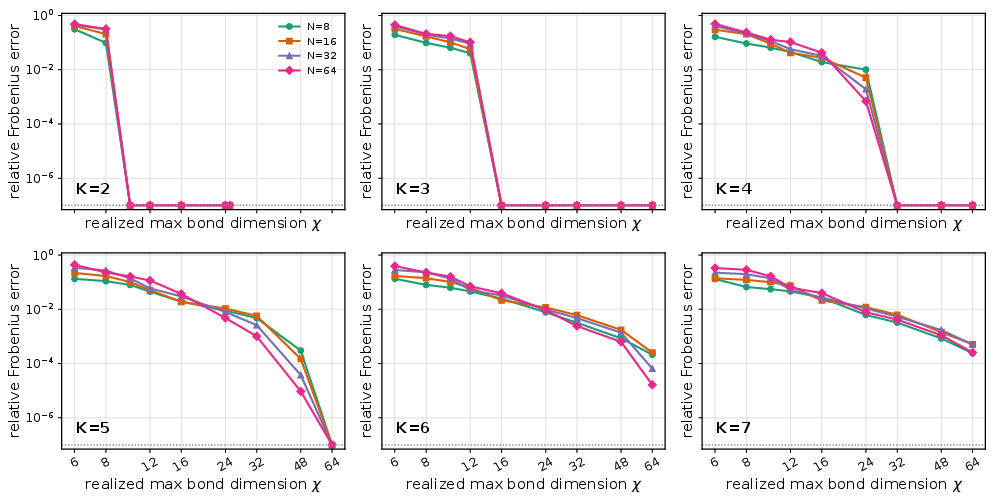
Figure 1: MPO bond dimension scaling for Hamiltonian powers. Modest growth in χ is observed and the bond dimension remains independent of system size.
Further, approximation of time evolution unitaries via Taylor-expanded MPOs yields even slower bond dimension growth, leveraging the rapidly decaying Taylor coefficients for high-order terms. Relative Frobenius errors in synthesizing e−iHt as an MPO Taylor expansion are quantified for various chain lengths and truncation parameters.
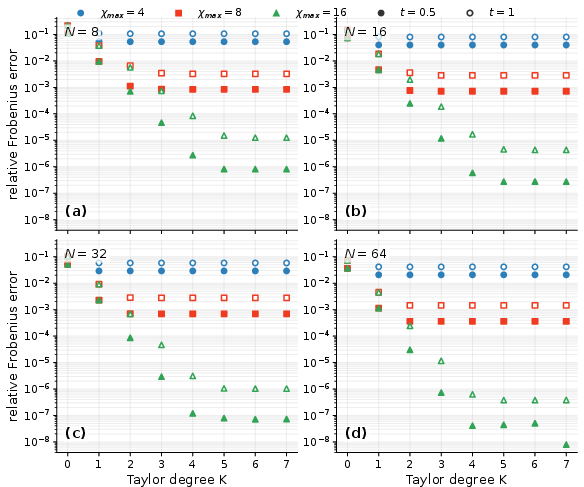
Figure 2: Relative Frobenius error for synthesizing Hamiltonian simulation unitaries as an MPO Taylor expansion, varying system size and bond dimension.
These results indicate that for N=64 and K=7, MPO representations capture ∼1015 Pauli terms in a compressed bond dimension of χ=24. The Frobenius error remains controlled (10−6 to 10−2), and bond dimension scaling is weakly dependent on system size.
Block-Encoding Normalization and Cost Scaling
The technical centerpiece is the analysis of the block-encoding normalization αMPO, which directly governs success probability and amplitude amplification costs in quantum circuits. The cost function for the MPO-transition LCU approach is Capply(Pχ)=αMPO(Pχ)CLCU(Pχ), where e−iHt0 denotes the compressed finite-time propagator MPO. For the tested Heisenberg and perturbed models, e−iHt1 remains bounded by modest constants, even as system size increases.
Strong numerical fits show nearly linear scaling: For e−iHt2, e−iHt3 scales as e−iHt4 (field-perturbed) and e−iHt5 (dimerized), while e−iHt6 incurs slightly higher exponents (e−iHt7, e−iHt8). This contrasts with the explicit Pauli LCU baseline cost, which grows as e−iHt9 for Taylor polynomial order N=640.
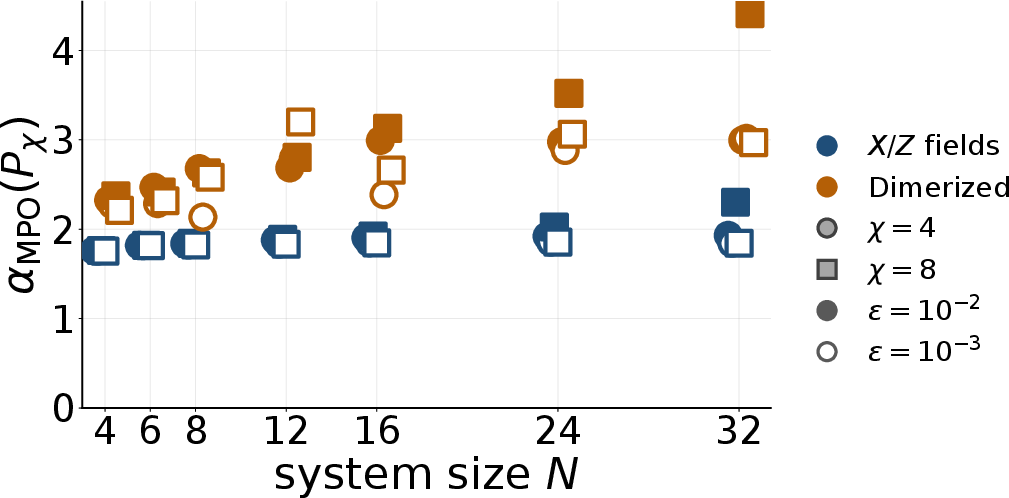
Figure 3: MPO block encoding normalization N=641 for perturbed Heisenberg models as a function of N=642, bond dimension N=643, and truncation error N=644.
This demonstrates that the compiled-polynomial MPO-transition route avoids both the exponential normalization penalty of tensor-dilation block encoding and the exponential combinatorial bottleneck of explicit LCUs.
Implications and Future Directions
Practically, this compiler strategy introduces classical preprocessing—compressing the generator, synthesizing the target propagator as a compressed MPO, then compiling a virtual-path LCU circuit. It enables quantum simulation routines with polynomial resource requirements, provided bond dimension and normalization remain controlled. The approach is not tied to integrable structures; it extends to non-integrable, perturbed models with only mild increases in resource scaling.
Theoretically, the work challenges the standard paradigm of circuit compilation, placing tensor networks as structured intermediate representations for quantum linear algebra. It opens questions regarding block-encoding routes for non-unitary functions, multiproduct formula integration, and synthesis of tensor-programmable circuits for broader classes of quantum algorithms (e.g., dissipative evolution, filters, and projectors).
A comprehensive comparison with qubitization-based methods, where complexity hinges on the block-encoding normalization and polynomial degree in eigenvalue transformation, remains an open avenue. In the MPO-transition LCU route, the dependence on physical time and target precision is channeled through polynomial order, bond dimension, and normalization growth of the compressed propagator. Extensions to applications such as block-encoded open system dynamics, incorporation of noise, and tensor-network-enhanced multiproduct formulas are natural future directions.
Conclusion
The study establishes a formal and practical framework for quantum operator block encoding using classical tensor network compression as a compiler primitive. By interpreting MPOs as virtual-path LCU programs and compiling polynomial transformations within the MPO representation, the proposed method sidesteps exponential resource growth inherent to explicit LCU and tensor-dilation block encoding. Empirical analyses for paradigmatic quantum simulation tasks corroborate both polynomial scaling and modest normalization overheads. The approach is generalizable, offering both an immediate improvement to quantum circuit resource efficiency and a foundational avenue for ongoing exploration in tensor-network-based quantum programming and compilation (2606.19083).

