- The paper demonstrates that quantum and classical latent GAN augmentation yield equivalent performance when using parameter-matched conditions.
- The controlled pipeline, employing VAE encoding and WGAN-GP, exposes mode collapse and off-manifold generation in low-data regimes.
- Future work should explore deeper quantum circuits and pixel-space generation to address limitations in expressivity and sample diversity.
Controlled Benchmarking of Quantum-Latent GAN Augmentation for Brain MRI
Introduction and Motivation
This work presents a systematically controlled comparison of quantum and classical latent generative augmentation pipelines for brain magnetic resonance imaging (MRI) classification. Motivated by the widespread adoption of generative augmentation—especially GAN-based methods—in addressing data scarcity for medical image analysis, the study interrogates whether the reported empirical benefits of quantum generative models persist under strict experimental controls and parameter-matched baselines. The context is augmented by the proliferation of claims of label-efficiency improvements due to quantum components, which are often confounded by inadequate statistical rigor, mismatched parameter budgets, or insufficient characterization of generated sample quality.
Methodology
A three-stage pipeline is deployed. First, MRI images are embedded into a 16-dimensional latent space using a convolutional VAE, regularized with a small KL penalty to ensure posterior coherence. Second, conditional Wasserstein GANs with gradient penalty (WGAN-GP) are trained in this latent space. The generator is either a four-qubit, depth-2 variational quantum circuit, outputting expectation values mapped via a classical head, or a classical stochastic generator of almost identical parameter count (1648 vs. 1632 trainable parameters). This direct parameter matching neutralizes capacity differences.
The synthetic latents are batch-decoded into images and then used, together with the available real data, to train a downstream ResNet-18 classifier with a four-class output, simulating a canonical medical AI workflow. Labeled-data fractions are swept logarithmically from 5% to 100% of the training set. Each experiment uses eight random seeds for classifier training, with paired statistical testing and correction for multiple comparisons.
A methodological pipeline schematic is provided to clarify the tightly controlled data and model flow between quantum and classical conditions.
(Figure 1)
Figure 1: The experimental pipeline, highlighting VAE encoding, parameter-matched quantum/classical WGAN-GP generators, and downstream classifier evaluation.
Experimental Results
Downstream Classification
Evaluation across the full range of labeled data fractions establishes that neither quantum nor classical latent GAN augmentation yields a statistically significant improvement in test accuracy or weighted F1 over training with real images alone. These trends persist after adjustment for multiple hypothesis testing and are robust to both t-tests and Wilcoxon signed-rank statistics. The quantum and classical generators perform equivalently at every fraction.
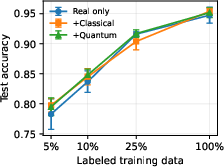
Figure 2: Test accuracy across labeled data fractions; all augmentation regimens overlap in variance, and augmentation confers no significant gain.
The sole marginal case—a near-threshold difference at 25% data fraction between quantum and classical augmentation—does not survive Bonferroni correction and is attributable to the instability of classical GAN training, not a substantive quantum effect.
Generator Diversity and Collapse
Comprehensive analysis of generated sample diversity using intra-set SSIM and per-pixel standard deviation shows severe mode collapse in both quantum and classical generators in the low-data regime (5–10%), with recovery of diversity only as data fraction increases toward 100%. The quantum generator is modestly less diverse than the classical baseline at small fractions.

Figure 3: Decoded synthetic samples at increasing data fractions; both generator types collapse to low-contrast, stereotyped images when data is scarce, with structure emerging only at higher fractions.
Distribution Overlap and Sample Fidelity
Latent-space t-SNE projections of real and synthetic codes show substantial distributional mismatch for both generator types at low data, with overlap only increasing as more real data become available. This precisely explains the observed label-efficiency plateau: synthetic images do not faithfully expand the data manifold when augmentation would be most needed.
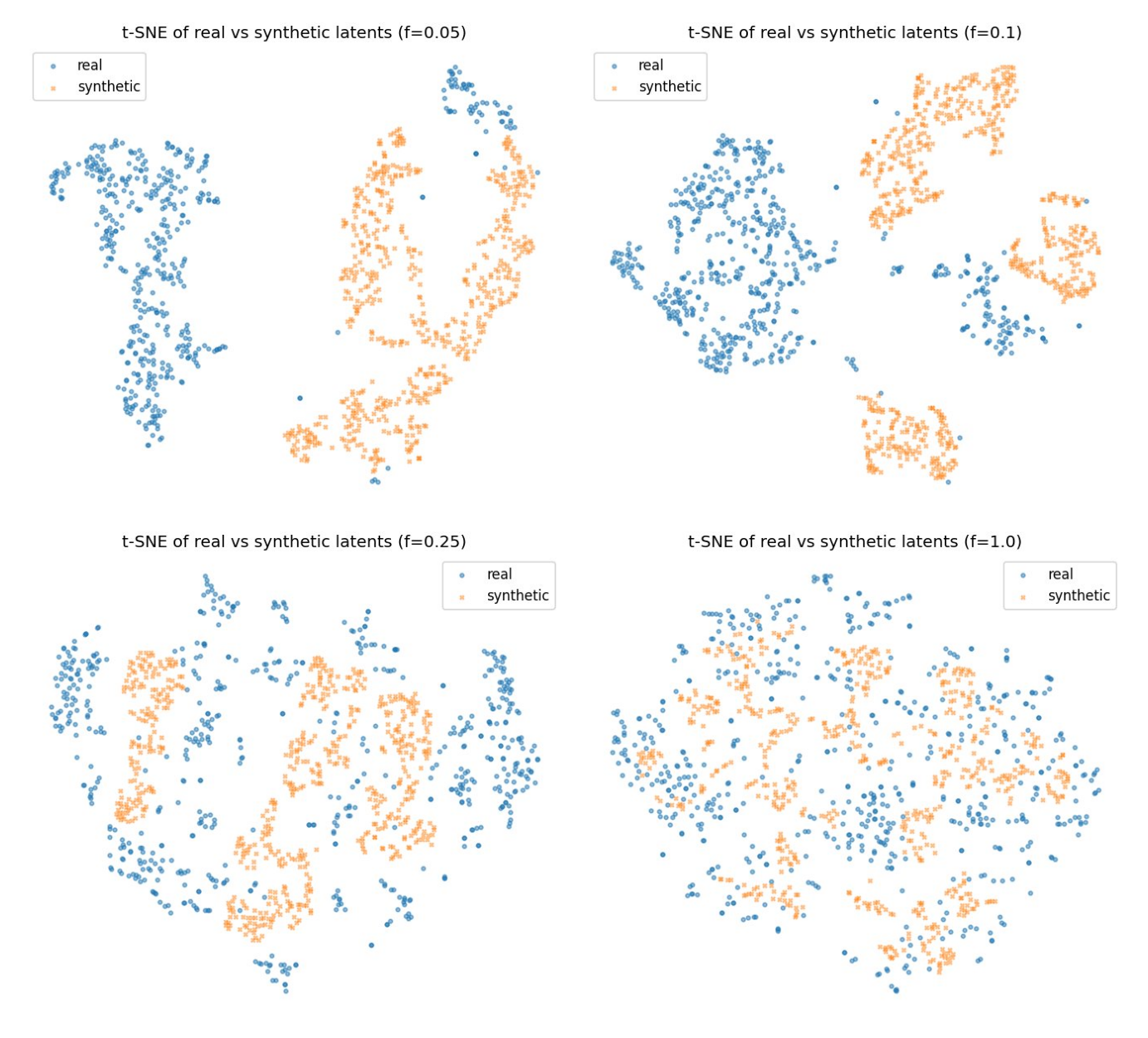
Figure 4: t-SNE projections reveal synthetic latent codes are off-manifold at low training data fractions, with real–synthetic overlap improving with more data.
Stability and Robustness
Secondary experiments varying generator initialization confirm that the core findings are not dependent on a single random seed. Generator initialization has variance lower than or comparable to the classifier-seed variance, further validating the parity outcome.
Discussion
Three salient factors explain why no quantum advantage appears under this protocol:
- Insufficient Model Expressivity: The quantum generator’s four expectation values, post-processed by a classical head, are easily replicated by a classical stochastic generator with a matching output dimension and inductive bias.
- Limited Circuit Depth and Entanglement: With four qubits and two layers, the quantum circuit offers limited expressivity and cannot capitalize on entanglement or non-classical correlations in the context of a low-dimensional latent space.
- Latent-Space Bottleneck: Operating generation in the VAE-learned latent space, rather than pixel space, ameliorates training pathologies but simultaneously removes generator-specific structural priors that might favor quantum circuits.
The study demonstrates that previously reported quantum augmentation benefits are likely artifacts of non-matched baselines, insufficient seeds, or variance in classical generator performance. Crucially, measured improvements are attributable to regularization noise, not the synthesis of novel, on-manifold examples.
Implications and Future Directions
Findings from this work pose critical benchmarks for evaluating quantum generative models for medical data augmentation. They mandate the use of:
- Parameter-matched classical baselines,
- Multiple seeds with statistical correction,
- Data regime sweeps, and
- Direct evaluation of generation diversity and distribution overlap.
Future exploration should involve scaling quantum architectures (more qubits, deeper circuits), deployment on real quantum hardware (to explicitly characterize the effect of quantum noise and decoherence), alternate imaging modalities, and potentially operation in pixel-space where quantum priors could interact more directly with image structure. Comparing quantum circuits to advanced diffusion-based classical models is also warranted.
Conclusion
This controlled benchmark demonstrates that, for brain MRI classification, quantum-latent GAN augmentation offers no measurable advantage over a capacity-matched classical counterpart when evaluated with proper rigor under simulated conditions. Both act, at best, as regularizers in data-limited regimes and produce off-manifold, mode-collapsed samples when augmentation is most needed. Thus, the quantum contribution in this configuration is indistinguishable from classical noise injection.
The provided protocol and codebase are intended to serve as reference standards for future studies assessing quantum generative augmentation on medical datasets. Broader claims about quantum supremacy for generative augmentation will require overcoming the limitations elucidated here and must be substantiated with similar experimental controls (2606.18970).