- The paper introduces TRUST, a framework that integrates target prediction confidence into counterfactual recourse generation.
- It employs Probabilistic Tsetlin Machines and Bayesian Optimization to balance cost, robustness, and confidence in actionable recourse.
- Empirical analyses demonstrate that higher target confidence yields more robust and interpretable counterfactuals on benchmark datasets.
Target-Confidence Counterfactual Recourse with Probabilistic Tsetlin Machines
Traditional counterfactual explanation (CE) methods in algorithmic recourse focus on generating the minimal input modification required to flip a model's prediction—essentially finding x′ such that M(x′)≥0.5 for a binary classifier M [wachter2017counterfactual]. Such boundary-hugging counterfactuals are technically valid yet often fragile: their decisions may reverse under small perturbations, model retraining, or operational noise, rendering them unreliable for high-stakes decision scenarios (e.g., credit, healthcare, hiring) [pawelczyk2022adversarial, upadhyay2021robust, slack2021manipulated]. Real-world policy frequently requires explicit confidence thresholds, making mere label flips insufficient for actionable or regulatory-compliant recourse.
The paper introduces TRUST—a target-confidence recourse framework where users specify desired prediction confidence τ as part of the CE generation process. The optimization becomes:
x′mind(x,x′)s.t.∣M(x′)−τ∣≤ϵ
for norm-based cost functions d and tolerances ϵ>0. This generalizes standard CE (τ=0.5), allowing principled cost-confidence-robustness trade-offs and alignment of recourse to procedural requirements.
Methodological Contributions
Probabilistic Tsetlin Machine Architecture
TRUST implements the CE search using the Probabilistic Tsetlin Machine (PTM) [kuruge2024probabilistic], which extends classical Tsetlin Machines (TM) [granmo2018tsetlin] by introducing stochastic clause evaluation. Decision rules are encoded as probabilistically activated propositional logic (Figure 1):
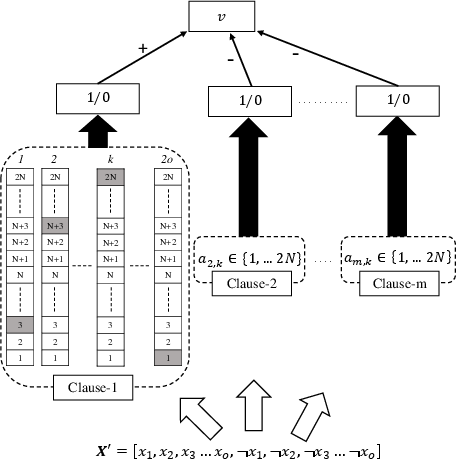
Figure 1: The Tsetlin Machine structure illustrating clause-based learning and aggregation for interpretable prediction.
PTM maintains state probability vectors for each clause literal, allowing uncertainty quantification over activation. This model structure is well suited for CE because it provides not only calibrated prediction probabilities but also clause-level explanations that trace confidence and robustness to specific logical rule activation.
Bayesian Optimization for Counterfactual Search
The CE search is conducted via Bayesian Optimization (BO), which efficiently navigates input space to minimize recourse cost while satisfying the confidence constraint. The acquisition function is tuned for proximity-confidence trade-offs, supporting scenario analysis at multiple τ values. The theoretical convergence (Appendix) guarantees asymptotic optimality under standard regularity assumptions.
Clause-Level Counterfactual Attribution
A key innovation is the mechanistic comparison between counterfactuals at identical target-confidence but differing input cost or robustness, via clause-level attribution. PTM allows tracking the probabilistic firing of underlying logic clauses. If two x′ instances satisfy the same clause, their reliability diverges according to how securely they satisfy the probabilistic boundary—higher confidence and lower fragility are achieved when input modifications place them well within the clause’s literal thresholds. This explanatory layer is absent in black-box models and permits practical selection of recourse solutions.
Experimental Evaluation
Four benchmarks (synthetic 2D/5D, Iris, Haberman Survival) were used for comparative analysis against gradient-based (Wachter) and sampling-based (GrowingSpheres) baselines. Metrics include L1/L2 cost, prediction confidence, robustness (fraction of noisy perturbations retaining validity), and success rate.
PTM+BO at boundary (M(x′)≥0.50) frequently achieves optimal cost but, as with baselines, produces fragile counterfactuals near the decision margin (Figure 2):
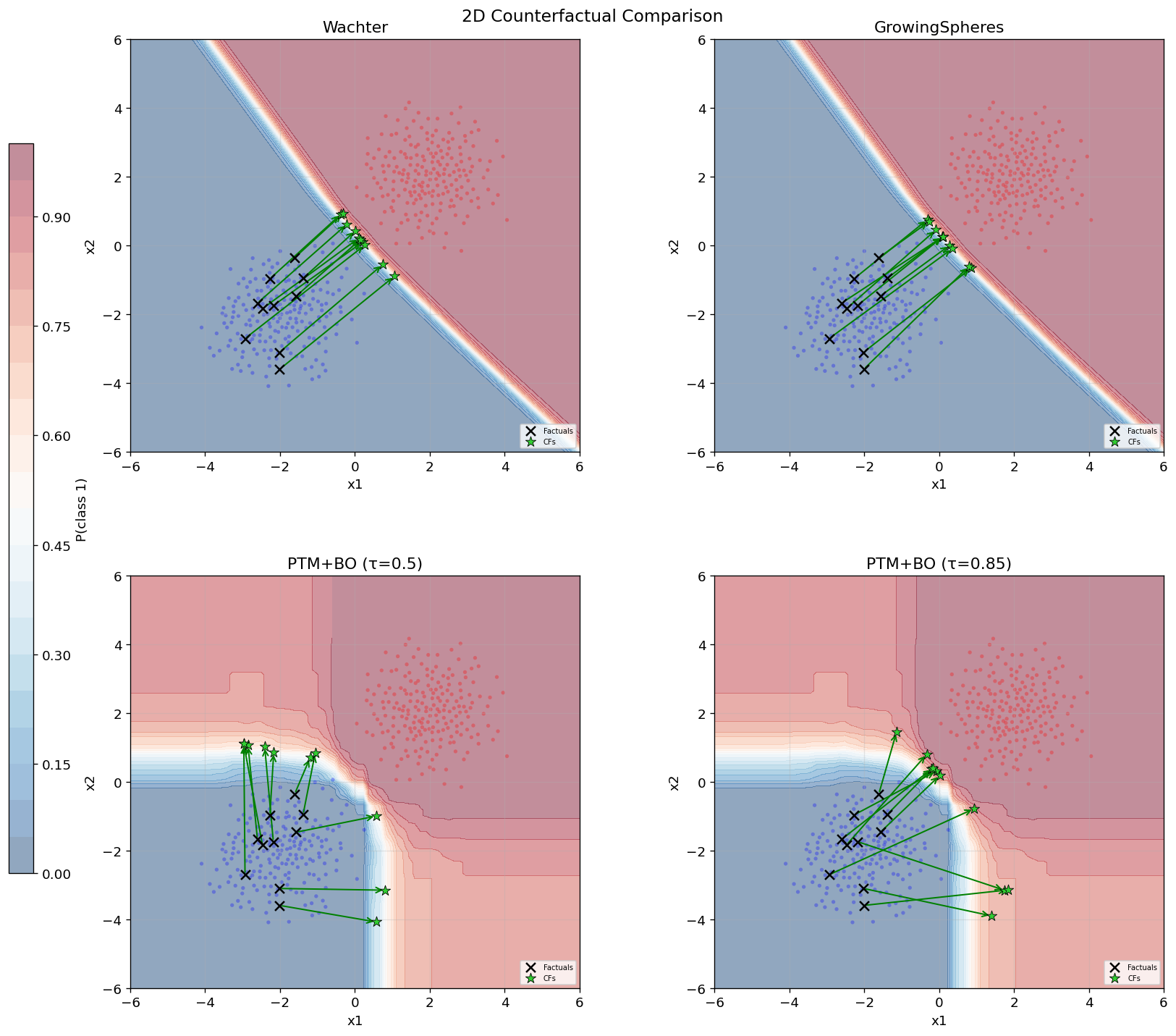
Figure 2: 2D Counterfactual Comparison; boundary-level counterfactuals cluster near the margin, high-confidence counterfactuals move deeper into robust regions.
Increasing M(x′)≥0.51 to 0.85 pushes PTM+BO counterfactuals deeper into the positive region, sacrificing cost for robustness and high confidence. In Haberman, PTM+BO attains L2 distance of 0.10 at 0.92 confidence, with perfect robustness—i.e., all perturbed copies retain outcome validity (Figure 3).
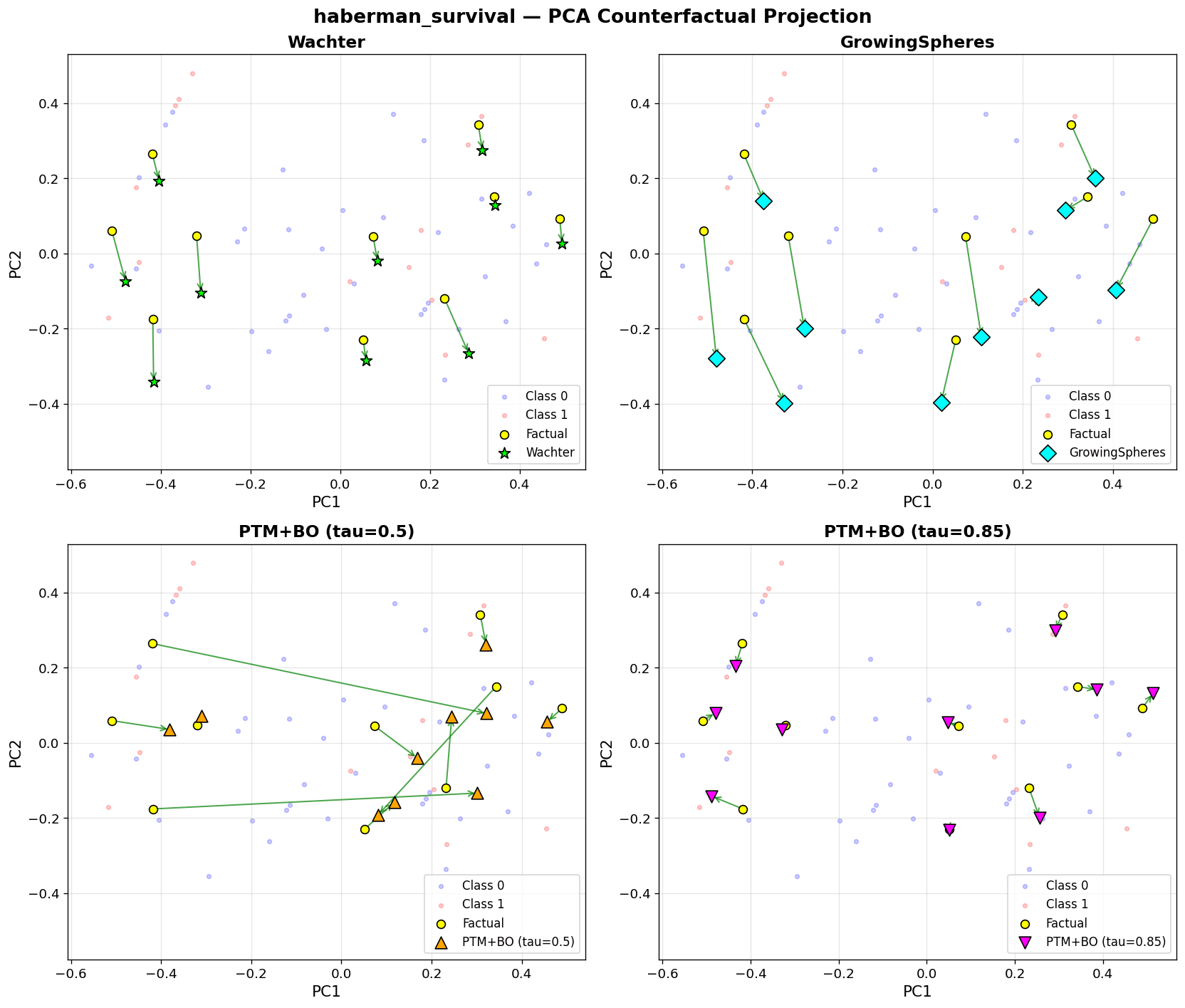
Figure 3: Haberman Survival Dataset PCA Projection — Counterfactuals revealing clustering of high-confidence, robust solutions at minimal displacement.
PTM+BO consistently dominates on robustness and confidence metrics across datasets, enabling explicit user control denied by baseline methods. PCA projections further visualize how higher-confidence counterfactuals are displaced from boundary regions to robust subspaces (Figures 3, 4).
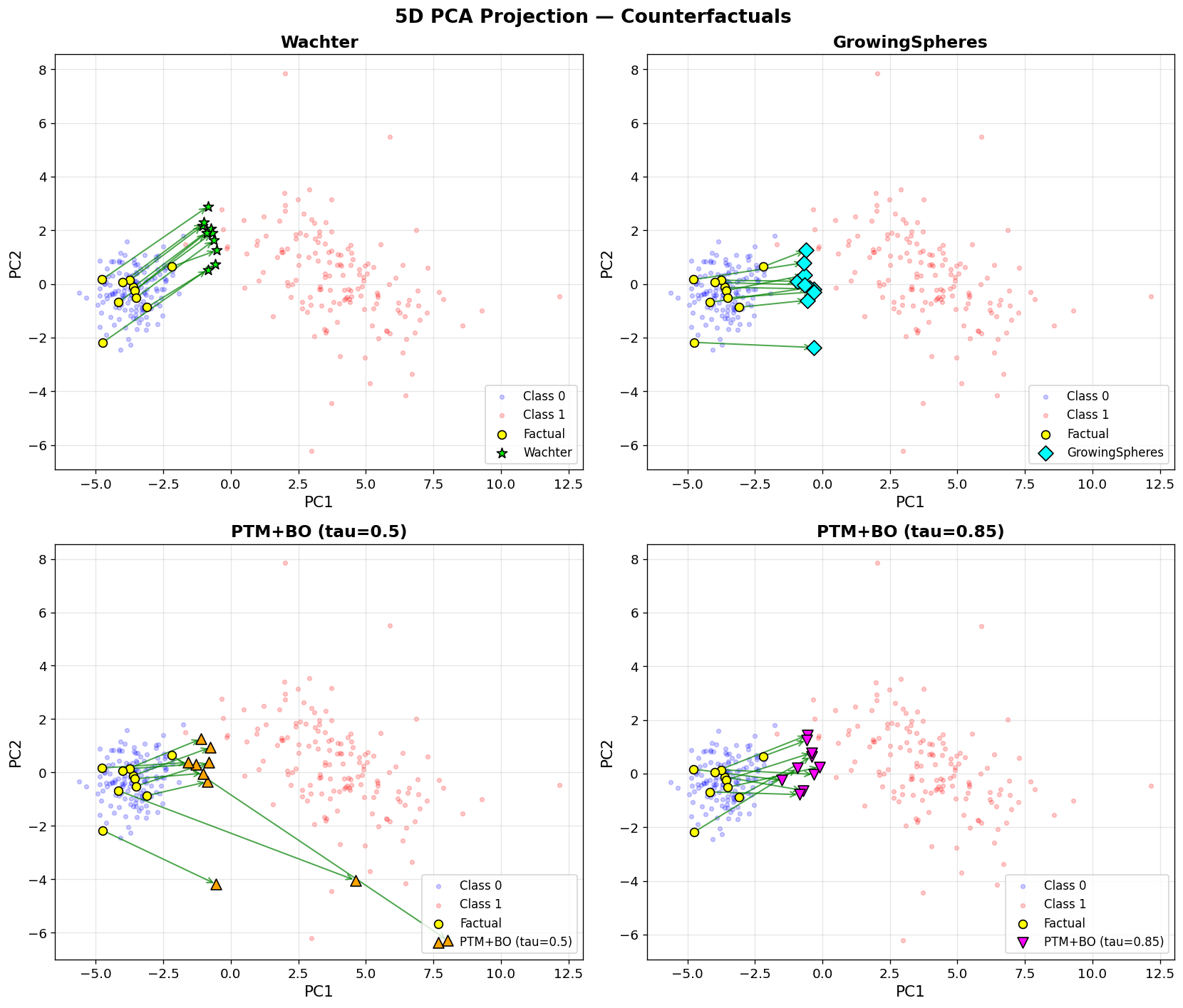
Figure 4: 5D PCA Projection — Counterfactuals show displacement along principal axes according to target-confidence.
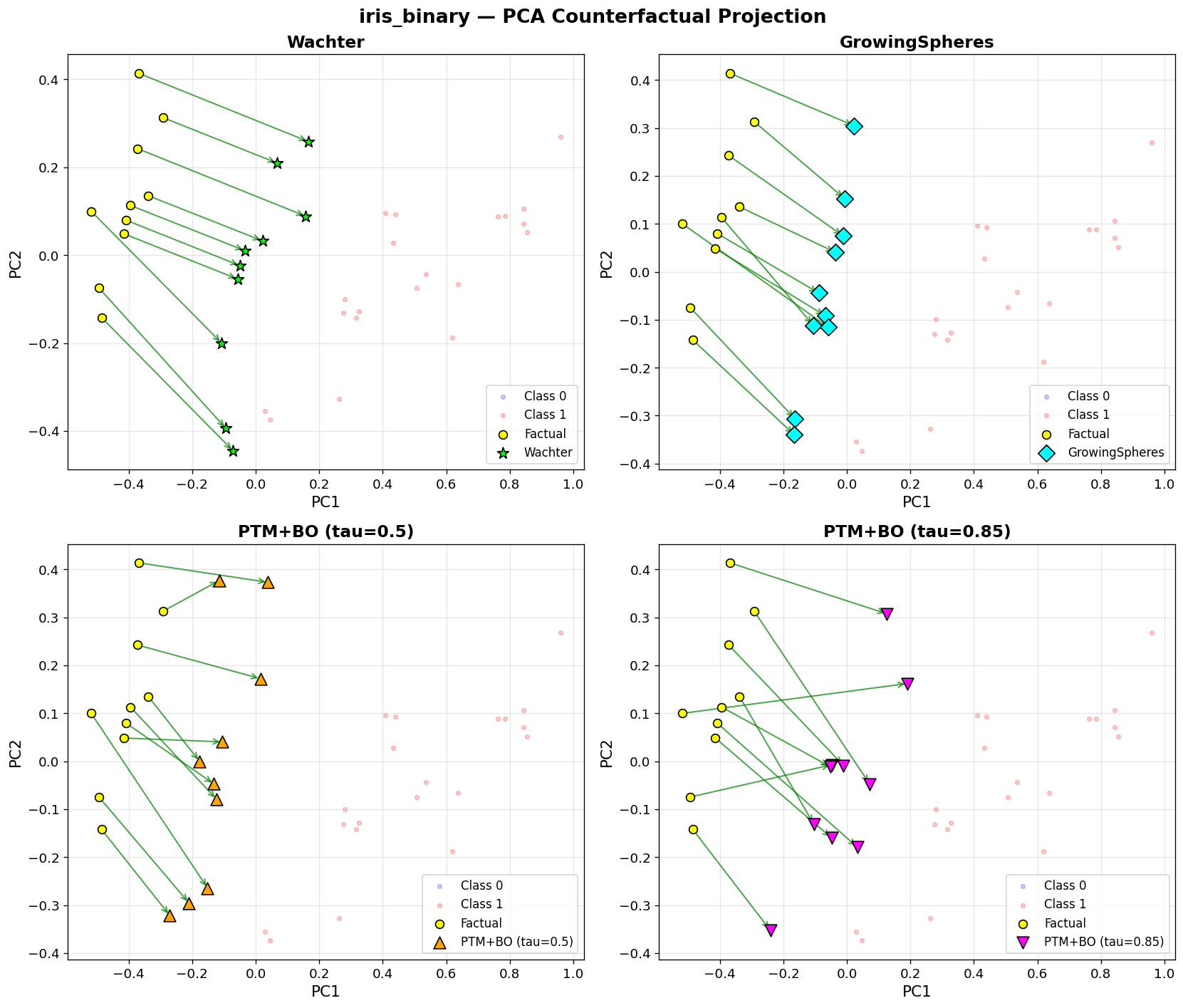
Figure 5: Iris Dataset PCA Projection — Counterfactuals demonstrate proximity vs. robustness via M(x′)≥0.52 control.
Mechanistic Interpretability and Robustness
Clause-level analysis on Haberman demonstrates why higher-confidence counterfactuals (e.g., reducing positive lymph nodes from 4 to 2) yield greater robustness: they remain valid under stricter clause conditions probabilistically activated during inference. Fragility arises when a counterfactual sits near the literal threshold—with non-negligible probability of clause tightening, validity collapses. TRUST’s framework provides explicit quantification of this mechanistic reliability.
Practical and Theoretical Implications
TRUST shifts recourse generation from post-hoc confidence assessment to design-time control, producing more actionable, robust, and transparent recourse. Clause-level attribution is critical for stakeholders needing to justify why certain recourse choices offer stronger guarantees or lower implementation risk (e.g., in regulated settings). The approach is broadly applicable since PTM’s interpretability and robustness can be leveraged in non-differentiable, non-black-box domains.
The main theoretical implication is the generalization of CE optimization and the demonstration that robustness can be achieved systematically by construction rather than as an emergent, post-filtered property. As PTM architectures become more efficient (including hardware acceleration [mao2025dynamic, duan2025ethereal]), TRUST’s deployment will scale to larger, real-time high-stakes applications.
Future developments may incorporate structured causal recourse [karimi2021algorithmic], fine-grained calibration strategies, and broader scenario analysis across confidence spectrums, extending the decision support toolset beyond classical boundary-based CE.
Conclusion
TRUST delivers a formal, interpretable, and robust counterfactual recourse framework by elevating prediction confidence to a first-class optimization constraint. Instantiated with PTM and BO, it generates cost-effective, confidence-aligned, and rule-transparent explanations and recourse actions. Empirical analyses substantiate that robustness and actionable recourse are achieved systematically, with explicit trade-off control. As more recourse frameworks migrate toward confidence-aware objectives and interpretable rule structures, TRUST establishes a rigorous foundation for algorithmic recourse in high-stakes AI settings (2606.18832).