- The paper presents a learned per-query radius selector that adaptively regresses the optimal support radius to enhance UDF estimation.
- It integrates a masked ResNet-PointNet encoder and an MLP regressor to predict continuous radii based on local patch features.
- Experimental results on ScanNet and other datasets demonstrate improved boundary preservation and enhanced F1 scores over curvature-based methods.
Learned Radius Estimation for UDF-Based Point Cloud Reconstruction: Technical Summary
Motivation and Background
Robust surface reconstruction from consumer-grade point cloud data is a fundamental requirement for applications in AR/VR, indoor mapping, and robotics. Unsigned Distance Fields (UDFs) have emerged as a practical implicit representation, as they circumvent inside/outside classification constraints and enable reconstruction of both closed and open surfaces with general applicability. The LoSF-UDF architecture estimates UDF values from local point patches; its lightweight design supports scalability and generalization across diverse shapes. However, the accuracy of local UDF estimators is heavily contingent on the selection of support radius. Existing curvature-based heuristics such as GeoLA fail to address the inherent heterogeneity in local patch geometry, impacting fine-grained reconstruction fidelity.
Framework Overview
The proposed framework introduces a learned per-query radius selector as a plug-in to the LoSF-UDF backbone. For each query point, the method extracts a parent patch with a fixed radius R and employs the selector to regress an adaptive support radius r^ based on local patch features. This radius is used to determine the subset of input points for UDF estimation, effectively enabling spatially adaptive context aggregation without retraining the backbone model.
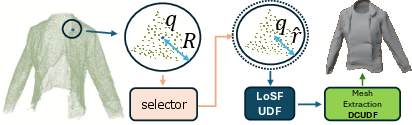
Figure 1: Parent patch extraction, learned selector, adaptive radius prediction, and UDF computation are visually summarized for each query point.
Offline, the selector is trained with target radii generated via local parabolic interpolation of UDF error curves across a set of candidate radii. This approach yields off-grid supervision, providing continuous regression targets rather than discrete labels and enhancing training signal fidelity. The selector architecture comprises a masked ResNet-PointNet encoder augmented with radial density histograms and cardinality features, followed by an MLP regressor.
Methodology
Target Radius Derivation
For each patch, UDF errors are computed across candidate radii. The target radius is determined by fitting a parabola around the minimal error triplet and extracting the vertex, yielding a continuous radius r∗ that minimizes local estimation error. Confidence-weighted loss is applied during selector training, assigning greater penalty on points where UDF estimation is highly sensitive to radius selection.
Selector Design and Integration
Patch features are encoded and concatenated with density and count statistics. The selector outputs a normalized radius ratio, which maps to the final adaptive radius. This regression is performed for every query, and the output patch feeds into the frozen LoSF-UDF module. Mesh extraction is performed using the DCUDF algorithm, which is robust to UDF extraction artifacts.
Experimental Evaluation
Quantitative evaluation is performed on ScanNet (real indoor scans), ShapeNet-Cars, and DeepFashion3D (CAD and garment meshes). The learned selector is trained exclusively on synthetic shapes, providing a stringent test of generalization.
Strict-distance metrics such as Chamfer Distance (CD) and [email protected] are reported alongside Normal Consistency (NC) and [email protected]. The learned selector achieves superior performance on CD and [email protected] across all datasets: for ScanNet, [email protected] improves from 0.645 (GeoLA) to 0.691, and CD drops from 0.795 (GeoLA) to 0.692. This validates the efficacy of adaptive, learned radius selection over scalar curvature heuristics. While NC and [email protected] remain marginally superior for the fixed-radius baseline on ScanNet, the selector maintains comparable scores and substantial improvements on boundary preservation and local detail.
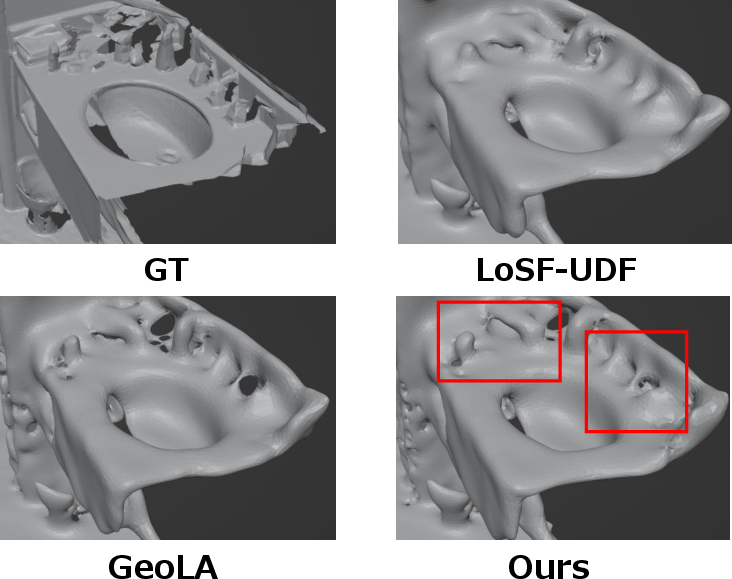
Figure 2: Qualitative reconstructions on ScanNet demonstrate improved boundary preservation and local structure retention by the learned radius selector, especially in regions with non-uniform sampling.
Qualitative results display enhanced recovery of fine details and accurate surface delineation, particularly at occlusion edges and wall-floor boundaries—regions where curvature-based methods produce oversmoothing or artifacts. The selector’s density-aware feature embedding enables robust adaptation, even in cross-domain scenarios.
Implications and Future Directions
The proposed method advances local UDF estimation by enabling data-driven, per-query support radius prediction. The pipeline remains compact at 4.7 MB, with zero backbone retraining and plug-and-play integration potential for consumer applications. The approach demonstrates strong cross-domain generalization, confirming the transferability of local patch features across synthetic and real-world datasets.
Practically, this technique is poised to improve fine-scale geometry acquisition from low-cost capturing devices, particularly where sampling density is highly variable. Theoretically, it establishes the value of patch-level feature embedding for hyperparameter adaptation in implicit surface modeling. Future research will likely extend robustness to noise, incomplete data, and dynamic scene capture, exploring temporal adaptation and multimodal integration.
Conclusion
A learned per-query radius selector for UDF-based point cloud reconstruction has been presented, trained with interpolated targets derived from localized error curve analysis. The method significantly outperforms data-independent and curvature-based approaches in fine-detail accuracy and strict-distance metrics, generalizing from synthetic to real-world scans without compromising pipeline simplicity. Future extensions targeting robustness and temporal adaptation will further consolidate its utility in practical 3D acquisition systems.

