Memory-assisted advantage for state transfer in disordered quantum many-body scar system
Published 17 Jun 2026 in quant-ph | (2606.18720v1)
Abstract: We analyze how memory in disorder facilitates quantum communication in many-body scar systems. We consider three distinct types of disorder, viz., memoryful, and memoryless uniform and Gaussian, and compare their respective performances in facilitating quantum state transfer. Using the maximum transfer fidelity and fidelity area as figures of merit, we find that memoryful disorder yields a better performance than the memoryless disordered channels. Furthermore, the maximum transfer fidelity exhibits an initial parabolic decay with disorder strength, followed by a linear decrease, for all the disorder models considered. We introduce a degree of scarness, and show that it is higher for memoryful disorder in comparison to memoryless disorders, implying a role of scarness in the quantum state transfer protocol. We further perform a scaling analysis, revealing that memory effect in disorder is not only beneficial for short-distance but also long-distance quantum state transfer. Finally, we show that the state yielding the maximum transfer fidelity has larger inverse participation ratio for memoryful disorder in comparison to the other two disorders, highlighting the role of nonergodicity in enhancing state transfer.
The paper demonstrates that incorporating time-dependent (memoryful) disorder significantly improves quantum state transfer performance, as evidenced by enhanced maximum fidelity and larger fidelity area compared to static models.
The study employs analytical techniques and high-resolution numerical simulations, including Chebyshev-polynomial propagation, to assess fidelity decay and scarness scaling across various system sizes.
Memoryful disorder preserves nonergodic dynamics and localization features, establishing a robust framework for scalable quantum communication protocols in realistic, disordered environments.
Memory-Assisted Quantum State Transfer in Disordered Many-Body Scar Systems
Introduction
The analysis focuses on the influence of disorder with memory on quantum state transfer (QST) protocols within many-body scar systems. Quantum many-body scars, characterized by the violation of the eigenstate thermalization hypothesis (ETH) and weak ergodicity breaking, have emerged as a mechanism for high-fidelity QST even in regimes typically dominated by chaotic dynamics. The work introduces a disordered extension of the one-dimensional scar Hamiltonian, systematically exploring uniform, Gaussian (memoryless), and time-dependent Gaussian (memoryful) disorder models. The quantitative assessment of QST performance relies on maximum transfer fidelity and fidelity area. The core contribution is the demonstration that memoryful disorder consistently enhances QST quality relative to conventional disorder models, elucidated through analytical and numerical evaluation.
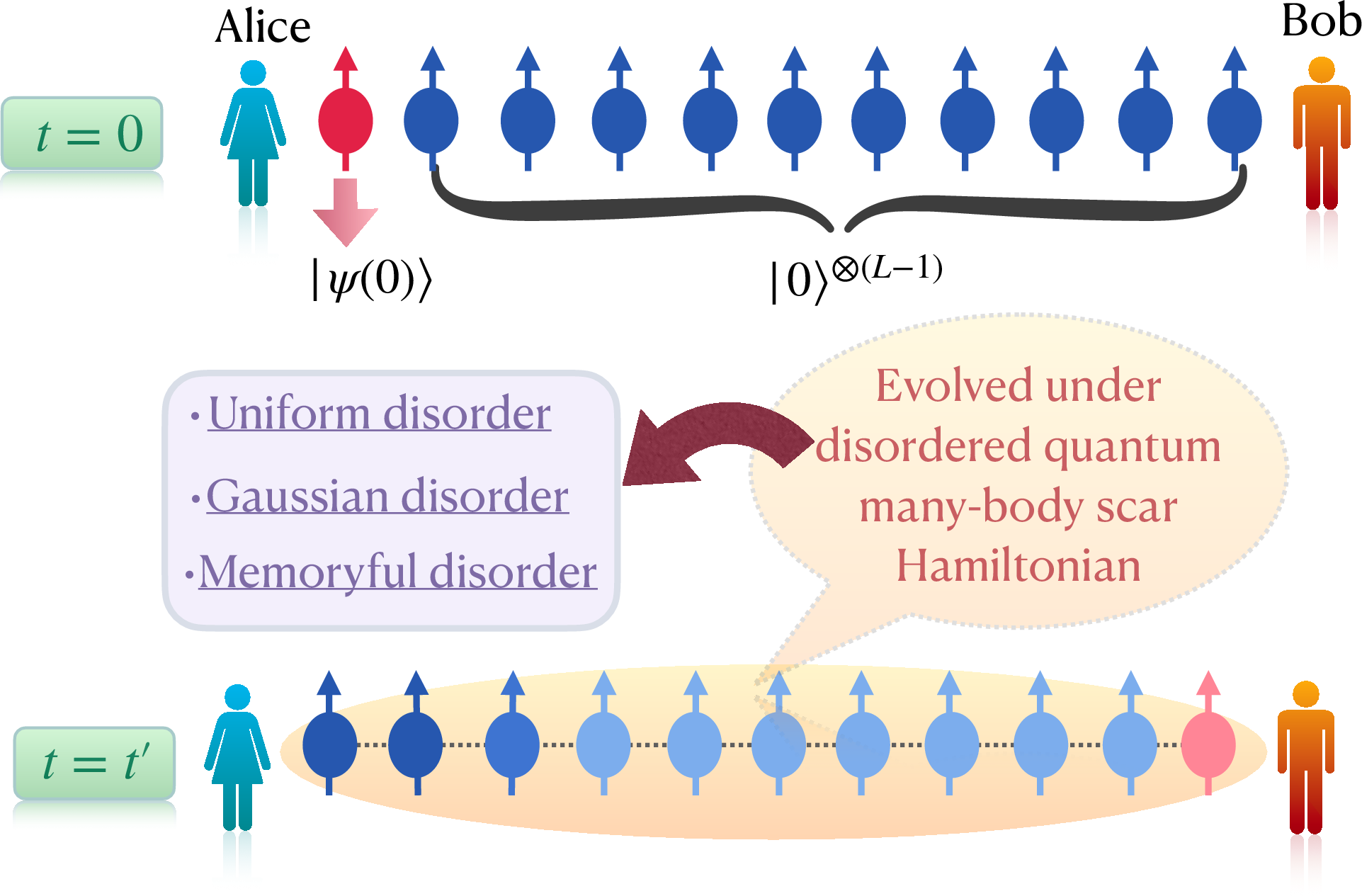
Figure 1: Schematic depiction of QST through a disordered many-body scar Hamiltonian. Alice transmits ∣ψ(0)⟩ to Bob via Hamiltonian evolution. The chain comprises L sites with initial configuration ∣0⟩⊗(L−1).
Disorder Models and Hamiltonian Structure
The Hamiltonian of the scar system employs site-dependent nearest-neighbor couplings and three-body projective constraints, with disorder introduced into the projectors. Three disorder distributions are considered: static uniform, static Gaussian, and time-dependent Gaussian (originating from elephant quantum walk statistics), the latter introducing non-Markovian temporal memory into disorder sampling.
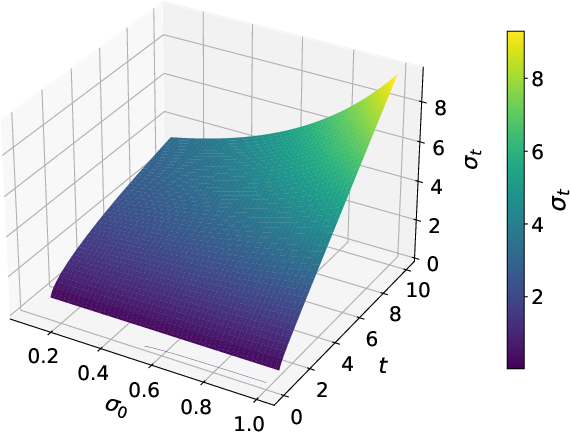
The time-dependent Gaussian disorder is implemented as:
This construction enables continuous disorder memory and diffusion, contrasting memoryless static models.
Figure 2: σt evolution with respect to t and σ0, showing memoryful disorder dispersion dynamics.
State Transfer Performance Metrics
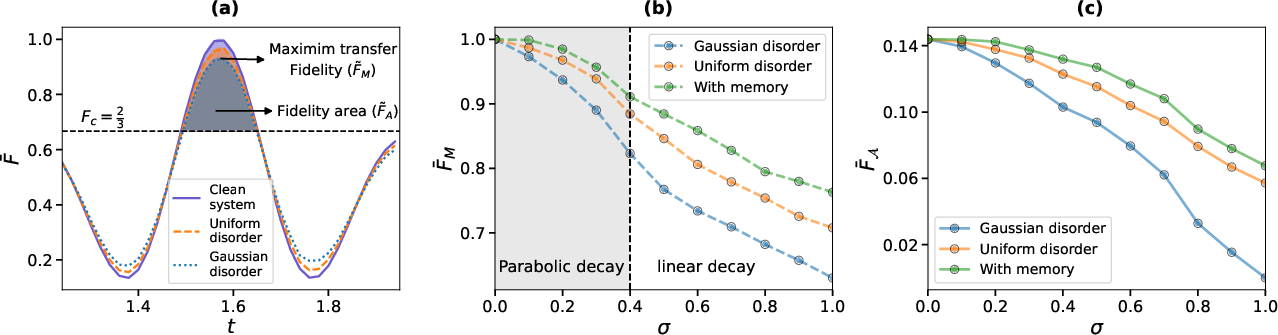
Two principal metrics are utilized: maximum fidelity (FˉM) and fidelity area (FˉA), denoting the temporal maxima and integrated regions above the classical threshold (Fc=2/3), respectively. The transfer protocol, while perfect in clean systems, degrades with disorder; however, temporal correlations in the disorder (memory effect) mitigate this deterioration.
Figure 3: Maximum fidelity and fidelity area profiles for various disorder strengths and models. Panels illustrate temporal fidelity behavior, L0 decay characteristics, and L1 dependence.
High-resolution numerical simulations (Chebyshev-polynomial propagation, averaging over disorder and initial conditions) reveal that memoryful disorder preserves higher transfer fidelity and larger fidelity areas across the disorder range. A parabolic-to-linear transition in the decay of L2 and L3 occurs universally around L4.
Quantifying Scarness
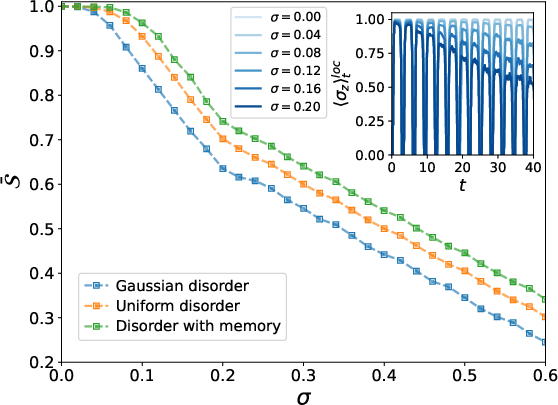
Scarness, reflecting the prevalence of periodic local observable revivals, is quantified via the degree of scarness L5. The observable L6 serves as the probe.
Figure 4: Degree of scarness vs. disorder strength for different disorder models, with inset showing dynamical local observable revivals.
Memoryful disorder consistently supports higher scarness, correlating directly with improved QST performance. The degradation of scarness with disorder mirrors fidelity decay, reinforcing the assertion that scars facilitate nonthermal dynamics advantageous for QST.
Finite-Size Scaling
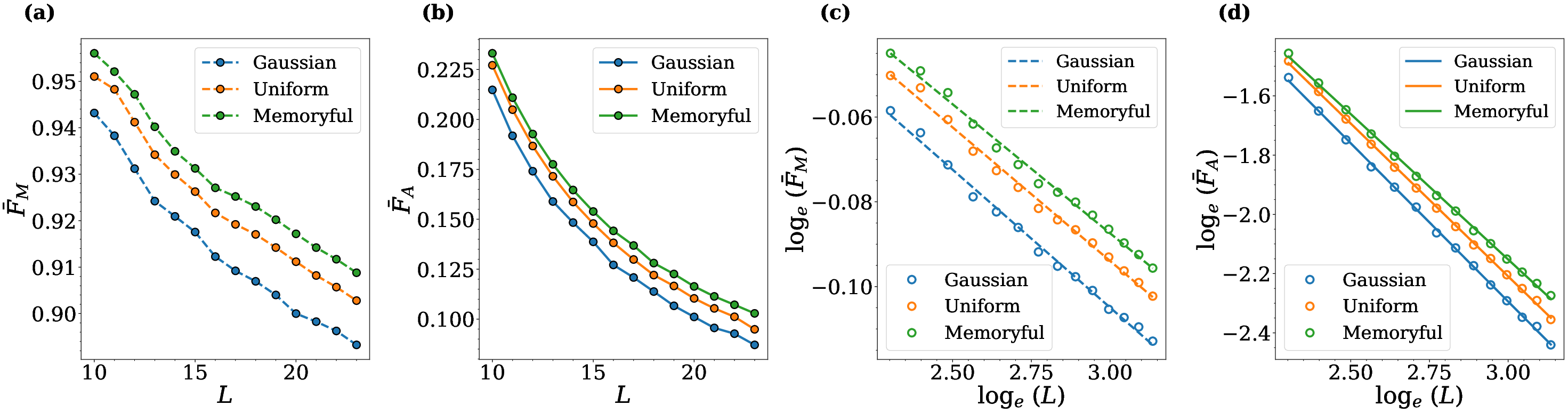
Scaling analysis across chain lengths (L7 to L8) for both metrics confirms L9-∣0⟩⊗(L−1)0 dependence:
∣0⟩⊗(L−1)1
where ∣0⟩⊗(L−1)2 represents ∣0⟩⊗(L−1)3 or ∣0⟩⊗(L−1)4, and ∣0⟩⊗(L−1)5 denotes ∣0⟩⊗(L−1)6. Memoryful disorder exhibits the slowest decay rate, indicating sustained QST efficacy at large distances.
Figure 5: ∣0⟩⊗(L−1)7 and ∣0⟩⊗(L−1)8 scaling with system size and fitted ∣0⟩⊗(L−1)9-P(δ,t)=2πσt21exp[−2σt2(δ−δˉ)2],σt=σ02+2tDs(t),Ds(t)=4a−2t2a−1−10 curves, highlighting memoryful disorder's superior scaling.
Ergodicity and Inverse Participation Ratio
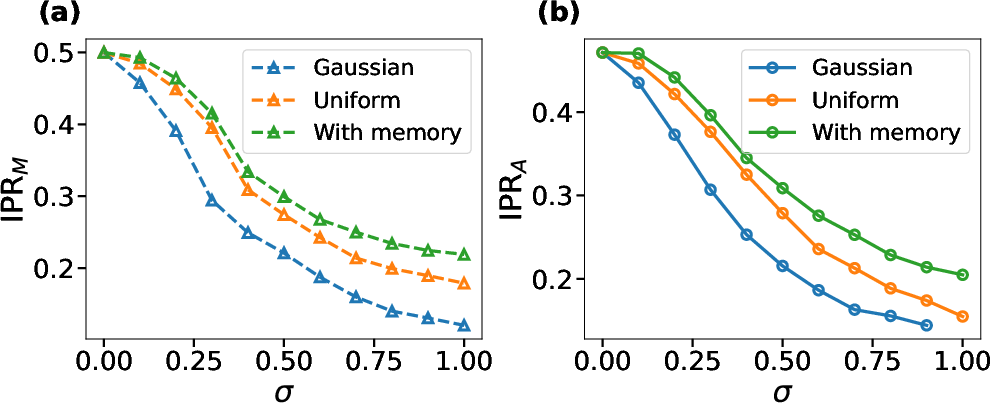
The inverse participation ratio (IPR) serves as a measure of localization vs. ergodicity, bridging the connection to scar-mediated QST.
Figure 6: IPR (P(δ,t)=2πσt21exp[−2σt2(δ−δˉ)2],σt=σ02+2tDs(t),Ds(t)=4a−2t2a−1−11, maximal fidelity state; P(δ,t)=2πσt21exp[−2σt2(δ−δˉ)2],σt=σ02+2tDs(t),Ds(t)=4a−2t2a−1−12, states above classical threshold) as a function of disorder strength for all disorder types.
Memoryful disorder yields higher P(δ,t)=2πσt21exp[−2σt2(δ−δˉ)2],σt=σ02+2tDs(t),Ds(t)=4a−2t2a−1−13 and P(δ,t)=2πσt21exp[−2σt2(δ−δˉ)2],σt=σ02+2tDs(t),Ds(t)=4a−2t2a−1−14 values across the disorder spectrum, confirming that localization and nonergodic characteristics are preserved, thus favoring effective QST. As disorder strength increases, thermalization enhances and IPR values diminish, negatively impacting transfer performance.
Practical and Theoretical Implications
These findings firmly establish the operational advantage conferred by memoryful disorder in quantum communication protocols utilizing many-body scars. By extending perfect and high-fidelity state transfer from idealized to realistic, disordered environments, this research lays groundwork for scalable quantum communication in noisy or dynamically complex architectures. The direct link between disorder memory, scarness, and ergodicity implies rich future directions—including optimization of non-Markovian disorder patterns and exploitation of scar states for metrology, battery performance, and quantum simulation. As experimental access to scarred regimes expands, disorder engineering will become a pivotal tool for robust quantum information transfer.
Conclusion
The study decisively characterizes the enhancement of quantum state transfer protocols in scarred many-body systems when disorder exhibits temporal memory. Both maximum fidelity and fidelity area exhibit superior robustness under memoryful disorder, and scaling analyses confirm the persistence of these advantages at larger system sizes. The degree of scarness and inverse participation ratio serve as effective diagnostic tools linking nonergodic dynamics to high-fidelity state transfer. Practical implications extend to architectures where disorder control is feasible, and theoretical avenues open for advanced disorder engineering and further exploration of quantum scars in communication and computation platforms.