- The paper presents a novel Physics-Informed Hybrid Photonic Quantum Neural Network that overcomes spectral bias in PDE learning using trainable photonic measurements.
- It integrates classical coordinate encoders with photonic phase encoders and multi-photon interferometric circuits to capture phase, frequency, and derivative information efficiently.
- The approach achieves up to 12x error reduction in phase-complex regimes with only 25% of the parameters compared to classical baselines, demonstrating enhanced robustness and parameter efficiency.
Introduction
This paper introduces the Physics-Informed Hybrid Photonic Quantum Neural Network (PI-HPQNN), a novel architecture utilizing photonic quantum measurement as a trainable representation for scientific machine learning tasks governed by PDEs. Unlike prior photonic and quantum approaches which serve as fixed feature maps or hardware accelerators, PI-HPQNN integrates the photonic circuit directly into the function space being optimized by physics-informed losses. The architecture jointly trains classical coordinate encoders, photonic phase encoders, multi-photon interferometric circuits, and classical decoders, leveraging the unique ability of photonic quantum systems to represent phase, frequency, and derivatives through measurement-defined nonlinear spectral moments. The primary motivation is to address the spectral bias limitations of classical PINNs when solving oscillatory, multiscale, or phase-sensitive equations, where phase mismatch leads to severe residual amplification in PDE learning.
Architecture and Methodology
PI-HPQNN replaces conventional neural field representations with a photonic quantum circuit that processes coordinates through optical phase encoding, multi-mode Fock-space interference, and photon-number measurement. The architecture comprises:
- Classical coordinate lifting: Physical coordinates are lifted into high-dimensional representations.
- Trainable phase encoding: Coordinate representations are mapped to optical phase variables.
- Photonic interferometric processing: Multi-photon interference is executed using MerLin-based photonic circuits (composed of single-mode rotations, coupling layers, and repeated phase reuploading).
- Fock-space measurement: Circuit outputs are read as photon-number probabilities, constituting the feature vector.
- Classical decoding: Measured probabilities are decoded into the PDE field, closing the loop for residual minimization.
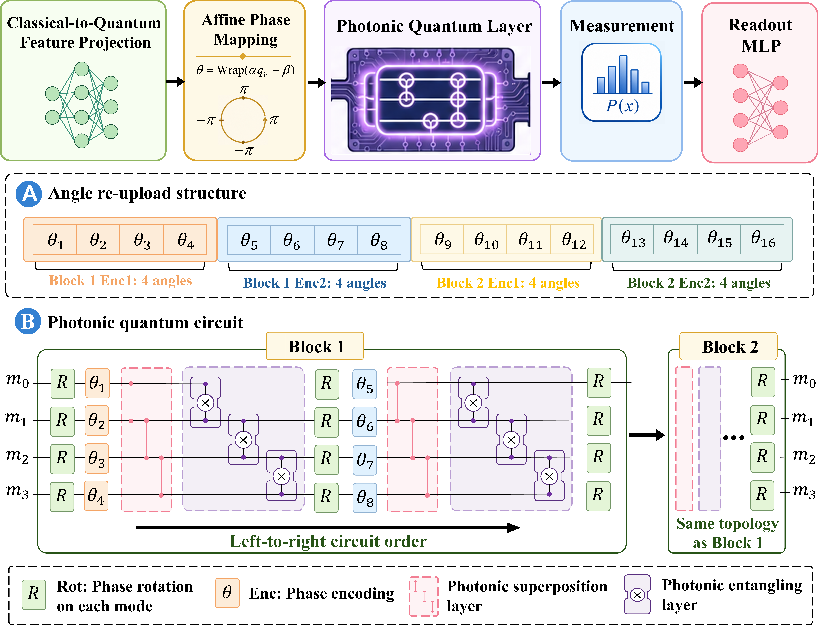
Figure 1: Physics-informed photonic quantum neural field, illustrating physical coordinate mapping to optical phase variables, multi-mode interference, and Fock-probability measurement for PDE solution decoding.
The entire composition is differentiable, ensuring all trainable parameters (including circuit and measurement choices) are optimized by the same physics-informed residual, boundary, and data loss terms as classical PINN baselines.
Numerical and Benchmark Analysis
Benchmarks are designed as phase-complexity ladders across multiple PDE types (elliptic, wave, dispersive, and nonlinear), progressively increasing oscillatory content and residual sensitivity to phase mismatch. Results reveal a consistent ordering inversion:
- Classical networks suffice in smooth regimes: At low phase complexity, coordinate and Fourier-feature networks achieve L2 errors below 10−3, outperforming PI-HPQNN.
- Photonic representation dominates in phase-complex regimes: As phase complexity increases (wavenumber λ, phase rate b, forcing k), PI-HPQNN achieves lower errors—by up to 12x—than classical baselines, using only ~25% of their trainable parameters.
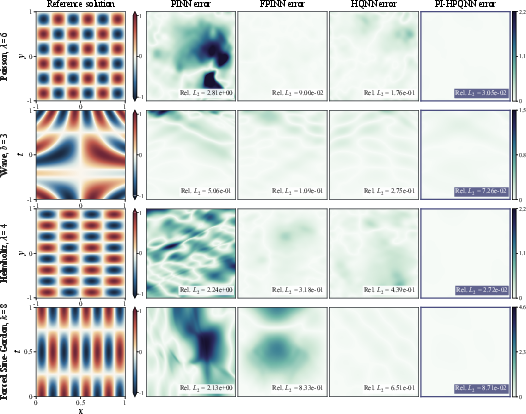
Figure 2: Error-field comparison for Poisson, wave, Helmholtz, and Sine–Gordon benchmarks, revealing geometry and suppression of coherent phase-aligned error patterns by PI-HPQNN.
The benefit is not uniform but selectively emergent when residual derivatives amplify phase mismatch, identifying a practical guideline: employ photonic spectral generators for derivative-amplified, phase-complex regimes; otherwise, classical baselines suffice.
Parameter Efficiency and Training Profile
Notably, PI-HPQNN achieves its accuracy gains without increasing parameter scale—trainable dimension is reduced relative to classical alternatives. This supports the thesis that photonic quantum measurement alters the representation, not simply the model size or expressivity.
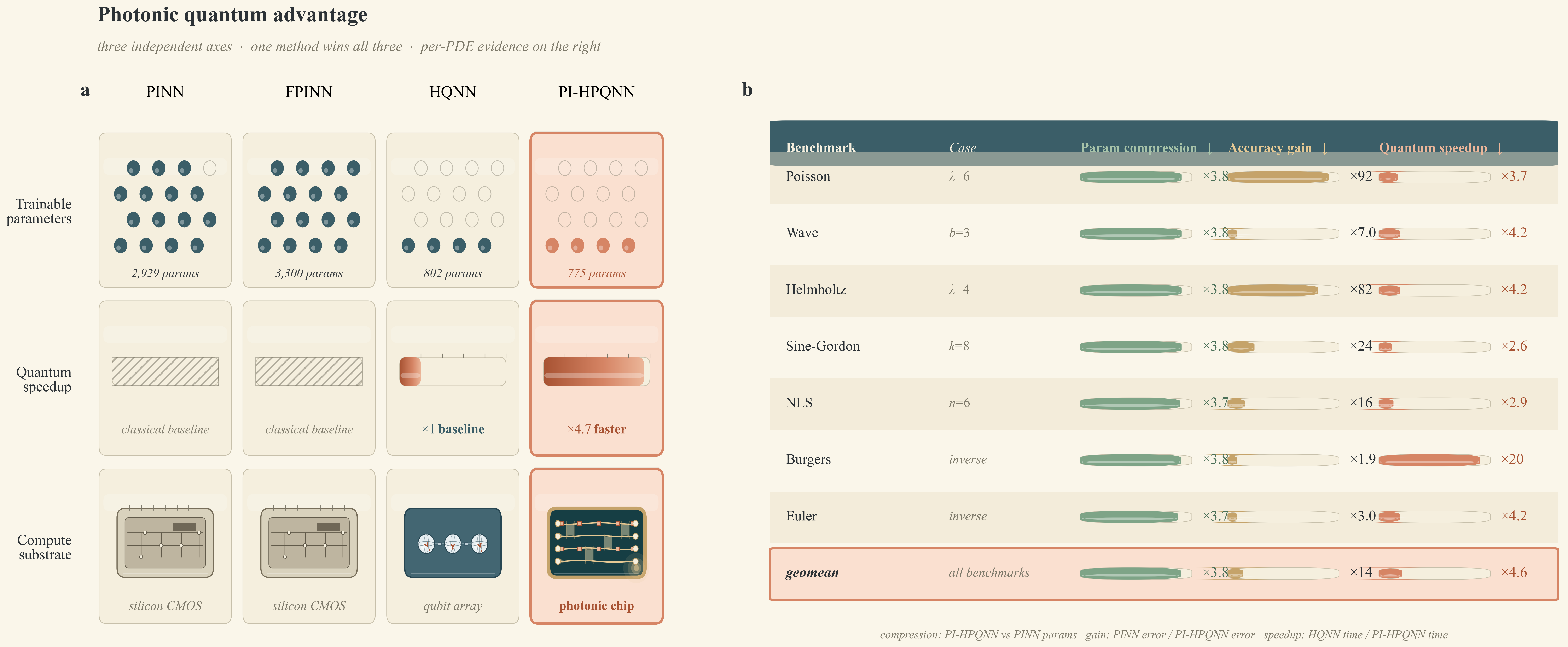
Figure 3: PI-HPQNN's compact parameter budget and classical simulation training profile across diverse PDE benchmarks.
Spectral Mechanism and Physical Measurement Features
The learned representation consists of structured photon-number probabilities corresponding to frequency-difference moments created by multi-photon interference. For highly complex benchmarks (e.g., nonlinear Schrödinger equation), these measured features align closely with the dominant PDE mode directions—no spectral labels are supplied during training; alignment arises from residual-based optimization.
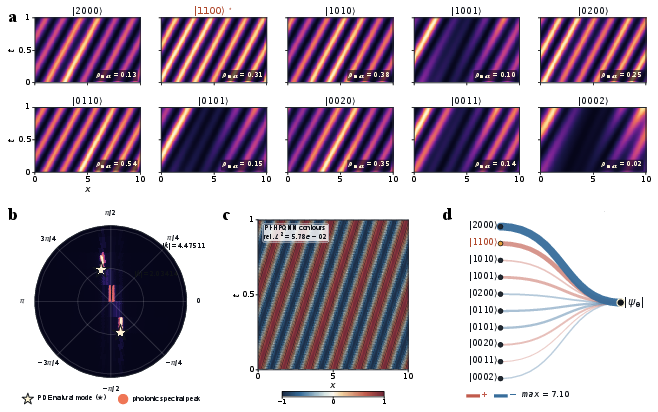
Figure 4: Fock-space interference atlas for high-complexity NLS, showing measured photon-number probabilities, spectral fingerprints, field reconstruction, and channel sensitivity in PI-HPQNN.
Frozen and shuffled circuit controls reveal a marked performance drop, confirming that parameter efficiency and phase-aligned spectral moments depend on learned photonic interference, refuting the hypothesis of performance gain from random feature access alone.
Robustness, Inverse Problems, and Practical Implications
Under compound perturbations (transmission, indistinguishability, finite-shot sampling), PI-HPQNN's measured Fock probabilities exhibit superior stability compared to qubit-based HQNNs. In inverse benchmarks (Burgers and Euler with sparse/noisy constraints), PI-HPQNN yields substantially better parameter recovery (e.g., viscosity and coupling coefficient) even when classical baselines deliver lower field errors, exposing the practical advantage for latent parameter identification.
Theoretical Implications and Outlook
PI-HPQNN is positioned distinctively relative to other physical computing substrates. Its computational primitive is trainable multi-photon interference and measurement, rather than fixed Fourier transform, matrix multiplication, or untrained nonlinear reservoir. The representation is a measured spectral function space with a mathematically characterized feature span: Fock-space moments form frequency-difference trigonometric features whose bandwidth and structure are controlled by photon number, circuit connectivity, measurement map, and data reuploading depth. The approximation theorem links circuit depth and photon number to the ambient spectral coverage and supports adaptive phase encoding for PDE residual optimization.
Limitations include current reliance on differentiable classical simulation, absence of native hardware training/data, and an intrinsic quasi-Fourier representation; smooth low-frequency problems are already efficiently addressed by classical coordinate networks.
Future directions include:
- Native photonic hardware benchmarking (addressing sampling, drift, multi-photon statistics, loss, and detection efficiency)
- Mathematical linkage between circuit design and target PDE Sobolev tails/convergence rates
- Integration with neural operator frameworks leveraging discretization-invariant trainable measurement spaces
Conclusion
This work demonstrates that photonic quantum measurement can serve as a trainable representation-learning principle in scientific machine learning for phase-sensitive PDEs. The evidence shows selective superiority in phase-complex regimes, compact parameterization, interpretable spectral structure, and robustness against compound noise. Practical implications span efficient PDE learning, improved parameter recovery in inverse problems, and the establishment of design rules linking photonic circuit topology to residual amplification, with theoretical implications for adaptive spectral approximation and measurement-driven machine learning representations. Future developments will pivot toward native photonic hardware, broader benchmarks, and mathematically precise characterization of spectral trial spaces, underscoring the role of trainable measurement processes in physical and scientific ML (2606.18713).

