- The paper demonstrates that statistical complexity diagnostics, such as Porter-Thomas statistics and IPR, can approach random-state benchmarks without inducing gradient vanishing.
- It establishes that locally generated circuit complexity from structured ansatzes decouples expressivity from trainability, ensuring effective VQE optimizations.
- Empirical results on cluster-Ising and generalized toric code models confirm that finite-depth circuits preserve optimization signals despite complex statistical signatures.
Separation of Statistical Complexity and Trainability in Variational Quantum Circuits
Overview and Motivation
This paper investigates the relationship between statistical signatures of complexity and trainability in variational quantum circuits (VQCs), focusing on architectures relevant for near-term quantum computing. Variational quantum algorithms (VQAs) leverage parametrized circuits to minimize cost functions, such as ground-state energies of many-body Hamiltonians. A persistent challenge is the emergence of barren plateaus, where gradients vanish exponentially with the number of qubits, causing optimization failure. The prevailing intuition links increased expressivity and random-state behavior to loss of trainability, as random circuits that form unitary $2$-designs are prone to barren plateaus. However, the authors demonstrate that statistical complexity diagnostics, e.g., Porter-Thomas statistics, entanglement-spectrum correlations, and inverse participation ratios (IPR), can approach random-state benchmarks well before the onset of gradient vanishing.
The main thesis is that locally generated complexity, arising from finite-depth structured circuits, produces statistical signatures typically attributed to random states without inducing global concentration-of-measure effects or loss of optimization signal. This highlights a fundamental separation between statistical complexity diagnostics and practical trainability in VQCs.
Circuit Architecture and Variational Framework
The study builds on three families of structured ansatz circuits: finite-depth circuits (FDC), finite-local-depth circuits (FLDC), and globally layered depth circuits (GLDC). All utilize a locally expressive two-qubit Cartan block as the variational unit, composed of local Euler rotations and Cartan entanglers (RXX, RYY, RZZ). Circuit scheduling varies across ansatz types, influencing correlation propagation and state complexity.
The cluster-Ising and generalized toric code Hamiltonians serve as testbeds. The former is a one-dimensional chain with cluster, Ising, and transverse-field terms; the latter, a stabilizer-based two-dimensional system, uses field-deformed versions of Kitaev’s toric code. Variational quantum eigensolver (VQE) optimizations are performed for both models using automatic differentiation and Adam, leveraging sparse Pauli-string encodings for efficient energy evaluations.
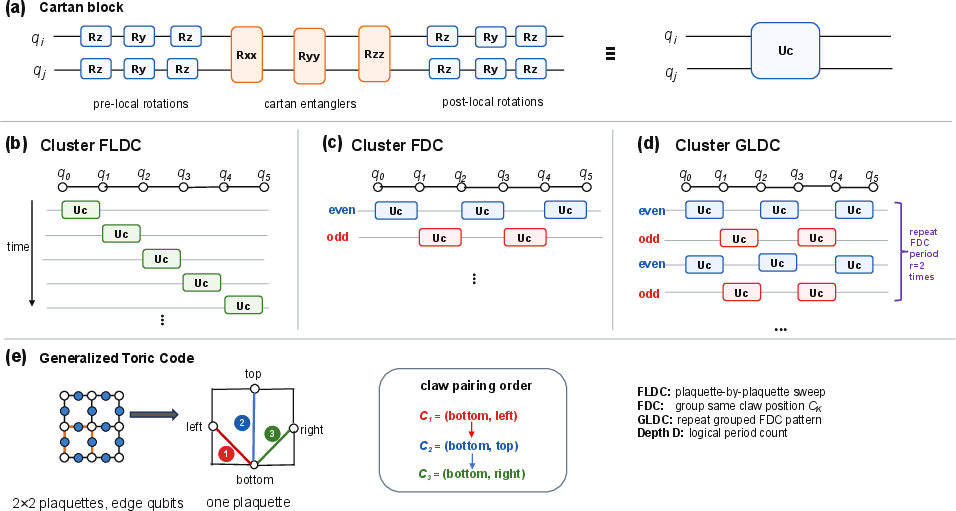
Figure 1: Circuit architecture illustrating Cartan block structure and gate scheduling for cluster-Ising and generalized toric code models.
Statistical Diagnostics and Complexity Metrics
Three statistical diagnostics are computed both for optimized and random-parameter circuit ensembles:
- Porter-Thomas statistics: Empirical computational-basis probability distributions are benchmarked against exponential distributions characteristic of Haar-random states, quantified via the Kolmogorov-Smirnov distance.
- Entanglement-spectrum adjacent-gap ratio (⟨r⟩): Entanglement spectra are analyzed for level repulsion, distinguishing Poisson statistics (uncorrelated) from GUE-like random-matrix statistics. ⟨r⟩ values near GUE benchmarks indicate strong spectral correlations.
- Inverse participation ratio (⟨IPR⟩): Assesses basis delocalization; Haar-random states show ⟨IPR⟩≈2, while computational-basis product states yield ⟨IPR⟩≫1.
Empirical Results: Cluster-Ising Model
VQE results for N=12 and RXX0 reveal that the optimized energies closely track exact ground states, with normalized errors sensitive to ansatz scheduling and depth, notably at low fields.

Figure 2: Cluster-Ising VQE energy per qubit and normalized error for various circuit architectures and depths.
Statistical diagnostics on random-parameter circuit ensembles show that increasing depth rapidly drives the Porter-Thomas KS distance down, RXX1 up toward GUE values, and the IPR toward random-state benchmarks. Importantly, these trends manifest at shallow depth where VQE trainability is preserved—no evidence of exponential gradient suppression is observed over accessible system sizes.
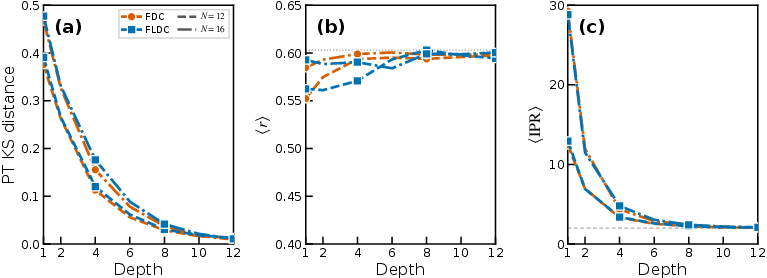
Figure 3: Cluster-Ising statistics-only diagnostics—Porter-Thomas distance, adjacent-gap ratio, and IPR vs. circuit depth.
Generalized Toric Code Hamiltonian
Similar results are observed for the generalized toric code. VQE energies converge to exact benchmarks, with GLDC architectures showing improved performance at low fields. Statistical diagnostics on random-parameter ensembles again reveal movement toward random-state metrics with increasing depth; Porter-Thomas statistics and RXX2 indicate strong delocalization and spectral correlations.

Figure 4: Generalized toric-code VQE energy per qubit and normalized error under claw-ordering.
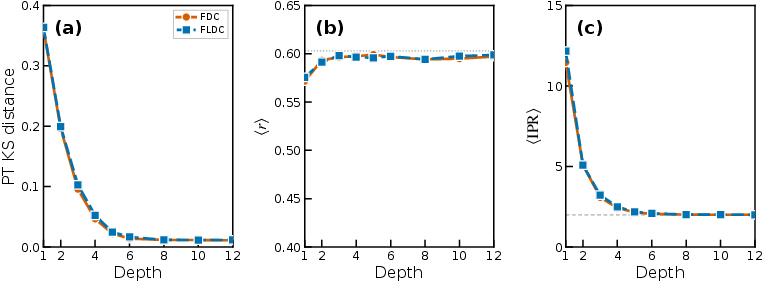
Figure 5: Statistics-only diagnostics for generalized toric-code ansatz—Porter-Thomas KS distance, adjacent-gap ratio, and IPR vs. depth.
Separation of Complexity and Trainability
Direct analysis of gradient statistics demonstrates that increased circuit depth reduces gradient variance per parameter but does not induce the exponential decay characteristic of barren plateaus. For both FDC and FLDC, mean per-parameter gradient variance remains robust over system sizes (up to RXX3).
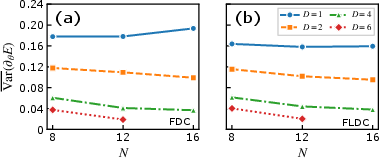
Figure 6: Mean per-parameter gradient variance for cluster-Ising model across circuit depths and system sizes.
Complementary analysis of the entanglement-spectrum gap ratio for optimized states reveals that VQE states possess strong spectral correlations even when gradients are not suppressed, reinforcing the claim that statistical complexity signatures precede trainability loss.
Locality and Physical Interpretation
The locality of the circuit schedule constrains the causal neighborhoods influencing gradients. As shown analytically, at finite depth, gradient components are affected only by Hamiltonian terms overlapping the local circuit light-cones, imposing a parameter-to-observable correspondence that is independent of system size. This contrasts with global randomization, which is responsible for concentration-of-measure effects in deep, nonlocal circuits.
Additional Results and Robustness
Supplementary data for varying system sizes, circuit depths, and ordering strategies (e.g., U-shaped plaquette ordering) confirm the qualitative conclusions. Additional gradient diagnostics (e.g., squared gradient norms) further illustrate the persistence of optimization signal throughout the observed parameter regimes.
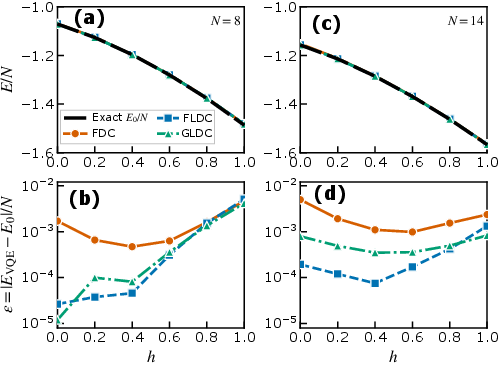
Figure 7: Cluster-Ising VQE results for intermediate system sizes (RXX4, RXX5).
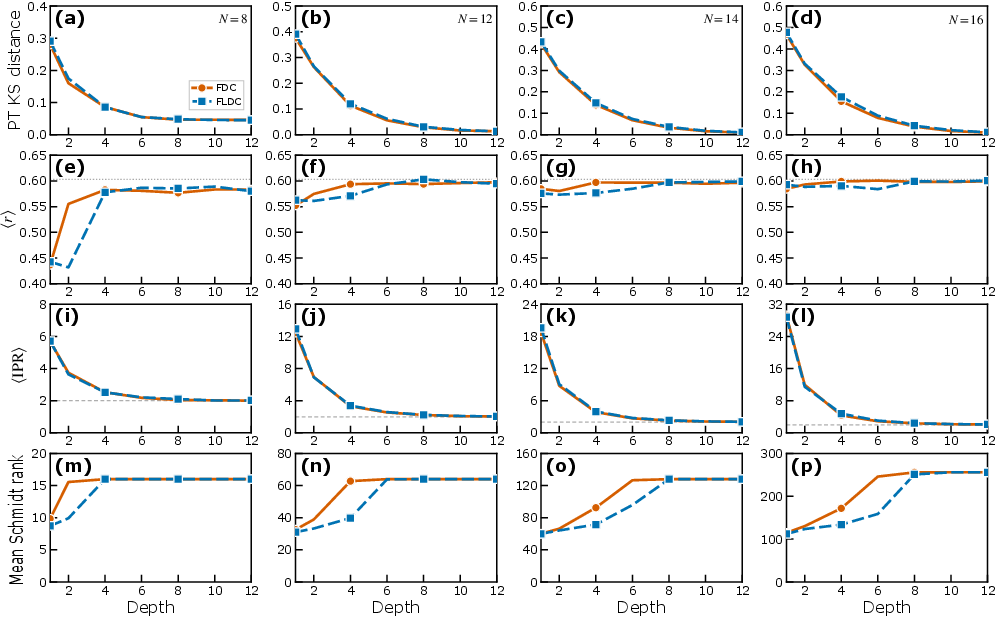
Figure 8: Full cluster-Ising statistics-only diagnostics across RXX6 showing consistency in complexity evolution.
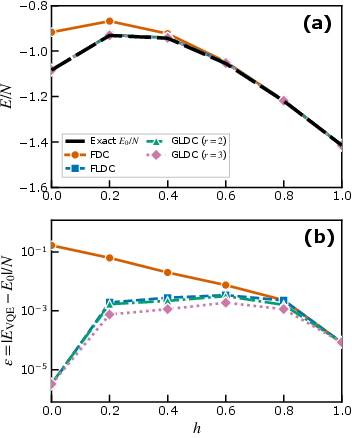
Figure 9: Toric-code VQE results for U-shaped within-plaquette ordering.
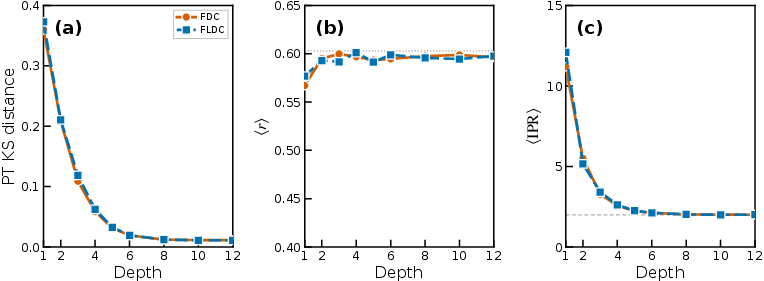
Figure 10: Statistics-only diagnostics for toric-code ansatz under U-shaped ordering.
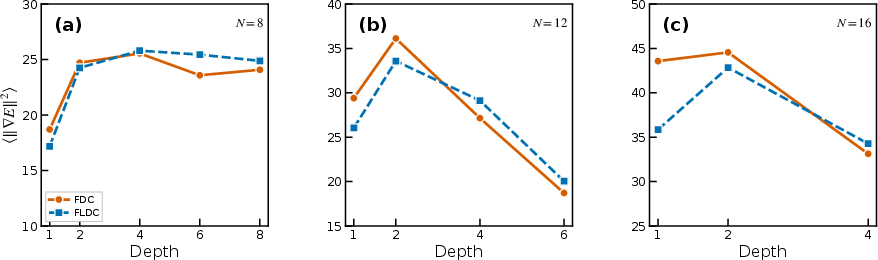
Figure 11: Averaged squared gradient norm for cluster-Ising model at various circuit depths and system sizes.
Theoretical and Practical Implications
The demonstrated separation between statistical complexity diagnostics and trainability has both theoretical and practical implications. From a theoretical perspective, it refines the understanding of expressivity-induced trainability loss: locally rich circuits may achieve complex quantum-state metrics without global scrambling, barring concentration-of-measure effects. Practically, this informs ansatz design in VQA applications—optimization can remain tractable in finite-depth, locally structured circuits even as diagnostics point to substantial complexity. This perspective aligns with recent findings in dynamic parameterized circuits, where expressivity and trainability can be decoupled by physical mechanisms (e.g., intermediate measurements, feedforward).
The results underscore the need for multi-faceted evaluation of circuit complexity, challenging the routine use of statistical benchmarks as proxies for trainability. Future directions include a systematic scaling analysis over larger systems and depths, exploration of alternative architectures, and benchmarking robustness across initialization and training strategies.
Conclusion
The paper provides compelling evidence that statistical complexity diagnostics—Porter-Thomas statistics, entanglement-spectrum correlations, and IPR—can approach random-state and random-matrix benchmarks at finite depth in structured variational quantum circuits, without incurring barren plateau behavior or gradient suppression. This establishes a nontrivial separation between statistical measures of complexity and practical trainability, pointing to the pivotal role of locality, circuit architecture, and scheduling. The findings advocate for nuanced ansatz engineering and caution against interpreting statistical complexity signatures as indicators of optimization failure in near-term quantum algorithms (2606.18580).