- The paper shows that deterministic approaches, such as AOT combined with CHL/PWM, achieve lower error means and faster convergence than stochastic methods at low noise levels.
- It rigorously compares data assimilation techniques using adaptive numerical schemes like MsDTM to enhance state estimation in chaotic models.
- Empirical findings reveal that while deterministic methods are computationally efficient and accurate, stochastic approaches provide robustness in higher noise scenarios.
Comparative Evaluation of Deterministic and Stochastic Parameter Recovery Algorithms in Chaotic Systems
Overview
The paper "Comparing Deterministic and Stochastic Parameter Recovery Algorithms Applied to Chaotic Systems" (2606.18568) presents a rigorous computational comparison of deterministic and stochastic data assimilation (DA) and parameter recovery (PR) algorithms in the context of nonlinear, chaotic systems subject to observational noise. The principal focus is on the Lorenz '63 and multiscale Lorenz '96 dynamical systems. The study involves generating synthetic noisy data using semi-analytic numerical schemes and evaluates the effectiveness, stability, and computational efficiency of various DA and PR paradigms. Deterministic approaches are based on nudging (AOT), whereas stochastic methods deploy EnKF, PF, ETKF, and variants; PR algorithms include deterministic schemes (CHL, PWM, AV), stochastic EM, and EnKI.
Mathematical and Computational Framework
Chaotic Systems and Identifiability
The Lorenz '63 and Lorenz '96 systems are canonical for evaluating DA and PR in chaotic scenarios. Their parameter identifiability is exploited in the experiments for σ (Lorenz '63) and $\overline{d_{1}$ (Lorenz '96).
Numerical Methods
Synthetic data is generated via adaptive Multi-step Differential Transform Method (MsDTM) and implicit Euler, enabling fine-grained resolution of the dynamics. Comparison with standard Euler discretization demonstrates enhanced robustness to non-trivial initial errors and improved convergence of state and parameter estimates using adaptive MsDTM.
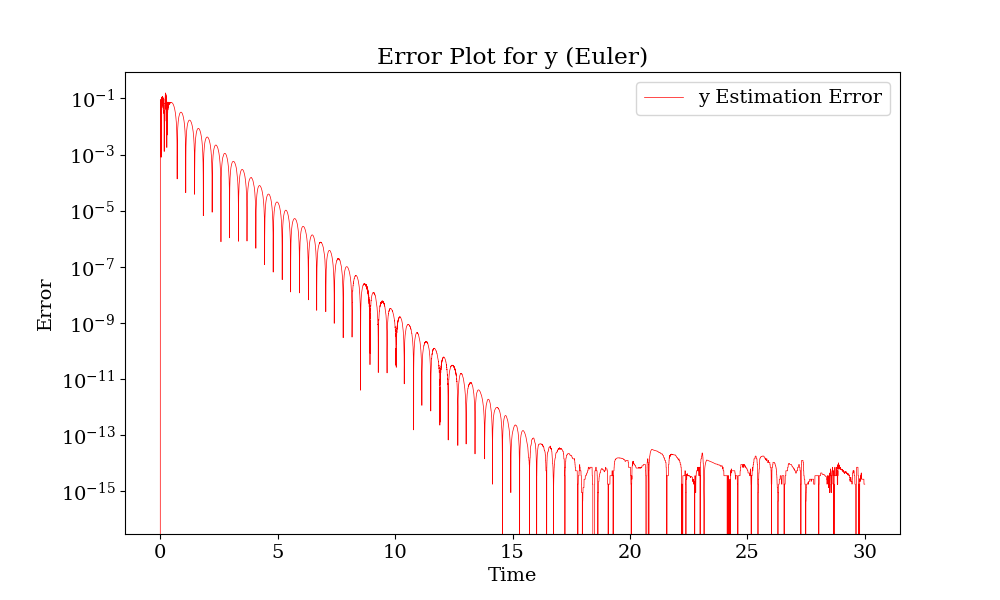
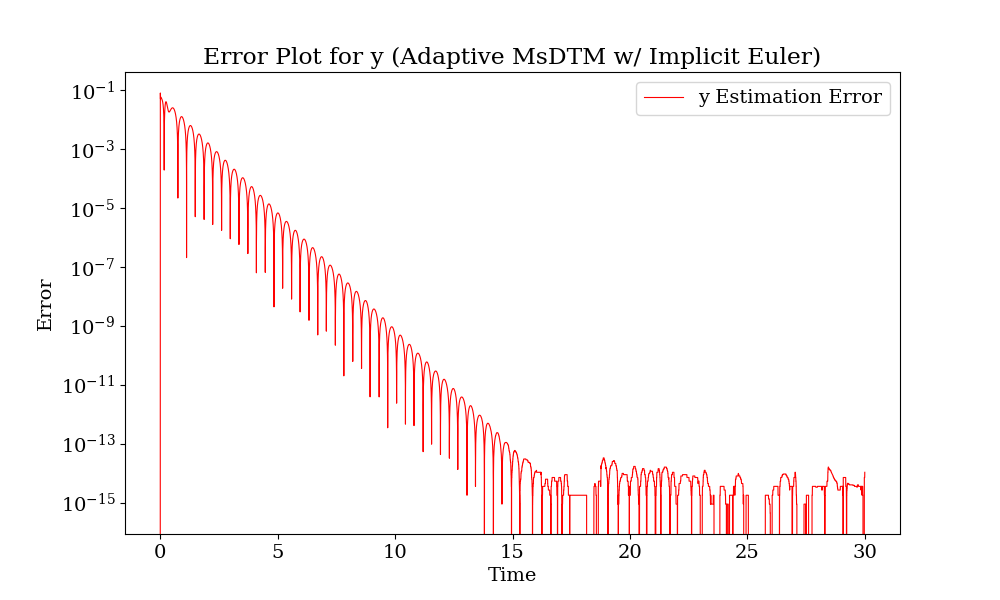
Figure 1: Euler method versus adaptive MsDTM for x1 state estimation in Lorenz '63 highlights superior stability and convergence of adaptive MsDTM.
Data Assimilation Algorithms
- Deterministic:
- AOT (Nudging): Based on continuous DA, incorporates relaxation terms that drive the nudged model towards observed states.
- Stochastic:
- EnKF and ETKF: Ensemble-based Kalman approaches, optimal for linear and Gaussian settings with extensions to nonlinear models.
- PF: Gaussianized optimal particle filtering to handle non-Gaussian distributions.
- EnKI: Transport-based inversion for finite-time parameter recovery.
Parameter Recovery Algorithms
- Deterministic PR: CHL, PWM, and AV methods, formulated for linear parameter dependence, with AV employing Levenberg-Marquardt minimization.
- Stochastic PR: EM formulated with ensemble integration, requiring explicit modeling of noise.
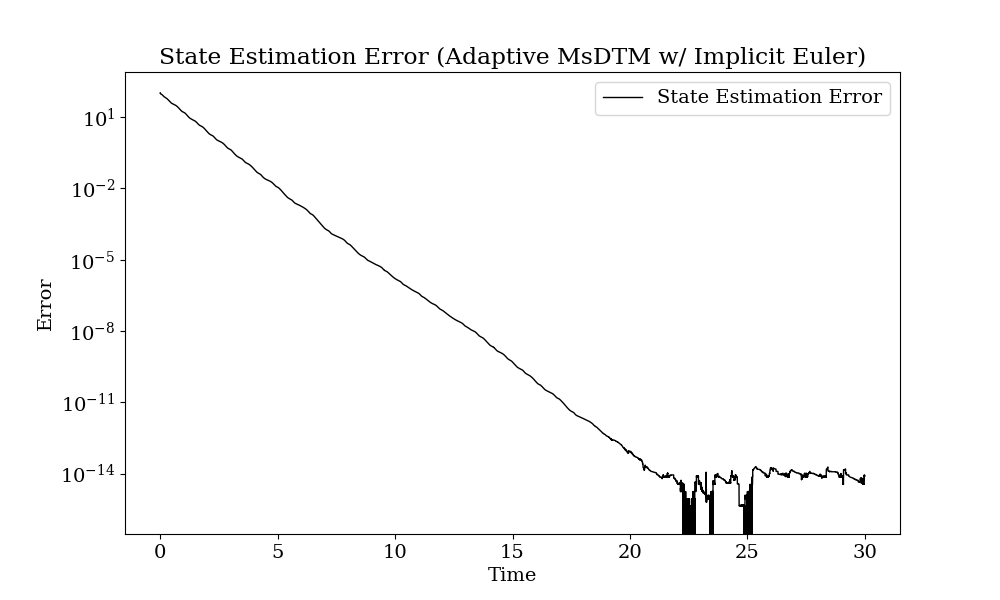
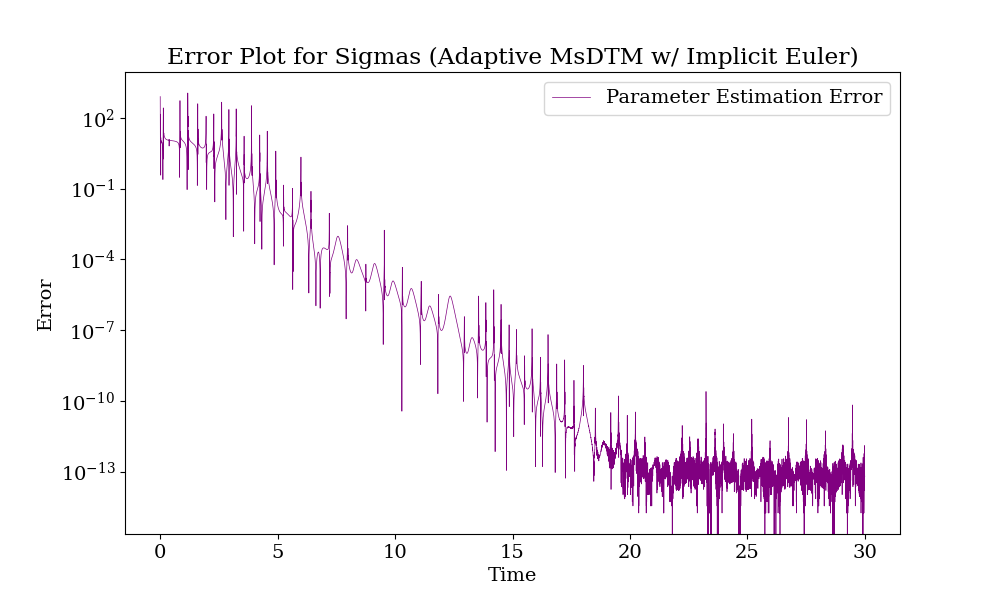
Figure 2: State estimation accuracy in Lorenz '63 for deterministic and stochastic DA, demonstrating lower error for deterministic (AOT) approaches.
Empirical Findings
Lorenz '63 Results
Deterministic AOT + CHL achieves higher parameter recovery accuracy at low to moderate noise, with mean errors below those of EnKF + EM, particularly for SD≤10−3. Stability of CHL degrades as noise increases, attributed to sensitivity in the update scheme. EnKF + EM exhibits improved variance robustness but overall higher computational expense.
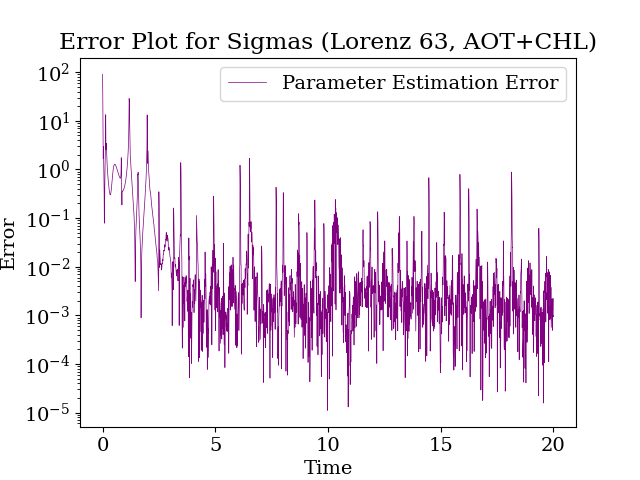
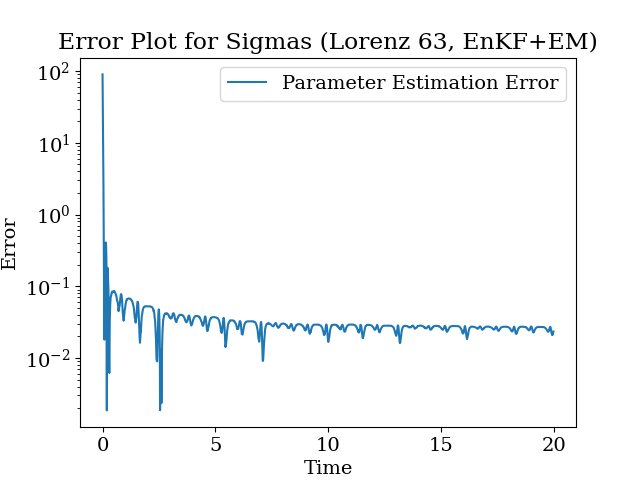
Figure 3: AOT + CHL parameter recovery error for Lorenz '63 illustrating strong convergence at low noise.
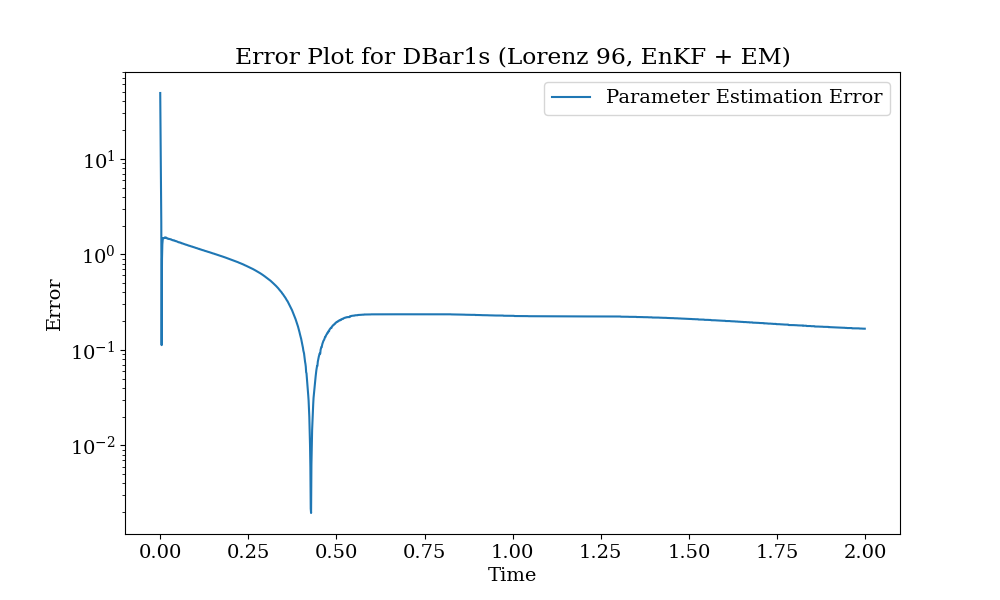
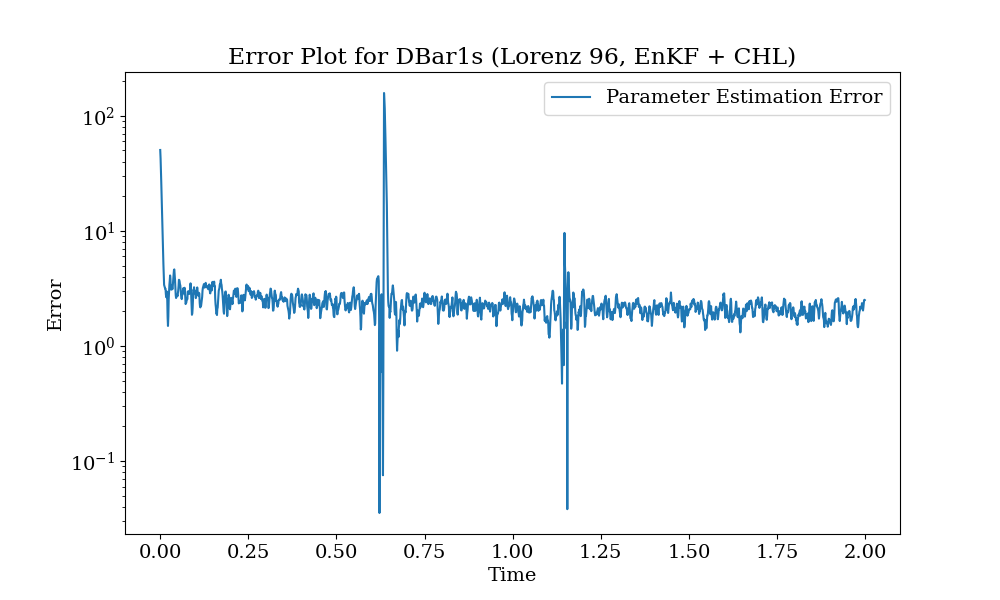
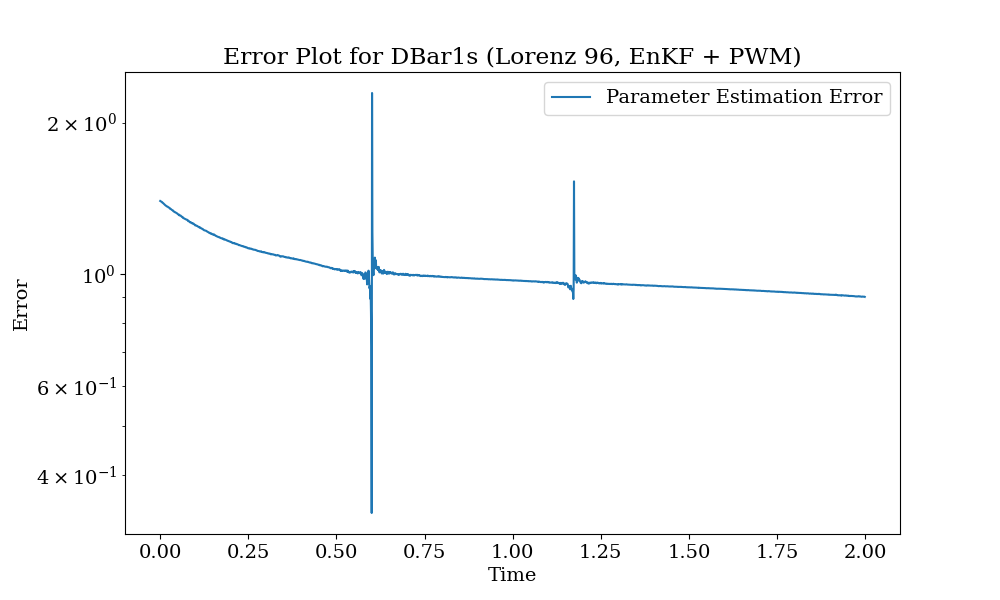
Figure 4: EnKF + EM parameter recovery error for Lorenz '63, showing slower convergence and larger variance.
Lorenz '96 Results
Deterministic DA/PR combinations (AOT + PWM/AV) consistently attain the lowest parameter error means and variances at low noise, outperforming stochastic methods and mixed combinations. ETKF + AV yields optimal performance among mixed methods, with higher robustness under noise. Stochastic methods, especially EM and EnKI, retain consistent error statistics as noise increases, but at the cost of accuracy and substantial runtime (orders of magnitude longer than deterministic algorithms).
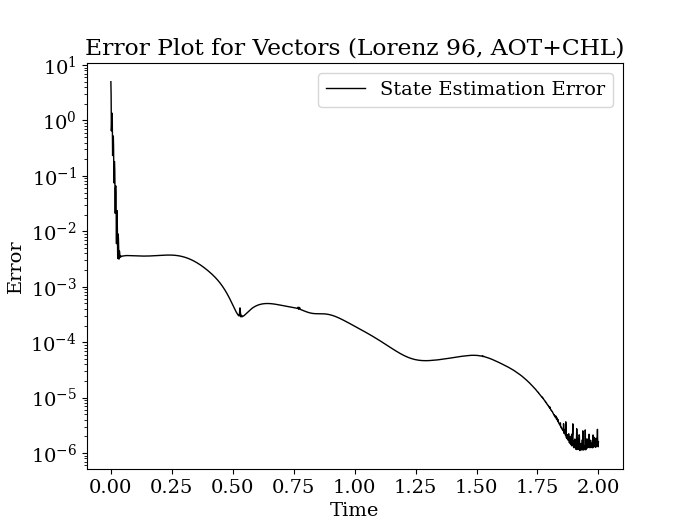
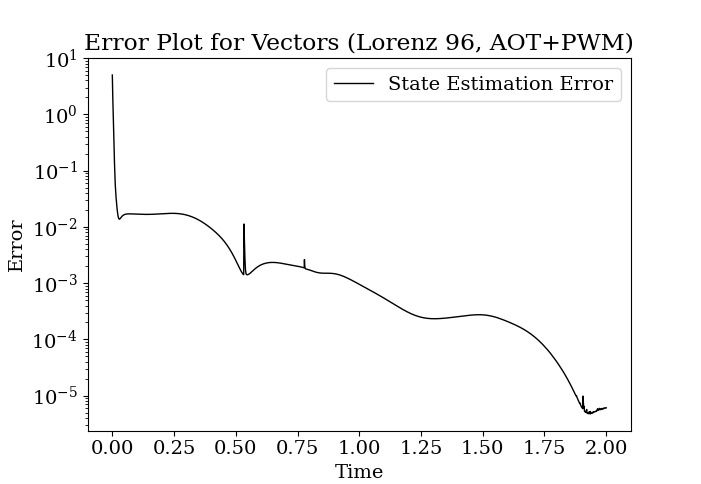
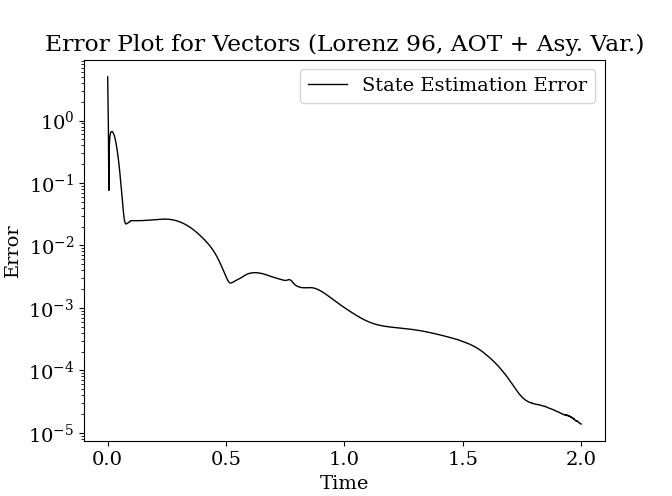
Figure 5: AOT + CHL DA error for Lorenz '96 indicating exceptional state estimation precision and stability.
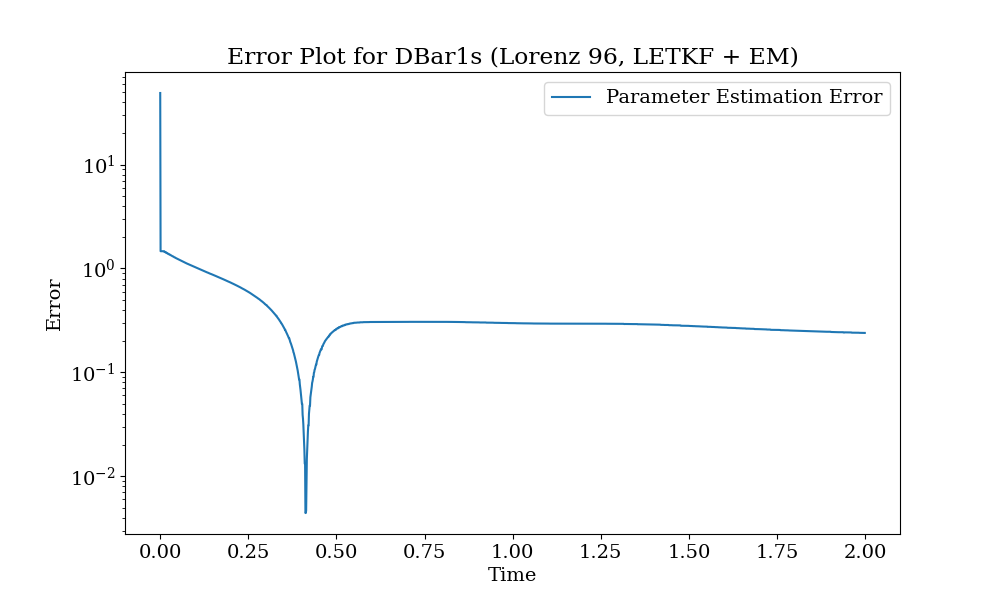
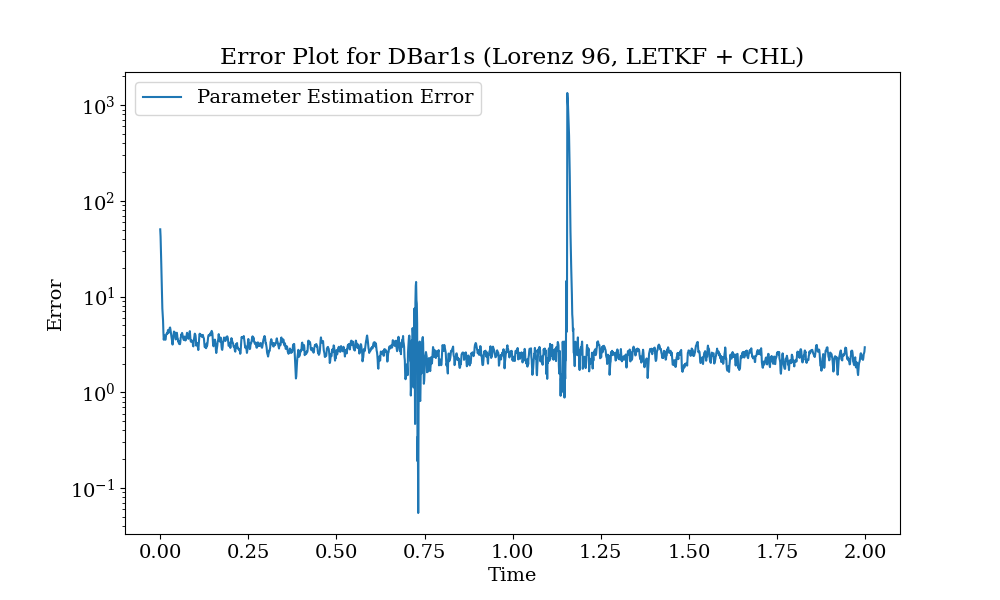
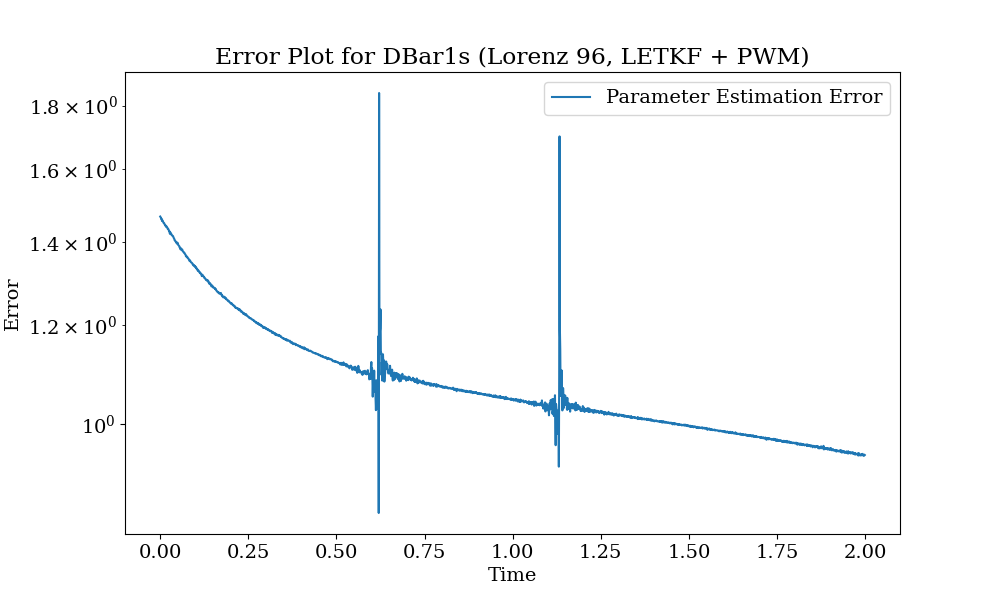
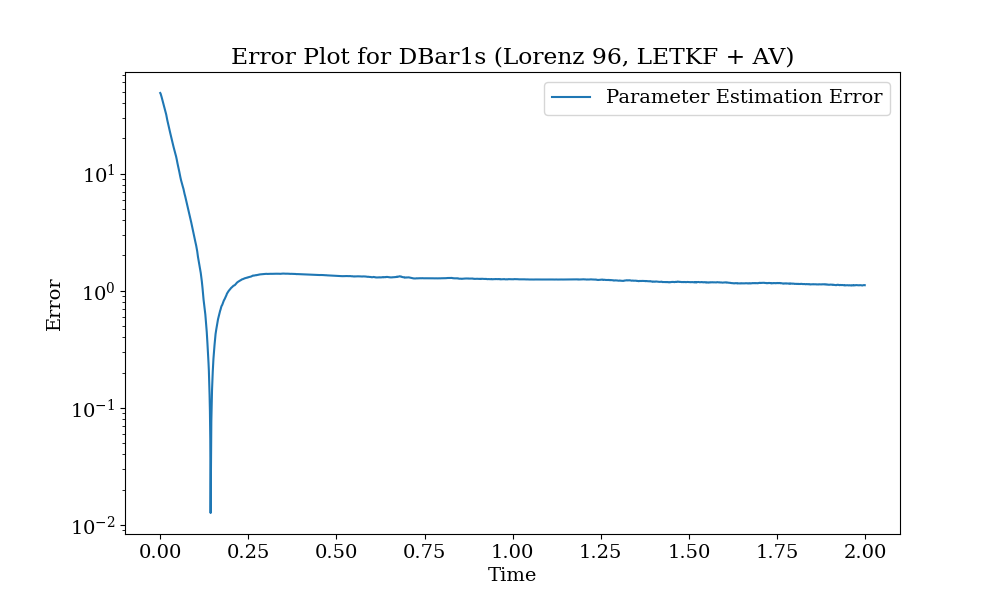
Figure 6: ETKF + EM PR error for Lorenz '96, highlighting robust but less accurate parameter recovery.
Runtime and Efficiency
Deterministic approaches are dramatically faster: AOT + CHL and PWM typically finish within seconds to minutes, while EM-based and particle-filter-based stochastic methods take several hours. This efficiency gain is especially pronounced in high-dimensional chaotic systems.
Contradictory Claims and Numerical Strength
- Contradiction to Prevailing Practice: The paper explicitly demonstrates that deterministic PR algorithms, previously considered suboptimal for noisy data, can outperform popular stochastic DA/PR methods in accuracy, stability, and efficiency when paired appropriately, challenging the dominance of stochastic methods in practical DA.
- Numerical Strengths: Deterministic DA/PR methods sustain mean parameter errors below 10−2 at SD=10−4, converging within theoretical time domains (∼1.0 time units), while stochastic methods are slower and have error floors an order of magnitude higher.
Practical and Theoretical Implications
- Hybridization Potential: The marked efficiency and accuracy of deterministic PR at low/moderate noise advocate for hybridized schemes, leveraging deterministic corrections with stochastic variance modeling.
- Sensitivity to Noise: Deterministic methods are more sensitive to noise, but PWM and AV exhibit improved robustness; adjusting recovery window and relaxation parameter μ can stabilize CHL even at larger noise levels.
- Nonlinear Parametric Dependence: The current analysis is limited to linear parameter dependence; future work should extend to nonlinear parameter regimes, particularly for variational DA and PR algorithms.
- Observation Frequency and Discretization: Deterministic PR stability is influenced by observation frequency and numerical discretization, warranting deeper investigation.
Speculation on Future Directions
- Algorithmic Hybridization: Integrating deterministic PR algorithms (e.g., AV-LM, PWM) with stochastic DA algorithms (e.g., ETKF) may yield DA/PR hybrids that fuse real-time efficiency with noise robustness.
- Extending PR to Nonlinear Parameters: Analytical work is necessary to generalize deterministic PR methods for nonlinear parameter dependence, potentially requiring new optimization formulations.
- Scalability and High-dimensional Systems: Expanding deterministic DA/PR to climate-scale models and 2D/3D PDEs, provided numerical discretization and observational strategies are optimized.
Conclusion
The study delivers an authoritative computational analysis establishing deterministic parameter recovery algorithms as highly effective alternatives to stochastic approaches for chaotic systems, provided noise levels are moderate and parameter dependence is linear. Deterministic DA/PR pairs, notably AOT + PWM and AOT + AV, surpass stochastic methods in accuracy, stability, and computational speed at low noise, while stochastic PR is preferable at high noise for robustness. These findings motivate further investigation into hybrid DA/PR methods, nonlinear parameter recovery, and sensitivity analyses with respect to observational protocols and numerical schemes.