- The paper demonstrates a novel framework using Trotterization and the Hadamard test to simultaneously extract ground- and excited-state energies from quantum spin models.
- The study shows that constant-depth circuits, optimized via BQSKit synthesis, reduce circuit complexity and gate counts on IBM quantum hardware.
- Experimental results on TFIM and TLFIM validate the methodology, achieving accurate energy extraction with noise thresholding against hardware-induced artifacts.
Energy Spectrum Estimation via Trotterization on IBM Quantum Hardware
Methodological Framework: Trotterization and the Hadamard Test
The paper presents a comprehensive framework for simultaneously extracting ground- and excited-state energies of quantum spin models using Trotterized time evolution combined with the Hadamard test (H-test) on IBM quantum processors. Specifically, the authors target the transverse field Ising model (TFIM) and the transverse longitudinal field Ising model (TLFIM).
The H-test is implemented by controlling the application of the time-evolution operator with an ancilla qubit, yielding expectation values encoding the real and imaginary components of the time signal g(t), which is used for energy extraction via classical Fourier transform. Compared to quantum phase estimation variants relying on quantum Fourier transform, this approach offers reduced circuit complexity, requiring only a single ancilla qubit and single-qubit measurements.
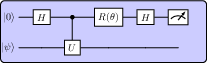
Figure 1: The Hadamard test circuit for computing both real and imaginary parts of the time signal g(t), with R(θ) as the phase gate.
Trotterization is used to digitize the time-evolution operator for non-trivial Pauli-sum Hamiltonians. Both first- and second-order Trotter formulas are considered, with second-order formulas yielding reduced leading-order errors and circuit depth.
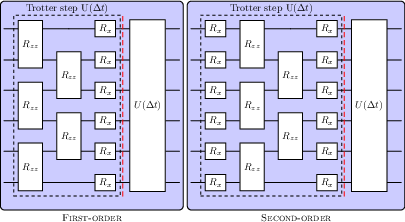
Figure 2: First and second-order Trotterization circuits for a 6-spin TFIM, showing the layer structure and gate angles for Rx and Rzz gates.
Constant-Depth Circuits and Circuit Synthesis
A central technical aspect is the demonstration that the Trotterized circuits for the TFIM possess a constant-depth structure (CDC) for arbitrary time evolution, thanks to their matchgate-based composition. This property is exploited both analytically and via circuit synthesis, enabling simulations with fixed circuit depth irrespective of the number of Trotter steps M. For the TLFIM, which does not admit CDCs analytically, the authors show that circuit synthesis using BQSKit achieves a CDC for the three-spin case, a result that contradicts expectations derived from fermionic representations.
The CDC construction for the TFIM is based on numerical optimization of matchgate layers, with parameters chosen to maximize fidelity with the target time-evolution operators. The scalability of CDC synthesis is discussed, highlighting manageable classical overhead for small N and exponential scaling for larger systems.
Implementation Details and Circuit Optimization
Circuits are transpiled into the native ISA of IBM QPUs, with Rx and Rzz gates included as fractional gates to reduce gate counts and ensure the circuits fit within NISQ limitations. Circuit optimization is performed using BQSKit's LEAP and instantiation strategies for both the TFIM and TLFIM cases. For controlled unitaries required by the H-test, decomposition into single-qubit rotations and CNOT (and CCNOT) gates is thoroughly detailed.
For the TLFIM, global synthesis via BQSKit successfully produces constant-depth circuits for N=3, yielding gate counts that fall well below those required by naive Trotterization. Gate count versus Trotter step analysis confirms CDC behavior for g(t)0, whereas for g(t)1 CDCs remain elusive, likely due to the exponential parameter space.

Figure 3: Gate counts versus Trotter steps g(t)2 for the N=3 TLFIM optimized by BQSKit, demonstrating constant-depth scaling after circuit synthesis.
Energy extraction is performed by capturing the time signal from the H-test and applying classical discrete Fourier transform (DFT). The signal structure and DFT methodology are discussed, including the normalization and noise thresholding procedure to distinguish genuine spectral peaks from background fluctuations due to hardware noise.
Numerical results include simulations for g(t)3 TFIM and g(t)4 TLFIM on IBM Fez and Boston QPUs. For the TFIM, up to nine (for g(t)5) and six (for g(t)6) eigenenergies are simultaneously extracted with amplitudes and ratios consistent with classical exact diagonalization. Critically, noise-induced artifacts such as zero-frequency peaks are identified as hardware-specific features, not physical eigenenergies.
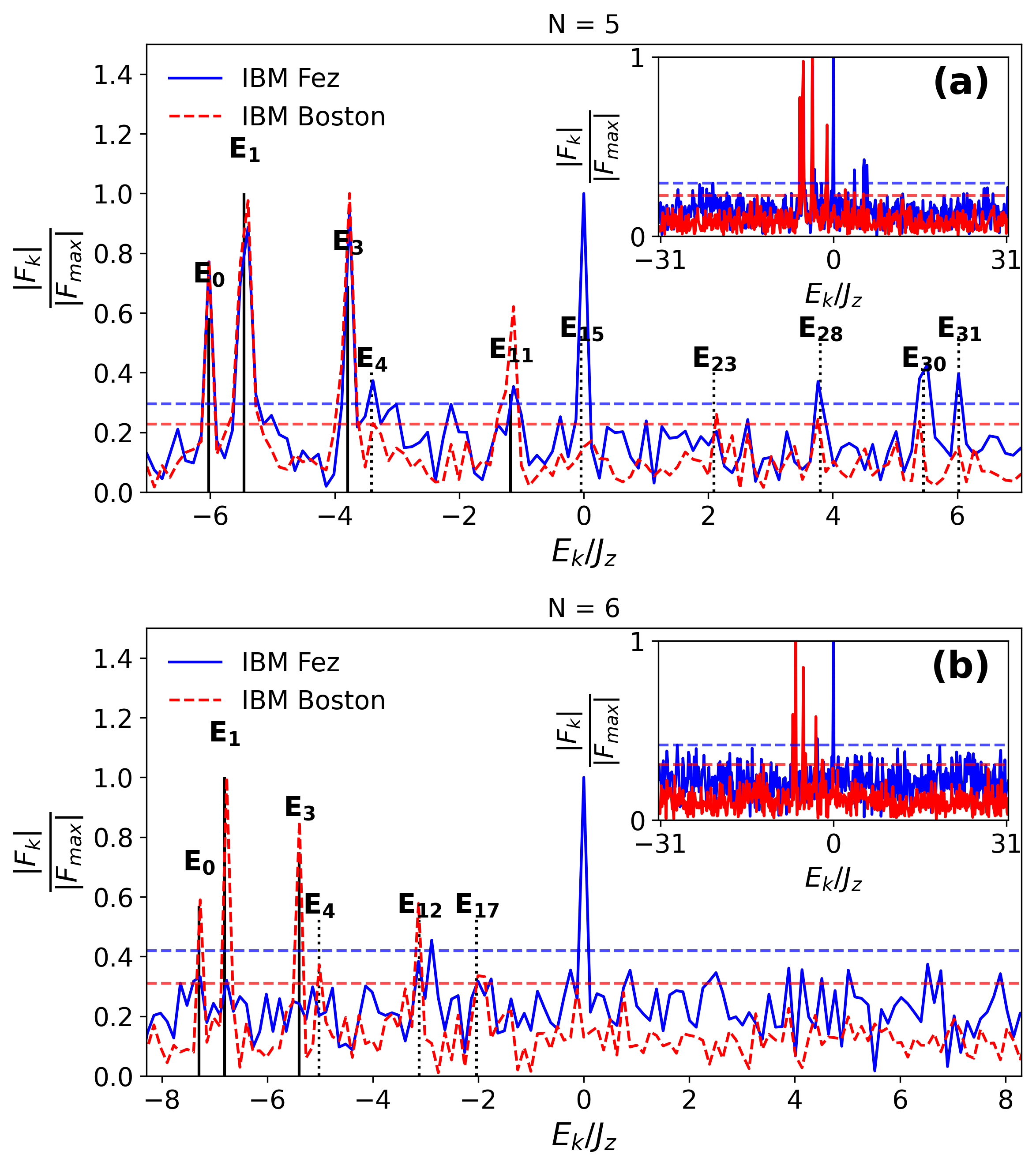
Figure 4: Fourier spectra of the TFIM on IBM hardware, demonstrating extraction of multiple eigenenergies and identification of noise thresholds.
For the TLFIM (g(t)7), both ground- and first-excited state energies are unambiguously resolved, enabled only by the CDC synthesized circuit. Higher excited states are not resolved due to frequency-space degeneracy and noise thresholding.
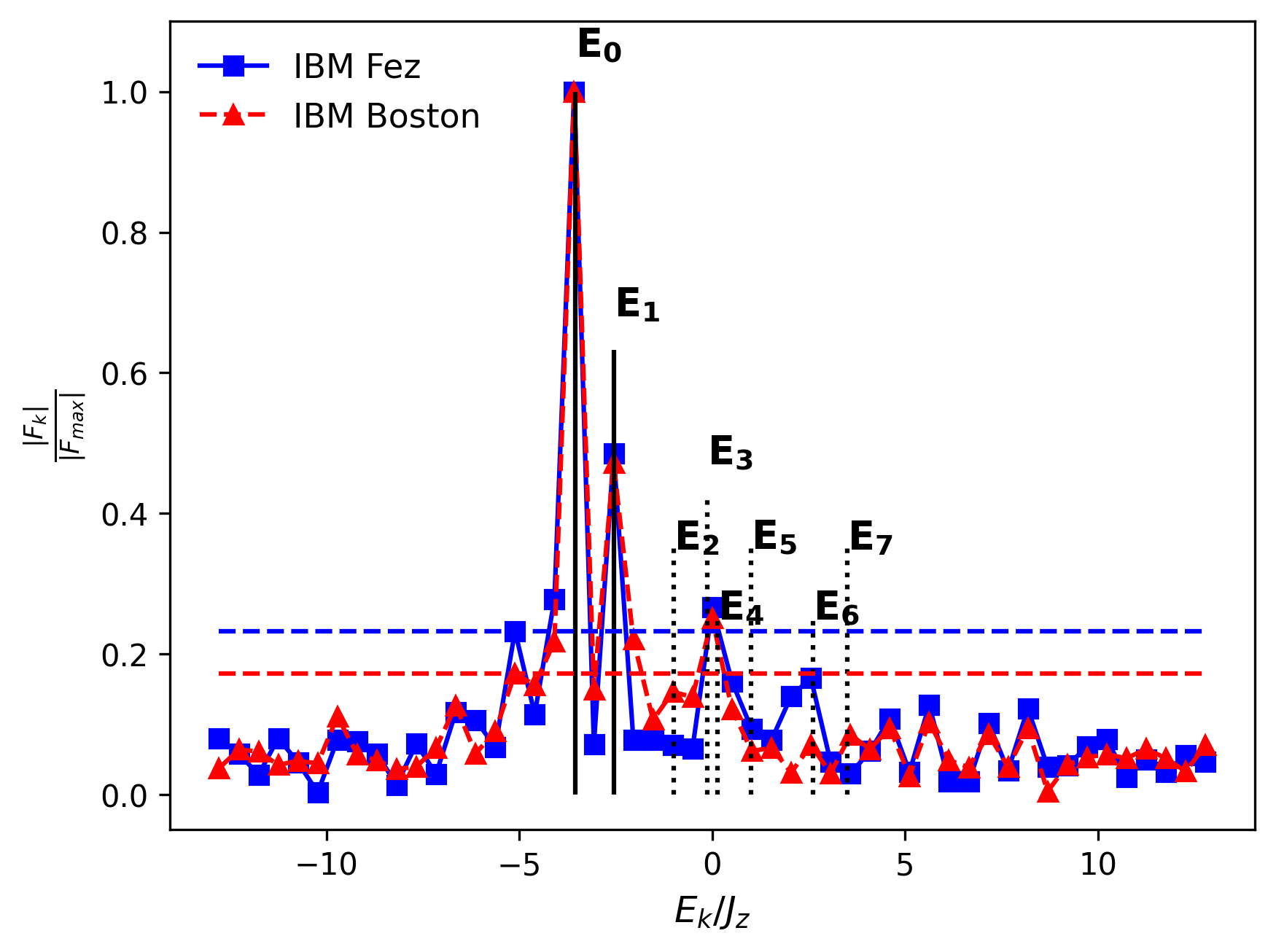
Figure 5: Fourier spectrum for the N=3 TLFIM with BQSKit-synthesized constant-depth circuit, displaying extracted ground and first-excited eigenenergy peaks.
Theoretical Implications and Comparison with Prior Work
The findings underscore the advantages of time-domain energy estimation via Trotterization for probing many-body quantum spectra on NISQ devices. The simultaneous extraction of multiple eigenenergies with correct amplitude ratios presents a significant improvement over variational and magnetization-based methods, which typically resolve only single (ground or highly excited) states or rely on specific parameter regimes.
The identification of CDCs for TFIM and three-site TLFIM highlights both the practical value and theoretical interest of circuit structure optimization. The failure to synthesize CDCs for larger TLFIM instances suggests future directions involving advanced machine learning-guided synthesis or seeded optimization. The approach is robust against barren plateau issues faced by VQE and theoretically improvable via higher-order Trotter formulas, advanced signal processing (compressed sensing, randomized evolution), and efficient construction of controlled time-evolution operators.
Conclusion
This work establishes Trotterization combined with the Hadamard test and circuit synthesis as a practical and effective framework for multi-eigenenergy extraction on quantum hardware. The analytical and numerical demonstration of constant-depth circuits for the TFIM, as well as synthesized CDCs for the three-spin TLFIM, enables time-series methods that fit within the tight error budgets of NISQ devices. The approach achieves simultaneous extraction of multiple low-lying eigenenergies and spectral weights, outperforming prior variational and magnetization-based schemes.
With impending advances in quantum hardware, synthesis algorithms, and signal processing, this framework lays a rigorous foundation for time-domain spectral analysis in quantum simulation of condensed matter and molecular systems. Extension to larger and more complex Hamiltonians, incorporating advanced error mitigation and compression, remains an important research frontier.