- The paper demonstrates QAQL, where quantum annealer sampling enhances Q-learning exploration for accurate remaining useful lifetime prediction.
- It achieves significant error reductions with RMSE of 20.86 on NASA C-MAPSS and 11.23 on fleet maintenance datasets.
- By recasting temporal difference updates as QUBOs, the approach reduces variance and overcomes exploration bottlenecks in non-linear degradation models.
Quantum Annealing Enhanced Reinforcement Learning for Remaining Useful Lifetime Prediction
Introduction
The paper "Quantum Annealing Enhanced Reinforcement Learning for Accurate Remaining Useful Lifetime Prediction" (2606.18503) introduces QAQL, a hybrid reinforcement-learning framework that leverages quantum annealing for action selection in tabular Q-learning applied to remaining useful life (RUL) prognostics. The study targets asset-centric predictive maintenance, with a focus on industrial, aerospace, and device-fleet datasets where the operational cost of unplanned failure greatly outweighs asset value. The central thesis is that integrating quantum annealer-driven sampling inside each Q-value update can overcome the exploration deficiencies of classical RL, yielding improved fit to non-linear degradation trajectories and enhanced operational accuracy.
Review of Prior Approaches
The literature evidences substantial progress in data-driven RUL estimation. Early physics-driven models (Wiener/gamma/Paris-Erdogan) are limited by sensor cardinality, regime variability, and non-monotonic trajectories. Deep learning (CNN, RNN, attention) has pushed RMSEs down considerably but remains highly dependent on exhaustive run-to-failure data and is susceptible to local optima due to non-convex loss surfaces. RL-based approaches (tabular Q-learning, deep Q-networks, PPO) treat RUL prediction as sequential decision-making but exhibit slow convergence and high variance in high-dimensional, non-stationary settings. Quantum machine learning has predominantly served as post-hoc feature extraction or hyperparameter optimization, rarely interfacing with the per-step learning dynamic.
QAQL is positioned at the intersection of these gaps, recasting the greedy action selection within each TD update as a QUBO, solved natively by D-Wave Advantage annealers to capitalize on their stochastic, near-optimal sampling characteristics.
QAQL Framework and Quantum Annealing Integration
The methodological architecture of QAQL is built upon the classical Q-learning skeleton but replaces argmaxaQ(s,a) with quantum annealer sampling. Each candidate action is binary-encoded with one-hot constraints, and the TD error forms the basis of the QUBO cost function. The annealer is not intended as a faster combinatorial optimizer; rather, its readout distribution—shaped by quantum tunneling and superposition—injects richer exploration, helping the agent avoid premature convergence in complex degradation landscapes.
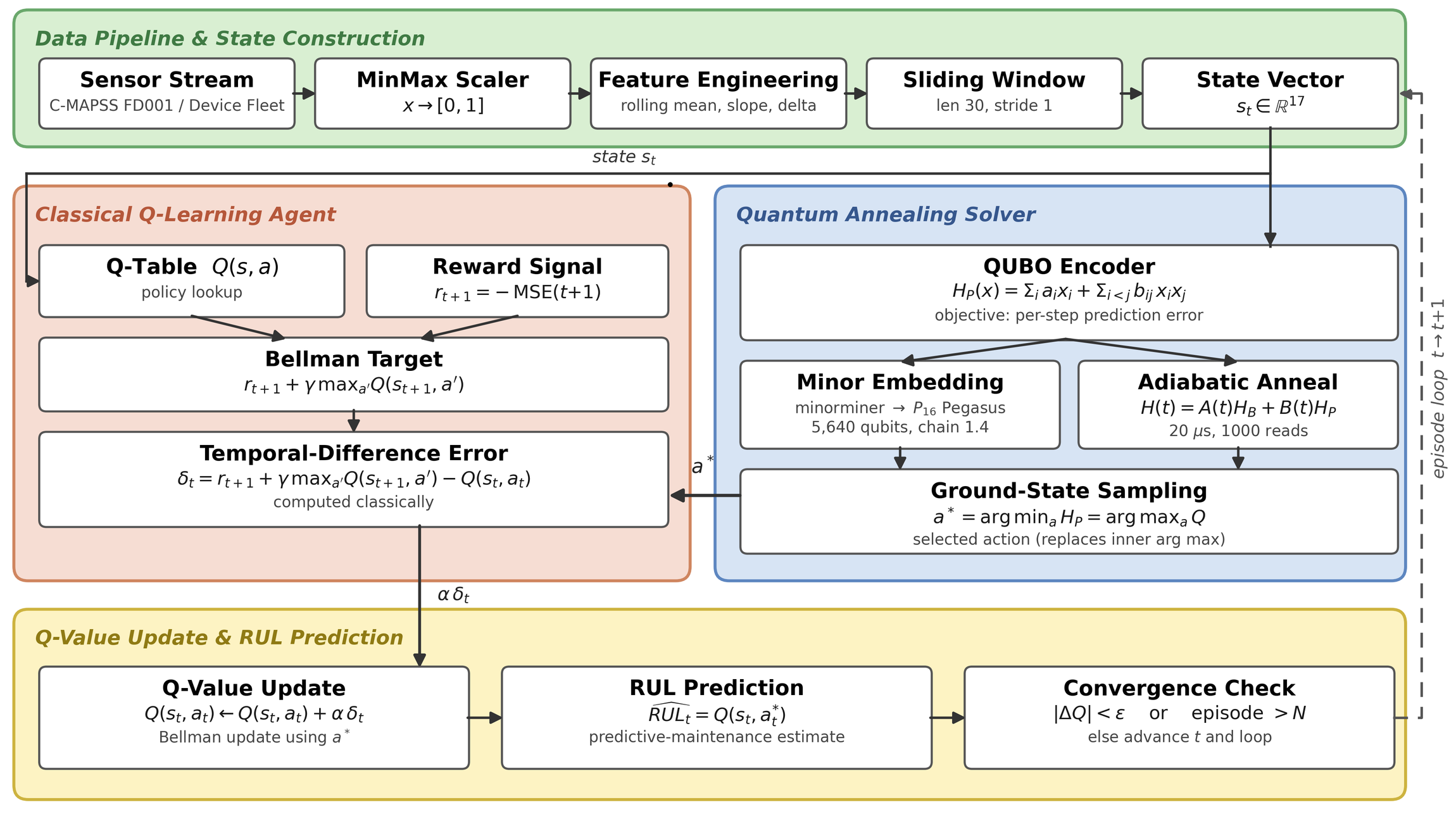
Figure 1: QAQL pipeline and QUBO-driven action selection, enabling quantum annealer sampling within the RL loop.
The TD signal incorporates cost-sensitive reward functions (negative MSE), enabling the RL update to prioritize operational objectives like timely maintenance intervention. The system executes the QUBO by submitting a dynamically constructed binary matrix to D-Wave, reads 1,000 samples per update (20 μs anneal), and updates Q-values accordingly. The feasibility of one-hot enforcement is rigorously maintained with adaptive penalty weights, ensuring the physical realization matches the theoretical construction.
Experimental Design and Dataset Processing
Robustness is examined on two principal benchmarks:
- NASA C-MAPSS FD001 Turbofan: Structured run-to-failure trajectories, single operational regime, HPC degradation. Input vectors are constructed from 14 sensor channels and 3 operational settings after variance screening, min-max normalization, and sliding window feature engineering.
- Fleet Predictive Maintenance: Large-scale, sparse-failure IoT device readings. Multi-feature engineering (rolling means/stdev, slope, delta, out-of-band counts) augments the raw nine channels; RUL labels are determined by failure proximity.
Each baseline (seven classical, seven quantum) is trained under identical partitioning, preprocessing, and hyperparameter schedules. Quantum annealing is performed remotely, and all wall-clock overhead is measured in operational analysis.
Results and Comparative Analysis
QAQL delivers the lowest error across all test cases evaluated under a unified protocol. On C-MAPSS FD001, QAQL achieves MSE = 435.28, RMSE = 20.86. On the Predictive Maintenance dataset, QAQL records MSE = 126.28, RMSE = 11.23. These outperform classical (Transformer: RMSE = 28.13, 16.01) and quantum baselines (Quantum VQL: RMSE = 23.49, 13.75) by statistically significant margins (p<0.01, paired Wilcoxon, Cliff's δ>0.85).
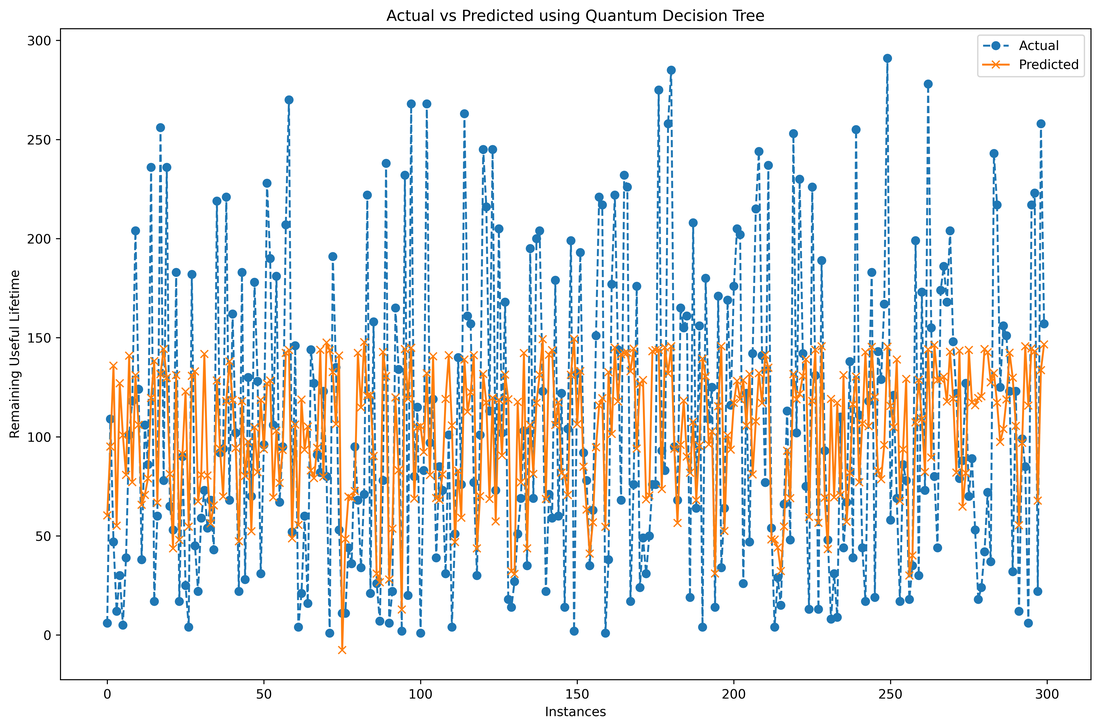
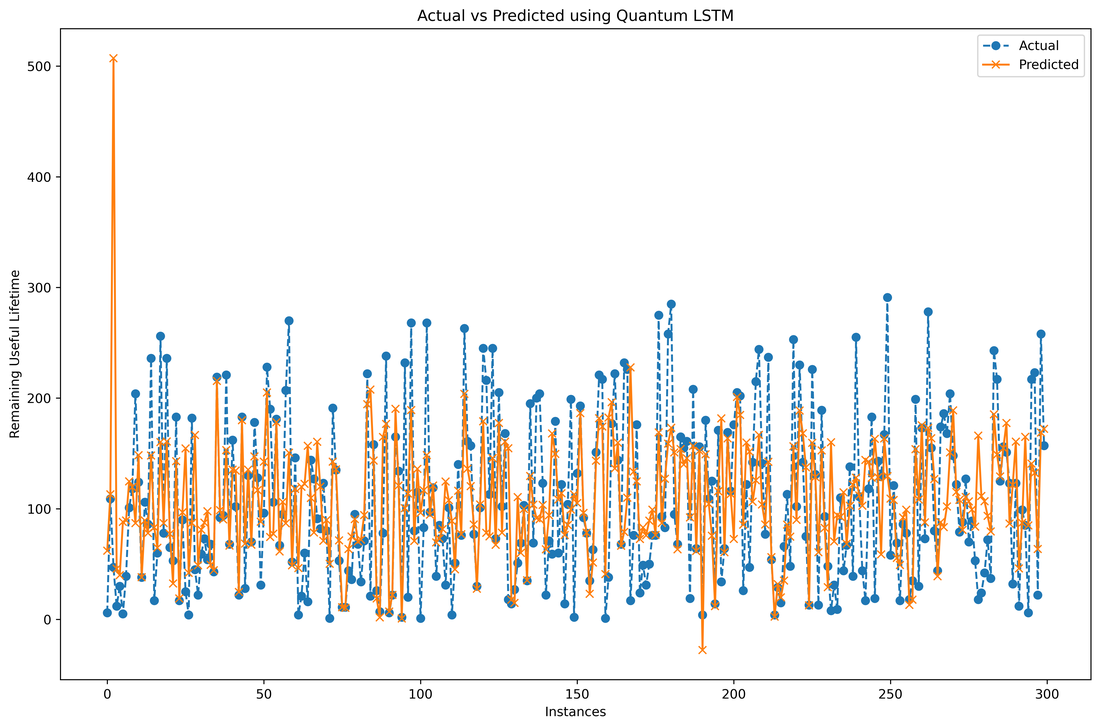
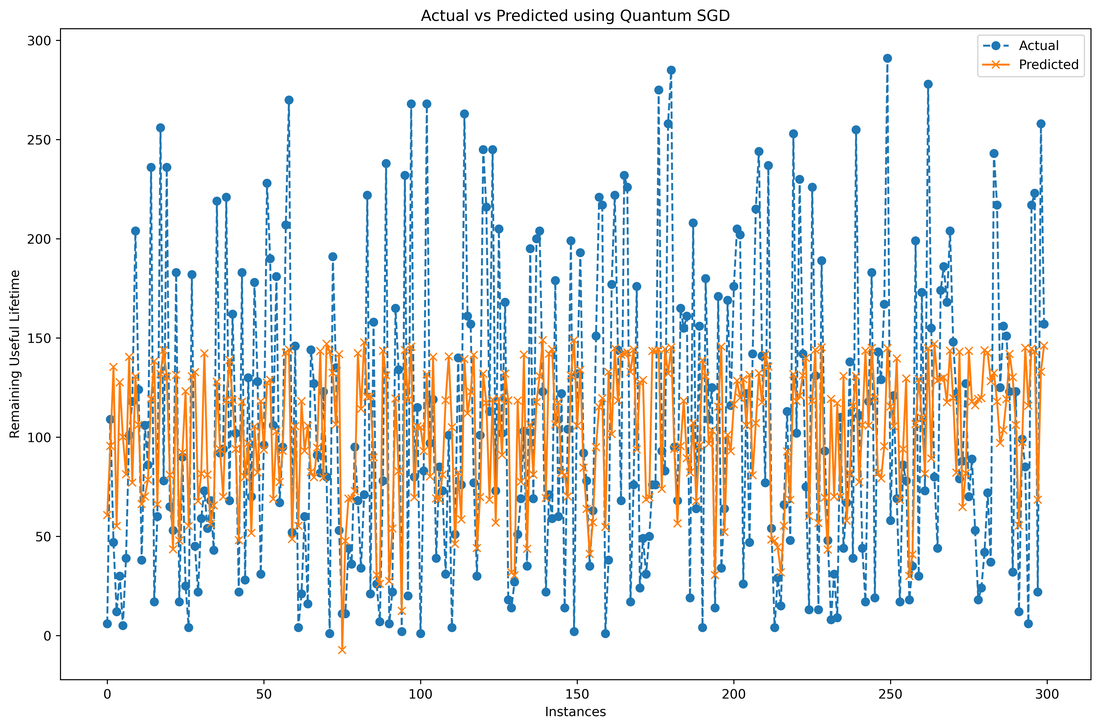
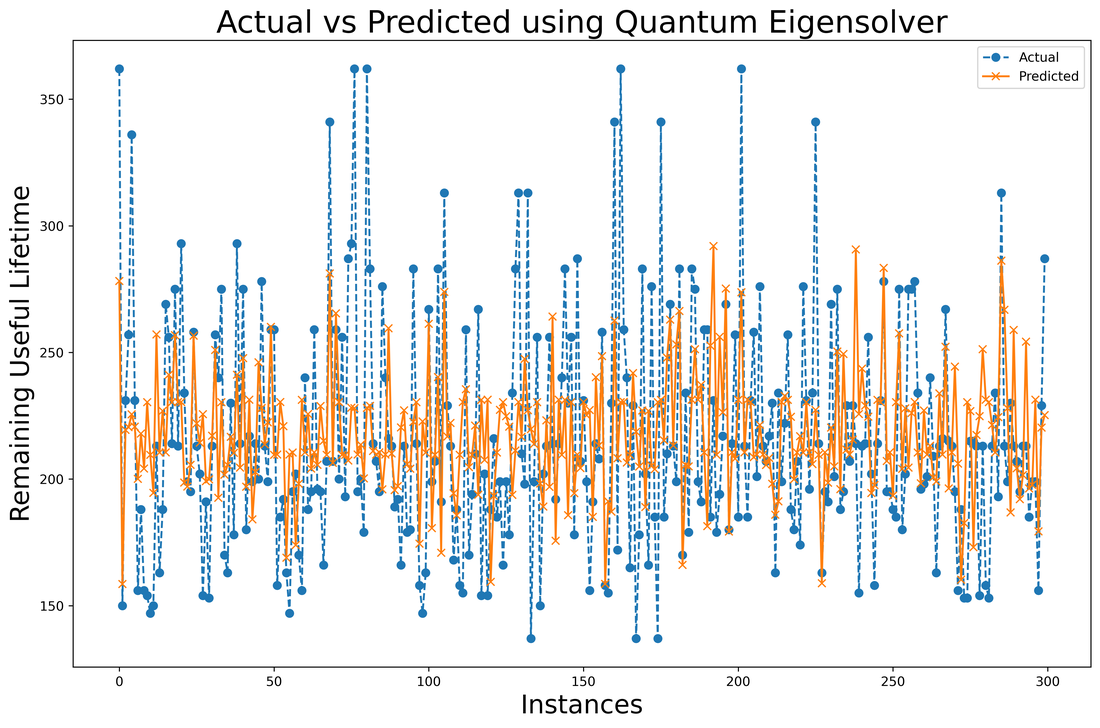
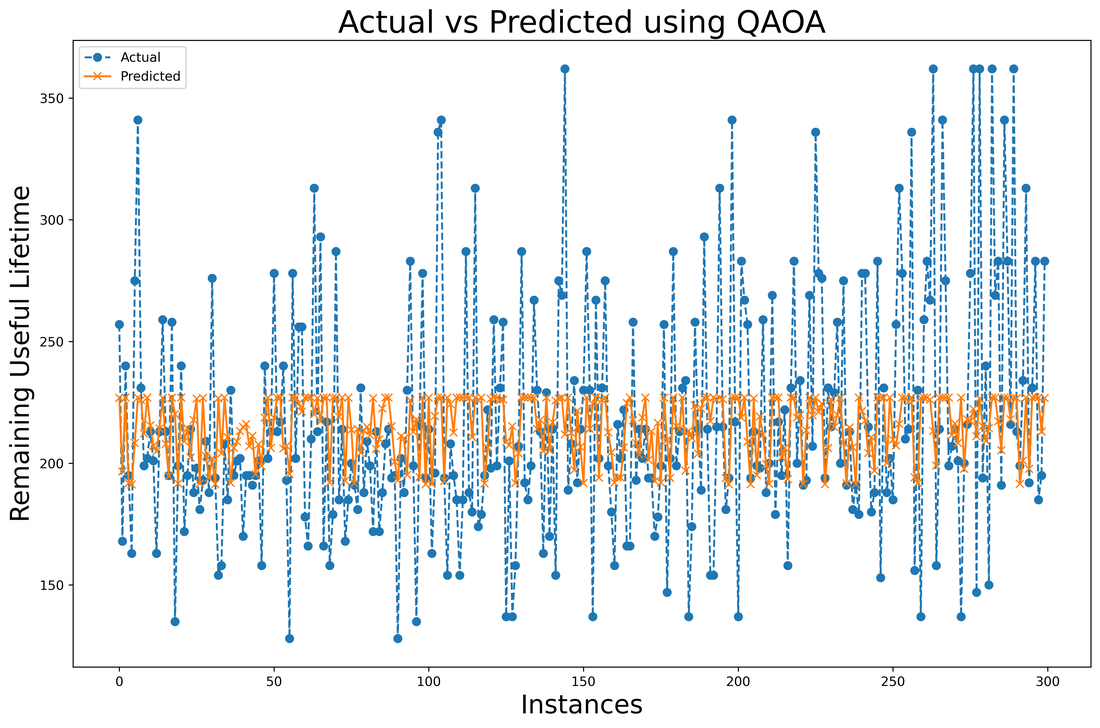
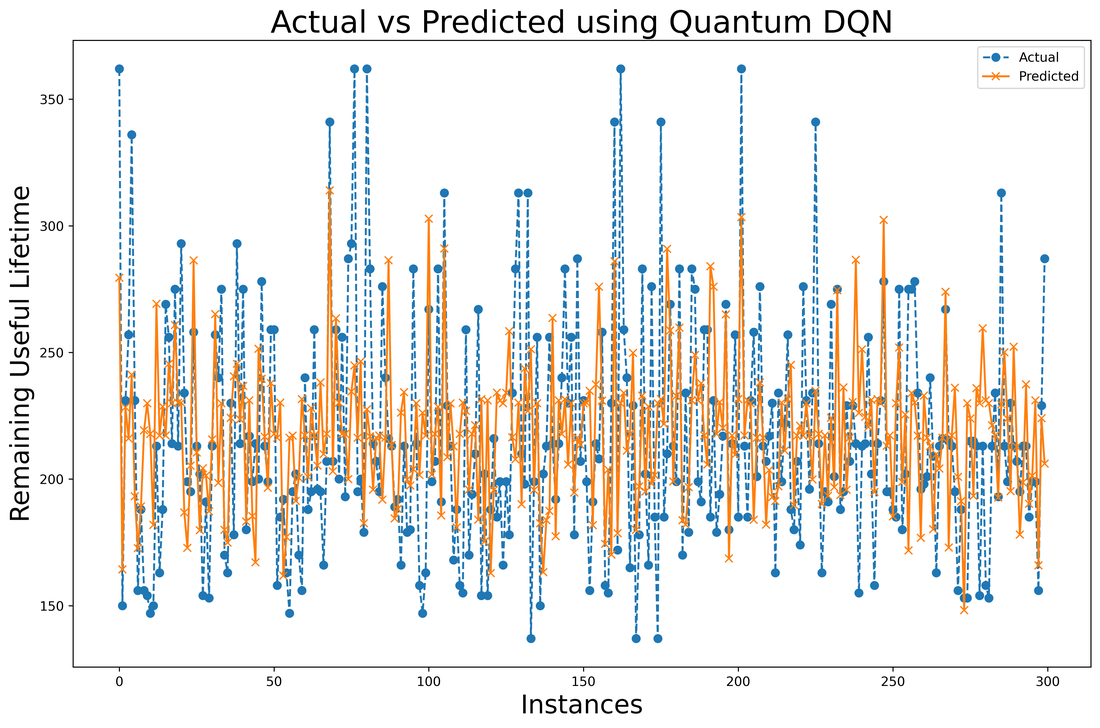
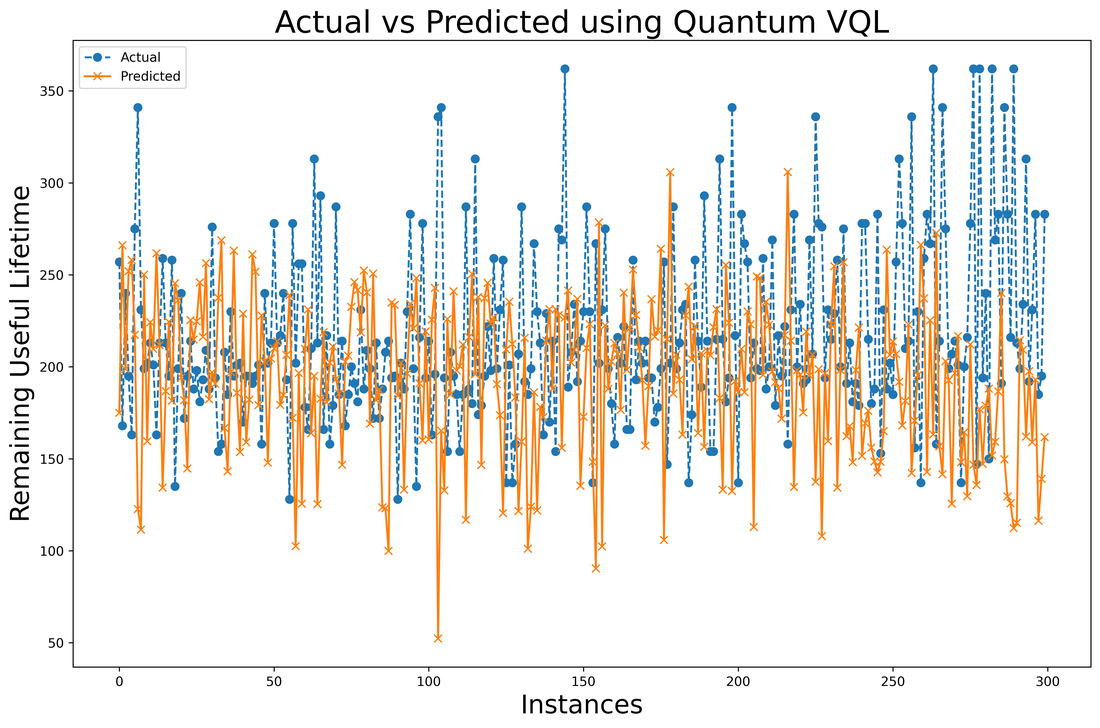
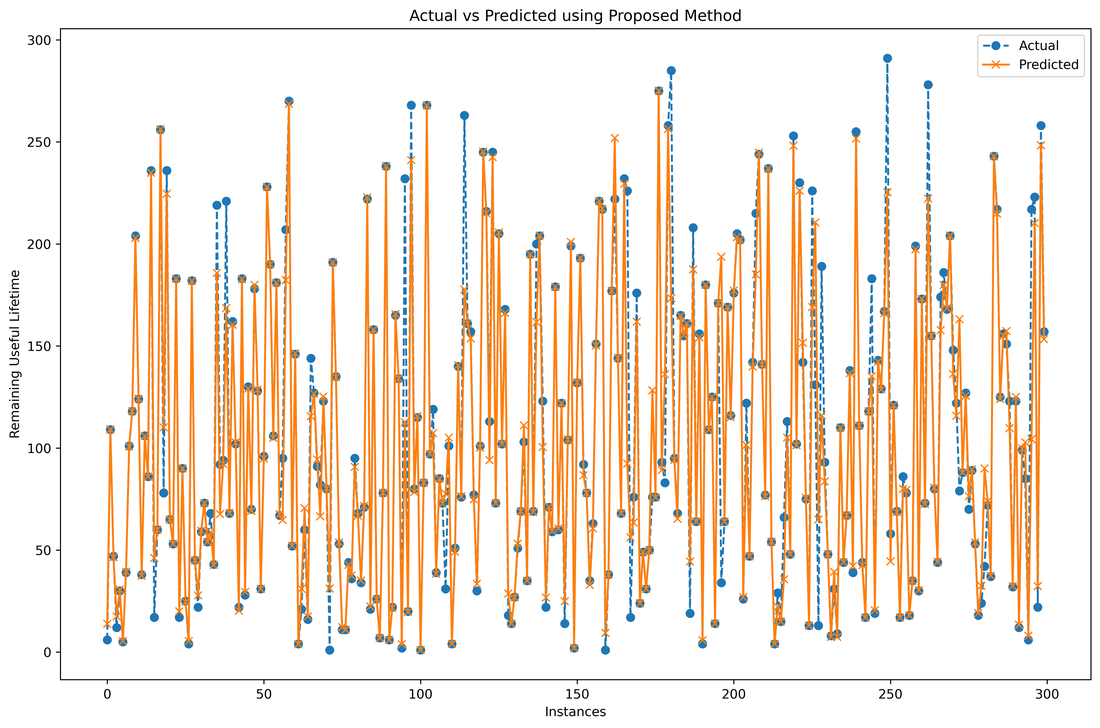
Figure 2: QAQL actual vs. predicted RUL on C-MAPSS FD001; superior tracking across degradation regimes.
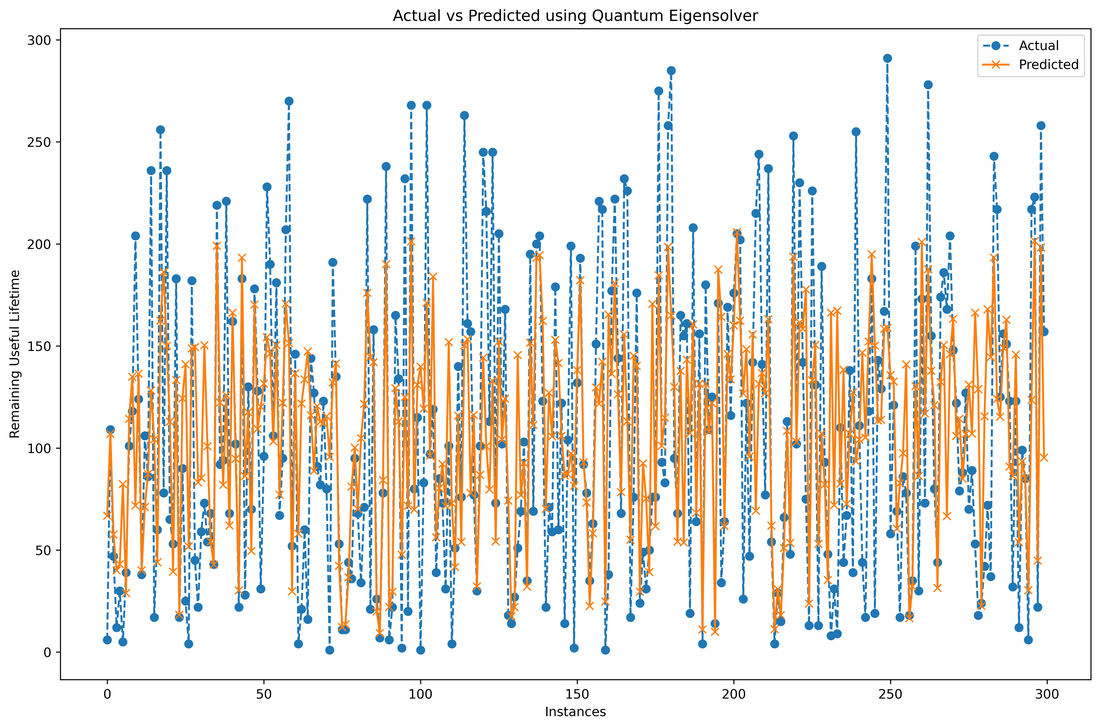
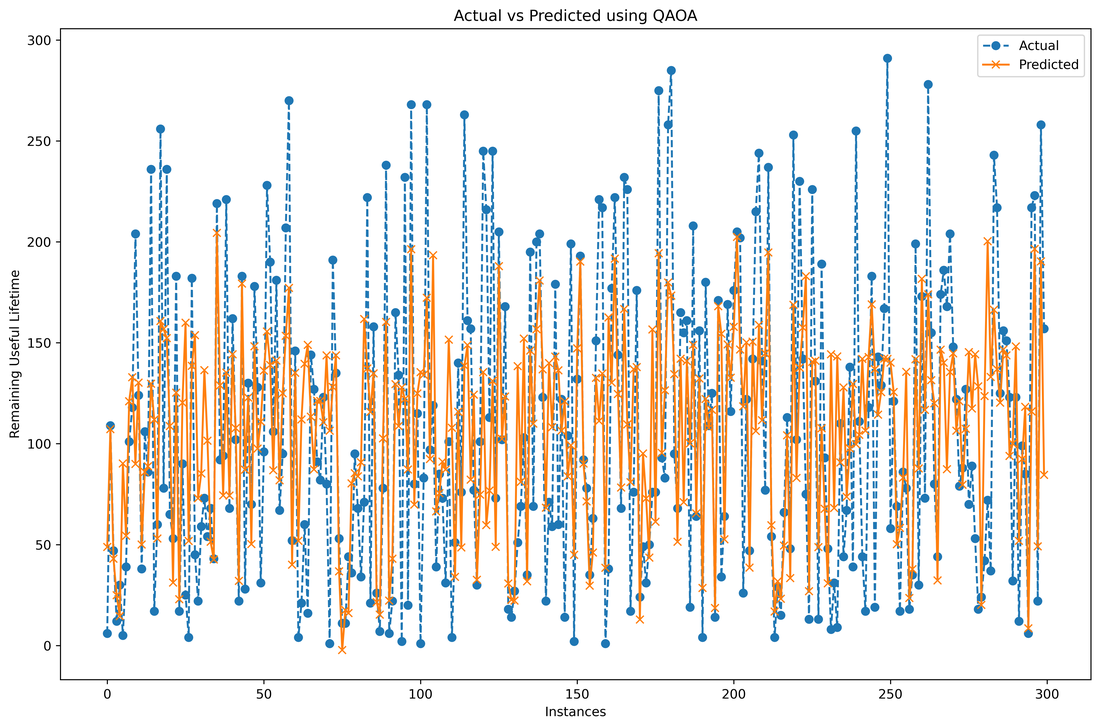
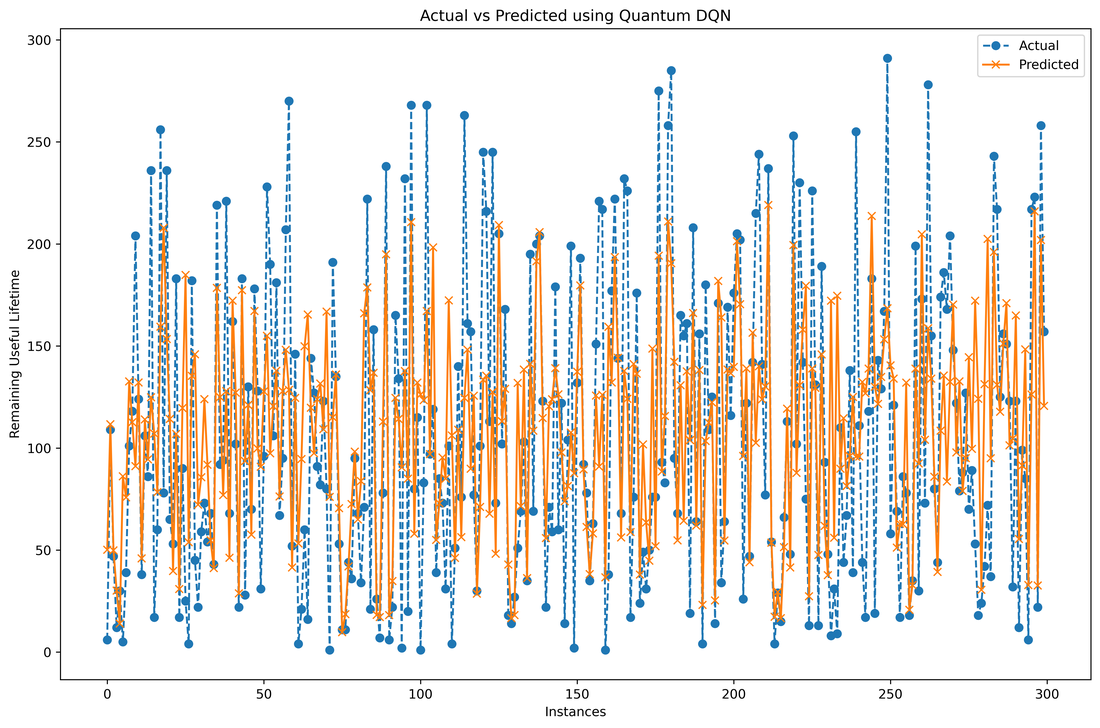
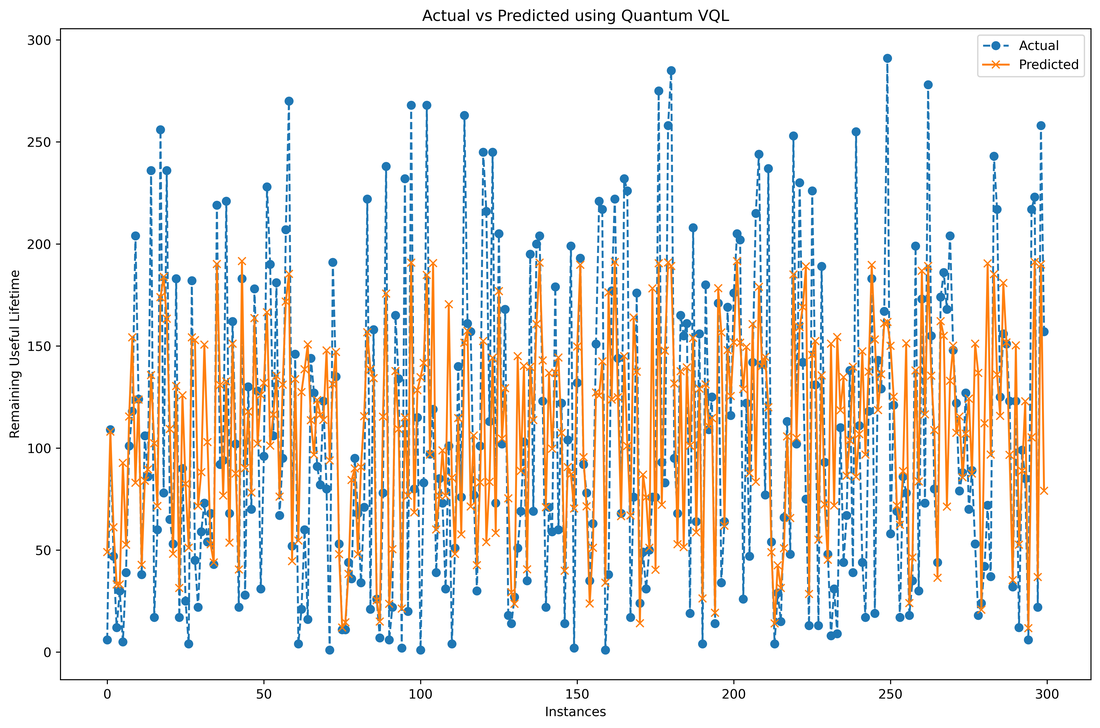
Figure 3: QAQL comparison on Predictive Maintenance, maintaining accuracy throughout device lifecycle.
The variance is substantially reduced relative to classical and quantum counterparts, indicative of repeatable annealer performance. Ablation studies confirm the criticality of quantum annealing and TD error propagation: removal of quantum annealing degrades RMSE by over 30% on both datasets.
Robustness to Multi-Condition Regimes
QAQL generalizes successfully to the challenging C-MAPSS multi-condition subsets (FD002–FD004), where it again attains the lowest RMSE (24.35 for FD002, 29.43 for FD004). The results confirm consistent tracking in highly non-stationary environments, with error figures reflecting the operational complexity rather than significant overfitting.
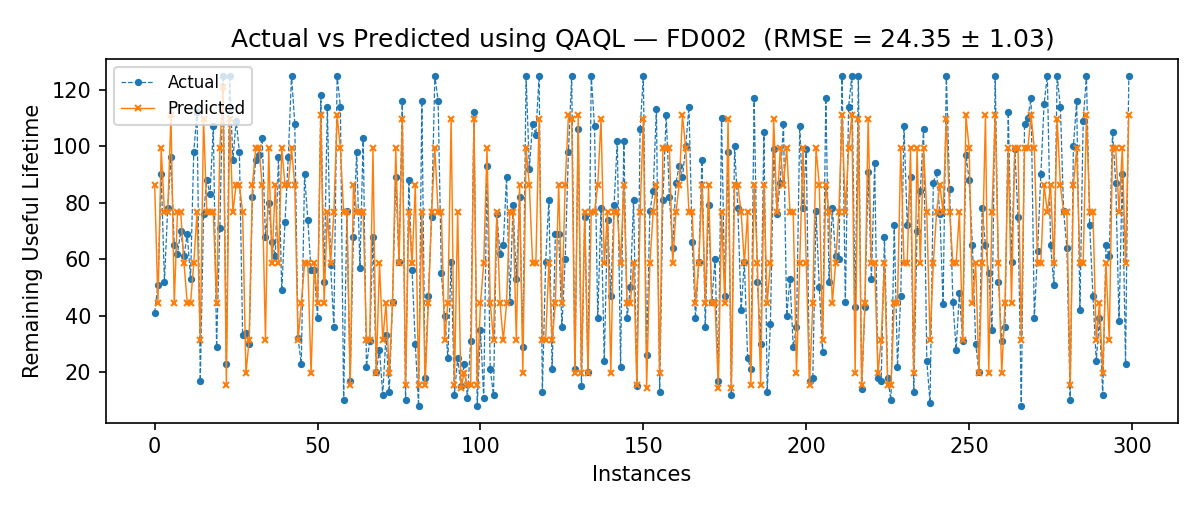
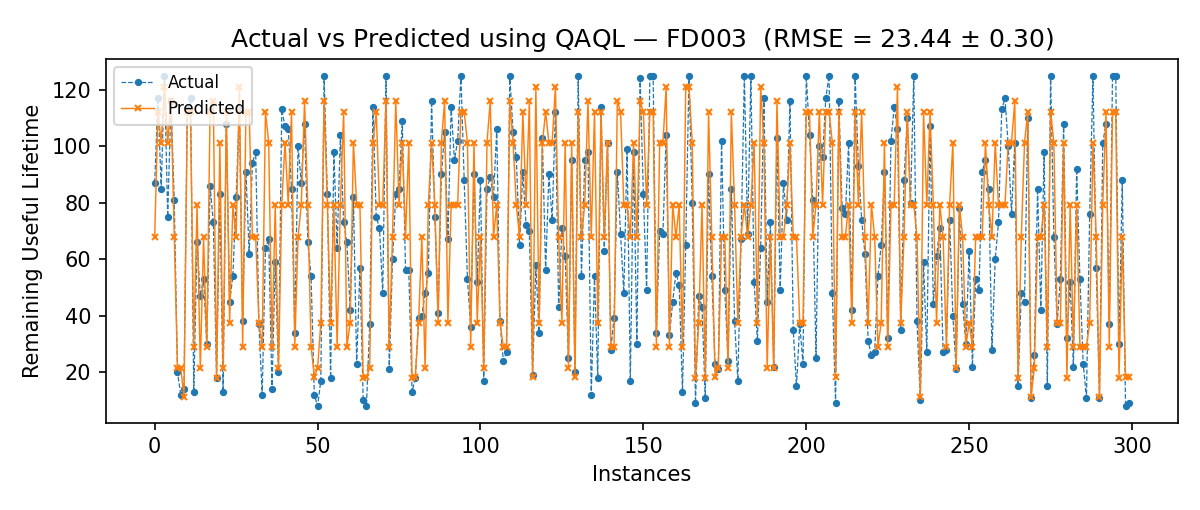
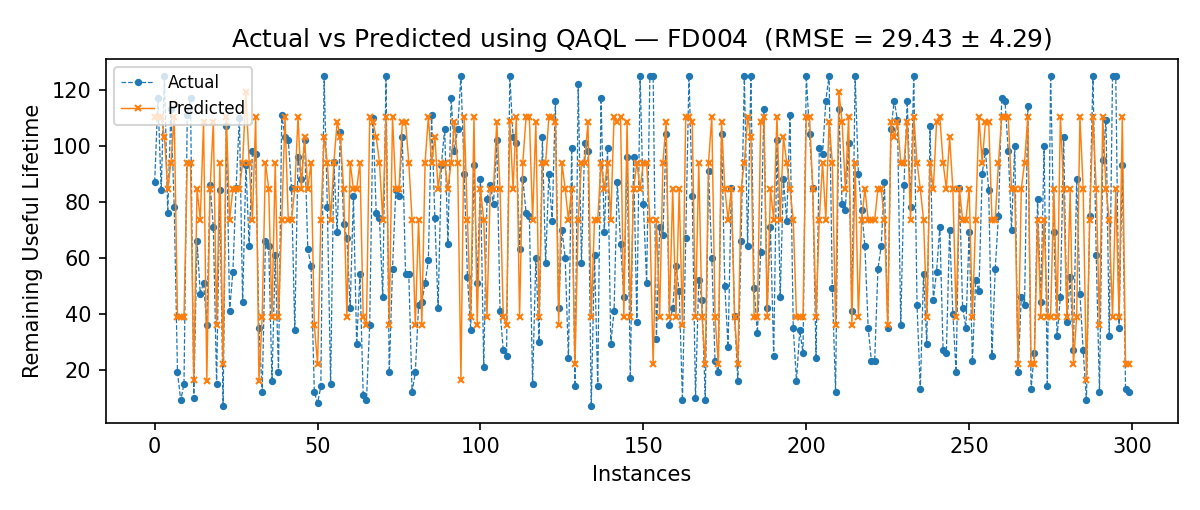
Figure 4: QAQL RUL predictions vs. ground truth on FD002–FD004, demonstrating stability under multi-regime, multi-fault conditions.
Computational Complexity and Operational Implications
QAQL's per-update complexity is dominated by QUBO encoding (O(k2)) and D-Wave hardware latency (~26ms/update). While classical Q-learning remains cheaper per-step for one-hot action spaces, QAQL's stochastic action selection translates to improved fit on rare, long-tail failures, which are critical to real-world maintenance decisions. Practical implication: a RMSE of ~11 days for device fleets aligns closely with industry maintenance windows, supporting accurate resource scheduling and asset retirement planning.
Limitations and Future Directions
Absolute benchmark error does not match highly optimized deep models on FD001, largely due to coarse action discretization and tabular representation. Current annealer architecture restricts problem size; richer action spaces will require hybrid solvers or problem decomposition. Generalization to endogenous maintenance decision MDPs (where actions influence degradation state) is a natural extension. Attribution of gain—distinguishing quantum-specific stochasticity from generic randomized selectors—remains an open question; comparison against classical stochastic exploration should be prioritized.
Conclusion
QAQL demonstrates that quantum annealing, when tightly integrated inside the RL loop as a per-step stochastic optimizer, offers tangible gains in RUL estimation accuracy and variance reduction under realistic degradation dynamics. By recasting TD updates as QUBOs solvable on hardware, QAQL sidesteps classical exploration bottlenecks and improves fit to non-convex trajectories, validated across industry-standard datasets and rigorous ablation/statistical analysis. Advancing to deep value networks, hybrid QUBO solvers, and endogenous control policies will further expand applicability in industrial prognostics and maintenance optimization.

