- The paper identifies locally-achiral manifolds as enabling universal extraction of the full TQFT partition function, including its phase information.
- It employs multi-entropy measures and gem combinatorics to construct explicit manifold probes, demonstrated through figure-8 knot derived examples.
- The study reveals that higher-dimensional obstructions, such as nonzero Pontryagin numbers, constrain probe applicability, offering a framework to distinguish non-modular topological orders.
Universal Multipartite Entanglement Probes and Locally-Achiral Manifolds
Introduction and Background
This paper addresses the fundamental problem of extracting universal topological information from the ground-state wavefunction of a topologically ordered (TO) phase using multipartite entanglement. Standard bipartite entanglement measures such as the Topological Entanglement Entropy (TEE) cannot fully classify TO phases, as they fail to distinguish states with identical TEE but distinct anyon data. Recent progress has focused on more general multipartite measures—multi-entropy measures—which generalize Rényi entropies by using replicas and permutation operators on subsystems, and whose expectation values can, for TO phases, be related to topological quantum field theory (TQFT) partition functions evaluated on manifolds constructed from the permutation structure.
A key open question addressed here is: To what extent do these multi-entropy measures provide a complete universal probe of TO, especially when the argument arg(Z(M)) of the partition function Z(M) is essential (e.g., for distinguishing a phase from its time-reversed partner, or invertible phases)? The main result is the identification and physical characterization of a class of manifolds—termed "locally-achiral" manifolds—on which the universal extraction of the full partition function, including its argument, is possible via multipartite entanglement probes.


Figure 1: Partition of the 1, 2, and 3-sphere into regions; the 3-sphere is represented as R3 compactified at infinity.
Multi-Entropy Measures and Topological Manifolds
The multi-entropy approach divides a sphere into d+2 regions (d is the spatial dimension), considers R replicas of the ground-state wavefunction, and applies permutations to each region across replicas. The expectation value of these permutation operators, on a wavefunction described by a TQFT, is closely related to the TQFT partition function Z(M) on a manifold M that encodes the permutation/gluing data. For instance, the trivial multi-entropy measure, with all permutations the identity, yields the partition function on the sphere SD obtained by gluing two D-simplices.
The connection between permutation structure and the topology of Z(M)0 is encoded via "graph-encoded manifolds" (gems). A gem is a colored, regular, bipartite graph such that the removal of any color yields graphs triangulating spheres of lower dimension, ensuring the underlying manifold is well-defined and topological. This combinatorial perspective enables systematic construction and analysis of the manifolds Z(M)1 associated with multi-entropy probes.

Figure 2: The figure-8 knot.
Local Achirality: Cancellation of Non-Universal Phase Contributions
Extracting Z(M)2 universally requires more than just magnitude extraction: the local, non-universal contributions (arising from regions of the multipartite decomposition) must not affect the phase. The main technical contribution is the introduction of the local achirality condition for a gem (and thus its associated manifold): a gem is locally-achiral if, upon removal of any color (i.e., restricting to a subgraph corresponding to the region around a "corner" of the partition), every such subgraph has a reflection positivity property. This ensures that any local, short-range entangled "counterterm" vanishes in the phase—only the global, topological data remain.
A manifold is locally-achiral if it admits some locally-achiral gem. The essential point is that, under this condition, the phase of the multi-entropy expectation value (properly normalized by magnitude) is the true topological phase Z(M)3, and is invariant under stacking with short-range entangled states or local unitary circuits.
Distinction of Theories Beyond Modular Data: The Mignard-Schauenburg Examples
One concrete application is to distinguishing modular tensor categories in (2+1)D that are not classified by modular data (Z(M)4, Z(M)5 matrices), such as the Mignard-Schauenburg (MS) examples. Here, different twisted quantum doubles Z(M)6 (with Z(M)7 a non-abelian group and Z(M)8 labeling a cohomology class) are known to have identical modular data for certain Z(M)9, but are not equivalent as anyon theories.
The paper constructs explicit (families of) locally-achiral 3-manifolds associated with the figure-8 knot—specifically, manifolds obtained by integer surgery on the knot, denoted R30. Gem constructions for these manifolds are detailed, and their associated multi-entropy measures are shown, by explicit calculation of the corresponding partition functions, to distinguish between the MS examples, even when R31 and R32 matrices do not.

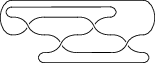
Figure 3: (a) The coloring rule for crossings; (b) Consistent coloring of the figure-8 knot for the evaluation of anyon knot invariants.
For certain infinite families, the authors prove that the expectation values on these locally-achiral manifolds provide complete invariants for distinguishing these TO phases, supporting the conjecture that multi-entropy measures built on locally-achiral manifolds are complete in (2+1)D.
Obstructions in Higher Dimensions: Pontryagin Number and T-SPTs
The analysis extends to four-dimensional manifolds. Here, an obstruction to local achirality is established: for smooth, compact, oriented 4-manifolds, any nonzero value of the (first) Pontryagin number R33 precludes the existence of a locally-achiral gem. Physically, this is rooted in the existence of beyond-cohomology time-reversal symmetry-protected topological (T-SPT) orders in 3+1D (notably, the three-fermion Walker-Wang model) whose TQFT action is proportional to the Pontryagin number mod 2.
The construction shows that if a manifold such as R34—with nonzero Pontryagin number—were locally-achiral, its ground state could be adiabatically connected to a trivial state via a path breaking time-reversal symmetry, contradicting the physical requirement for T-SPT detection. The argument extends (conjecturally) to higher dimensions, where all Pontryagin numbers must vanish for the existence of locally-achiral gems.
The paper further provides an explicit multi-entropy probe, constructed using the permutation structure encoding the gem of R35, which functions as an entanglement order parameter for the 3FWW state—even in the absence of a locally-achiral gem—when restricted to time-reversal-invariant systems.
Implications and Future Directions
The identification of local achirality as the topological criterion for universal entanglement extraction of R36 has far-reaching implications for both practical TO phase identification and theoretical classification:
- For (2+1)D TO, the results provide evidence that, modulo possible exceptions related to invertible T-SPTs in higher dimensions, multi-entropy measures based on locally-achiral manifolds suffice to distinguish all phases.
- The connection to gem combinatorics enables both explicit computer searches for diagnostic manifolds and systematic theoretical analysis.
- The precise relation between locally-achiral manifolds and the absence of nontrivial Pontryagin (or Stiefel-Whitney) numbers hints at a deep topological-physical correspondence constraining possible multipartite entanglement invariants.
- The framework lays foundational groundwork for extending multipartite entanglement diagnostics to fermionic systems, including the explicit incorporation of spin structure and sign data into the permutation/gem framework.
Conclusion
This work establishes local achirality as the central topological property necessary for universal entanglement probes of topological order. By precisely characterizing when universal R37 extraction is possible via multipartite entanglement—both in (2+1)D, where it connects to completeness of phase invariants, and in higher dimensions, where it is obstructed by nontrivial Pontryagin numbers—the paper provides a unifying perspective at the intersection of quantum entanglement, TQFT, and manifold topology. The framework offers a promising route for complete entanglement-based classification of TO phases and highlights new directions for probing invertible phases, SPTs, and fermionic phases via multipartite entanglement measures.