- The paper establishes that interband plasmon modes exhibit monopole structures and finite vorticity connected to the Weyl node's Chern number.
- It employs a quantum geometric framework, using Bloch band analysis and the RPA to rigorously characterize plasmon envelope functions.
- The findings highlight distinct optical selection rules and nonlinear responses that differentiate topological plasmons from conventional modes.
Introduction
This work rigorously investigates the quantum geometric and topological properties of bulk plasmon excitations in three-dimensional (3D) Weyl metals. By formulating the plasmon problem using the quantum geometry of Bloch bands, the authors characterize how plasmon modes in Fermi surfaces enclosing topological Weyl points encode both the band topology (Chern number) and the quantum metric. The study demonstrates that these plasmon modes possess a monopole structure, have topologically protected vorticity, and exhibit distinctive optical selection rules absent in conventional metals.
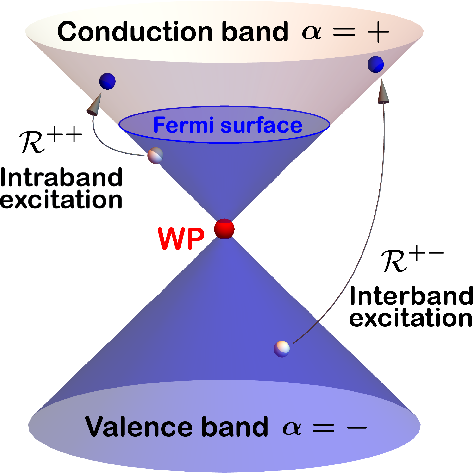
Figure 1: Energy bands near a Weyl point (WP) enclosed by a Fermi surface. Both intraband and interband plasmonic processes contribute to the plasmon envelope function, with the interband component displaying monopole structure and finite vorticity in relative momentum.
Plasmon Envelope and Quantum Geometry
The plasmon excitation is expressed as a coherent superposition of particle-hole states near the Fermi level, parameterized by the envelope function Rkαβ(Q) with center-of-mass (COM) momentum Q. The analysis incorporates both intraband (α=β) and interband (α=β) contributions. The Hamiltonian for a single Weyl node is diagonalized into energy eigenstates, and the envelope function’s transformation properties are derived using band space unitary rotations, in which the Berry connection and quantum metric tensors arise naturally from the expansion of the form factor matrix for electron-electron interactions.
Crucially, the interband components of the plasmon envelope function, which are negligible in conventional Fermi liquids, display singular quantum geometric and topological features. Specifically, they acquire monopole (vortex) structures in the space of relative momentum, which are intimately connected with the Weyl node’s Chern number.
Topological Characterization: Vorticity and Monopole Harmonics
Solving the eigenproblem for the full Bethe-Salpeter kernel in the random phase approximation (RPA), the authors show that the interband plasmon components are characterized by spin-weighted (monopole) spherical harmonics. These components possess finite vorticity ζ=±2, equal to twice the Weyl point's Chern number. The vorticity manifests as two vortices or antivortices aligned with the COM momentum direction Q^. In contrast, the intraband components exhibit a p-wave structure with no vorticity.
(Figure 2)
Figure 2: (a) Intraband plasmon envelope has a nodal plane with no topological vorticity. (b) Interband R+− component exhibits a vorticity ζ=−2 as two vortices around the Q^ axis. (c) Interband Q0 shows Q1, two antivortices around Q2.
This topological distinction leads to fundamentally different physical properties for plasmons in topological vs. trivial Fermi surfaces. The plasmon frequency dispersion is also modified by quantum geometry, where the leading-order redshift from interband processes is logarithmic in the ratio of bandwidth to Fermi energy and can suppress plasmonic formation if the Fermi surface is too small.
Optical Selection Rules and Dipole Moment
The optical response of Weyl plasmons is formulated using the density matrix formalism under an external linearly polarized electric field. The plasmon effective electric dipole moment Q3, originating from the quantum-geometric contributions of the Berry connection, aligns strictly with the COM plasmon momentum Q4. This is in contrast to conventional (trivial) plasmons which can, due to symmetry, couple to light of arbitrary polarization.
The selection rule derived implies that only light linearly polarized along the direction of Q5 can efficiently excite the topological plasmon mode. This property results in highly anisotropic optical activity and can be exploited to distinguish topological plasmons from those in non-chiral metals.
Experimental Signatures and Nonlinear Effects
The topological dipole character of Weyl plasmons implies broken inversion symmetry per Weyl node and enables nonlinear optical phenomena such as second harmonic generation within a single node. In realistic multivalley Weyl materials, symmetry-imposed cancellations may occur for the total dipole response, but breaking global inversion symmetry restores these nonlinear effects, enabling unique plasmon-induced photocurrents and high-order harmonics.
Observation of such effects would require Fermi surfaces that are sufficiently small to suppress conventional plasmon spectral weight, thereby enhancing the topological plasmon visibility—a challenging but experimentally viable scenario in certain semi-metals.
Conclusion
This paper establishes that bulk plasmons in Weyl metals inherit the quantum geometry and topology of the underlying electronic bands. The envelope functions of interband plasmons display quantized vorticity and monopole structures tied to the Weyl node Chern number. The resultant finite, directionally constrained electric dipole moments engender unique optical selection rules and nonlinear optical responses specific to topological Fermi surfaces. These findings open pathways for plasmon-based probes of band topology and suggest novel photonic applications exploiting quantum geometric effects in gapless topological systems.

