- The paper introduces a hybrid formalism combining exact Kerr geodesics with Newtonian environmental effects to capture the complex orbital evolution of asymmetric binaries.
- It demonstrates that relativistic corrections significantly diverge from Keplerian predictions, especially in orbits with high eccentricity and inclination subject to repeated disk crossings.
- The study reveals that disk microphysics, rather than SMBH spin, predominantly drives the secular damping and circularization of orbits in accreting environments.
Orbital Evolution of Asymmetric Binaries in Accreting Environments
Introduction and Theoretical Framework
This work investigates the secular orbital evolution of extreme mass-ratio binaries, particularly compact objects like stellar-mass black holes (BHs) or neutron stars, as they inspiral within thin accretion disks around supermassive black holes (SMBHs). The study develops a hybrid formalism: the conservative motion is modeled by exact Kerr geodesics, while dissipative environmental effects (hydrodynamic drag, dynamical friction, mass accretion) are incorporated using effective Newtonian prescriptions. Two canonical accretion disk models are employed: the Sirko-Goodman (SG) model, incorporating disk self-gravity and Keplerian dynamics, and the Penna model, extending the Novikov-Thorne (NT) relativistic thin-disk solution with GRMHD calibration.
The secondary object experiences repeated disk crossings, which drive momentum and mass exchange and modulate the orbital parameters over secular timescales. The complexity of the interaction increases for generic, inclined, and eccentric orbits, as environmental torques and hydrodynamic effects are highly sensitive to the local disk structure and the dynamical state of the binary.
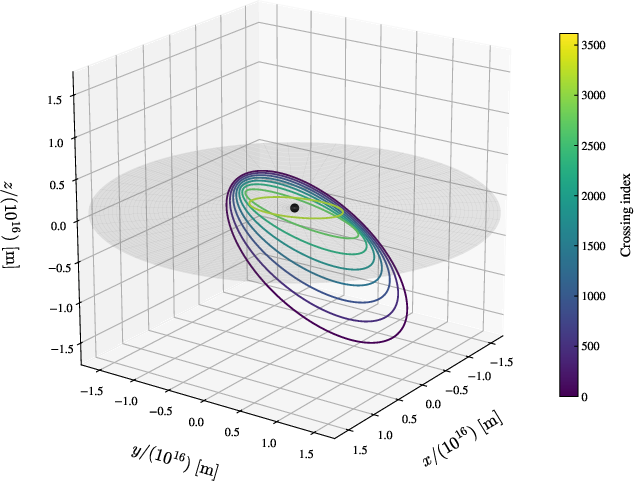
Figure 1: Orbital evolution of a compact object around a spinning SMBH within a thin accretion disk; repeated disk crossings yield nonlinear changes in inclination and eccentricity, with rapid planar alignment and subsequent circularization.
Numerical Implementation and Methodology
The numerical scheme is initialized with an orbital triplet: semi-major axis a, eccentricity e, and inclination ι, from which the constants of motion (E,L,Q) and four-velocity are established. Between successive disk crossings, the orbital evolution is calculated using the Mino-time parametrization of bound timelike Kerr geodesics. At each crossing, the position is determined by a root-finding procedure for θ(λ)=π/2, and the effects of dynamical friction, hydrodynamic drag, and mass accretion are applied.
Dynamical friction follows the Ostriker formalism, which distinguishes subsonic and supersonic regimes via the local Mach number. Mass accretion is handled through the Bondi-Hoyle-Lyttleton prescription, with velocity updates preserving conservation of momentum. Hydrodynamic drag is also included, but its contribution for BH secondaries is found to be subdominant compared to dynamical friction except for highly extended objects.
The disk profile (density ρ, sound speed cs, scale height H) is evolved self-consistently along the orbit, with significant differences observed between SG and Penna models, especially in the relativistic regime (R≲104M).
Large Separation and Secular Dynamics
Simulations at large separations (a0=106M) reveal a characteristic two-stage orbital evolution driven by disk-induced dissipation: rapid alignment of the orbital plane with the disk (occurring over timescales roughly an order of magnitude shorter than circularization), followed by secular damping of eccentricity toward a quasi-circular coplanar configuration. The characteristic circularization timescales span e0 yr, with a moderate dependence on secondary mass.
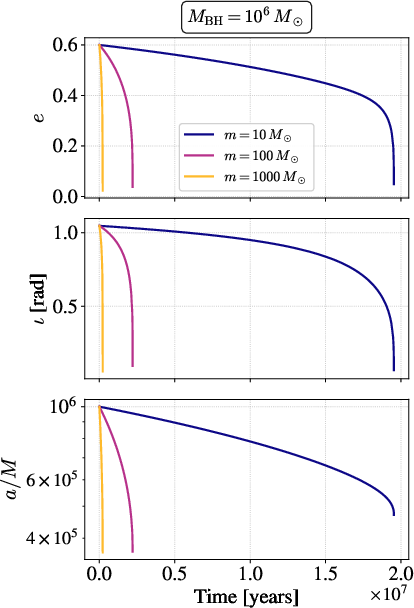
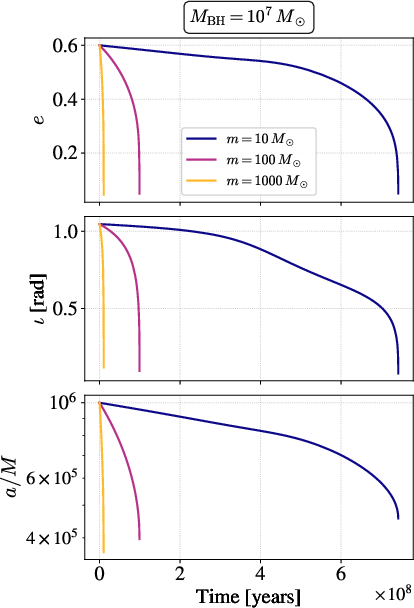
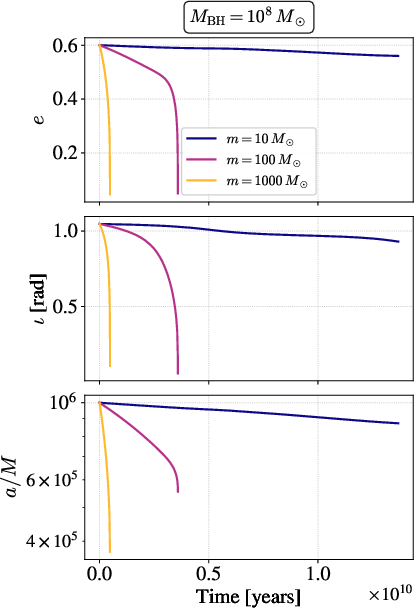
Figure 2: Secular evolution of eccentricity, inclination, and semi-major axis for various primary and secondary masses; all cases show fast inclination damping and slower eccentricity reduction under disk-driven dissipation.
Keplerian versus Relativistic Evolution
A key result is the demonstration that even at modest compactness, secular relativistic corrections induce significant cumulative deviations compared to a purely Keplerian description. The mismatch between the two approaches grows nonlinearly with the number of disk crossings, with higher eccentricity and inclination accelerating divergence. Particularly, moments of pericenter passage in relativistic orbits experience much stronger environmental dissipation, an effect that is systematically underestimated in classical treatments.
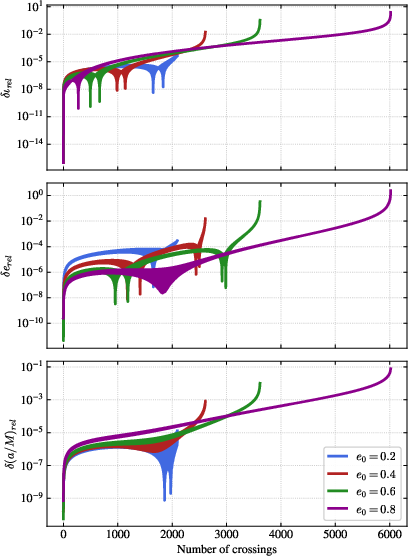
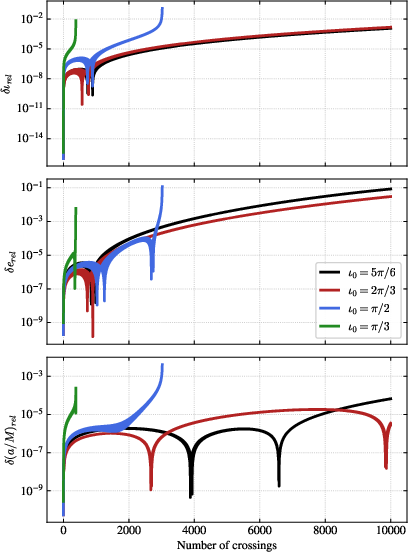
Figure 3: Quantitative comparison of Keplerian and Kerr-geodesic secular evolution; discrepancies in orbital parameters accumulate even at large separations, emphasizing the necessity of relativistic dynamics.
With initial separations at e1, relativistic effects become more pronounced. Simulations indicate a rapid breakdown of Keplerian approximations for both the dissipation rates and the secular geometry, especially for high-eccentricity, high-inclination orbits. The number, geometry, and frequency of disk crossings are modulated by precessional effects, and the local dissipation rates are sensitive to relativistic corrections in the secondary's four-velocity.
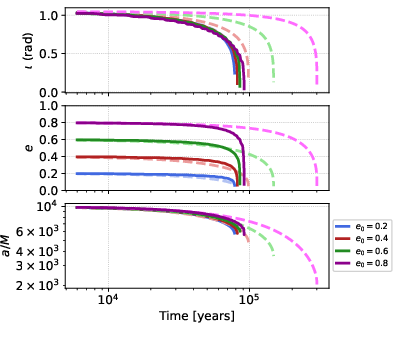
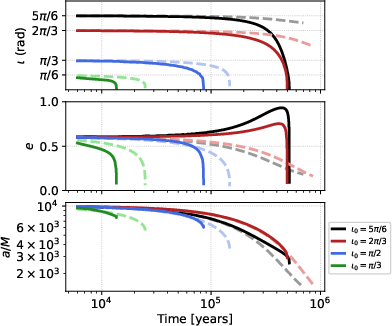
Figure 4: Strong relativistic effects on secular inclination, eccentricity, and semi-major axis damping, demonstrating pronounced divergence in the intermediate regime.
Impact of Disk Structure and SMBH Spin
Systematic comparison between SG and Penna disk models at e2 reveals that relativistic disks (Penna/NT) have reduced midplane densities and larger scale heights compared to the SG prescription. As a result, environmental dissipation, circularization, and migration proceed more slowly: the choice of disk model is quantitatively more important than the inclusion of SMBH spin for secular orbital evolution.
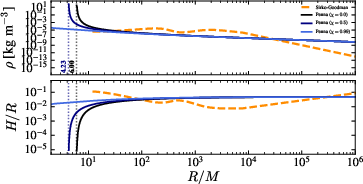
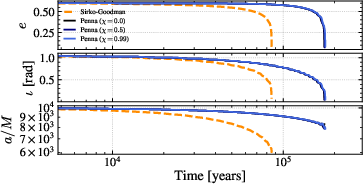
Figure 5: Disk structure (density, aspect ratio) differences between SG and Penna models (top) with corresponding slower orbital evolution (bottom) in Penna disks.
The efficiency of circularization, measured by the number of disk crossings to achieve low eccentricity, is almost invariant under changes in SMBH spin for both models. This points to a dominant role for disk microphysics over spin-dependent gravitational effects, at least for the orbital regimes under consideration.
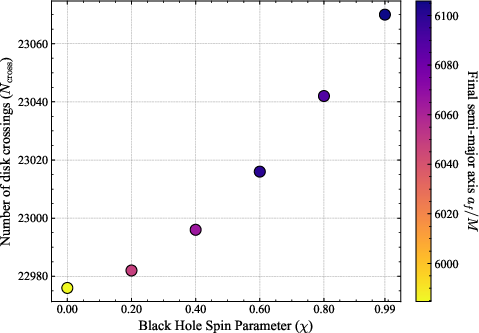
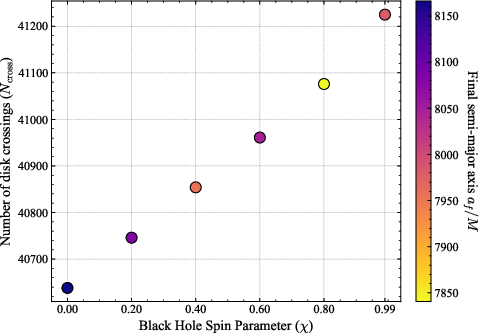
Figure 6: Number of disk crossings to circularization depends very weakly on SMBH spin, but strongly on disk prescription.
Astrophysical Implications and Environmental Modulation
The study has several implications for the interpretation of compact-object binary evolution in AGN disks. It provides a crucial reference for constructing waveform templates and inferring binary parameters when GW signals are modulated by environmental effects. For EMRIs, the results imply that LISA-band inspirals may retain significant eccentricity and alignment information reflective of their dynamical history, with environmental dissipation altering the final observable state. Additionally, the modulation of disk crossing timescales and the approach to circularization provide a theoretical underpinning for interpreting quasi-periodic eruption (QPE) phenomena, whereby the alignment and circularization of embedded objects can govern the interval structure and recurrence of high-energy flares.
In the regime considered here, disk-driven effects dominate over gravitational radiation reaction; GW emission only becomes significant at substantially smaller separations and higher eccentricities.
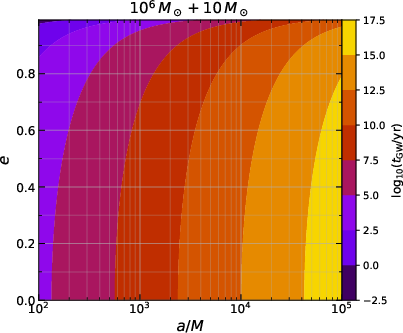
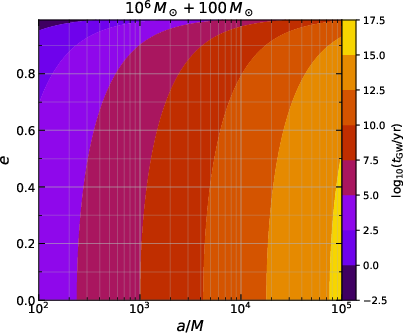
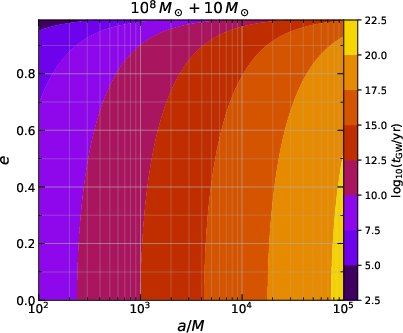
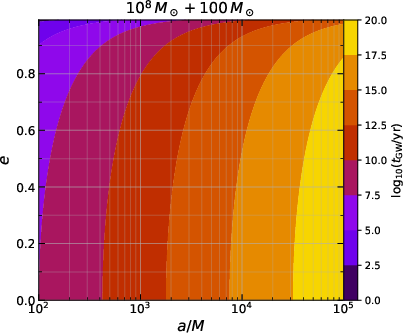
Figure 7: GW-driven merger times for EMRIs in the relevant parameter range are always subdominant compared to dissipation by repeated disk crossings.
Conclusion
This work rigorously demonstrates that modeling both strong-field relativistic dynamics and realistic accretion disk structure is essential for accurately predicting the secular evolution of asymmetric binaries in accreting environments (2606.18341). Keplerian orbital models and simplistic disk prescriptions systematically overestimate environmental dissipation, planar alignment, and orbital decay rates, particularly for eccentric and inclined orbits.
Theoretical implications extend to waveform modeling, population synthesis of LISA-detectable EMRIs, and electromagnetic counterparts. Practically, waveform template construction and inference pipelines must incorporate relativistic effects and disk model uncertainties to avoid measurement biases. Future work should extend this framework to fully relativistic treatments of environmental interaction (beyond the effective prescriptions used here) and incorporate additional physical ingredients such as magnetic fields, disk turbulence, and time-dependent accretion structures.
The hybrid approach outlined here provides an essential bridge between gravitational theory, astrophysical modeling, and future observational campaigns aiming to distinguish environmental imprints from fundamental physics in high-precision GW data.

