Ice Giants Revisited: Uranus and Neptune as Magma Ocean Worlds
Abstract: Uranus and Neptune are commonly interpreted as volatile-rich "ice giants", an assumption that underpins most interior models. Here we show that their observed radii, bulk densities, gravitational harmonics, normalized moments of inertia, intrinsic luminosities, and key features of their atmospheric compositions are consistent with interiors comprising supercritical, hydrogen-rich magma oceans overlain by H2-rich envelopes. Our results, based on three fit parameters for each planet, provide a parsimonious explanation for the structures, thermal states, and atmospheric chemistries of Uranus and Neptune. We find that the Solar System's ice giants are better understood as magma-ocean giants, with origins parallel to those of sub-Neptune gas-dwarf planets. A continuum among gas dwarf planets permits Neptune and Uranus to serve as accessible, data-driven test cases for structure models and material properties used to understand sub-Neptunes.
- New indication for a dichotomy in the interior structure of Uranus and Neptune from the application of modified shape and rotation data (2012)
- Uranus and Neptune as methane planets: producing icy giants from refractory planetesimals (2024)
- H$_{2}$-H$_{2}$O demixing in Uranus and Neptune: Adiabatic structure models (2024)
- Compositional Convection in the Deep Interior of Uranus (2021)
- Thermodynamically Governed Interior Models of Uranus and Neptune (2020)
- The measured compositions of Uranus and Neptune from their formation on the CO iceline (2014)
- Ice Giants (2025)
- Different Inhomogeneous Evolutionary Histories for Uranus and Neptune (2025)
- An idealized general circulation model for the atmospheric circulation on the ice giants (2025)
- Icy or Rocky? Convective or Stable? New interior models of Uranus and Neptune (2025)
Summary
- The paper reinterprets ice giants by proposing a magma ocean structure featuring supercritical silicate–iron cores overlaid by hydrogen-rich envelopes.
- The paper employs a three-parameter model with ab initio equations of state and MCMC exploration to accurately reproduce gravitational moments, radii, and thermal observables.
- The paper links ice giants to sub-Neptune exoplanets, reconciling discrepancies in atmospheric chemistry and luminosity through a unified formation framework.
Reinterpreting Uranus and Neptune: From Classic Ice Giants to Magma Ocean Worlds
Introduction and Motivation
"Ice Giants Revisited: Uranus and Neptune as Magma Ocean Worlds" (2606.18219) presents a quantitative framework that challenges the prevailing view of Uranus and Neptune as "volatile-rich ice giants" dominated by water, ammonia, and methane mantles encasing small rocky cores. Instead, the authors model Uranus and Neptune as hydrogen-rich, supercritical silicate–iron magma ocean planets, overlain by hydrogen-dominated envelopes. This alternative paradigm is physically motivated by recent progress in material equations of state, cosmo- and astrochemical constraints on planet formation, and observed exoplanet populations. The work directly links the solar system’s ice giants to the rapidly growing population of sub-Neptune gas dwarfs, characterizing all as “magma ocean giants”.
Observational Constraints and Formation Considerations
The canonical three-layer (rock–ice–H/He) model for Neptune and Uranus is not strongly required by constraints from J2, J4, normalized moment of inertia, radius, and atmospheric temperature/luminosity. Instead, reinterpretation of formation cosmochemistry—the likely positions of snowlines in the solar nebula at the planets' formation epoch, and the ice/rock fractions in prevailing solid planetesimals—points to progenitors that are only modestly ice-rich and could be rock-dominated. Empirical evidence from Kuiper belt objects and comets indicates maximum ice fractions of 25–30% by mass, inconsistent with the >50% “ice-dominated” assumption.
The authors further note that primary composition is decoupled from formation location due to post-accretion chemical processing: substantial water can be produced internally from hydrogen–silicate reactions at high P,T and is not solely delivered as primordial ice. Recent DFT-MD and experimental studies [gilmore_core-envelope_2025; Young_2024; Miozzi2025] show that at the pressures and temperatures prevalent in these interiors, silicates, iron, and hydrogen form single, supercritical, fully miscible phases—not discrete layers. This necessitates reconsideration of what “rocky” and “icy” mean in the planetary context.
The Magma Ocean Model: Structural and Physical Principles
The physical structure posited in this study is a core–envelope continuum: a central, supercritical silicate–iron–hydrogen “magma ocean” surrounded (at a composition- and temperature-dependent binodal boundary) by an H2-rich, less dense envelope. The interface between these regions corresponds to a first-order phase boundary (the binary MgSiO3–H2 binodal, previously quantified by Gilmore & Stixrude [gilmore_core-envelope_2025]). At the base of the envelope, a Ledoux-stable region forms due to molecular weight gradients, further inhibiting convection and reducing luminosity, particularly in Uranus.
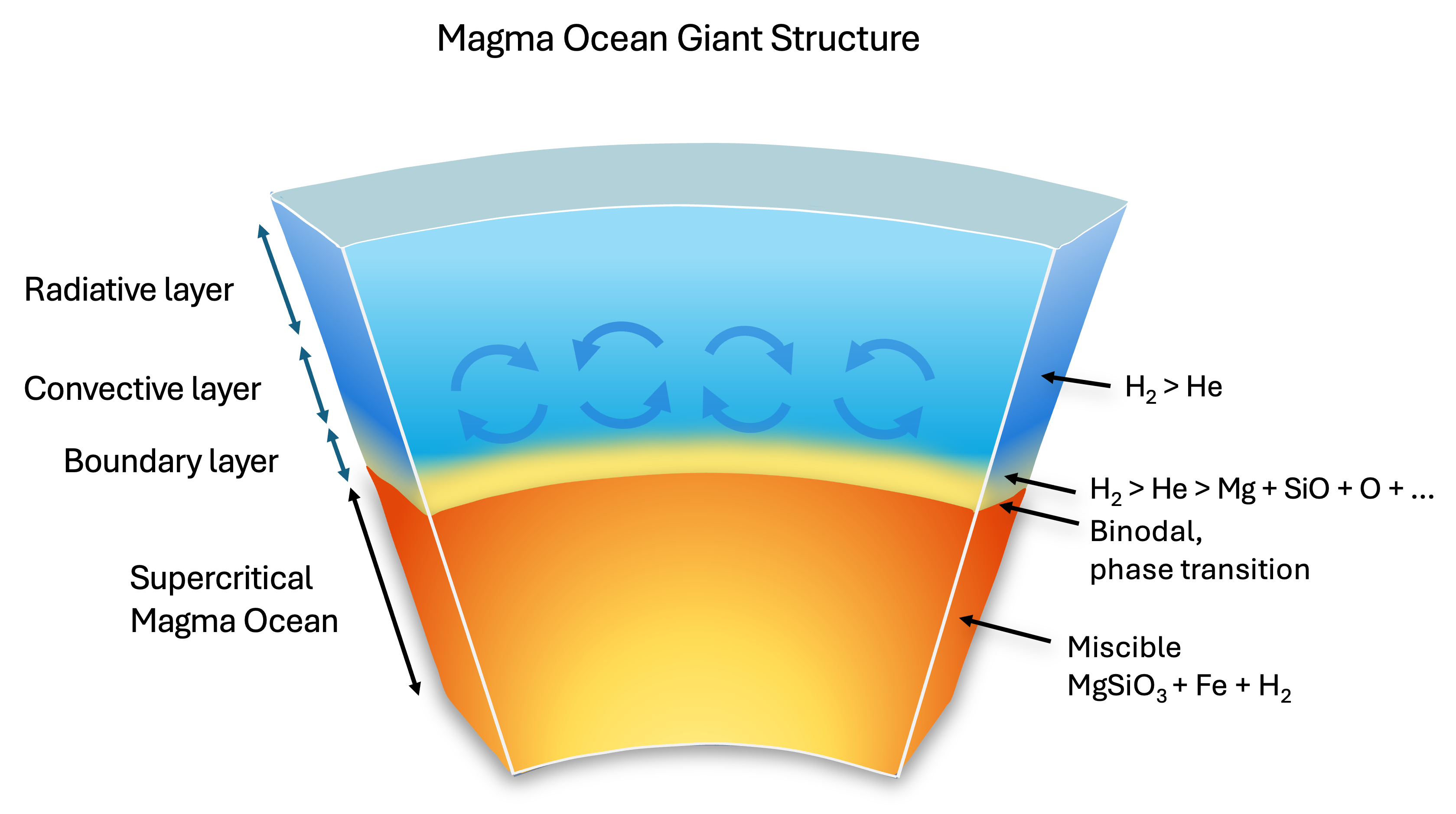
Figure 1: Schematic of the layered structure of Neptune and Uranus as inferred in the magma ocean model: an extended, deep supercritical silicate-iron-hydrogen core, Ledoux-stable boundary, and hydrogen-rich envelope.
Model Implementation and Fitting to Observables
The authors employ a planet structure solver informed by ab initio and experimental equations of state for MgSiO3–H2–Fe supercritical fluids. The model is parameterized by just three free parameters per planet: the pressure at the binodal boundary, the total hydrogen mass fraction, and the Rayleigh number ratio for the envelope (Ra/Racrit), which controls boundary layer width and thus intrinsic luminosity.
For both Uranus and Neptune, the model is constrained to fit:
- Mass and 1-bar equatorial radius,
- Gravitational moments (J2, J40, with explicit wind-induced dynamic corrections from wind field modeling),
- Normalized moment of inertia,
- 1-bar atmospheric temperature,
- Intrinsic luminosity.
Markov Chain Monte Carlo (MCMC) exploration of parameter space yields model realizations consistent with all key observables for both planets.
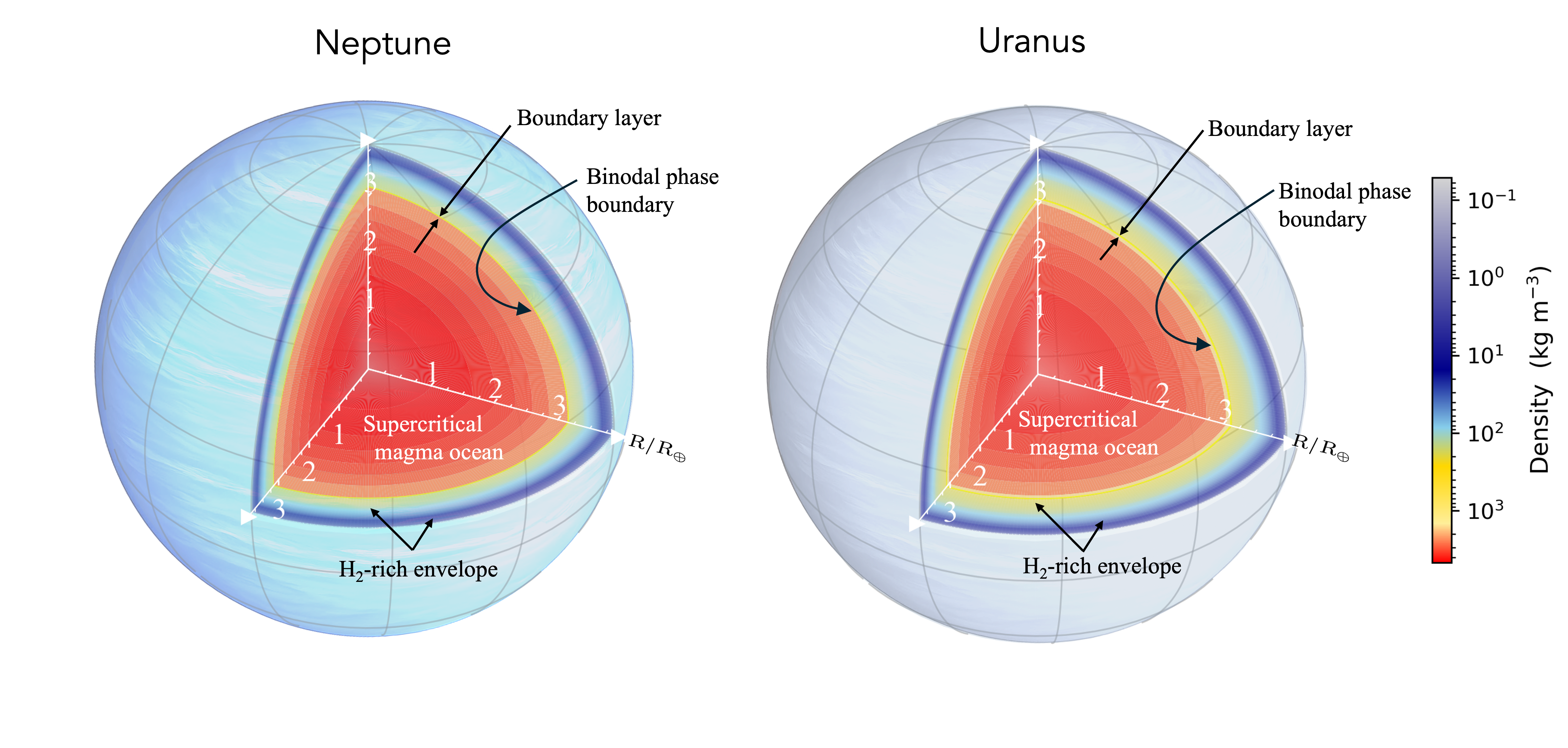
Figure 2: Density versus radius profiles for the derived models of Neptune and Uranus; the narrow Ledoux-stable boundary layer at the base of the envelope is apparent.
For Neptune, the best-fit hydrogen fraction is 13% by mass, binodal pressure 5.4 GPa; for Uranus, slightly higher at 14.4% HJ41 by mass, binodal pressure 7.0 GPa. The normalized moments of inertia and gravity moments match static+dynamic-corrected values within or near 1J42, and intrinsic luminosities are reproduced without explicit tuning. The only significant residual is a J4312 K overestimate of Neptune’s 1-bar temperature, which is argued to fall within model opacity systematics.
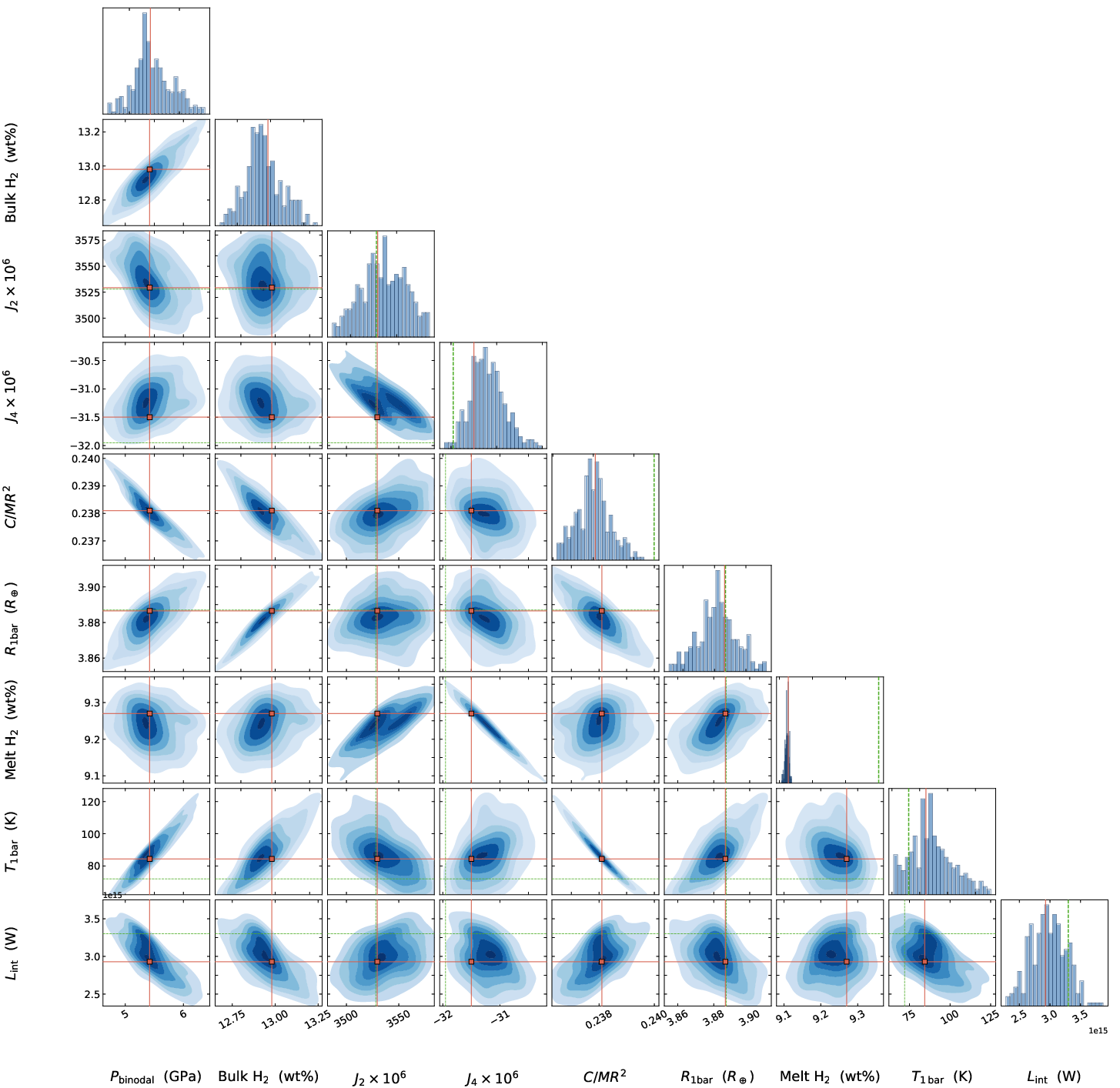
Figure 3: Marginalized MCMC posterior (corner plot) for Neptune showing parameter correlations; especially strong are binodal pressure vs HJ44 fraction, and HJ45 fraction vs J46.
Thermochemical and Physical Implications
The structural phase boundary is not arbitrary: its J47–J48–composition behavior is anchored by first-principles DFT-MD simulations and experimental data, and is directly responsible for setting the mass partitioning and radii. The supercritical core's density is greatly reduced, and its compressibility increased, relative to pure MgSiOJ49 due to HP,T0 dissolution, substantially affecting radius and moment of inertia.
A further key result is that the model can explain:
- The strong atmospheric enrichment in CHP,T1 and HP,T2S and depletion in NHP,T3 via equilibrium with a magma ocean surface, consistent with both Uranus/Neptune and JWST-observed sub-Neptunes [Werlen2026].
- The low intrinsic luminosity of Uranus, reproduced by a thicker Ledoux-stable (compositionally stratified) boundary layer, requiring a Rayleigh number ratio 100× lower than Neptune's.
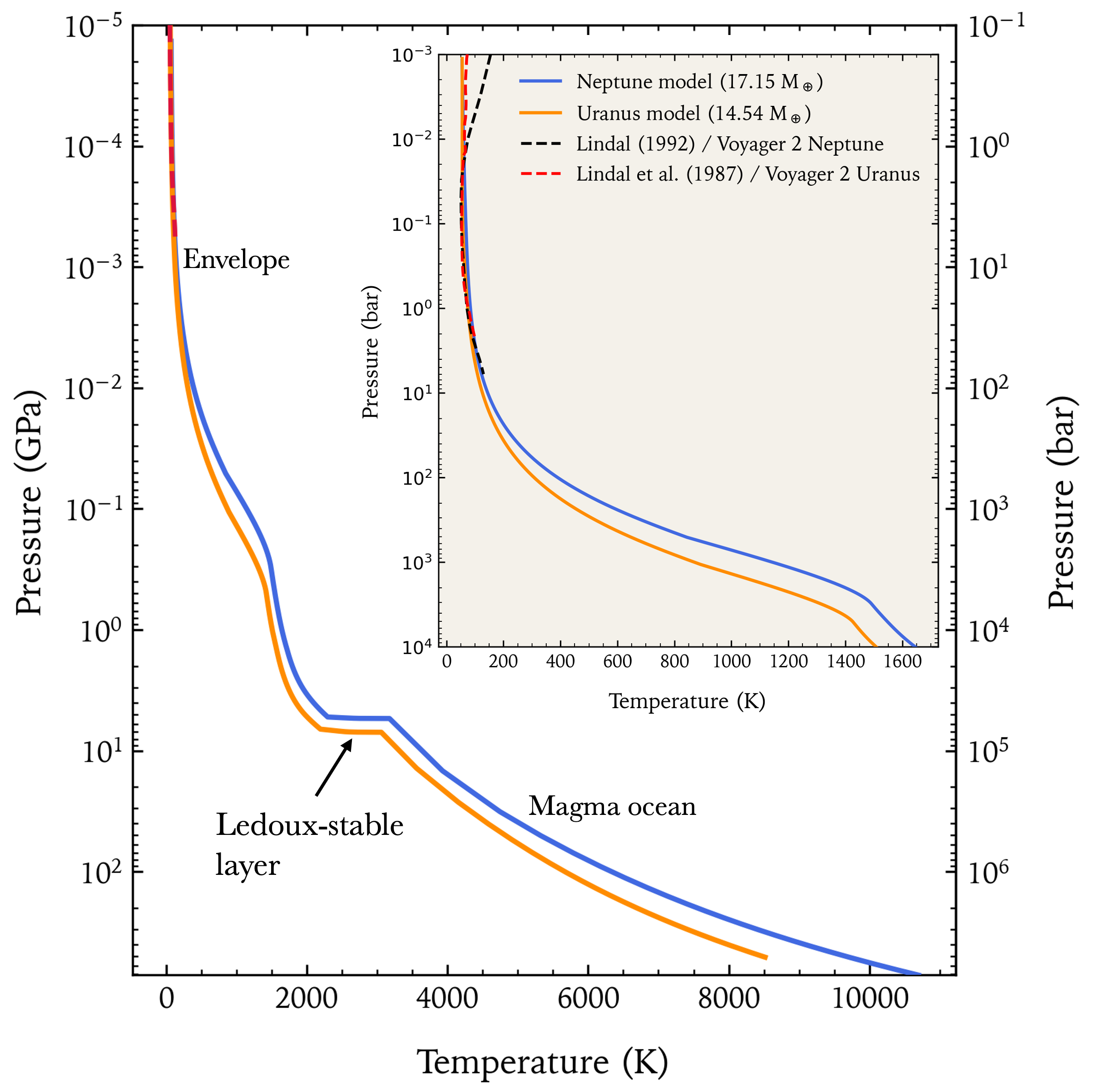
Figure 4: Modeled P,T4–P,T5 atmospheric profiles for Neptune/Uranus; Ledoux-stable regions and supercritical core depths are indicated. The model reproduces the observed atmospheric temperatures and Voyager 2 upper atmosphere constraints closely.
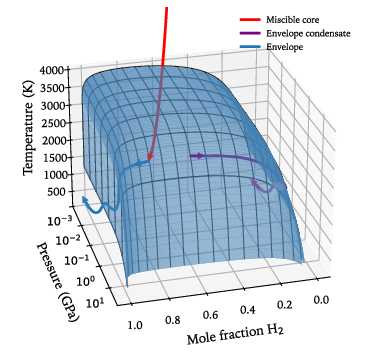
Figure 5: The binodal phase boundary in P,T6–P,T7–P,T8 space; the red curve is the miscible interior, with arrows indicating transition through the phase boundary into the HP,T9-rich envelope and silicate rain paths.
Hydrogen Accretion and Evolution
The paper presents a stochastic accretion model, parameterizing planet assembly as serial addition of embryos with variable HH20 retention, and cooling-limited accretion prescription. This toy model naturally yields a systematic relation between planet mass and HH21 envelope mass fraction that matches the inferred values for ice giants in this study and those recognized in sub-Neptunes (1–15% HH22 by mass).
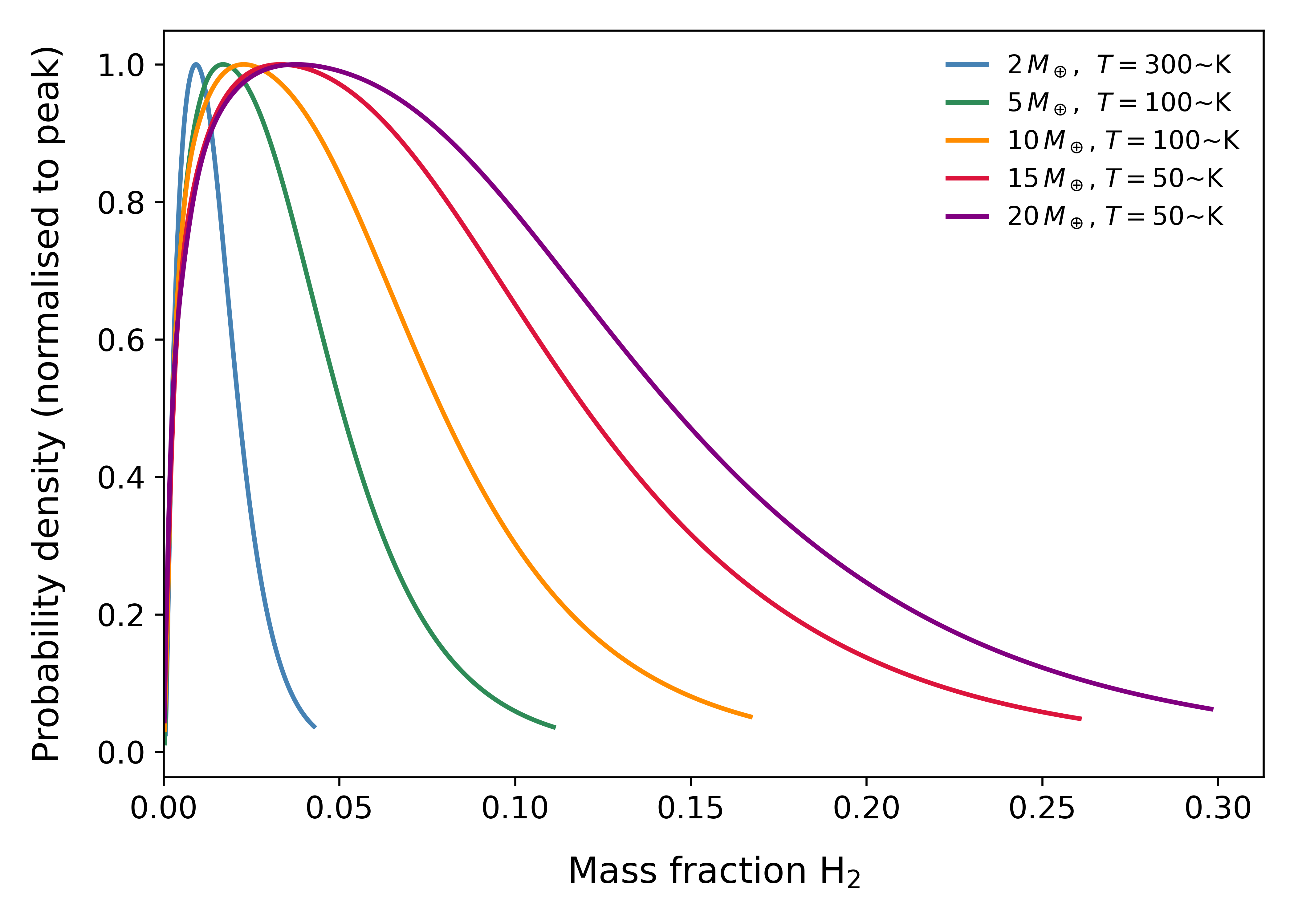
Figure 6: The resulting distribution of hydrogen mass fractions from the accretion experiment displays a mass dependence and spread consistent with sub-Neptune and ice giant properties.
The computed long-term thermal evolution of Neptune in the magma-ocean model shows only moderate secular changes in radius, temperature, and hydrogen partitioning since formation, indicating structural robustness.
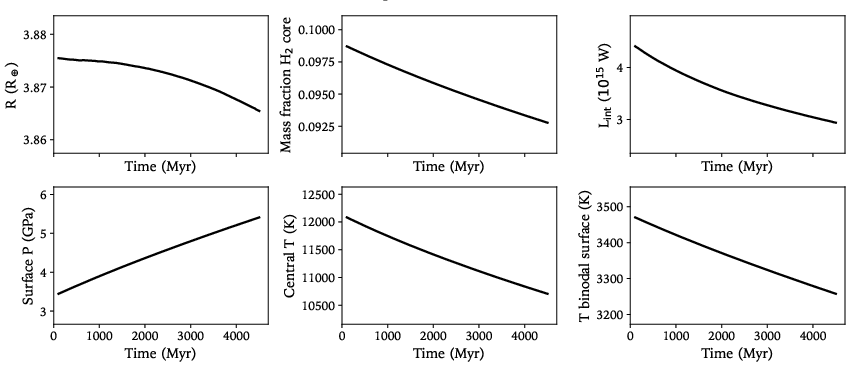
Figure 7: Predicted evolution of Neptune’s structure and hydrogen fraction over 4.5 Gyr, showing modest radius contraction and HH23 redistribution.
Equation of State Calibration and Sensitivity
The adoption of a DFT-MD-based EoS for MgSiOH24–HH25 mixtures is a principal technical step forward. Simulations show that the addition of HH26 both depresses the melting point of silicates and significantly modifies compressibility and density. Density–pressure relations for the relevant compositions and pressure/temperature regimes match first-principles and experimental data to within a few percent.
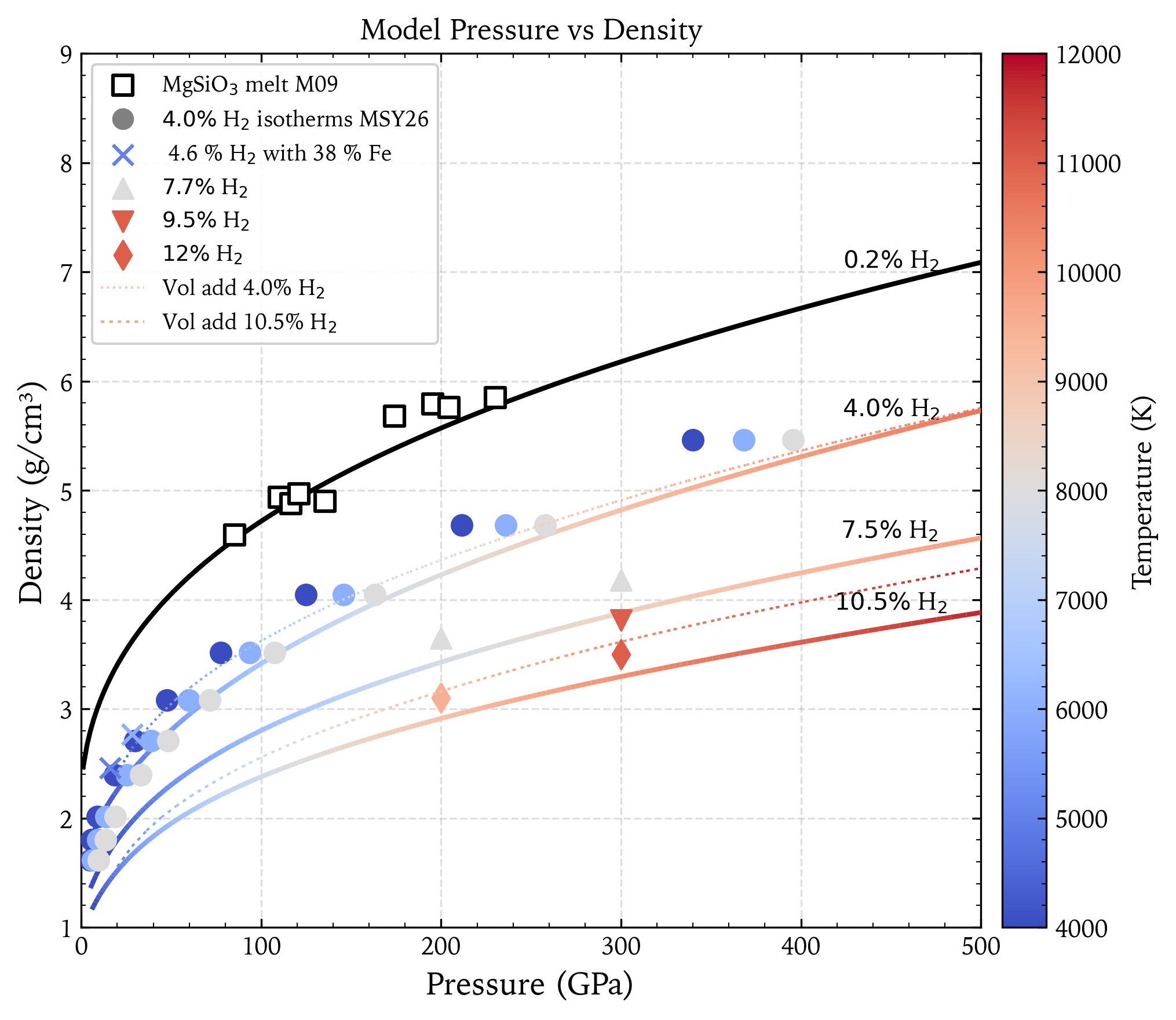
Figure 8: EoS and density calibration for MgSiOH27–HH28 mixtures compared to DFT-MD and experiments; mixture adiabats and compositional interpolation are validated.
Quantitative uncertainty in the absolute HH29 mass fraction (±2% by mass) is acknowledged and will further decrease as more detailed EoS measurements and simulations become available.
Dynamic Gravity Harmonization and Winds
The static–dynamic decomposition of gravitational harmonics incorporates wind field profiles derived from cloud tracking, with physically motivated meridional and radial decay. The resulting wind-induced corrections to 30 and 31 are critical for an accurate structural fit and underscore the coupled nature of dynamical and static planet properties.
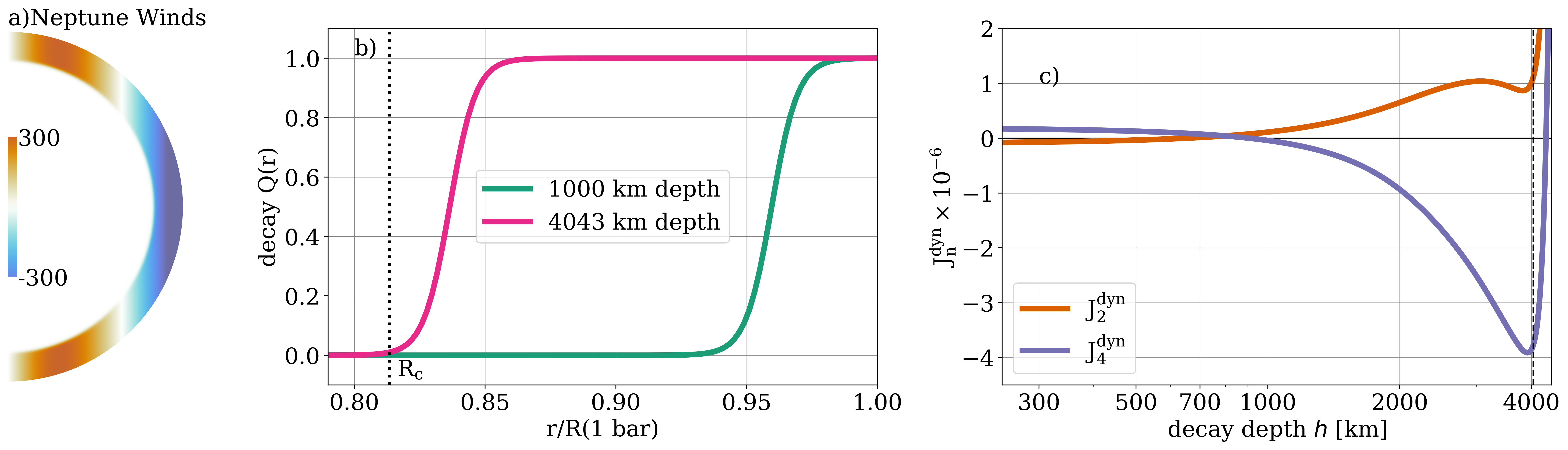
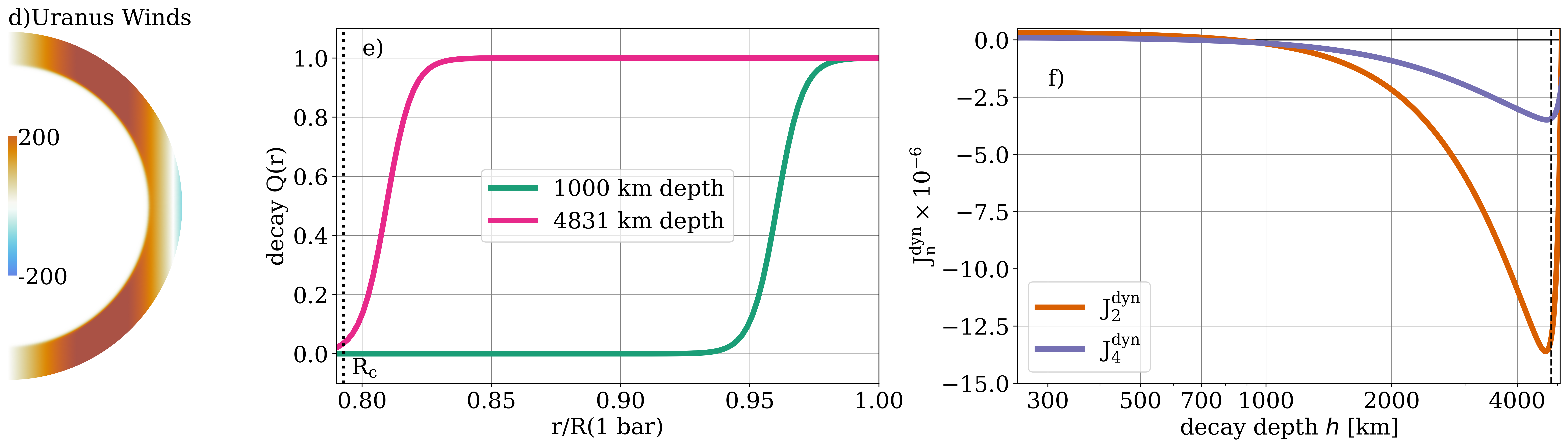
Figure 9: Extrapolated wind models for Neptune and Uranus; panel c/f show the effect of wind depth on 32 and 33, aligning with gravity observations when normalized wind depths reach the bottom of the convective zone.
Broader Implications: Ice Giants as Sub-Neptune Analogs
This model demonstrates that the observed gravity, size, internal luminosity, and atmospheric chemistry of Uranus and Neptune are not explained uniquely by classic rock–ice–gas stratification. Instead, they are equally or better-represented as end-members of a continuous population that includes the sub-Neptune class, with extended supercritical silicate–hydrogen–iron interiors overlain by hydrogen-rich envelopes. This physically links solar system ice giants to exoplanet gas dwarfs—negating the necessity for water/ice-dominated interiors and motivating a new framework for interior–atmosphere coupling in volatile-rich planets across stellar environments.
Further, the model’s simplicity—three free physically interpretable parameters, no manually-imposed water/ice layers or ad hoc boundaries, and built-in coupling between composition, structure, and phase chemistry—avoids the overparameterization and degeneracy that complicate many classical interior models.
Conclusions
"Ice Giants Revisited" (2606.18219) fundamentally rebases the structure and formation paradigm of Uranus and Neptune. Strong numerical fits to all relevant observables—including 34, 35, radius, luminosity, 1-bar temperature, and moment of inertia—are achieved with physically minimal and interpretable parameterization, leveraging major advances in equations of state for planetary materials and cosmochemical constraints on planet formation.
Key claims:
- The structure and chemistry of Uranus and Neptune are consistent with an extended, fully miscible supercritical silicate–iron–hydrogen core (magma ocean), not a segregated rock–ice–H/He system.
- The inferred bulk H36 fractions are 13–14% by mass, matching the high-mass end of the sub-Neptune envelope fraction distribution.
- The Ledoux-stable boundary layer at the core–envelope interface, set by molecular weight gradients, is quantitatively tied to the observed low luminosity discrepancy between Uranus and Neptune.
- Atmospheric methane and H37S enrichment and NH38 depletion are naturally reproduced via equilibrium with a magma ocean, consistent with both Solar System and JWST sub-Neptune atmospheric data.
Theoretical and practical implications:
- Ice giants and sub-Neptunes form a structural continuum, with implications for interpreting observations of both solar system and extrasolar planets.
- Improved laboratory calibration of supercritical silicate–H39 equations of state will further anchor these results.
- Future missions to Uranus and Neptune can leverage these predictions to target observations—e.g., gravity, magnetic field, atmospheric composition—that distinguish rocky–ice–gas stratification from the proposed magma ocean scenario.
In summary, this paper advances a physically-consistent, minimal-parameter model for Uranus and Neptune that is as constrained by data as the canonical three-layer ice giant model, but more directly tied to recent theoretical, chemical, and exoplanetary advancements.
Paper to Video (Beta)
No one has generated a video about this paper yet.
Whiteboard
No one has generated a whiteboard explanation for this paper yet.
Paper Prompts
Sign up for free to create and run prompts on this paper.
Top Community Prompts
Open Problems
We haven't generated a list of open problems mentioned in this paper yet.
Continue Learning
- How does the magma ocean model challenge the traditional rock–ice–gas stratification in ice giants?
- What specific insights do ab initio simulations provide for modeling supercritical silicate–H2 mixtures?
- How do the recalibrated gravitational moments improve our understanding of Uranus and Neptune's internal structures?
- What are the implications of linking ice giants to sub-Neptune exoplanets for planetary formation theories?
- Find recent papers about magma ocean dynamics in ice giants.
Tweets
Sign up for free to view the 2 tweets with 0 likes about this paper.