- The paper introduces flash memory endurance as a depreciating asset by defining an endurance shadow price (η) for erase cycles.
- It formulates memory placement as a capital budgeting problem with a wear-augmented index that optimally distributes data among RAM, NVM, and cloud.
- Empirical results reveal regime-dependent value–write coupling and show that wear-aware placement may not enhance task success due to natural workload constraints.
Memory as a Wasting Asset: Pricing Flash Endurance for Embodied Agents
The paper establishes flash memory in robots as a non-renewable, depreciating asset: each persisted write consumes NAND program/erase (P/E) cycles, after which memory capacity is permanently lost. The analysis introduces the endurance shadow price, η, representing the present-value scarcity rent of an erase cycle. This formalism connects memory management in embedded agents to classical capital asset theory, transforming placement across RAM, flash (NVM), and cloud tiers into a capital budgeting problem governed by η. The placement policy ties the physical location of each memory to its assessed value, write-intensity, and endurance cost, rather than solely maximizing task success or working within a fixed capacity.
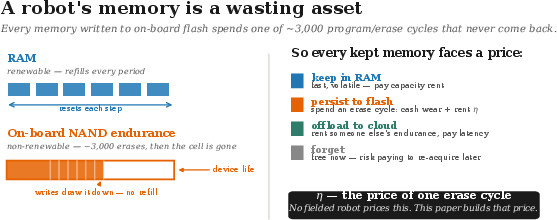
Figure 1: On-board NAND endurance is a non-renewable stock; memory placement is governed by a single endurance rent η.
The economic logic centers on deciding, per memory item, whether to retain in RAM, persist to NVM (spending an erase cycle), offload to the cloud, or forget, under a threshold defined by η. Each memory retention choice is priced, with physical layer decisions determined by cost-optimality subject to endurance scarcity.
Model Architecture and Theoretical Results
Formal assumptions are given for item value (v), depreciation (δ), retrieval rate (λ), size (s), write-intensity (w), and recompute cost (κ), with tiered storage (RAM/NVM/cloud) and physical constraints. Placement is solved as an optimal control problem: items are placed in the fastest tier their wear-augmented index clears, considering simultaneously endurance, energy, and economic rents.
The wear-augmented index:
η0
is cost-optimal regardless of the value-write coupling η1. However, when η2, the optimal policy is proven to be non-monotone in item value: the probability an item is persisted to NVM first rises and then falls with value, resulting in the highest-value memories being routed away from flash, not kept locally.
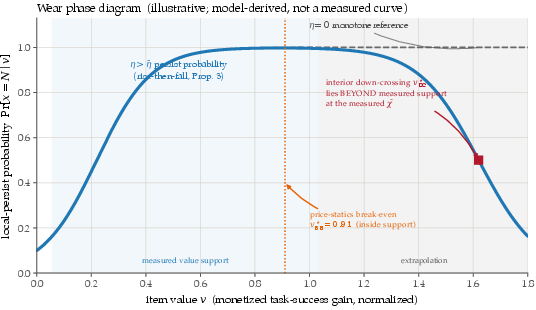
Figure 2: Wear phase diagram showing a rise-then-fall persist-probability curve with theory interior down-crossing beyond normalized value support.
This non-monotonicity is cleanly derived, contingent on empirical verification of η3, and controlled by endurance tightness (η4). The monotone regime is recovered when endurance is abundant or η5.
Empirical Analysis: Regime-Dependence of Value–Write Coupling
A major empirical contribution is the measurement of the value–write coupling η6 on real robot logs, at a pre-specified decision gate. The sign and magnitude of η7 are shown to be regime-dependent: positive on recurrent, long-horizon manipulation (LIBERO-Long, SmolVLA-0.5B: η8, CI strictly positive), null on shorter-horizon data, and negative on non-recurrent teleoperation (DROID: η9, CI strictly negative).
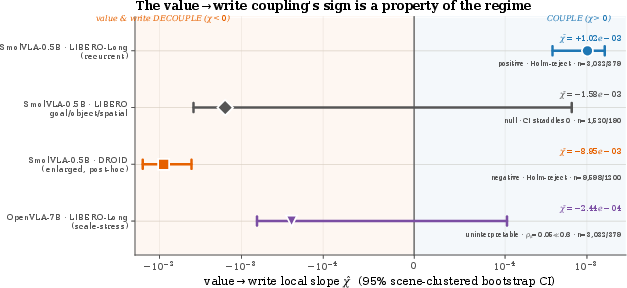
Figure 3: Regime-dependent sign of value-to-write coupling η0; positive and CI-excluding-zero on recurrent LIBERO-Long, negative on DROID teleoperation, straddling zero on OpenVLA-scale.
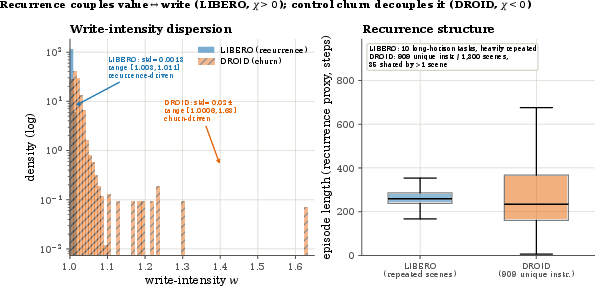
Figure 4: Recurrence-driven vs. churn-driven write intensity; recurrent manipulation homogenizes writes, teleoperation introduces dispersion.
A dose-response experiment blending these regimes confirms monotonicity in η1 as a function of recurrence (Spearman η2, η3).
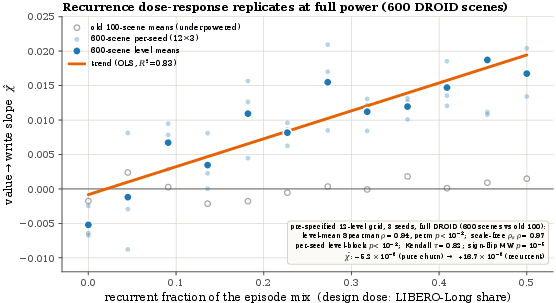
Figure 5: Dose-response replication: η4 increases with recurrence fraction, confirming the coupling mechanism.
Binding Endurance Budget and Placement Effects
The endurance budget is dormant on premium TLC (η5 P/E) modules at typical prices, but binding on commodity QLC/eMMC (η6 P/E) that inexpensive edge robots actually deploy. When endurance binds, the controller strictly beats naive all-NVM but only ties price-based routing on task value: realized value is tier-invariant across RAM/NVM/cloud, so rent η7 governs device lifetime and cost, not performance.
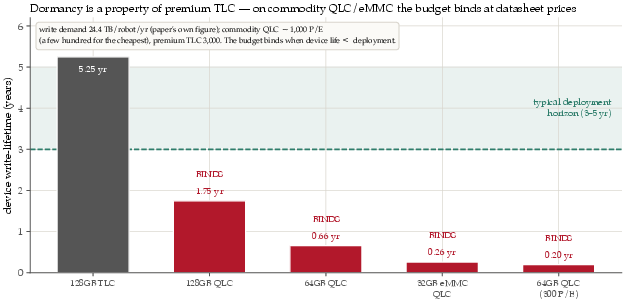
Figure 6: Endurance budget binds at datasheet prices for commodity storage but not for premium TLC, highlighting economic live-ness.
The wear-augmented index is only advantageous when write-intensity dispersion (η8) is substantial; with homogeneous writes (LIBERO: η9), the index collapses to value-ranking, and wear-aware placement offers no added value.
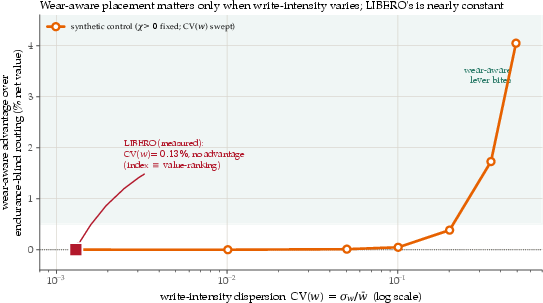
Figure 7: Advantage in net realized value is flat unless write-intensity dispersion is substantial; LIBERO's measured dispersion sits at the floor.
The combination of positive η0 (from recurrence) and high write dispersion necessary for a win is structurally empty in surveyed workloads, revealing an anti-correlation between them.
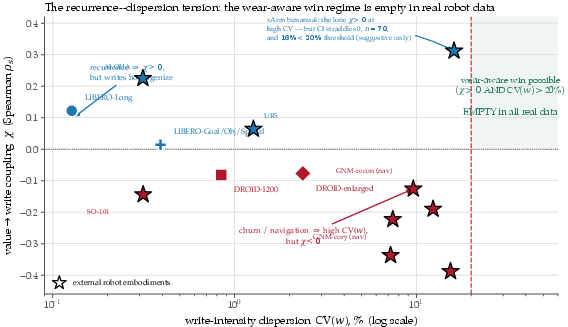
Figure 8: Recurrence–dispersion tension; no surveyed workload exhibits both positive η1 and sufficient write dispersion for wear-aware placement to win.
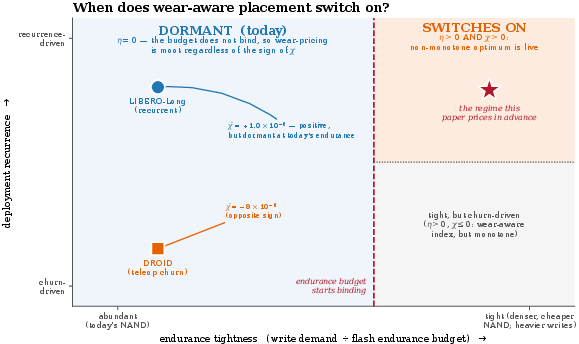
Figure 9: Regime map: wear-aware placement switches on only in the upper-right cell where endurance binds and η2; measured datasets occupy endurance-abundant regimes.
Economic Calibration and Comparative Statics
Calibrated measurements relate endurance rent and item value thresholds to economic primitives. The wear and rent break-even for NVM placement is quantified (η34.8 \times 10{-5}η4\approx39\%.</sup><imgsrc="https://emergentmind−storage−cdn−c7atfsgud9cecchk.z01.azurefd.net/paper−images/2606−18144/figcalibration.png"alt="Figure10"title=""class="markdown−image"loading="lazy"><pclass="figure−caption">Figure10:Calibratedeconomicprimitives;break−eveninwear+rentperGB−dayandJorgensonusercostforoneerase.</p><imgsrc="https://emergentmind−storage−cdn−c7atfsgud9cecchk.z01.azurefd.net/paper−images/2606−18144/figpricestaticsfan.png"alt="Figure11"title=""class="markdown−image"loading="lazy"><pclass="figure−caption">Figure11:PricecomparativestaticsoverUnifiedLow/Base/Highpricebands;equilibriumrentdeclineswhileNVMshareremainsbudget−pinned.</p></p><h2class=′paper−heading′id=′controller−evaluation−and−negative−results′>ControllerEvaluationandNegativeResults</h2><p>Atrained\eta5M−parametercontrollerusingBCwarm−start+<ahref="https://www.emergentmind.com/topics/trust−region−policy−optimization−ppo"title=""rel="nofollow"data−turbo="false"class="assistant−link"x−datax−tooltip.raw="">PPO</a>returnsanegativeresult.Non−monotoneoptimalpersistenceisnotobservedatanyseed,successproxytieseverycost−matchedbaseline,andcontrolleradvantageonlyappearsinscenarioswithartificiallyincreasedwritedispersion,notinanymeasuredrealworkload.<imgsrc="https://emergentmind−storage−cdn−c7atfsgud9cecchk.z01.azurefd.net/paper−images/2606−18144/figp2controller.png"alt="Figure12"title=""class="markdown−image"loading="lazy"><pclass="figure−caption">Figure12:Controllerrobustness;seed−dependentoutcomes,someexhibitingmetric−gamingartifacts,othersidenticaltoAURAbaseline;invariantacrossstream−stitchfamilies.</p></p><h2class=′paper−heading′id=′practical−and−theoretical−implications′>PracticalandTheoreticalImplications</h2><p>Theformalismestablishesaprincipledmethodforpricingmemoryplacementunderaphysicalenduranceconstraint,connectingmemorymanagementtoeconomictheoryofexhaustibleresources.Practically,endurance−awareplacementextendsdevicelifetime,deferringembodiedcarbonande−waste;theergodicrent\eta$6 maps directly to device life extension, with order-of-magnitude estimates provided at fleet scale.
Limitations and Future Directions
- The effect of wear-aware placement on task value is not demonstrated; realized value is tier-invariant, and causal impact awaits validation in settings where flash is forced and scarce.
- The value–write association $\eta$7 is regime- and backbone-conditional; non-monotonicity is thus not universal.
- The optimal placement's benefit is structurally limited by the anti-correlation of recurrence and write-dispersion in natural workloads.
- Placement–task-success causality requires integration with memory-augmented backbones capable of end-to-end demonstration.
Conclusion
The paper provides a rigorous framing for memory placement as a capital budgeting problem under an endurance constraint, governed by a single shadow price $\eta$8. The cost-optimal placement rule, wear-augmented index, and regime-gated non-monotonicity theorem are theoretically and empirically supported. However, real-world measured workloads do not provide the dispersion and positive coupling required for task-value payoff, and controller advantages are not observed empirically. Device lifetime extension and cost shaping are robust, but maximizing task success via endurance-aware placement remains open for future empirical validation.