- The paper introduces a robust platform achieving strong light-matter coupling with nonlinear trion-polariton formation in moiré heterobilayers.
- The methodology employs micro-PL and reflectance spectroscopy combined with a three-state coupled oscillator model to extract Rabi splittings and quantify screening effects.
- Results reveal high-velocity, long-diffusion trion-polaritons with nonlinear coefficients outperforming previous TMDC systems, promising advances in quantum optoelectronics.
Highly Nonlinear Moiré Exciton and Trion Polaritons in Microcavity-Coupled Heterobilayers
Introduction
The study presents a comprehensive investigation into the nonlinear optical phenomena arising from strong light-matter coupling in n-doped MoSe2/WS2 moiré heterobilayers integrated within metal-DBR optical microcavities. The work distinguishes itself by focusing on the nonlinear and non-monotonic dependencies of oscillator strengths and polariton nonlinearities, particularly those arising from the interplay between trion formation, Lindhard screening, and the unique absence of electron capture in the studied moiré superlattice. This platform enables the realization of high-velocity, long-diffusion trion-polaritons and demonstrates nonlinear coefficients exceeding previously reported values for TMDC-based polaritonic systems.
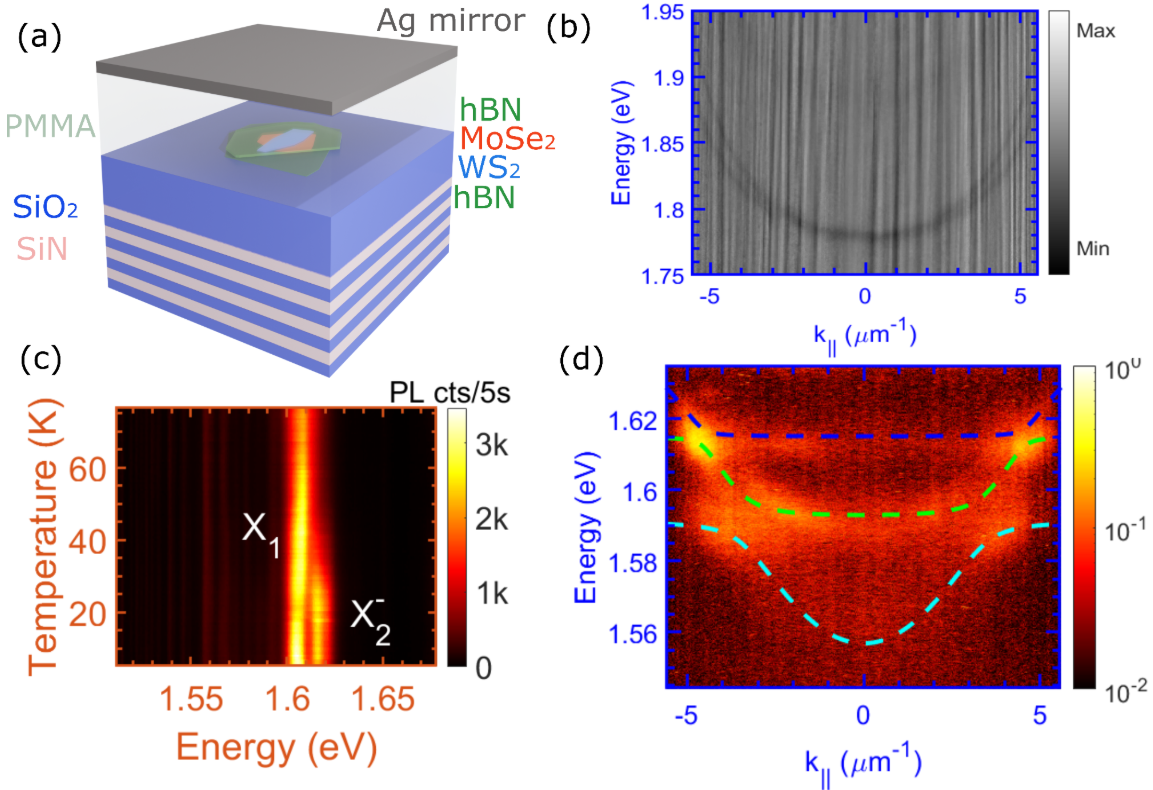
Figure 1: Device geometry and photoluminescence characteristics confirming strong coupling to exciton and trion resonances in the microcavity.
The heterostructures were realized by mechanical exfoliation and deterministic stacking of n-doped monolayers of MoSe2 and WS2, separated and capped by hBN spacers. The stack was transferred onto a bottom DBR with carefully engineered thicknesses to spectral-match the cavity resonance with the optically active region. The structure was then sealed with a thin Ag top mirror to complete the λ-cavity architecture.
Micro-PL and reflectance spectroscopy were performed using a custom confocal setup at 5 K, ensuring high signal-to-noise and stability at variable excitation densities. Both steady-state and real-space-resolved PL measurements were employed to extract polariton dispersion, spectral linewidths, and spatial dynamics.
Polaritonic Dispersion and Coupled Oscillator Model
PL spectra and reflectance confirm the existence of three coupled resonances in the cavity: the X1 and X2 excitons and the X2− trion, each hybridized with the cavity photon mode. Diagonalization of a three-state coupled oscillator Hamiltonian yields the polaritonic eigenstates, with extracted Rabi splittings of ΩX2=32.4 meV, ΩX1=7.5 meV, and ΩX2−=3.3 meV. The X20 trion linewidth places the system solidly in the strong-coupling regime. Notably, the Rabi splitting associated with the X21 exciton is higher than previous reports, attributed to the twist-angle mediated redistribution of oscillator strength between exciton branches.
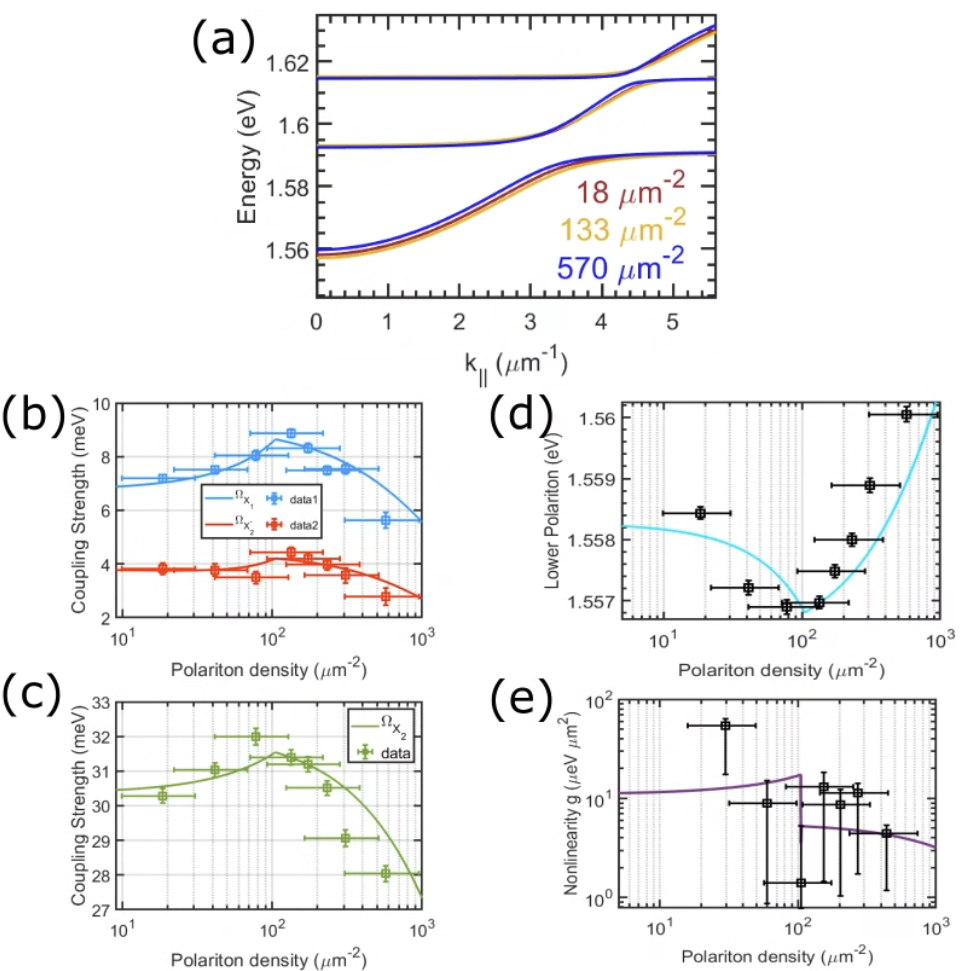
Figure 2: Non-monotonic variation of polaritonic coupling strengths and lower branch energy with polariton density, fitted with Lindhard screening and Coulomb blockade models.
Emergence of Strong Nonlinearity: Lindhard Screening and Electron Capture Suppression
A critical finding is the nonlinear, non-monotonic response of both the lower polariton branch energy and the oscillator strengths as a function of polariton density. With increased excitation, carrier screening initially decreases due to dopant depletion driven by trion formation, resulting in upward oscillator strength renormalization, before saturating and reversing at higher densities as in conventional Coulomb blockade.
A phenomenological model, leveraging rate equations for exciton and trion populations and incorporating Lindhard screening, accurately recapitulates the observed dispersive and nonlinear trends. This framework accounts for the absence of electron capture in the moiré superlattice, eliminating optically generated trions via free carriers and driving an initial enhancement in the trion oscillator strength. The extracted screening coefficients reveal that the trions, owing to their charge, experience the strongest screening, in line with theoretical expectations.
The measured nonlinear coefficient for the lower polariton branch, 22 μeV·μm23 at low densities, is several times larger than previous TMDC-based results and at least an order of magnitude above undoped moiré heterobilayer polaritons. The model predicts that, under suitable conditions, the second-order nonlinearity can diverge—an avenue for accessing ultra-strong photon-photon interaction regimes.
Temperature Dependence and Sample Inhomogeneity
Temperature-dependent PL spectroscopy validates the trion-character of the top polariton branch: it vanishes above 24 K as trion dissociation dominates. The coupling strengths and the nonlinearity exhibit spatial inhomogeneity—a direct consequence of local dopant density variations—demonstrating the tunability of the nonlinear response via material engineering and local electrostatics.
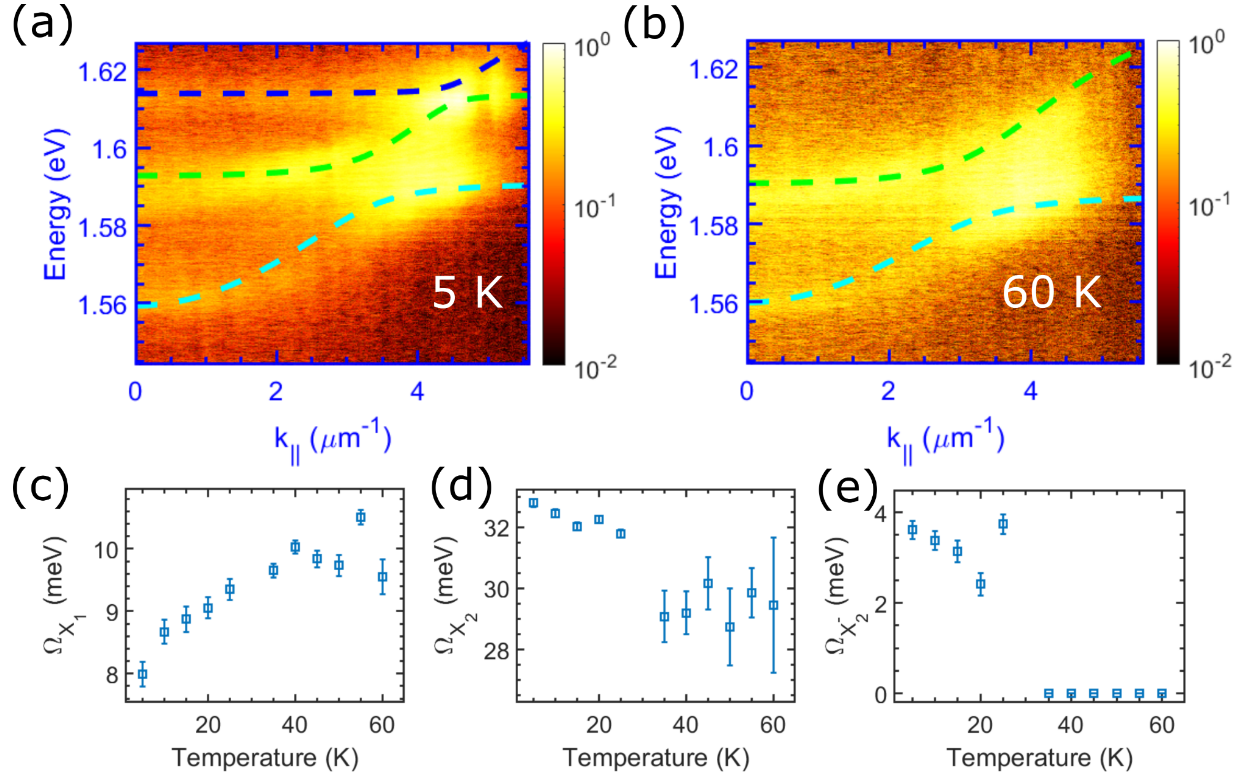
Figure 3: Temperature dependence of PL dispersions and coupling strengths, confirming trion-polariton character and highlighting phonon-mediated broadening mechanisms.
Real-Space Transport: High-Velocity Trion-Polaritons
A unique hallmark of the studied system is the emergence of hot trion-polaritons with large group velocity and diffusion lengths approaching 100 μm, as revealed by spatio-spectral imaging at low excitation densities. This transport behavior fundamentally deviates from the slow, localized trions in bare monolayers, establishing the key role of strong cavity coupling and the engineered moiré potential.
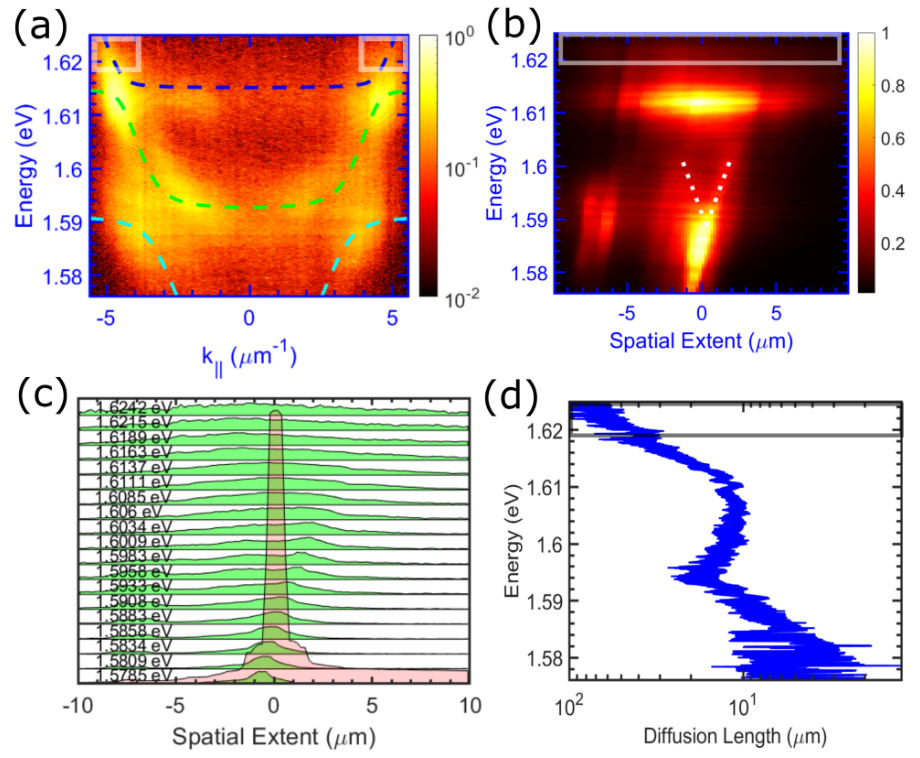
Figure 4: Real-space mapping of PL emission and extracted diffusion lengths, illustrating high-velocity trion-polariton transport.
Implications and Future Directions
The realization of tunable, highly nonlinear trion-polaritons in moiré heterobilayers represents a substantial advance for quantum optoelectronics. The demonstrably large nonlinearities and controllable response position this platform for applications in polaritonic quantum gates, all-optical switching, and as a testbed for studying correlated photonic many-body states. The ability to modulate nonlinearity via local doping and excitation paves the way for electrically reconfigurable polariton devices, with prospective operation at single-photon or single-electron scales.
The high mobility and extended diffusion of trion-polaritons suggest future breakthroughs in polariton transport physics, and potentially in the study of nonequilibrium quantum fluids in engineered moiré landscapes. These results invite further efforts into scalable device integration, precise control of local doping, and exploration of fractional filling effects enabled by correlations and moiré topology.
Conclusion
This work establishes n-doped MoSe25/WS26 moiré heterobilayers in optical microcavities as a robust platform for accessing the highly nonlinear and non-monotonic photonic responses via trion-polariton formation. The unique interplay between Lindhard carrier screening, dopant-driven trion dynamics, and electron capture suppression enables second-order nonlinearities and polariton transport regimes unattainable in conventional TMDC or undoped moiré systems. These developments foreshadow the practical realization of strong photonic nonlinearity for quantum technologies and open new opportunities in engineered light-matter physics.