Broken-symmetry phenomena enhanced by quasi-bound states in the continuum
Published 16 Jun 2026 in physics.optics | (2606.18012v1)
Abstract: Many of the most powerful and elegant models in physics are grounded in symmetries. In electrodynamics, for example, geometric symmetries govern the observable effects of light-matter interactions. However, for man-made objects, exact symmetries are rarely met and tiny deviations are common. Nonetheless, even approximate symmetries keep many symmetry-derived rules effectively intact. However, as we will show here, this is not universally true. We demonstrate that an incremental violation of the symmetry of a carefully designed system can produce an optical response maximally different from the unbroken symmetry case. To do so, we exploit symmetry-protected quasi-bound states in the continuum (qBICs). Specifically, we design a four-fold rotationally symmetric metasurface composed of nearly dual-symmetric meta-atoms that supports a pair of spectrally aligned electric and magnetic qBICs. At normal incidence, symmetry forbids helicity-preserving reflection. However, for arbitrarily small deviations from normal incidence, the strong resonant enhancement associated with the qBICs overcomes the near-symmetry suppression and enables perfect helicity-preserving reflection. This rapidly emerging violation of symmetry-rules reveals a fundamental intricacy when it comes to treating near-symmetric systems. At the same time, our work opens the door to novel applications in metrology and sensing.
The paper shows that infinitesimal symmetry perturbations in metasurfaces hosting quasi-BICs induce a non-perturbative, dramatic onset of helicity-preserving reflection.
It employs a near-dual symmetric design of silicon nano-cylinders in a C4 lattice, achieving optimal dimensions with a duality breaking parameter below 3×10⁻³.
The study reveals that the quasi-BIC Q-factor scales as 1/θ², ensuring robust helicity-preserving reflection even with realistic material losses and enabling chiral photonic applications.
Symmetry Breaking Amplified by Quasi-Bound States in the Continuum
Introduction: Symmetry Rules and Their Perturbative Violation in Electromagnetic Scattering
This work investigates how infinitesimal perturbations to geometric symmetry, in a system designed to host quasi-bound states in the continuum (qBICs), can induce maximal violations of otherwise strictly enforced selection rules in electromagnetic scattering. The study focuses on metasurfaces constructed from nearly dual-symmetric dielectric nano-cylinders arranged in a four-fold (C4) rotational lattice. By spectrally co-aligning electric and magnetic qBICs at normal incidence, a regime is found in which even infinitesimally small departures from perfect symmetry (i.e., very small incidence angles) generate a dramatic emergence of helicity-preserving reflection—an effect strictly forbidden under exact C4 symmetry and duality symmetry due to the generalized Kerker condition. This contradicts the conventional assumption that small symmetry violations only produce weak forbidden effects, demonstrating a non-perturbative amplification mechanism stemming from resonant enhancement.
Meta-Atom Design: Realization of Near-Dual Symmetry
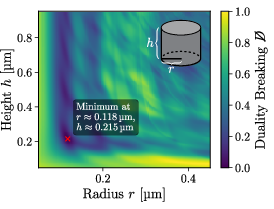
Duality symmetry, corresponding to the invariance under exchange of electric and magnetic fields, is quantified using the duality breaking parameter D calculated from the T-matrix in the helicity basis. Cylindrical dielectric scatterers (silicon-like, with εr=11.9, μr=1) embedded in a lower index background (silicon dioxide-like, εr=1.44) are systematically optimized for minimal D. The parameter sweep reveals optimal duality preservation (D<3×10⁻³) for cylinders of radius 118 nm and height 215 nm at λ0=1μm. These dimensions are compatible with established silicon nano-fabrication techniques.
Figure 1: Duality breaking D for Si nanocylinders as function of radius and height; minimum is reached near (r,h)≈(118nm,215nm).
These nearly dual-symmetric building blocks ensure that the lattice metasurface inherits an effective duality, except for the potential enhancement of nonmatching multipole contributions due to collective near-field effects.
Metasurface Resonances: Formation and Alignment of Coincident BICs
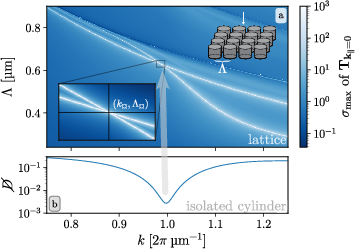
Arranging the optimized cylinders on a square lattice (Λ) produces spectrally sharp BICs, protected by symmetry and inaccessible from the continuum under perfectly normal incidence. The collective lattice T-matrix's largest singular value, εr=11.90, identifies the BIC resonances. By adjusting the lattice constant, the electric (z-dipole) and magnetic (z-dipole) BICs are brought into spectral coincidence at the point of minimum duality breaking.
With this configuration, at normal incidence, neither BIC can be excited and backreflection is symmetry-forbidden, but as soon as the incident wave is tilted by an arbitrarily small angle, both BICs transition to qBICs and become accessible.
Rapid Onset of Helicity-Preserving Reflection via qBICs
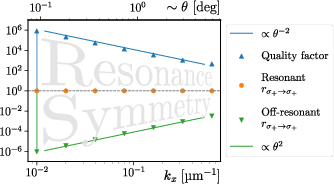
A detailed analysis of reflection spectra under varying incidence reveals a pronounced increase in helicity-preserving reflectance immediately as rotational symmetry is perturbed. For a perfectly symmetric lattice under normal incidence, helicity-preserving reflection is suppressed. At nonzero but small incidence angles, both qBICs couple to circularly polarized light, generating near-unity helicity-preserving reflection, which persists for angles approaching zero in the absence of material losses.
Figure 3: Scaling of helicity-preserving reflection (at resonance and off-resonance) and qBIC Q-factors as a function of the asymmetry (angle of incidence).
The Q-factor of the qBICs scales as εr=11.91, with εr=11.92 the incidence angle. Off-resonant helicity-preserving reflection is quadratically suppressed for small angles, in accordance with perturbative predictions. However, at resonance, the εr=11.93 enhancement from the qBICs offsets the suppression, yielding a robust, rapid transition to perfect helicity-preserving reflection in response to infinitesimal symmetry breaking. This behavior is formally captured by temporal coupled mode theory, which predicts that for negligible non-radiative losses, 100% reflection can be achieved at specific detunings unless εr=11.94, where εr=11.95 is the background transmission coefficient.
Impact of Material Losses
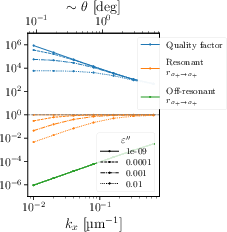
Inclusion of finite imaginary permittivity (εr=11.96) in the cylinders damps the qBIC resonances, reducing the Q-factor and limiting the degree of helicity-preserving reflection achievable as the symmetry-breaking parameter approaches zero. The decay of the maximal reflection at small angles follows the anticipated reduction in the Q-factor imposed by loss channels. Despite this, the effect remains significant for realistic material parameters and persists for incidence angles up to tenths of a degree.
Figure 4: Influence of increasing material loss on Q-factors and helicity-preserving reflection, illustrating robustness of the effect for realistic dissipations.
Theoretical and Practical Implications
This study establishes that the presence of spectrally aligned electric and magnetic qBICs gives rise to an intrinsic amplification of forbidden effects—here, helicity-preserving reflection—in systems where symmetry suppression would otherwise dominate. This has direct consequences for enantioselective photonic interfaces, such as helicity-preserving cavities and mirrors for chiral sensing and quantum optics, where efficient control of polarization-dependent responses near the symmetry point is critical. In the broader context, the results underscore the necessity of reconsidering the design principles for symmetry-protected photonic devices, particularly when resonantly enhanced selection-rule violations may undermine the expected suppression of unwanted modes or responses.
Future explorations may involve the intentional engineering of qBICs to realize abrupt, resonantly enhanced breaking of other forbidden processes, such as nonlinear harmonic generation or topological interface states sensitive to weak perturbations, as well as extending the symmetry-breaking amplification paradigm to acoustic or elastic wave systems.
Conclusion
The interplay between discrete rotational and duality symmetry, when coupled with qBICs in a metasurface, leads to a non-perturbative and rapidly emerging helicity-preserving reflection response upon the slightest symmetry violation. This challenges the standard perturbative treatment of symmetry-breaking effects and introduces new routes for the design and optimization of photonic metasurfaces leveraging resonant enhancement mechanisms. The robustness of this amplification effect to realistic material losses further facilitates its integration into practical devices for spin-photonics and chiral light–matter interactions.