- The paper presents a Bayesian framework that jointly fits adiabatic and NDI modes to constrain the sum of neutrino masses.
- It shows that including neutrino density isocurvature yields only a minor relaxation of neutrino mass upper limits, emphasizing prior dependence.
- The study demonstrates that dark energy parameterization critically affects mass bounds, motivating joint analyses with upcoming surveys.
Neutrino Mass Constraints and Primordial Isocurvature: Insights from ACT DR6 and DESI DR2
Introduction
The determination of absolute neutrino masses and their ordering remains a central unresolved topic intersecting particle physics and cosmology. Laboratory oscillation experiments constrain squared mass splittings but not the absolute scale or mass hierarchy. In contrast, cosmological datasets, through their sensitivity to structure growth and the cosmic microwave background (CMB), provide the most stringent upper limits on the sum of neutrino masses (∑mν), with current claims approaching the normal hierarchy floor. However, these limits depend on assumptions about the early universe, most critically the nature of primordial perturbations. While the standard model assumes purely adiabatic initial conditions, mixed scenarios with non-negligible neutrino density isocurvature (NDI) can occur in multi-field inflationary models or with non-standard neutrino physics. This work (“Constraints on the Sum of Neutrino Masses from ACT DR6 and DESI DR2 Considering Isocurvature Initial Conditions” (2606.17994)) presents a comprehensive Bayesian analysis of ∑mν that for the first time jointly fits both adiabatic and NDI modes and confronts cosmological data with physically motivated priors.
Theoretical Framework and Parameterization
Massive neutrinos imprint themselves onto the CMB and large-scale structure primarily by free-streaming effects that suppress power on sub-degree angular scales and on wavenumbers k≳0.01hMpc−1. The standard analysis is typically performed with the ΛCDM model, adiabatic initial conditions, and degenerate mass (DH) or normal/inverted hierarchy (NH/IH) priors.
In this work, the initial condition sector is generalized via a basis of adiabatic and neutrino density isocurvature modes, with the primordial power spectrum described by a symmetric matrix with independent amplitudes at two physically motivated pivots (k=0.002 and 0.1Mpc−1). This parameterization captures both the scale-dependent effects of NDI and allows for explicit tests of their detectability with current data. The isocurvature power component PII(k) can in principle be correlated with the adiabatic part, but in this analysis only the uncorrelated regime is considered. The NDI amplitude β(k) is left fully free at both pivots.
Extensions to the late universe, specifically the Chevallier–Polarski–Linder (CPL) dynamical dark energy model, are analyzed in parallel to ΛCDM in order to quantify model-dependence.
Data and Methodology
The analysis exploits the synergy of the latest high-resolution CMB datasets—ACT DR6, SPT-3G, and Planck 2018—as assembled by the CMB-SPA likelihood construction. This CMB data is complemented with DESI DR2's percent-level BAO measurements (which span a broad redshift range and include Lyα), and the DES Year 5 supernovae sample for additional leverage on expansion history. Parameter inference is carried out via MontePython using the CLASS Boltzmann solver. Both the sum of neutrino masses and the full set of isocurvature/adiabatic amplitude parameters are sampled, with hierarchical priors and lower bounds on ∑mν0 varied for thoroughness.
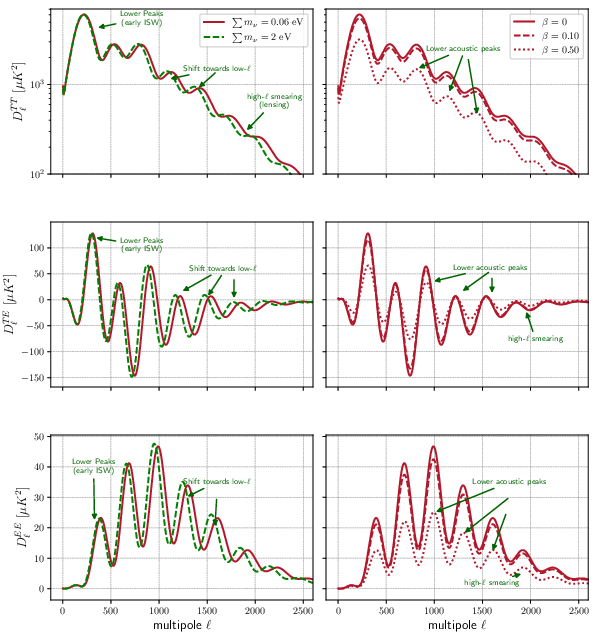
Figure 1: Lensed CMB TT and polarization power spectra at fixed ∑mν1 and varying NDI fraction ∑mν2 (right panels), demonstrating the distinct scales at which isocurvature alters the observables.
Physical Degeneracies and the Role of NDI
The analysis makes explicit the scale separation between the effects of massive neutrinos and NDI. Increasing ∑mν3 (under fixed adiabaticity) suppresses the CMB and matter power spectra at relatively fine angular scales (large ∑mν4) and high ∑mν5. NDI, in contrast, induces features on larger angular scales (low multipoles, particularly ∑mν6) and distinct modulations of the first acoustic peaks. This separation is visualized in Figure 1; the distinct signatures mean that high-resolution CMB data and large-volume LSS surveys can efficiently break degeneracies between the two physical effects.
Main Results: Posterior Distributions and Robustness of Neutrino Mass Bounds
The posterior for ∑mν7 in various modeling scenarios reveals several key features, as shown in the following figures:
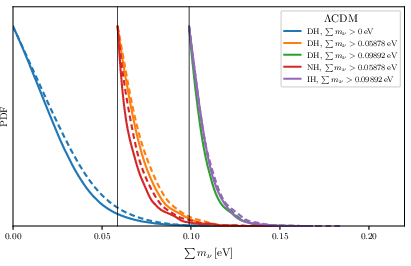
Figure 2: Posterior distributions for ∑mν8 under adiabatic and mixed (adiabatic∑mν9NDI) scenarios in k≳0.01hMpc−10CDM, showing marginal shifts in the upper bound in the presence of NDI modes.
- k≳0.01hMpc−11CDM, Adiabatic: The 95% CL upper limit is k≳0.01hMpc−12 eV (with prior lower bound at zero).
- k≳0.01hMpc−13CDM, +NDI: Including a free NDI amplitude degrades the limit only slightly, to k≳0.01hMpc−14 eV, and the amplitude of NDI is driven to zero by the data.
- CPL Dark Energy, Adiabatic: The upper bound weakens to k≳0.01hMpc−15 eV.
- CPL, +NDI: The bound shifts to k≳0.01hMpc−16 eV, again with the NDI amplitude consistent with no signal.
The triangle plots of the cosmological parameter posteriors support that the inclusion of NDI has only a minor effect on correlated parameters, indicating that current data robustly restrict the shape of the primordial spectrum (see Figure 3).
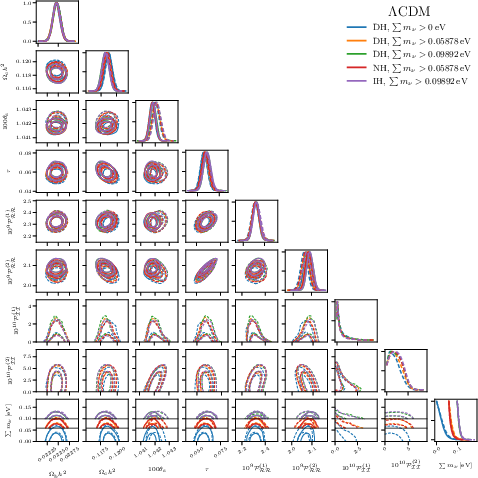
Figure 3: Triangle plot of cosmological parameters in k≳0.01hMpc−17CDM, showing tight posteriors and little impact from the inclusion of NDI.
Crucially, the dependence of the upper bound on k≳0.01hMpc−18 on prior choice is highlighted. The lowest physically meaningful value for the sum is set by the NH limit (k≳0.01hMpc−19 eV); imposing this as a lower bound increases the 95% CL upper limit to Λ0 eV in Λ1CDM, demonstrating how choices in parameter space definition can appear as artificial improvements in the mass constraint if not stated clearly.
Implications for Early Universe Physics and Future Cosmological Analyses
The main implications are:
- Absence of Evidence for NDI: The NDI amplitude is always driven toward zero, indicating that primordial perturbations are consistent with adiabatic initial conditions. Cosmological neutrino mass bounds are therefore robust to isocurvature sector extensions (within current instrument sensitivity).
- Sensitivity to Dark Energy Parameterization: Allowing for time-varying dark energy (as in CPL) degrades neutrino mass constraints by almost a factor of two, illustrating that late-time model-dependence is currently a greater systematic than initial conditions.
- Prior Dependence: The explicit demonstration that the minimal prior for Λ2 dramatically alters the apparent bound if the data are peaking near the physically allowed floor signals the necessity to always quote prior assumptions, especially as cosmological constraints continue to improve.
These results suggest that, with the current generation of CMB and LSS data, the upper bounds on Λ3 are statistical and systematic-limited and cannot break through the floor set by the minimal mass allowed by the mass hierarchy without new physics or more precise data.
Prospects
Upcoming surveys, including CMB-S4, LiteBIRD, and Euclid, will further reduce both isocurvature and neutrino mass error bars (possibly to Λ4 eV). Simultaneous constraints on NDI modes, Λ5 and neutrino self-interactions will be a necessity to ensure astrophysical robustness. Model-independent bounds may require breaking remaining degeneracies in late-universe physics, motivating joint analyses and stronger control of systematic uncertainties.
Conclusion
The paper provides a stringent and physically nuanced analysis of cosmological neutrino mass limits, quantifying their sensitivity to isocurvature, dark energy, hierarchy, and prior choice. The findings confirm that current cosmological datasets show no indication of neutrino density isocurvature modes and that upper bounds on Λ6 are generically robust to plausible extensions of the initial conditions sector. However, these bounds remain sensitive to late-time DE parameterizations and to the details of the likelihood priors, which must be contextually specified in future work and for robust comparisons with laboratory experiments and cosmological forecasts.