- The paper presents a semantics-first approach that recovers high-frequency details and long-range anatomical coherence using a novel latent modeling framework.
- It integrates a Latent Harmonization Encoder, a Semantic Recovery Block, and an Anatomy-aware Frequency Loss to achieve effective semantic alignment and structure preservation.
- The proposed method outperforms traditional models on BraTS and IXI datasets, achieving higher PSNR/SSIM and lower LPIPS scores in MRI reconstruction and synthesis tasks.
Semantics-First Latent Modeling for 3D MRI: A Comprehensive Framework
Introduction
High-fidelity multi-contrast MRI synthesis remains a fundamental challenge due to the high-dimensional structure of volumetric data and the complexity of anatomical presentations across different contrasts. Traditional pixel-space generative models for 3D MRI are computationally infeasible due to the volume size, leading to a prevalent two-stage paradigm: volumetric compression into a latent space followed by generative modeling therein. However, existing latent compression architectures have substantial deficiencies, notably in the preservation of long-range anatomical dependencies, semantic disentanglement, and high-frequency detail fidelity. The present work proposes a semantics-first paradigm, introducing three innovative components for robust 3D MRI reconstruction and cross-modality synthesis: the Latent Harmonization Encoder (LHE), the Semantic Recovery Block (SRB), and the Anatomy-aware Frequency Loss (AFL).
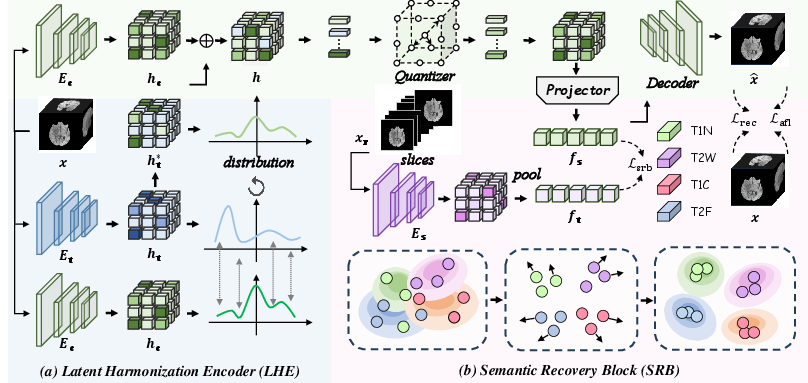
Figure 1: Overview of the semantic-first latent modeling framework integrating the Latent Harmonization Encoder, Semantic Recovery Block, and Anatomy-aware Frequency Loss for structured representation and robust 3D MRI synthesis.
Semantic-Preserving Latent Compression
Latent Harmonization Encoder (LHE)
Conventional volumetric compressors rely predominantly on convolutional architectures with limited receptive fields, resulting in fragmented long-range anatomical coherence. LHE addresses this limitation by integrating local convolutional features with slice-wise ViT-derived global context features, aligned statistically prior to fusion for harmonized representation. This dual-pathway encoding ensures that the discretized latent codes maintain anatomical continuity critical for downstream generative modeling by effectively leveraging both local and non-local information flows.
Semantic Recovery Block (SRB)
Standard latent compressors prioritize local pixel fidelity at the expense of contrast-specific semantics, resulting in severe feature entanglement as visualized via t-SNE of raw FSQ latents (Figure 2(a)). The SRB counteracts this by aligning the quantized latent codes with semantic prototypes acquired by a frozen, DINO-pretrained ViT teacher. The student latent vectors, projected into the semantic space via a learned MLP, are directly optimized to match these teacher features, effectively restoring contrast-aware separability (Figure 2). This semantic alignment is critical for accurate cross-contrast mapping and robust downstream synthesis performance.
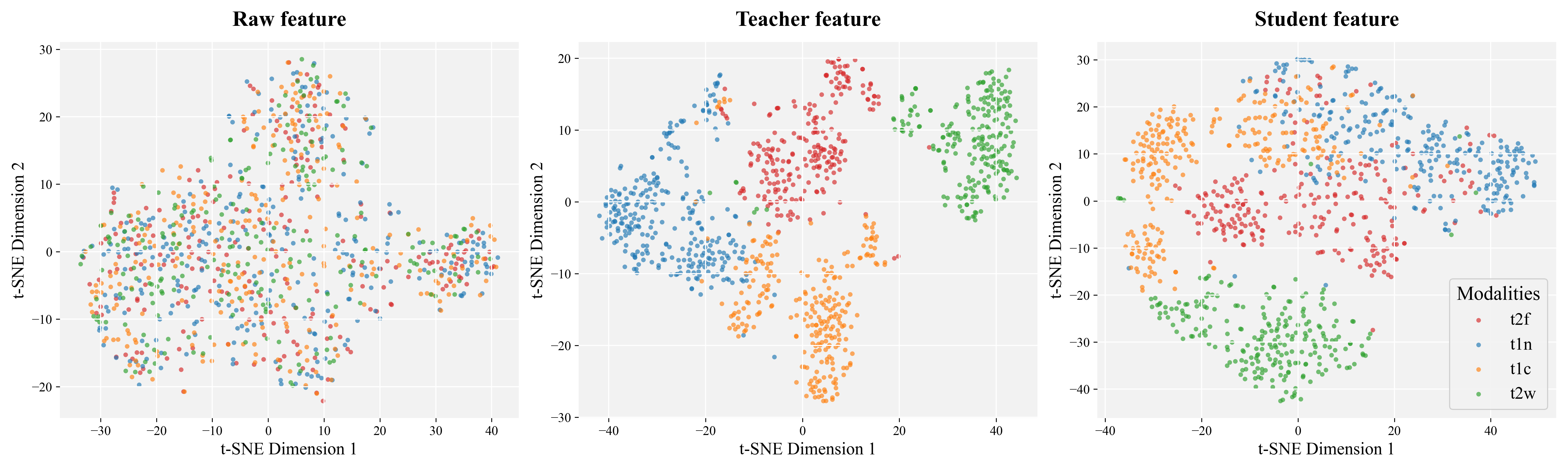
Figure 2: (a) t-SNE of raw FSQ latents showing strong entanglement; (b) contrast-wise clustering by DINO teacher features; (c) SRB-aligned latents with restored semantic separability.
Frequency-Aware Structural Preservation
Anatomy-aware Frequency Loss (AFL)
AFL supplements pixel-wise objectives, which notoriously favor low-frequency consistency and induce over-smoothing, by enforcing high-frequency structure preservation specifically within anatomically and semantically relevant regions. The mechanism constructs attention maps from volumetric gradients (capturing local edges) and semantic self-attention distributions from the pretrained teacher, jointly weighting high-frequency residuals in the loss. This yields reconstructions that better retain subtle boundaries, textures, and diagnostically critical features, as highlighted in AFL’s architecture (Figure 3).
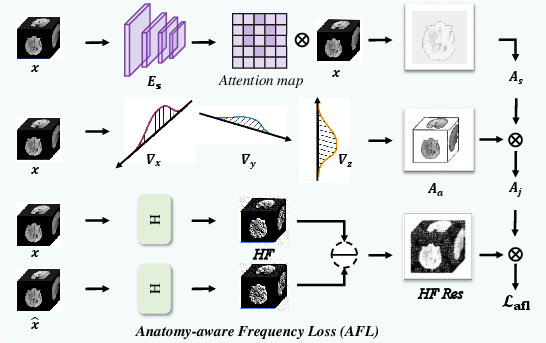
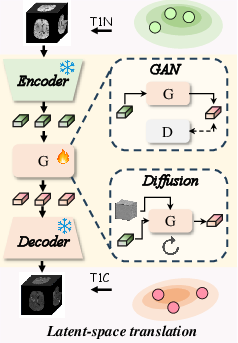
Figure 3: Anatomy-aware Frequency Loss uses a joint anatomy-semantic attention to enforce high-frequency fidelity in significant regions.
Experimental Validation
The framework is evaluated on BraTS and IXI datasets for both volumetric reconstruction and cross-contrast synthesis (e.g., T1 → T1C; T2 → FLAIR). Quantitatively, the model surpasses VQVAE, VQGAN, and FSQ baselines, achieving peak PSNR/SSIM (up to 33.65 PSNR, 0.9377 SSIM, lowest LPIPS of 0.0450 on IXI). When adapted into CycleGAN and Latent Diffusion backbones, the semantics-first latents yield significant translation quality improvements, e.g., a +3.48 dB gain for Latent CycleGAN (T1→T1C). Reconstruction and synthesis visualizations consistently confirm improved anatomical continuity and preservation of fine details (Figure 4).
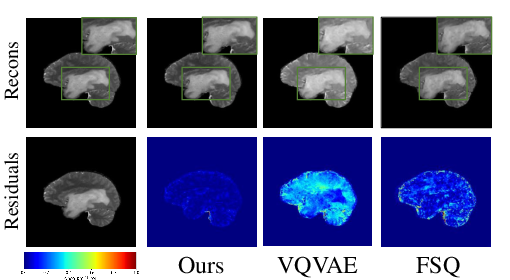
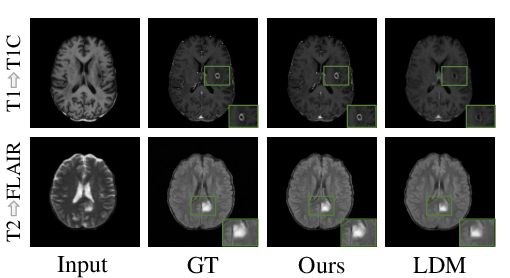
Figure 4: Visual comparison emphasizes the improved fidelity and structural preservation of the proposed semantics-first framework compared to conventional baselines.
Ablation and Analysis
Module ablation demonstrates LHE’s contribution to long-range coherence, SRB’s enhancement of latent separability, and AFL’s ability to recover fine-grained, high-frequency information. Optimal results are achieved only when all modules are combined, evidencing their complementary design. The semantic teacher ablation further indicates that DINO-pretrained ViTs provide stronger anatomy-aware supervision than ResNet-50 or MAE, resulting in maximal PSNR/SSIM and minimal perceptual discrepancy.
Implications and Future Directions
The explicit recovery and alignment of contrast-specific semantics and fine anatomical structure within the latent space set new benchmarks for both 3D MRI reconstruction and synthesis. This framework is hardware-efficient, compatible with orthogonal advances in generative models, and agnostic to subsequent generator design, thus directly porting to GANs and diffusion models for various clinical settings. The paradigm also presents a robust foundation for integrating VLM/LLM-driven supervision for further context-aware guidance and generalization beyond brain MRI to multi-organ, multi-modal clinical imaging.
Conclusion
The semantics-first latent modeling framework systematically addresses entanglement, loss of coherence, and over-smoothing prevalent in conventional volumetric compression for 3D MRI. Through synergistic application of LHE, SRB, and AFL, the model consistently enhances both quantitative and qualitative outcomes for reconstruction and cross-contrast synthesis. The modular and data-driven design presents significant potential for extension to broader medical imaging and multi-modal generative learning research.

