- The paper introduces Child-Fit Security, reframing child online protection from exclusion to system-level safeguards that support children’s rights and development.
- It employs empirical critiques of traditional containment models and promotes design principles such as participatory design and developmental appropriateness.
- The work shifts accountability from users and caregivers to system designers by advocating native security features over reactive controls.
Child-Fit Security: Reframing Online Child Protection Beyond Exclusion
Context and Critique of the Containment Paradigm
Prevailing models in online child protection emphasize containment, characterized by access restrictions, age-based bans, surveillance, and content filtering. These approaches position children as vulnerabilities to be controlled rather than legitimate digital citizens. Regulatory regimes such as COPPA in the US and the proliferation of age verification systems exemplify this orientation. Empirical analysis demonstrates that such interventions frequently shift accountability from system designers to users and caregivers, driving platform responses focused on legal compliance rather than robust, child-centered architectures.
These interventions produce significant side effects: circumvention by minors, privacy-invasive age assurance, weakened security guarantees for all users (notably threats to E2EE in the name of detection), and exacerbation of access inequalities, especially among marginalized or already vulnerable children. Critically, surveillance-driven controls can undermine trust and paradoxically decrease safety by incentivizing unsupervised access to less-regulated environments.
Reconceptualizing Security: Child-Fit Security Paradigm
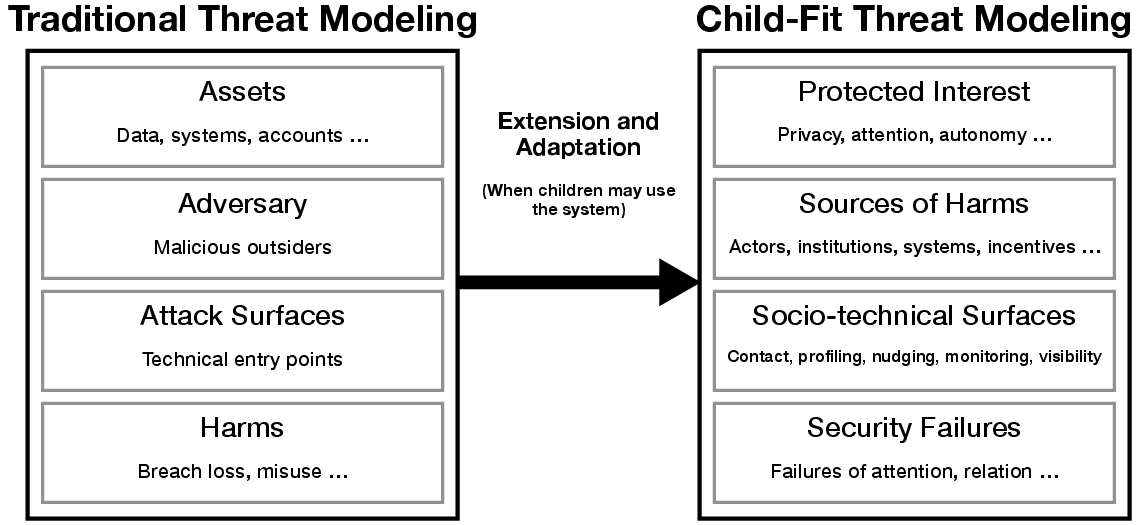
The paper introduces Child-Fit Security as a design paradigm, which asserts that digital systems likely to be used by children must treat children as legitimate users whose core assets include not just data and account integrity, but privacy, agency, development, identity, and emotional wellbeing (2606.17957). This marks a paradigmatic shift: the focus moves from securing systems against children to securing for children, emphasizing their needs, evolving capacities, and rights as axes of first-order analysis.
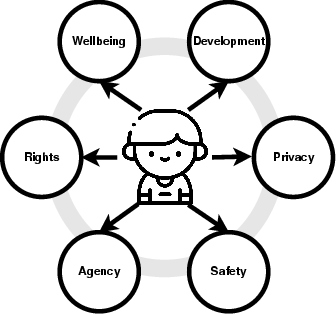
Figure 1: Six core requirements of Child-Fit Security—rights, wellbeing, development, privacy, safety, agency—proposed as inseparable security properties for systems likely to be used by children.
Central principles include:
- Legitimacy of child users: Systems must anticipate child users as default, not edge cases.
- Developmental appropriateness: Protections and affordances must be tailored to stage-appropriate needs, recognizing heterogeneity among children.
- Agency support: Children should be enabled to make, understand, and reverse choices, with agency accommodated in threat models.
- Participatory design: Children’s perspectives must directly inform feature design and risk modeling; mechanisms for input and override must be concrete.
- Rights preservation: Core children’s rights (privacy, autonomy, expression, access, and participation) must be secured, not traded off for convenience or regulatory minimalism.
From Containment to Systemic Protection
The authors articulate operational differences between the containment and Child-Fit paradigms:
Implications for Security, Practice, and Research
This reconceptualization broadens the scope of security research by including harms not reducible to external attack—compulsive use as attention capture, algorithmic surfacing of age-inappropriate content, or manipulative UI—as security failures. The approach demands extensions or reinterpretations of threat modeling techniques (e.g., re-framing “information disclosure” to encompass wrongful exposure of identity or developmental vulnerabilities).
Practically, this reframing calls for:
- Technical standards and APIs supporting child-fit defaults, reporting, and override.
- Developer support: Concrete templates, test suites, and design patterns to operationalize progressive affordance, participatory input, and bias assessment against extractive models.
- Empirical methods to rigorously study child-centric risk, resilience, and protective affordance in situ, resisting one-size-fits-all regulatory approaches.
- Governance and compliance models that reward system-level design for child-fit security rather than checkbox legalism.
Contradictory and Strong Claims
A central, bold claim is that harms traditionally framed as user failures—circumvention, unwitting oversharing, exposure to exploitation—are security failures traceable to the absence of child-centered system architecture. The paper contests the adequacy of exclusion and surveillance, asserting that such measures not only fail to guarantee safety but can amplify risk, marginalize vulnerable groups, and weaken infrastructure-level guarantees.
Future Prospects
The research agenda highlights several open lines: embedding developmental insight into engineering practice, establishing systematic participatory design with minors, and evolving threat modeling to treat children’s developmental needs as core assets. There is a call to develop empirical and design methodologies commensurate with the regulatory momentum toward child protection. Substantial work remains in specifying, prototyping, and evaluating Child-Fit Security mechanisms at platform scale.
Conclusion
The containment model of child digital protection is shown to be technologically naive, empirically ineffective, and ethically problematic. Child-Fit Security reframes child protection as a security engineering challenge, requiring the inclusion of children’s rights, agency, and developmental needs as security properties rather than afterthoughts. This inversion of paradigm has profound implications not only for system architecture, but for the conceptual boundaries of security research itself, opening new trajectories for theory, technical design, and policy (2606.17957).