- The paper demonstrates that regular black hole solutions are achieved by coupling scalar-tensor gravity with NLED to produce a de Sitter core that avoids curvature singularities.
- It uses power-series expansion and odd-parity linear perturbation analysis to show that a positive effective potential outside the horizon ensures dynamic stability.
- The study identifies a critical mass gap leading to black hole remnants, offering insights into resolving the information loss paradox.
Stability of Regular Spherically Symmetric Black Holes in Scalar-Tensor Gravity Coupled to Nonlinear Electrodynamics
Theoretical Framework: Scalar-Tensor Gravity and Nonlinear Electrodynamics
The paper investigates spherically symmetric solutions in scalar-tensor gravity non-minimally coupled to nonlinear electrodynamics (NLED), targeted at addressing the formation and stability of regular black holes (RBHs) as alternatives to the standard singularity-laden general relativistic solutions. The action is formulated initially in the Jordan frame and then conformally transformed to the Einstein frame, yielding a theory with a canonical scalar field ϕ coupled multiplicatively to a NLED sector. Choices for the scalar-electromagnetic coupling f(ϕ), such as e2αϕ and cosh(γϕ), are considered to link dilaton gravity or to maintain desired symmetries.
The NLED models are selected to ensure asymptotic correspondence with Maxwell electrodynamics and a regularized finite energy density at r=0: the canonical Born-Infeld model and rational Lagrangians of the Bronnikov and Bardeen type are utilized to this end. For purely magnetic backgrounds, the electromagnetic invariant F=2qm2/r4 diverges at r→0, but the specific NLED Lagrangian selections guarantee L(F)→Lc as F→∞, avoiding curvature singularities—a feature prohibited for purely electric solutions by Bronnikov's "no-go" theorem.
Global Regularity and Asymptotics
A rigorous power-series analysis at r→0 is performed. By expanding the metric functions and scalar field in even powers of f(ϕ)0, the coefficients are fixed such that all curvature invariants remain finite at f(ϕ)1. The Ricci and Kretschmann scalars attain finite, non-divergent limits determined by the scalar potential and the asymptotic value f(ϕ)2 of the NLED Lagrangian. The sufficiency of this regularization is confirmed by explicit demonstration that the spacetime geometry near f(ϕ)3 is that of a de Sitter core, with the effective cosmological constant determined by the matter fields.
At infinity, the requirement for strict asymptotic flatness is imposed. The ADM mass is shown to be finite; the scalar field vanishes exponentially for massive potentials, and the NLED sector recovers Maxwell's theory, producing consistency with observational constraints.
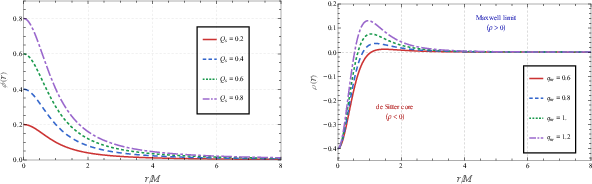
Figure 1: Left panel—radial profile of the scalar field f(ϕ)4 for various scalar charges f(ϕ)5. Right panel—the effective energy density f(ϕ)6 for different magnetic charges f(ϕ)7, showing bounded negative energy near the core and recovery of the Maxwell regime asymptotically.
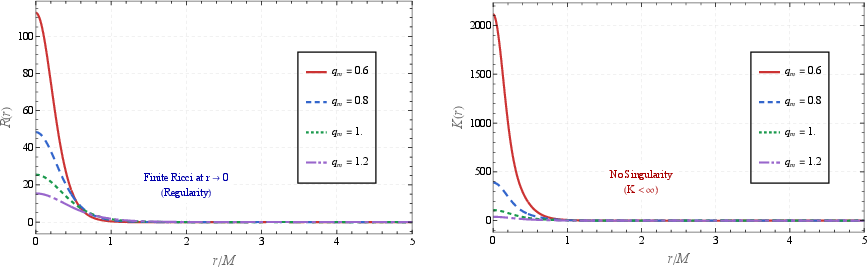
Figure 3: The Ricci scalar f(ϕ)8 and Kretschmann scalar f(ϕ)9 as functions of e2αϕ0, both globally finite and regular at e2αϕ1.
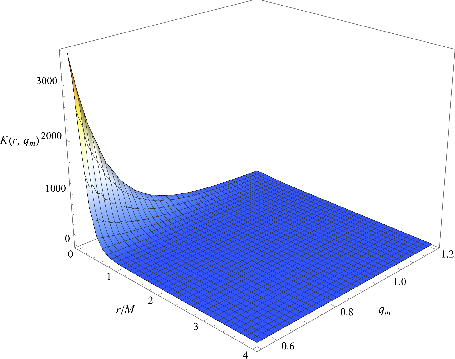
Figure 2: 3D surface plot of the Kretschmann scalar e2αϕ2; for all physical values of e2αϕ3, e2αϕ4 is bounded at e2αϕ5.
Linear Stability Analysis: Odd-Parity Sector
Stability under external perturbations is investigated via linearized analysis of the Einstein-NLED-scalar field equations. The metric, scalar, and electromagnetic fields are perturbed; by parity expansion, the odd-parity (axial) Regge-Wheeler sector decouples from scalar perturbations due to selection rules (e2αϕ6). The resulting master equation for metric perturbations (Regge-Wheeler equation) is derived, yielding a Schrödinger-type wave equation for the perturbation variable with an effective potential e2αϕ7 dependent on the background solution.
A positivity condition for e2αϕ8 outside the event horizon is established as sufficient for linear mode stability. The dependence of e2αϕ9 on the NLED magnetic charge cosh(γϕ)0 and multipole index cosh(γϕ)1 is explored: High multipole number increases the centrifugal barrier, and sufficient magnetic charge suppresses the emergence of potential wells that could support unstable (tachyonic) modes.
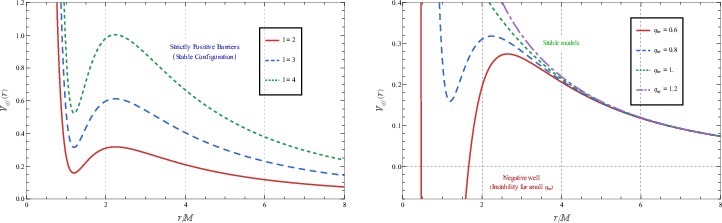
Figure 4: Effective cosh(γϕ)2 for axial perturbations. Left: Strengthening of the potential barrier with increasing cosh(γϕ)3. Right: The disappearance of negative wells with increasing cosh(γϕ)4 indicating stabilization.
Phase Structure and Parameter Space of Stability
The parameter space delineating regular black holes, extremal objects, and horizonless regular cores is mapped. The cosh(γϕ)5-cosh(γϕ)6 plane demonstrates that for sub-critical cosh(γϕ)7, negative wells in the potential are confined behind the event horizon—dynamically inaccessible to external observers and consistent with cosmic censorship. For super-critical cosh(γϕ)8, globally regular, horizonless solutions ("naked cores") are achieved, but no curvature singularity is present.
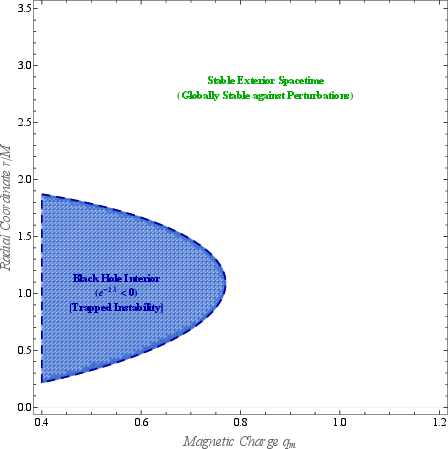
Figure 5: Phase diagram in the cosh(γϕ)9 plane; blue shading indicates the black hole interior. Stable configurations (no negative r=00 outside the horizon) occur for r=01 above a critical value.
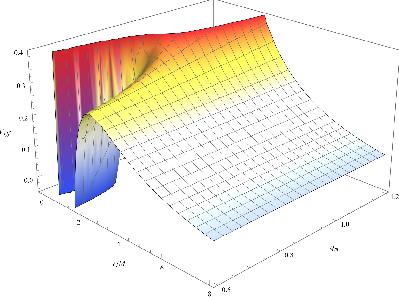
Figure 6: 3D topology of r=02 showing removal of the negative well at larger r=03.
Dynamical Evolution: Time-Domain and QNM Spectrum
Time-domain integration using the Gundlach-Price-Pullin scheme confirms dynamical stability: generic axial perturbations exhibit quasinormal ringing followed by exponential decay, with no growing modes. The WKB analysis of QNM frequencies is consistent: as the extremal limit is approached, the real part of the fundamental frequency increases while the imaginary part decreases in magnitude, corresponding to longer-lived oscillatory signals.
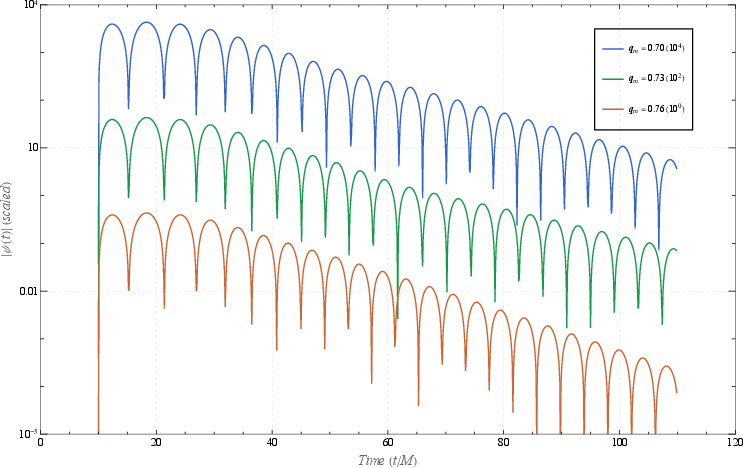
Figure 7: Time-domain evolution of r=04 for r=05 axial perturbations of regular black holes with varying r=06; all signals decay exponentially.
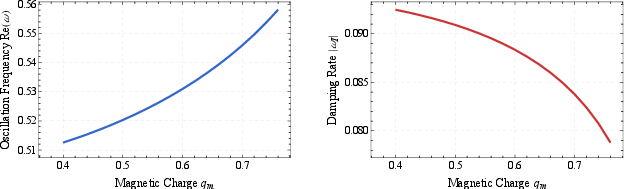
Figure 8: Dependence of the real and imaginary components of the fundamental axial QNM frequency on r=07.
The mass-radius diagram reveals the existence of a strict lower mass bound r=08 for given r=09. Solutions with F=2qm2/r40 are extremal; those with F=2qm2/r41 behave as regular black holes with two horizons, while those with F=2qm2/r42 form stable regular cores without horizons. This critical mass gap implies that Hawking evaporation, if present, cannot exhaust the black hole's mass beyond F=2qm2/r43—the evolution halts, and a remnant persists. This supports scenarios where the black hole information paradox is ameliorated due to the absence of complete evaporation and a regularized core.
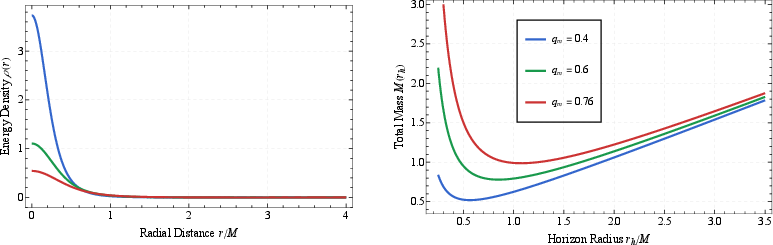
Figure 9: Left—the NLED energy density profile F=2qm2/r44, regular at the center, transitions smoothly to zero. Right—The ADM mass F=2qm2/r45 as a function of horizon radius F=2qm2/r46; the minima define the extremal mass gap.
Conclusion
The study provides a thorough demonstration that regular, spherically symmetric gravitational configurations—resolving the Penrose singularity by means of a de Sitter-like core—exist within scalar-tensor gravity non-minimally coupled to NLED. The framework overcomes "no-go" theorems for electric regularity by exploiting purely magnetic configurations. Global dynamical and thermodynamic stability are established: the effective potentials for perturbations present no external instabilities, and restriction of mass by extremal solutions enforces the survival of regular remnants, contributing a viable framework for information conservation in black hole evaporation.
The results mark an advancement in constructing non-singular, stable compact objects from field-theoretic extensions of General Relativity. The implications for quantum gravity, gravitational wave phenomenology (via the altered QNM signatures), and quantum information loss are substantial. Future work should generalize to rotating (Kerr-like) regimes and analyze even-parity perturbations to establish robustness under generic perturbation spectra.