- The paper presents FllumaOne, a novel CAD dataset with executable Python programs, kernel-validated geometry, and complete feature histories.
- It details a procedural generation pipeline that aligns multiple modalities including code, feature trees, IR, and STEP geometry for comprehensive validation.
- Baseline results reveal near-perfect execution and geometric fidelity, establishing a strong foundation for editable CAD reconstruction and cross-modal benchmarks.
FllumaOne: A Code-Native Multimodal CAD Dataset with Executable Programs and Kernel-Validated Feature Histories
Motivation and Context
Advancements in data-driven editable CAD require datasets that move beyond rigid object geometry and supply rich construction histories, programmatic synthesis, and validated multimodal alignments. FllumaOne addresses this by integrating aligned source code, feature trees, and geometry within a kernel-validated generation pipeline. This stands in contrast to prior geometry-only datasets (e.g., ShapeNet (Chang et al., 2015), ABC [koch2019abc]) and command-sequence collections (e.g., DeepCAD [wu2021deepcad], Fusion 360 Gallery [willis2021fusion360gallery]), which either lack executable structure or do not support large-scale, multimodal alignment with replayable construction logic.
Dataset Construction and Modal Alignment
Each FllumaOne sample includes: an executable Python CAD program (Flluma API), a canonical feature tree, training-oriented IR, kernel-exported STEP geometry, area-proportional point cloud with normals, eight canonical visible-edge renders, kernel-derived deterministic descriptions, LLM-enriched captions, and metadata traces. All modalities are aligned via hashes and originate from the same kernel-validated construction sequence.
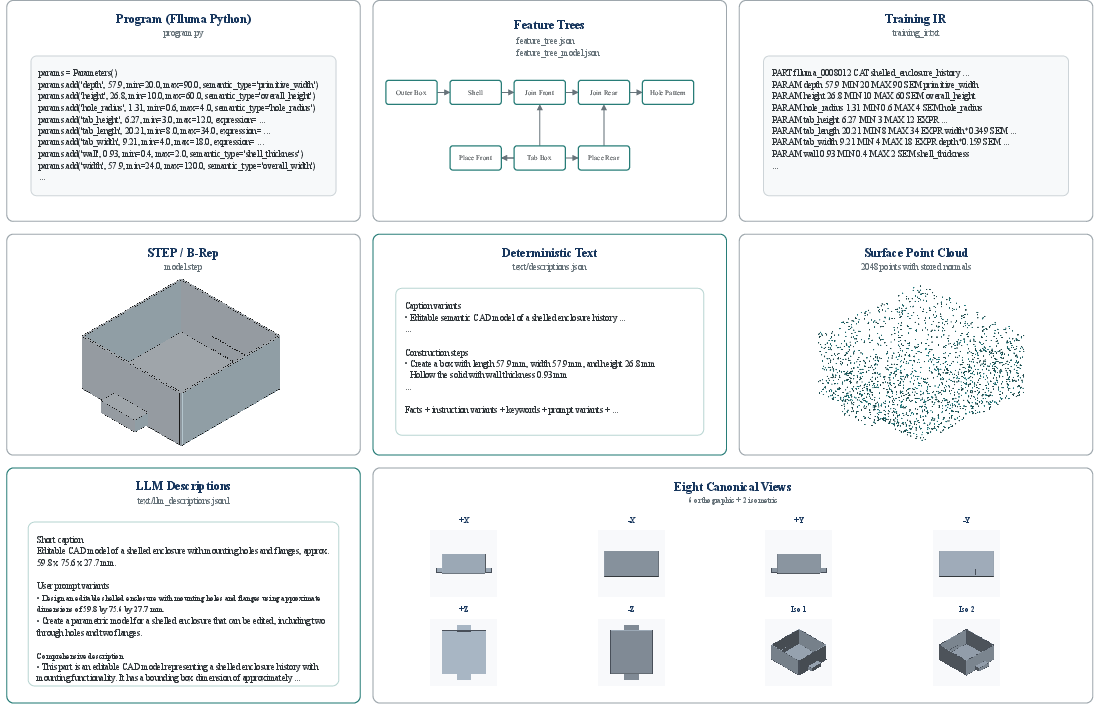
Figure 1: Aligned representations for a single FllumaOne sample showing executable code, structured feature tree, IR, kernel B-Rep, point cloud, text, and canonical renders.
The generation pipeline implements deduplication (construction signature), geometric validation (OpenCASCADE kernel), export checks (STEP/AP214), modality packing, and integrity reporting. Releases distribute both raw per-sample folders and machine learning-ready Parquet splits. The canonical eight-view set encodes axis-aligned and isometric views optimized to expose feature boundaries, not photorealism.
Scale, Complexity, and Diversity
FllumaOne comprises 100,000 valid samples, stratified across four generator-assigned complexity levels (L1–L4) mapped to template families: L1 focuses on primitives, L2 on basic parametric combinations, L3 and L4 span multi-feature histories and complex mechanical parts. The allocation closely matches targets: 3,056 (L1), 16,966 (L2), 55,219 (L3), and 24,759 (L4).
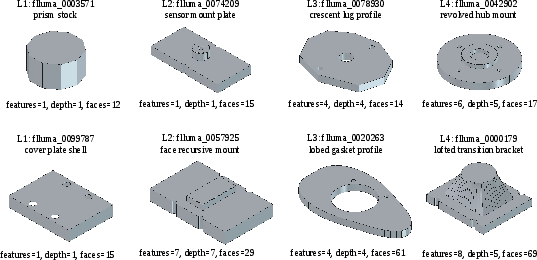
Figure 2: Examples from four complexity levels, with isometric views, sample metadata, and geometry statistics.
Program and feature-tree diversity is controlled via template libraries that instantiate primitives, compound operations, variable dependencies, and semantic feature roles. The 44-token operation vocabulary and 60-label feature-tree set cover a wide operational regime (e.g., expert-level hole patterns, lofts, sweeps, shells, fillets, chamfers, patterns).
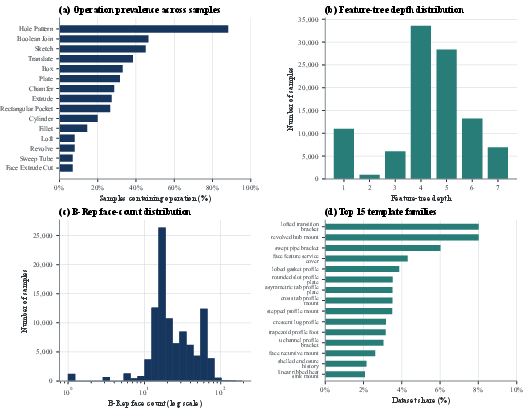
Figure 3: Distributional analysis for operation prevalence, feature-tree depth, B-Rep face counts, and template family coverage across the 100K corpus.
No exact duplicates exist under program, feature-tree, IR, or solid-signature hashes. Template normalized entropy (0.915) and Gini coefficients quantify operational and class diversity, with no template family exceeding 8% of the dataset.
Data Generation Pipeline
The FllumaOne pipeline leverages the Flluma kernel (Qt/C++/OpenCASCADE), which implements a Python-facing API with explicit operation names, typed arguments, and stable intermediate handling. Programs are generated procedurally from parametric template libraries, deduplicated at the feature-tree level, executed and validated in the kernel for solid-geometry correctness, and only then released.
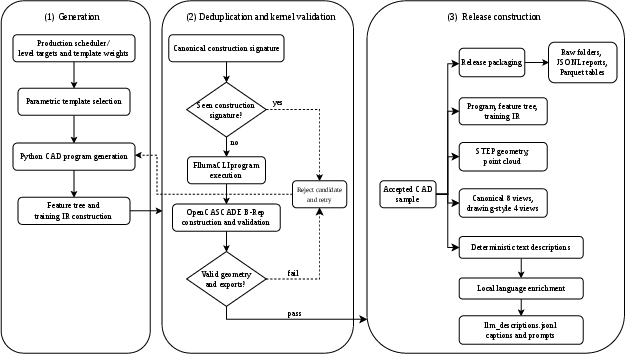
Figure 4: Schematic of the FllumaOne data generation and validation pipeline from template sampling to validated multimodal packaging.
The procedural generator varies operation counts, parameter ranges, operation order, and semantic types to maximize diversity within the constraints of regular APIs and validation. The kernel validation chain includes solid and surface checks, Boolean operation robustness, explicit export validation, and geometric property annotation (e.g., area, bounding box, aspect ratio).
Supported Learning Tasks and Benchmark Protocol
FllumaOne is extensible to multiple supervised and generative tasks:
- Text-to-program and sequence synthesis: Language- or caption-conditioned reconstruction of executable code, feature trees, or IR, prioritizing editability.
- Image/point-cloud-to-CAD reconstruction: Conditioning models on canonical renders or sampled surfaces for parametric, interpretable program prediction.
- Feature-tree and operation prediction: Learning to extend partial construction histories or auto-complete design logic.
- Cross-modal retrieval: Embedding representations into shared spaces to retrieve editable models from language, visual, or geometric queries.
- B-Rep-based analysis: Direct association of kernel-validated geometric features with their construction provenance.
These benchmarks admit direct kernel-validated evaluation, including syntax checks, execution rates, geometric fidelity (normalized Chamfer Distance), and editability-preserving metrics.
Baseline Results
A Qwen2.5-Coder-1.5B LoRA baseline, trained on 80K samples for text-to-program, yields:
- 99.98% Python syntax validity and 99.97% Flluma execution/build rate
- 99.14% kernel-solid and STEP-export validity
- Mean normalized Chamfer Distance 0.002124 on 9,909/10,000 geometric comparisons (test split)
- Mean source-code similarity 87.34%, operation F1 99.96%, LCS ratio 99.94%
Program validity and geometric errors are strongly correlated with construction complexity and template family. The highest reconstruction uncertainty and geometric deviation occur in L4, despite elevated code similarity, due to the inherent regularity and length of these sequences.
The results confirm robustness for interpolation within the generator distribution, but generalization to unseen templates or free-form human CAD remains unproven.
Dataset Comparison and Limitations
FllumaOne occupies a unique position versus prior datasets. Unlike geometry-only collections [koch2019abc], pure command-sequence sets [wu2021deepcad], or text-CAD with limited multimodal alignment [lv2025cadinstruct, xu2025cadmllm], FllumaOne guarantees full cross-modality integrity and kernel validation for every sample. The executable program is directly human-auditable and enables failure tracing across all levels of the modeling stack, from source code and IR down to B-Rep geometry and release metadata.
However, the distribution reflects procedural design choices—template coverage, operation parameters, validation policies. Out-of-distribution coverage for free-form user-generated CAD, large assemblies, or surface-rich products is limited. Language supervision is split between deterministic and LLM-enriched variants, with the latter not involved in geometry generation. Models may also overfit the Flluma API structure, necessitating new benchmarks for parameter editability and template-disjoint generalization.
Implications and Future Directions
Practically, FllumaOne establishes a comprehensive testbed for code-native, auditable, reproducible, and executable CAD learning at scale. It is now possible to rigorously debug, validate, and compare code-generation models through direct audit trails from prompt through executable program, kernel output, and geometric supervision. This is expected to accelerate development of interpretable, controllable, and edit-friendly CAD generation techniques.
Theoretically, the dataset underlines the distinction between shape reproduction and construction logic recovery. As downstream research pivots to editability, design-intent preservation, and open-vocabulary multimodality, the boundaries set by procedural datasets will require future expansion: incorporating human-authored histories, surface-based design regimes, assembly logic, and stronger language-geometry entanglement. Advanced metrics for robustness under parameter edits and novel construction intent will be required for substantial future progress.
Conclusion
FllumaOne delivers an aligned, program-executable, and kernel-validated multimodal CAD dataset supporting a broad regime of learning tasks and accurate, auditable benchmarking. By tightly integrating programmatic, feature, geometric, and multimodal perspectives, it facilitates both practical reverse engineering and foundational research in editable generative geometry. Future extensions should address broader generative diversity and editing benchmarks to close the gap with industrial and user-centric CAD creation.