- The paper introduces an LLM-driven method that automates process twin construction from unstructured documentation while achieving a mean F1 score of 95.2%.
- It employs a human-in-the-loop strategy that ensures safe, real-time binding of live data to process steps via dynamic OPC UA tag discovery.
- Experimental evaluations show an 84% reduction in development time, validating the system's efficiency across diverse industrial workflows.
FacProcessTwin: An LLM-Based System for Data-Bound Process Twin Development
Introduction
FacProcessTwin introduces an LLM-driven methodology for automating the construction of process twins in industrial settings directly from natural-language plant documentation and operator input. In contrast to asset-based twins centered on individual machines, process twins model the coordinated structure and data flows of entire production processes. This comprehensive perspective delivers improved potential for whole-system optimization, but traditional development workflows are hindered by the laborious requirements of process structure formalization and live data integration. FacProcessTwin addresses this bottleneck by automating both process model recovery and data binding, integrating human oversight at critical safety junctures to avoid the pernicious risks of incorrect autonomous binding.
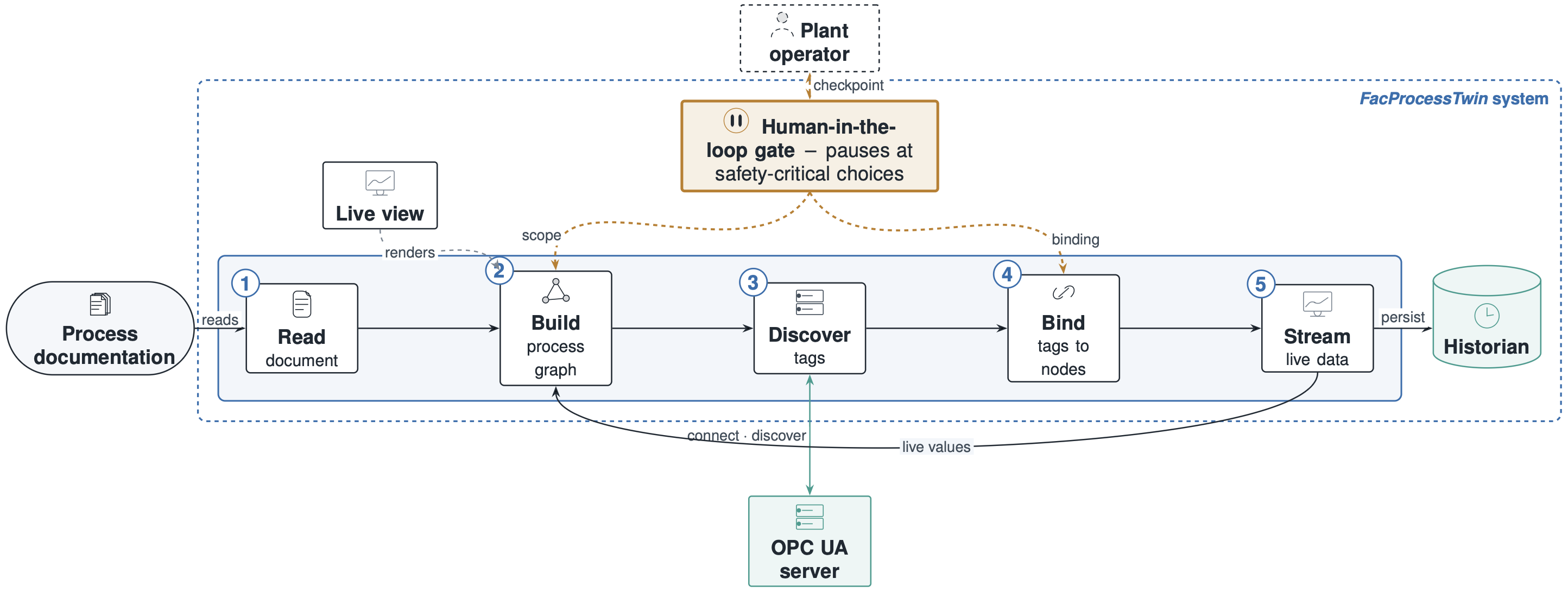
Figure 1: Architecture of FacProcessTwin, highlighting the human-in-the-loop LLM agent, deterministic toolchain, and interaction with process documentation, operator, and live plant data via OPC UA.
System Architecture and Workflow
FacProcessTwin operates as an orchestrated pipeline under human-in-the-loop governance. There are five distinct operational stages:
- Document Ingestion: The system parses heterogeneous process documentation (PDF/DOCX, prose, and tables) to extract candidate product flows.
- Process Graph Construction: An LLM agent recovers the ordered process sequence, annotating steps with critical control points; the resulting DAG is rendered as an interactive process diagram.
- OPC UA Tag Discovery: The system dynamically discovers available live data tags, accommodating non-standard and vendor-specific behaviors with multi-strategy enumeration and identifier repair.
- Tag-to-Step Binding: The agent proposes tag bindings with automatic confirmation for unambiguous cases, but suspends and escalates to human input for ambiguous or safety-critical mappings, enforcing strong HITL safeguards.
- Live Data Streaming: Upon binding confirmation, live values are streamed and visualized in real time, with archival to plant historian systems.
The agent’s autonomy is limited by design: the LLM intervenes solely for semantic extraction and proposal, while deterministic tools execute actions and persistent human-in-the-loop checkpoints prevent silent critical errors—particularly in tag binding.
Evaluation: Fidelity, Safety, and Efficiency
Process Model Fidelity
Across 16 ground-truth flows from an Australian food manufacturer’s SOP, FacProcessTwin reconstructed process topologies with a mean F1 score of 95.2% (range 85.7–100). Sequence accuracy averaged 90.2% with exact order restored in half the cases; residual errors were concentrated in a small number of flows, primarily due to runtime budget limitations. Control-point annotation accuracy reached 96.4%, demonstrating robust extraction of safety-relevant process semantics.
Data Binding and Human-in-the-Loop Governance
Recall for tag-to-step mappings was 100%—all necessary bindings were established. Precision, at 74.2%, reflected superfluous bindings to duplicate units not disambiguated by the source SOP, rather than agent-generated classification error, underscoring limitations of input completeness over algorithmic deficiency.
Critically, a controlled ablation demonstrated HITL efficacy: for 20 ambiguous, safety-critical tag cases, a baseline agent mis-assigned 75% silently, versus zero incorrect assignments with HITL escalation. On unambiguous tags, agent accuracy was unaffected by the governance layer (90.0% vs 89.4%). Thus, the HITL policy removes hazardous automation errors without degrading overall performance.
Development Effort
FacProcessTwin reduced the time required for twin construction and binding by approximately 84%, from an average manual effort of 31.8 minutes per flow to 5.2 minutes. Operator queries averaged two per flow, with the fastest automated execution always outperforming the slowest manual counterpart. These results held across a diverse set of LLM backbones, validating architecture-agnostic claims.
Implications and Future Directions
FacProcessTwin empirically validates the feasibility and practicality of end-to-end process twin generation from unstructured documentation, leveraging an LLM for semantics and delegation to human experts exclusively where LLM uncertainty or ambiguity intersects with process safety. The evaluation specifically highlights:
- Feasibility of accurate, scalable twin generation from non-formalized documentation in realistic settings.
- Robustness to LLM backbone selection, positioning the system to benefit from continual model improvements without retraining.
- Residual limitations inherent to incomplete or ambiguous documentation, shaping future research towards integration of ERP/MES data feeds for richer context.
- The HITL mechanism as necessary for deployment in operational-technology domains, transforming unsafe automation risks into manageable operator interactions.
The current evaluation is bounded to flows within one plant’s consistent SOP. Extension to multi-site, multi-format scenarios and formal operator-burden acceptability studies remain open priorities. The modular tool-based system design supports straightforward integration with varied document schemas and data protocols.
Conclusion
FacProcessTwin presents an operationally validated pipeline for process twin development that automatically extracts procedural knowledge and binds it to live plant data, with human-in-the-loop governance enforcing safety at ambiguous decision points. The system delivers high-fidelity models (mean F1 95.2%, 100% critical tag recall), avoids safety-critical binding errors, and achieves a substantial reduction in development time—affirming the viability of LLM-governed automation for digital twin deployment in real-world industrial settings. These results motivate further studies on generalization across industrial contexts and integration with richer, multi-source plant datasets.