- The paper presents a novel QMCS framework that quantizes Newtonian mechanics by treating position and velocity as independent observables.
- It employs a reformulated Hilbert space based on (x, v) states to maintain classical trajectories and avoid the conceptual inconsistencies of standard quantum mechanics.
- The approach promises enhanced modeling in fields like molecular dynamics and deepens the understanding of quantum-classical continuity in foundational physics.
Quantum Mechanics in Configuration Space: A Comprehensive Analysis
Context and Motivation
The relationship between classical and quantum mechanical descriptions of physical systems has been a persistent area of conceptual and technical debate. The paper "Quantum mechanics in configuration space in context" (2606.17622) evaluates this relationship by re-examining the foundations on which standard quantum mechanics (SQM) is built, positing that a physically motivated quantization of Newtonian mechanics—not Hamiltonian mechanics—generates a more conceptually continuous framework between quantum and classical regimes. This formulation, termed quantum mechanics in configuration space (QMCS), redefines quantum kinematics and dynamics in terms of position-velocity (x,v) states, directly reflecting the Newtonian perspective.
The paper emphasizes that the three main formulations of classical mechanics—Newtonian, Lagrangian, and Hamiltonian—are not fundamentally equivalent, despite frequent pedagogical claims to the contrary. Newtonian mechanics provides a direct, causal representation of particles in terms of positions and velocities, while Hamiltonian mechanics introduces canonical conjugate variables through a Legendre transformation, opting for mathematical elegance at the expense of physical perspicuity.
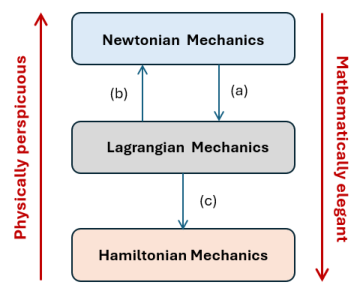
Figure 1: The relations among Newtonian, Lagrangian, and Hamiltonian mechanics, highlighting derivations and non-equivalences in classical theory structures.
This choice of starting point for quantization has a profound impact: canonical quantization of Hamiltonian mechanics, the foundation for SQM, conflates momentum with the generator of spatial translations, leading to conceptual inconsistencies and the loss of an independent velocity observable. In contrast, Newtonian mechanics distinctly maintains position and velocity as foundational entities.
Physical Basis and Hilbert Space Construction
QMCS posits that the quantum description should preserve the physical degrees of freedom evident in Newtonian mechanics—namely, position x and velocity v. Each (x,v) classical state is directly promoted to an orthonormal quantum state ∣x,v⟩. The collection of these states forms the complete Hilbert space for a single particle, with the quantum state given by
∣ψ(t)⟩=∬dxdvψ(x,v,t)∣x,v⟩,
where ψ(x,v,t) is the wave function in the configuration space basis.
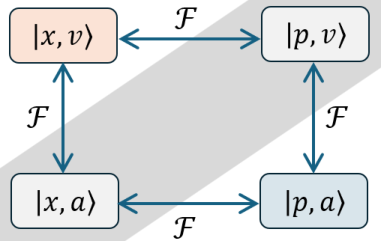
Figure 2: Four basis sets (e.g., ∣x,v⟩, ∣p,a⟩) interconnected by Fourier transforms, highlighting the distinction between classical and "least classical" quantum states.
This construction enables novel representations, including ∣p,v⟩, x0, and especially x1, which is a basis with no classical analogue. Importantly, x2 are the most classical quantum basis states, while x3 exhibit maximal quantum delocalization.
Observables and Generators
In the QMCS framework, the position x4 and velocity x5 operators act diagonally on their basis:
x6
There also exist translation generators in both position and velocity—momentum x7 and acceleratum x8—with
x9
All nontrivial commutators stem from v0 and v1, enabling simultaneous sharp specification of position and velocity, a property not available in SQM due to the sole use of position and momentum as canonical conjugates.
Dynamics
QMCS dynamics are encoded in a Schrödinger-type equation with a dynamical Hamiltonian v2 chosen such that the basis states v3 evolve according to Newton's laws. For a free particle:
v4
which is Hermitian (since v5 and v6 commute), and ensures trajectories remain sharply localized if initially prepared as such. This is in marked contrast to SQM, where wave packets universally delocalize over time due to the quadratic kinetic energy operator.
Empirical and Theoretical Claims
Conceptual and Empirical Continuity
The central claim is that QMCS achieves strong conceptual continuity with Newtonian mechanics by:
- Representing both position and velocity as independent, simultaneously measurable observables.
- Ensuring localized quantum particles remain localized during free evolution, directly mirroring Newtonian trajectories.
- Avoiding the conflation of velocity with translation generator (momentum), which in SQM leads to differing treatments of massive particles and photons with respect to wave-particle duality.
These features allow for enhanced explanatory power in the classical-to-quantum transition, as exemplified by the faithful reproduction of classical motion and energy conservation in the quantum theory.
Relation to Standard Quantum Mechanics
A direct comparative analysis shows that SQM, based on Hamiltonian mechanics and canonical quantization, lacks several physical observables (such as an independent velocity operator) and thus cannot represent certain limits or features of classical systems without invoking approximations (e.g., Ehrenfest theorem, which is not universally valid in SQM).
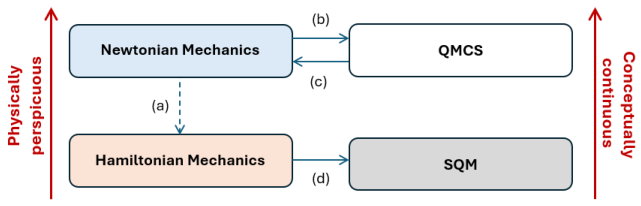
Figure 3: Schematic relating QMCS and SQM to their respective classical theories, emphasizing conceptual continuity upwards from classical to quantum domains.
Implications and Future Directions
The QMCS framework suggests that the choice of classical theory formulation deeply influences quantum theory's physical content and modeling capacity. The potential to straightforwardly extend Newtonian concepts, including causal trajectory-based motion, into quantum theory has several implications:
- Practical Modeling: QMCS may provide more robust classical-quantum hybrid methods in molecular dynamics, quantum chemistry, and condensed matter, especially where decoherence and localization are central.
- Foundational Physics: The presence of independent velocity and acceleratum operators may provoke re-examination of quantum relativity, quantum gravity, and the quantum-field-theoretic formulation of matter, particularly given the closer analogy to quantum electrodynamics for photons.
- Measurement Theory: The improved treatment of wave-particle duality could unify the description of particles and fields in quantum theory without recourse to distinct quantization schemes or ambiguous identification of observables.
Further research is required to extend the formalism to interacting systems, relativistic regimes, and coupled fields, as well as to determine whether predictions of QMCS and SQM diverge in scenarios not trivially mappable between the two.
Conclusion
Quantum mechanics in configuration space offers a physically motivated alternative to standard quantum mechanics, predicated on the direct quantization of Newtonian mechanics and the preservation of position and velocity as independent degrees of freedom. The approach resolves several conceptual inconsistencies present in standard canonical quantization, leading to enhanced empirical and conceptual continuity between quantum and classical mechanics. The implications of this framework extend from improved practical modeling tools to foundational questions in quantum theory, warranting further investigation and development.

