- The paper introduces a Floquet-based framework demonstrating how vortex-light beams generate coexisting topologically protected edge and vortex states in massive Dirac systems.
- The methodology leverages numerical diagonalization and LDOS analysis to reveal state localization, spectral gap formation, and impurity-induced angular momentum mixing.
- Results highlight that polarization detuning partially fills the dynamical gap and underscores the robustness of engineered topological states against moderate disorder.
Vortex-Beam-Induced Topological States in Dirac Materials: Effects of Impurity and Polarization Detuning
This study develops a comprehensive Floquet-based framework to analyze the impact of vortex-light beams (VLBs) on finite-size massive Dirac systems, emphasizing impurity scattering and polarization detuning. The model considers a two-dimensional massive Dirac Hamiltonian subjected to irradiation by a Laguerre-Gaussian type vortex beam, which imparts both spin and orbital angular momenta (SAM and OAM) onto the system. The driving field is incorporated via minimal coupling, generating an explicitly time- and space-dependent Floquet Hamiltonian. In the case of circular polarization (CP), total angular momentum (JzF) is conserved, allowing classification of eigenstates by combined electronic and photonic angular momentum quantum numbers. An effective particle-hole symmetry emerges, yielding distinct spectral and spatial features.
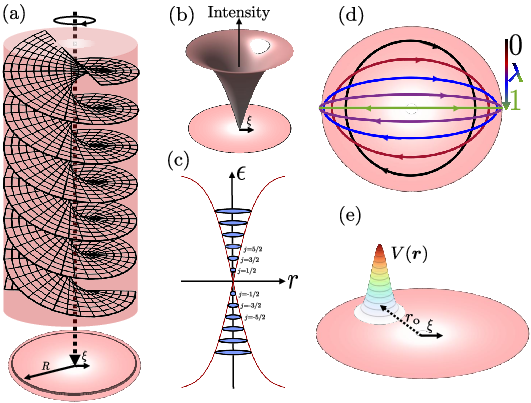
Figure 1: Schematic of VLB driving; radial intensity profile, vortex states versus intensity, polarization detuning towards linear, and impurity response at off-center positions are depicted.
Quasienergy Spectrum: Vortex and Edge State Structure
Numerical diagonalization using a fermion-doubling-free discretization yields the Floquet quasienergy spectra. For CP VLBs, a dynamical gap emerges at the one-photon resonance. Within this gap, photoinduced topologically protected edge states and multiply quantized vortex states, whose vorticity is set by the beam OAM ℓ, coexist. The number of vortex branches and their spectral dispersion depend on ℓ. The vortex-state branches exhibit linearly dispersing modes with slopes determined by the sign of ℓ, whereas the topological edge-state dispersions are fixed by the SAM.
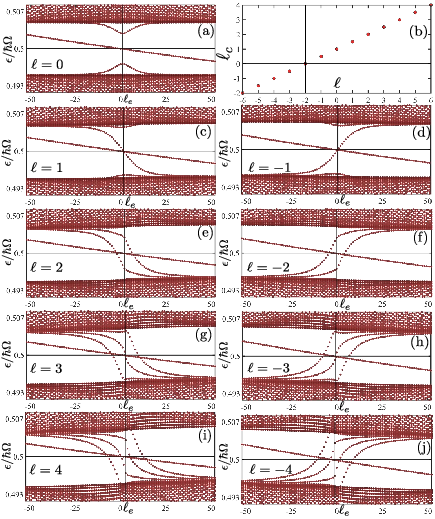
Figure 2: Quasienergy spectra versus OAM ℓ; vortex and edge states are resolved, and the particle-hole symmetry center ℓc distinguishes even/odd-∣ℓ∣ structure.
The real-space analysis reveals that vortex states are radially localized according to their total angular momenta, with confinement radius Rj scaling with ∣j∣. Particle-hole partner states share identical spatial profiles, reflecting the underlying symmetry constraints.
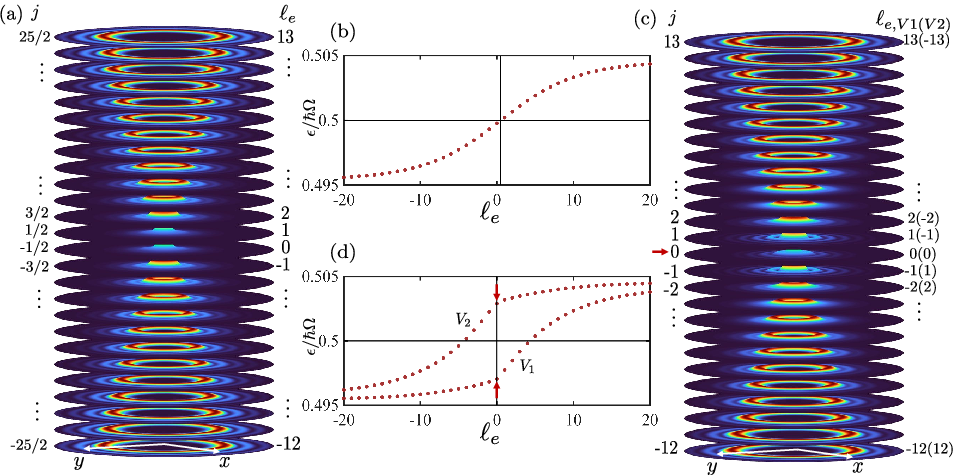
Figure 3: Radial probability densities for vortex states; states are organized by angular momentum j and their quasienergy dispersion within each vortex branch is shown.
The local density of states (LDOS) computed for various probe quasienergies and OAM values reifies both the topological edge and light-induced vortex signatures. For instance, ℓ0 yields exclusively edge states, while higher OAMs produce well-localized vortex densities concentric with the vortex core, observable in spatially resolved spectroscopy.
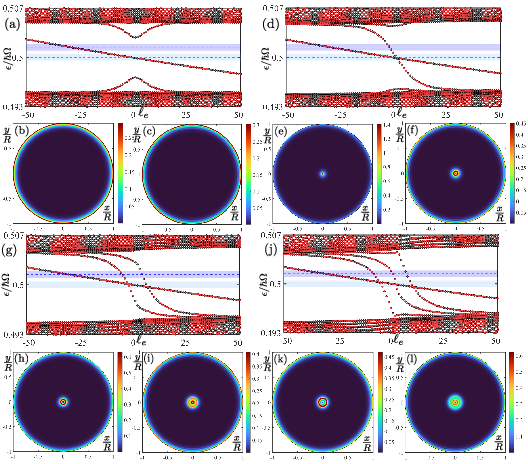
Figure 4: LDOS maps at various probe energies and OAM values; vortex-induced ring localizations and edge-state density at the sample boundary are evident.
Impurity-Induced Angular Momentum Mixing
The introduction of scalar impurities modeled by Gaussian profiles leads to local mixing between Floquet states with different angular momenta. For off-center impurities, matrix elements are non-vanishing between different ℓ1 sectors. The spectral response is governed by the overlap between impurity profile and the spatial localization of the vortex states—short-range impurities only perturb states with small ℓ2, while extended impurity clusters shift the entire vortex spectrum quasi-uniformly. Edge states, due to spatial separation, are relatively robust.
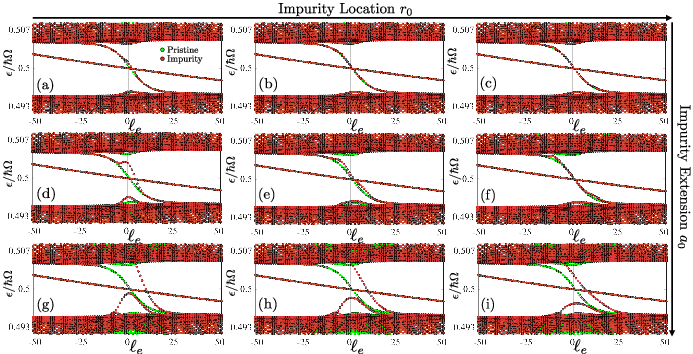
Figure 5: Quasienergy shifts of vortex states as a function of impurity location and range; localized versus cluster impurities show distinct coupling strengths and behavior.
The impurity also modifies the spatial structure of the Floquet states, producing angular modulations (dipole and multi-pole) in the density, with the sign and magnitude contingent upon the admixed angular momentum channels and radial proximity.
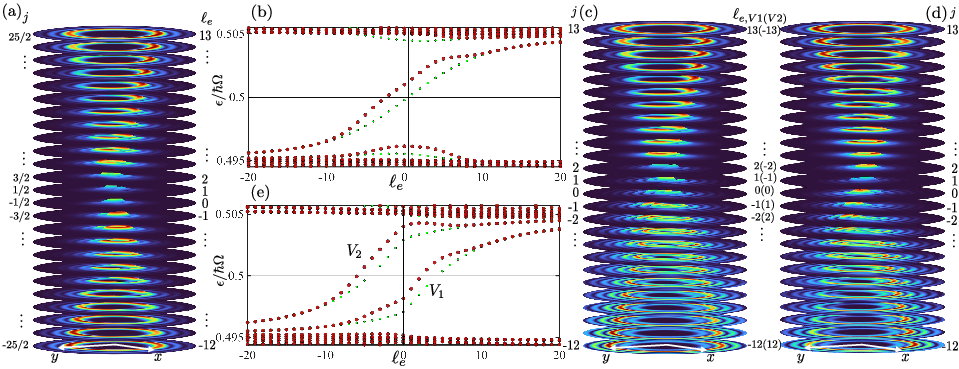
Figure 6: Real-space density distortions of individual vortex states in the presence of an off-center impurity; dispersion diagrams display impurity-induced energy shifts.
These effects manifest directly in the LDOS, which acquires spatial modulations and ring-splitting reflecting the underlying impurity-induced state mixing.
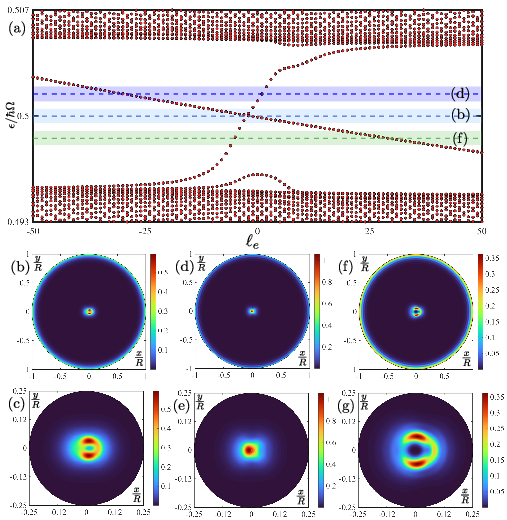
Figure 7: LDOS maps showing impurity-induced angular and radial modulations for ℓ3: both central and off-center probe energies illustrate the evolution of vortex signatures.
For higher-order vorticity (e.g., ℓ4), the increased number of vortex branches and hybridization with bulk states leads to more intricate interference and oscillation patterns in both LDOS and spatial charge distributions.
(Figure 7-2)
Figure 7-2: Impurity-modified LDOS for ℓ5; oscillatory features derive from intra- and inter-branch state mixing.
Polarization Detuning: Robustness and Gap Filling
Departing from perfect CP by introducing a linearly polarized component (parametrized by ℓ6) breaks total angular momentum conservation and provides an additional angular-momentum mixing channel. The effect appears at second-order in ℓ7; selection rules dictate that only states with angular momentum differing by two (ℓ8) hybridize to leading order. The most pronounced spectral modifications occur near the bulk bands, leading to progressive gap filling as ℓ9 increases.
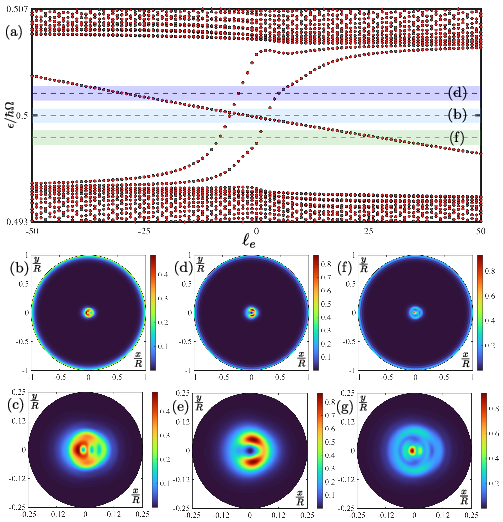
Figure 8: Evolution of the quasienergy spectrum under increasing deviation from CP; the dynamical gap closes via the incursion and hybridization of bulk-derived states.
Despite angular-momentum mixing, the effective particle-hole symmetry of the Floquet Hamiltonian persists, maintaining a quasienergy reflection symmetry in the spectrum as bulk states populate the gap.
Experimental Implications and Outlook
This study establishes that VLB-driven Dirac materials in finite geometries manifest robust, coexisting vortex and edge states, whose visibility survives moderate impurity disorder and up to ℓ0 deviations from perfect CP. The system provides unique possibilities for tunable, spatially structured Floquet topologies not accessible by uniform illumination. The spatial LDOS patterns, and their response to impurities or polarization detuning, offer direct routes for detection by STM or time-resolved scanning probe methods. The theoretical framework underscores the organizing roles of vorticity and particle-hole symmetry, and points toward further investigation of additional symmetry-breaking perturbations, engineered vortex beam profiles, or electron-electron interactions in the driven state.
Conclusion
The interplay of OAM-carrying vortex beams and massive Dirac systems yields a rich Floquet-engineered landscape of edge and vortex states, governed by total angular momentum conservation and effective particle-hole symmetry. Realistic imperfections—local disorder or imperfect polarization—reshape but do not obscure the organizing topological features. These results set a foundation for experimental exploration of structured light-matter interactions in quantum and topological materials.

