- The paper demonstrates that geometry-induced screening aligns attractive interactions at band extrema, leading to a marked enhancement of the superconducting transition temperature (Tc).
- It employs the Skyrmion Lattice Model to compute RPA-screened potentials, comparing SLM and ideal Landau-level form factors to elucidate the pairing symmetries.
- The study reveals distinct spin-unpolarized and spin-polarized pairing channels, with extended s-wave, chiral p-, and f-wave symmetries determining superconducting behavior.
Geometry-Driven Kohn--Luttinger Superconductivity in Flat Chern Bands
Motivation and Background
The emergence of superconductivity adjacent to fractional Chern insulator (FCI) phases in moiré materials has highlighted the intimate coupling between topological flat band geometry and collective instabilities. Conventional Kohn–Luttinger (KL) theory demonstrates that pure repulsive interactions can mediate pairing via fluctuation-induced attraction. However, in flat Chern bands, quantum geometry, nontrivial form factors, and the lack of Fermi surface confinement fundamentally reshape both screening and pairing symmetries.
This work establishes a geometry-induced KL mechanism where Landau-level-like form factors, specific to Chern bands, strongly align attractive RPA-screened Coulomb lobes with form-factor maxima near band extrema. This paradigm is investigated using the Skyrmion Lattice Model (SLM), a minimal model realizing topologically nontrivial flat bands with tunable quantum geometry.
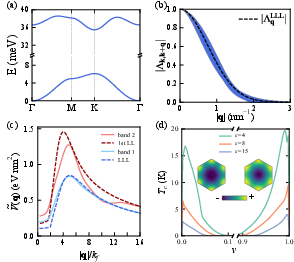
Figure 1: (a) SLM band structure; (b) Comparison of SLM and ideal Landau level form factors; (c) RPA-screened potential V~(q) for SLM vs. Landau levels; (d) Tc versus filling ν for varying dielectric constants ϵr.
Band Geometry, Screening, and the Emergent Mechanism
The SLM yields nearly dispersionless Chern bands, where both the band structure and the associated quantum metric closely emulate an ideal Landau level. A crucial result is the weak momentum dependence of the form-factor magnitude—a property enabling near-perfect k-space translational symmetry for the effective interaction.
Projection of screened interactions onto the flat band, calculated via the RPA formalism, reveals that for the SLM in the low-filling limit, the screened potential assumes a lobe-centered attractive form at low kF. Analytical and numerical treatment—informed by both SLM-specific and ideal Landau-level form factors—show that this geometric alignment substantially enhances the strength of effective attraction at band extrema, producing a sharply peaked filling dependence of Tc near the band edges.
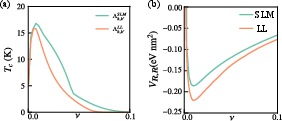
Figure 2: (a) Tc curves with SLM and Landau level form factors; (b) Effective attraction in the plane-wave channel versus filling.
Pairing Symmetry: Spin-Unpolarized and Spin-Polarized Channels
In the spin-unpolarized (time-reversal symmetric) regime, the effective interaction becomes nearly momentum-transfer diagonal, and the gap equation's leading instability is an extended s-wave state. The solution is governed by a C3-invariant order parameter, originating from the geometric structure of the form factors and the symmetry of the SLM. Computational solutions confirm that the mean-field Tc0 is maximized at the band edges and remains robust over a range of screening strengths.
For the spin-polarized channel, where time-reversal symmetry is absent, the phase of the form factor enters crucially, producing a superconducting phase with even higher Tc1 and a broadened filling window relative to spin singlet pairing. The dominant pairing symmetries are chiral Tc2-wave at low filling and chiral Tc3-wave at high filling. The optimal filling for Tc4 depends nonmonotonically on the dielectric constant, facilitated by the interplay of geometric screening and evolution of Fermi surface topology.
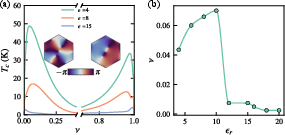
Figure 3: (a) Tc5 and phase of the order parameter as a function of filling for spin-polarized SLM; (b) Optimal filling as a function of Tc6.
Extensions to higher SLM bands establish that the band-extrema enhancement generalizes beyond the LLL analog, with the details of the optimal channel determined by the nodal structure and range of the relevant Landau-level form-factor.
Finite Temperature, Superfluid Weight, and BKT Transition
At finite temperatures, thermal smearing of the Lindhard function modifies the Tc7-dependence of RPA screening. Nonetheless, the peak in the attractive interaction and the enhancement of Tc8 near band edges persist, albeit with reduced magnitude. The superconducting transition in two dimensions is ultimately determined by the Berezinskii--Kosterlitz--Thouless (BKT) mechanism; the BKT temperature is bounded by the superfluid stiffness, itself composed of conventional and geometric contributions.
Notably, in the weak screening limit (small Tc9), the geometric (quantum metric) contribution dominates at low fillings, producing an enhanced BKT transition temperature at the band edges. In contrast, in strong screening regimes, the conventional contribution determines the filling dependence.
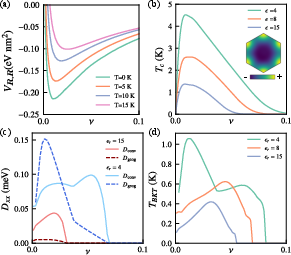
Figure 4: (a) RPA interaction strength (plane-wave channel) vs. filling at different temperatures; (b) ν0 and order parameter symmetry vs. filling with finite-ν1 screening; (c) Conventional vs. geometric superfluid weights; (d) BKT transition temperature, showing band-edge enhancement for small ν2.
Implications and Future Directions
The identification of a geometry-organized, band-extrema-dominated KL mechanism in flat Chern bands provides a direct, testable design rule for maximizing superconducting ν3 in moiré and atomic flat-band systems proximate to FCIs. The results predict that optimal superconductivity generically appears near local extrema (band edges) of flat Chern bands where the effective interaction and the Landau-level form-factor strongly reinforce each other. The theoretical framework unifies the fate of singlet and triplet pairing in spin-unpolarized and spin-polarized channels, showing that quantum geometry—in both magnitude and phase—dictates the pairing symmetry and ν4 profile.
The work also highlights the resilience of the mechanism to thermal and phase fluctuations and its extension to higher Chern bands with different form-factor structures. Open questions include the interplay with magnetic order, possible promotion by spin/valley fluctuations, and the influence of real-material disorder or multi-band effects.
Conclusion
This study establishes that the geometry-induced KL mechanism, governed by the alignment of RPA-screened attraction and Landau-level-like form factors, controls unconventional pairing in flat Chern bands. Both theoretical analysis and numerical simulations validate a band-extrema enhancement of ν5, robust to thermal and BKT fluctuations, providing a universal organizing principle for superconductivity in engineered flat-band Chern systems. This paradigm enables targeted design strategies for maximizing ν6 in moiré heterostructures and related materials, linking quantum geometry to tangible superconducting functionalities.