- The paper establishes a theoretical framework quantifying reranking risk in stochastic rankers through rigorous mathematical analysis of rank perturbations.
- It demonstrates that uniform and locality-biased perturbations differently impact retrieval metrics, with risk scaling as Θ(log k/M) and reducing with higher locality parameters.
- Empirical validation on TREC Fairness data confirms that predicted DCG risk aligns with observed rank shifts, guiding risk-aware design in IR systems.
Theoretical Foundations for Reranking Risk in Stochastic Rankers
This essay analyzes the paper "A Theoretical Framework for Risk Analysis of Stochastic Rankers" (2606.16970), which develops a rigorous foundation for quantifying the retrieval effectiveness variation—termed reranking risk—induced by stochastic ranking policies in IR systems. Stochastic rankers, which sample from distributions over permutations to achieve fairness or diversity, contrast with deterministic rankers in their inherent uncertainty regarding retrieval outcomes. This paper poses the critical ex ante question: how much can effectiveness (e.g., DCG, RR) change due to randomly sampled permutations before reranking is applied, and what governs this risk?
Risk Characterization: Single and Multiple Relevant Documents
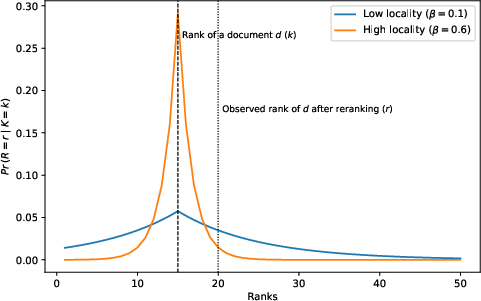
The analysis begins in the single relevant document case, modeling the rank perturbation as a permutation drawn from either a uniform or a locality-biased (kernel-based) distribution.
This structural decomposition highlights that for realistic policies, risk is inherently constrained by the necessary rank movement permitted by the stochastic mechanism.
Extension to Multiple Relevant Documents and DCG
The framework is extended to the general case of multiple relevant documents, adopting DCG as the effectiveness metric. The key result employs Taylor expansion to show that the expected change in DCG, per relevant document, scales with the expected displacement and with derivative bounds on the discount function:
- Uniform Model (Corollary): k0, where k1 is the highest-ranked relevant document and k2 is the total number of relevant documents. The risk grows with both the number of relevant documents and the length of the candidate list.
- Locality Model (Corollary): The above becomes k3, demonstrating improved risk bounds under local perturbation conditions.
Theoretical analysis in this work establishes that permutation-induced effectiveness variation is dominated by the positions of relevant documents (recall points) and the distributional aggressiveness of the stochastic ranking policy. For practical stochastic policies commonly motivated by fairness/diversity (e.g., Plackett-Luce, MAB), most permutations result in only small, local rank shifts for relevant documents, thus upper-bounding risk.
Empirical Validation: TREC Fairness Track
Empirical validation is conducted using stochastic rankers from TREC Fairness 2022 submitted runs that leverage multi-armed bandit-based optimization. These real policies include fixed-exploration, k4-decay, and attribute-weighted variants. The key experimental methodology consists of:
- Estimating locality parameter k5 from observed rank displacements in an initial batch of stochastic samples per query.
- Predicting the risk bound k6 for unseen permutations using the derived theoretical formulae.
- Comparing predicted and observed effectiveness deltas across hundreds of query-ranker-realizations.
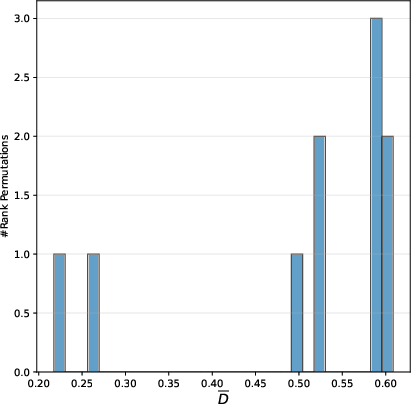
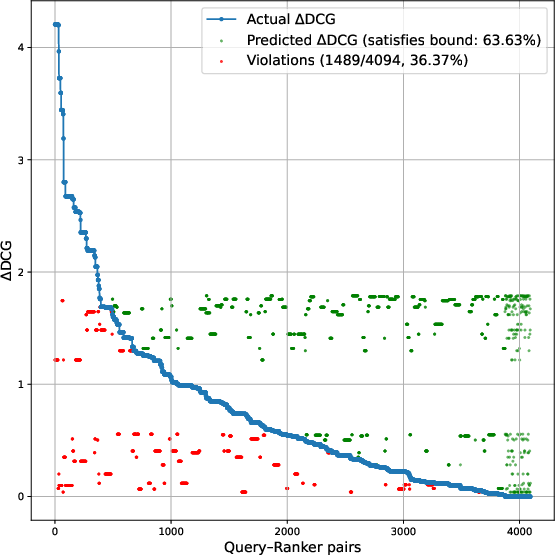
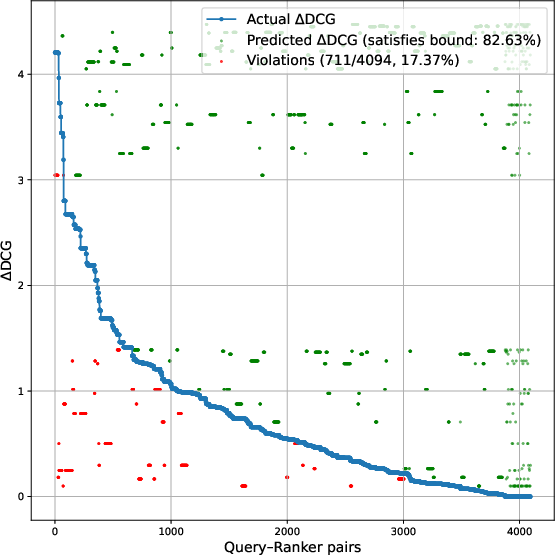
Figure 2: Mean displacement k7 and accuracy of theoretical DCG risk bounds for fixed MAB policy.
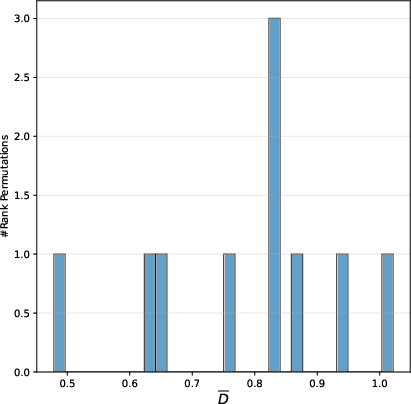
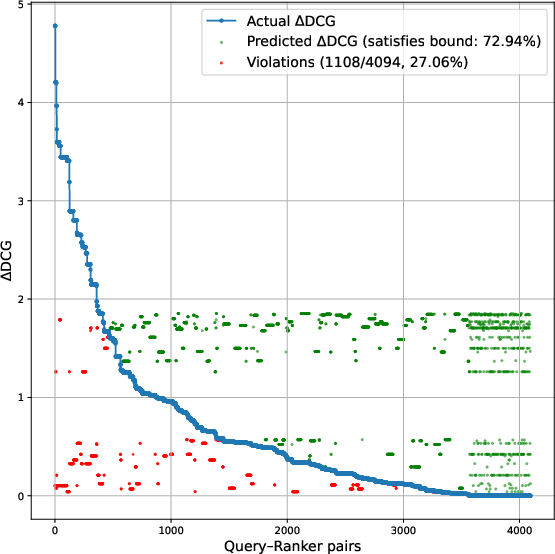
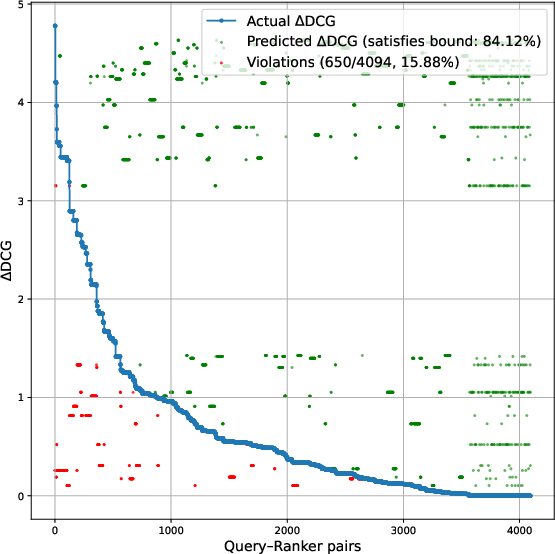
Figure 3: Mean displacement k8 and accuracy of bounds for k9-decay bandit policy (MAB-ED).
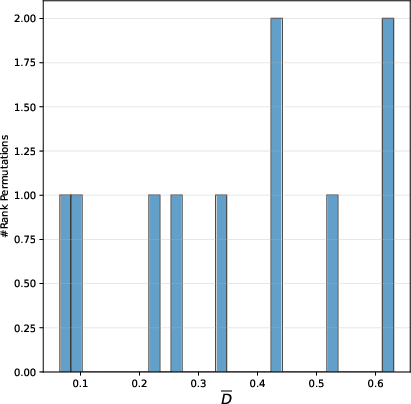
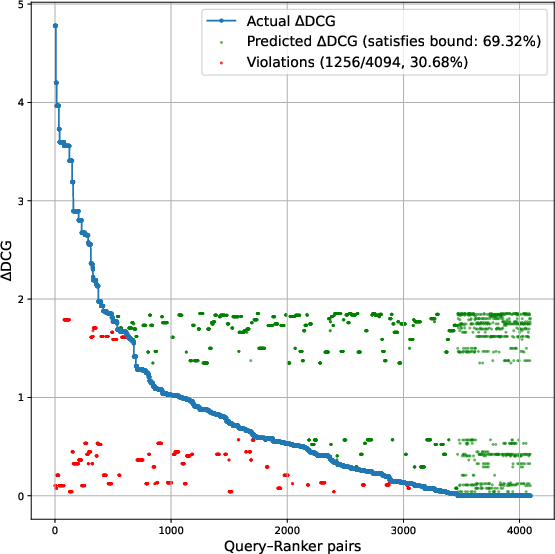
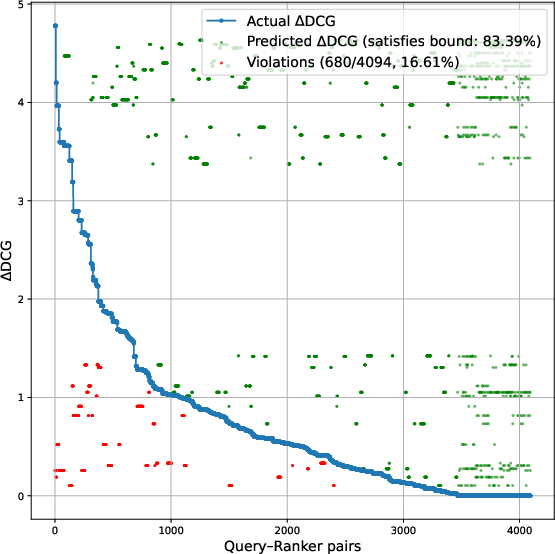
Figure 4: Mean displacement Θ(Mlogk)0 and accuracy of bounds for attribute-weighted bandit policy (MAB-SA).
Results reveal that, while not always tight for individual realizations (especially in high-variance tails), the theoretical predictions align closely with actual effectiveness variations—particularly in the bulk of instances with small rank displacements. The robustness parameter Θ(Mlogk)1 in empirical estimation plays a direct role in this alignment. The Θ(Mlogk)2-decay policy, which reduces stochasticity over time, displays the strongest conformity with risk bounds. Simultaneously, attribute-aware policies also sustain the predictive power of the locality-based theoretical model.
Implications, Limitations, and Future Directions
The proposed theoretical framework for reranking risk is pragmatically significant for the deployment and evaluation of stochastic rankers:
- Optimality and Safety: By quantifying worst-case (ex ante) randomization-induced risk, practitioners can set exposure strategies that optimize fairness and diversity objectives without unbounded quality loss.
- Risk-Aware Sampling: In high-stakes or high-risk contexts, risk-aware sampling can discard permutations with predicted deleterious impact, thereby raising the floor for guaranteed effectiveness.
- Parameter Estimation: Reliable early estimation of the locality parameter from sparse observations is feasible, enabling live risk prediction and adaptive control.
- Compatibility with Click Models: When manual relevance is unavailable, click logs and click models can act as proxies, strengthening real-world applicability.
Of note, the framework does not provide pointwise guarantees under all practical stochastic policies, as real implementations may include hybrid mechanisms and constraints not captured by idealized kernel models. Empirical violations are mainly restricted to rare, large-rank-shift events. Nonetheless, the general scaling and structural dependencies remain predictive.
Directions for future work include integrating risk bounds into stochastic policy optimization objectives, developing online adaptive risk controllers that incorporate user feedback, extending theoretical analyses to new stochastic mechanisms, and studying interplay with user click/noise dynamics and RAG pipelines.
Conclusion
This paper formalizes the quantification of reranking risk for stochastic IR rankers, establishing exact and asymptotic bounds that depend on recall points and policy-locality. The findings provide essential guidelines for balancing fairness/diversity-driven IR objectives with retrieval stability, supplying actionable insights into sensitivity analysis and risk-aware design. Empirical validation confirms that risk is both predictable and controllable in real-world stochastic bandit-based ranking systems, supporting theoretically grounded practice and the emergence of more robust, fair IR solutions.