- The paper presents a closed-form mapping between input l1-norm coherence and output entanglement negativity using a CNOT gate.
- It demonstrates that phase damping scales entanglement linearly with (1-p) while global depolarization induces sudden entanglement death above a critical noise threshold.
- Numerical simulations confirm the analytic predictions, providing practical benchmarks for optimizing quantum circuits in NISQ devices.
Quantifying Coherence-to-Entanglement Conversion Efficiency under Noisy Operations
Introduction and Motivation
This work presents an exact analytic treatment of noise-limited conversion of local quantum coherence into bipartite entanglement in an elementary two-qubit circuit, formalizing operational resource quantification in noisy intermediate-scale quantum (NISQ) devices. The protocol under analysis consists of a single-qubit coherent input, an incoherent ancilla, an ideal CNOT entangling unitary, and subsequent noise modeled as either independent phase damping (pure dephasing) or a global two-qubit depolarizing channel. The primary aim is to obtain closed-form mappings between input l1-norm coherence and output entanglement negativity, quantifying the conversion efficiency and the degradation effect of distinct noise mechanisms.
Theoretical Framework and Protocol Description
The protocol initializes qubit A in the pure state cosθ∣0⟩+eiϕsinθ∣1⟩, and qubit B (ancilla) in the incoherent state ∣0⟩. The system then undergoes a CNOT gate (control: A, target: B), resulting in the output cosθ∣00⟩+eiϕsinθ∣11⟩. In the noiseless scenario, the bipartite entanglement generated solely depends on the input coherence. Entanglement negativity—specifically suited for two-qubit characterization due to the sufficiency of the PPT criterion—is used as the entanglement measure.
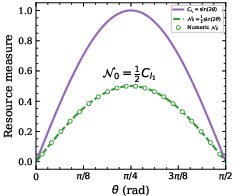
Figure 1: Ideal coherence–entanglement relation in the noiseless CNOT protocol: Cl1 coherence of input is mapped to output negativity N0=21sin(2θ).
The protocol's density matrix before noise has an A0-state form with only the populations A1, A2 and the anti-diagonal coherence nonzero.
Analytic Results: Noiseless and Noisy Coherence-to-Entanglement Mappings
Ideal (Noiseless) Mapping
The analysis establishes that the output negativity after the CNOT operation, as a function of the input angle A3, is
A4
This proportionality is a direct, closed-form mapping: regardless of the input phase, the A5-coherence is deterministically converted into negativity entanglement with conversion factor A6.
Phase Damping
Phase damping is treated as independent decoherence on each qubit. The anti-diagonal element A7, responsible for entanglement, is suppressed by A8, while populations remain unaltered. The output state retains an A9-form, leading to a compact analytic expression for the negativity: cosθ∣0⟩+eiϕsinθ∣1⟩0
The conversion efficiency, defined as the ratio of output to ideal negativity, is
cosθ∣0⟩+eiϕsinθ∣1⟩1
which is independent of the input coherence angle cosθ∣0⟩+eiϕsinθ∣1⟩2. There is no entanglement sudden death: entanglement persists for all cosθ∣0⟩+eiϕsinθ∣1⟩3 for any nonzero input coherence.
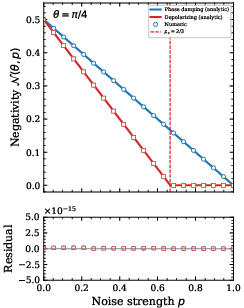
Figure 2: Entanglement negativity cosθ∣0⟩+eiϕsinθ∣1⟩4 for maximally coherent input under increasing noise for both phase damping and global depolarization.
Global Depolarizing Channel
Global depolarizing noise is modeled as a CPTP map replacing the output state with the maximally mixed state with probability cosθ∣0⟩+eiϕsinθ∣1⟩5: cosθ∣0⟩+eiϕsinθ∣1⟩6
Unlike individual dephasing, this channel isotropically mixes all components. The negativity after depolarization is given by
cosθ∣0⟩+eiϕsinθ∣1⟩7
leading to entanglement sudden death at the threshold
cosθ∣0⟩+eiϕsinθ∣1⟩8
For maximally coherent input (cosθ∣0⟩+eiϕsinθ∣1⟩9), B0, recovering the Werner-state separability point.
The conversion efficiency is coherence-dependent: B1
Here, input coherence also increases robustness to depolarization, in contrast to phase damping where robustness is uniform with respect to B2.
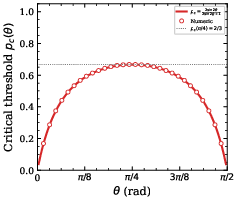
Figure 4: Entanglement sudden-death threshold B3 for global two-qubit depolarizing channel; maximal for maximal input coherence.
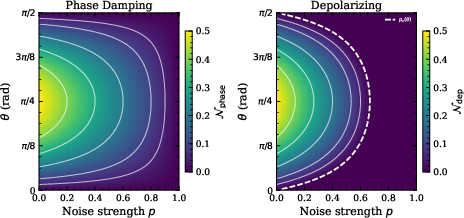
Figure 6: Two-dimensional negativity landscape B4 for both phase damping and global depolarization, showing the entangled and separable regions.
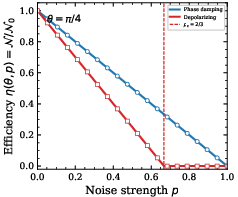
Figure 5: Coherence-to-entanglement conversion efficiency B5 as a function of depolarizing or phase-damping noise; global depolarization leads to a thresholded drop in efficiency.
Numerical Validation and Spectral Insights
The analytic predictions for the output negativity were corroborated through explicit density-matrix simulations, demonstrating agreement to within numerical roundoff. The partial transpose spectra under both noise channels confirm that only one eigenvalue can become negative and that its behavior under the two noise channels fundamentally diverges: smooth decay for phase damping and thresholded (sudden) death for depolarization.
These findings rigorously characterize two physically distinct noise-induced degradation mechanisms for coherence-to-entanglement conversion in quantum circuits:
- Phase damping preserves conversion efficiency proportional to remaining single-qubit coherence, suggesting entanglement distribution via dephased but coherent ancillae can remain robust in systems dominated by pure dephasing noise.
- Global depolarization enforces a coherence-dependent ceiling on both entanglement and conversion efficiency, reflecting universal mixing (“white noise”) processes prevalent in crosstalk- or reset-dominated quantum devices.
These results establish analytic reference points for benchmarking coherence-to-entanglement protocols in NISQ devices and for calibrating optimal input state preparation in the presence of realistic device noise.
Additionally, the exact threshold for entanglement sudden death under depolarization aligns with and generalizes the Werner state boundary, which is a widely used reference in open-system quantum information theory.
Future Directions
Potential extensions include analysis of local depolarizing noise, amplitude damping, noisy entangling gates, and generalizations to multi-qubit “cascaded” entanglement networks. The interplay between restricted B6-state structures and efficient entanglement negativity calculations may also be exploited in larger quantum circuits and for novel resource theories.
Conclusion
This work provides a comprehensive analytic characterization of how the conversion efficiency between quantum coherence and entanglement in a two-qubit CNOT protocol is fundamentally constrained by both phase damping and depolarizing noise. The derived closed-form mappings and efficiency landscapes offer a quantitative framework for analysis, benchmarking, and future engineering of elementary quantum-information technologies operating under nontrivial environmental noise (2606.16916).