- The paper demonstrates enhanced optomechanical coupling in MHz flexural modes via an asymmetric photonic-crystal cavity design.
- It employs complex-band-engineered serpentine interconnects to achieve exponential suppression and tunability of mechanical coupling.
- Experimental validation confirms controlled, lithographically calibrated readout and connectivity for scalable nanomechanical circuits.
Coupled Flexural Optomechanical Cavities Enabled by Complex-Band-Engineered Nanomechanical Interconnects
Background and Motivation
Integrated nanomechanical circuits demand the co-design of motion confinement, readout, and connectivity across dense networks of resonant elements. While GHz optomechanical crystal modes benefit from wavelength-scale phononic bandgap engineering for compact isolation and strong optomechanical coupling, MHz flexural modes offer larger driven displacement and accessible nonlinear effects favorable for sensing and dynamical manipulation. However, these modes face challenges in confinement and controlled inter-resonator coupling due to their extended wavelength and sensitivity to global boundary conditions. The work addresses two core engineering roadblocks: (1) achieving robust optical transduction of in-plane flexural motion within single nanobeams, and (2) implementing lithographically compact, predictable mechanical mirrors and couplers for MHz flexural waves.
Photonic-Crystal Cavity Design and Asymmetry-Induced Enhanced Optomechanical Coupling
A one-dimensional silicon photonic-crystal nanobeam serves as the optical cavity platform, leveraging asymmetric defect profiles to overcome cancellation effects intrinsic to symmetric designs. Lateral structural asymmetry shifts the electric field off the centerline, markedly increasing overlap with in-plane flexural displacement and yielding optically bright MHz mechanical modes without auxiliary neighboring structures.
The engineered asymmetry enables optomechanical coupling rates g0 for in-plane flexural modes (one-, three-, and five-antinode) that are four to six times larger than achieved in nominally symmetric cavities (g0,1a=29.0 kHz≈5.2g0,1s, g0,2a=91 kHz≈6.0g0,2s, g0,3a=83 kHz≈4.4g0,3s). Notably, the increased coupling stems from a partial cancellation in the moving-boundary integral that is highly sensitive to field and geometry engineering, indicating further gains are possible with refined asymmetry.
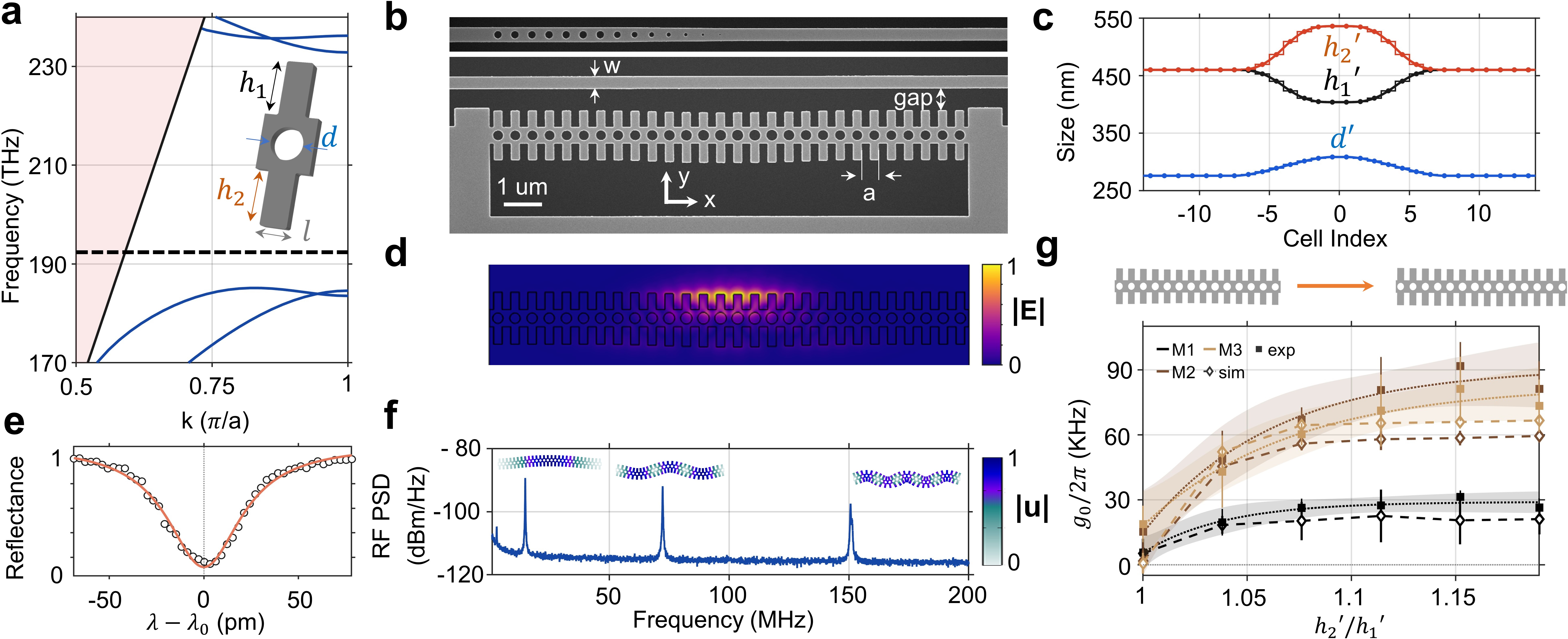
Figure 1: Optical band structure and field distribution of the asymmetric photonic-crystal cavity, with g0 as a function of defect asymmetry revealing substantial enhancement in optomechanical coupling to flexural modes.
Complex-Band Engineering of Serpentine Mechanical Interconnects
The serpentine mechanical interconnect, parameterized via elliptical cell geometry, acts as a compact MHz stop-band mirror and evanescent coupler for in-plane flexural waves. Complex band structure calculations reveal attenuation constants per cell in engineered stop-band regions, enabling exponential suppression of mechanical coupling across increasing interconnect lengths.
Simulation and experiment confirm that the normal-mode splitting between symmetric and antisymmetric hybridized flexural modes decays as g(N)=g(0)exp(−Nα), with α extracted from both unit-cell and full-system simulations. The attenuation can be continuously tuned via the cell parameter s, which shifts the vertical semi-axis of the ellipse and the position of the confined flexural mode relative to the stop-band edge.
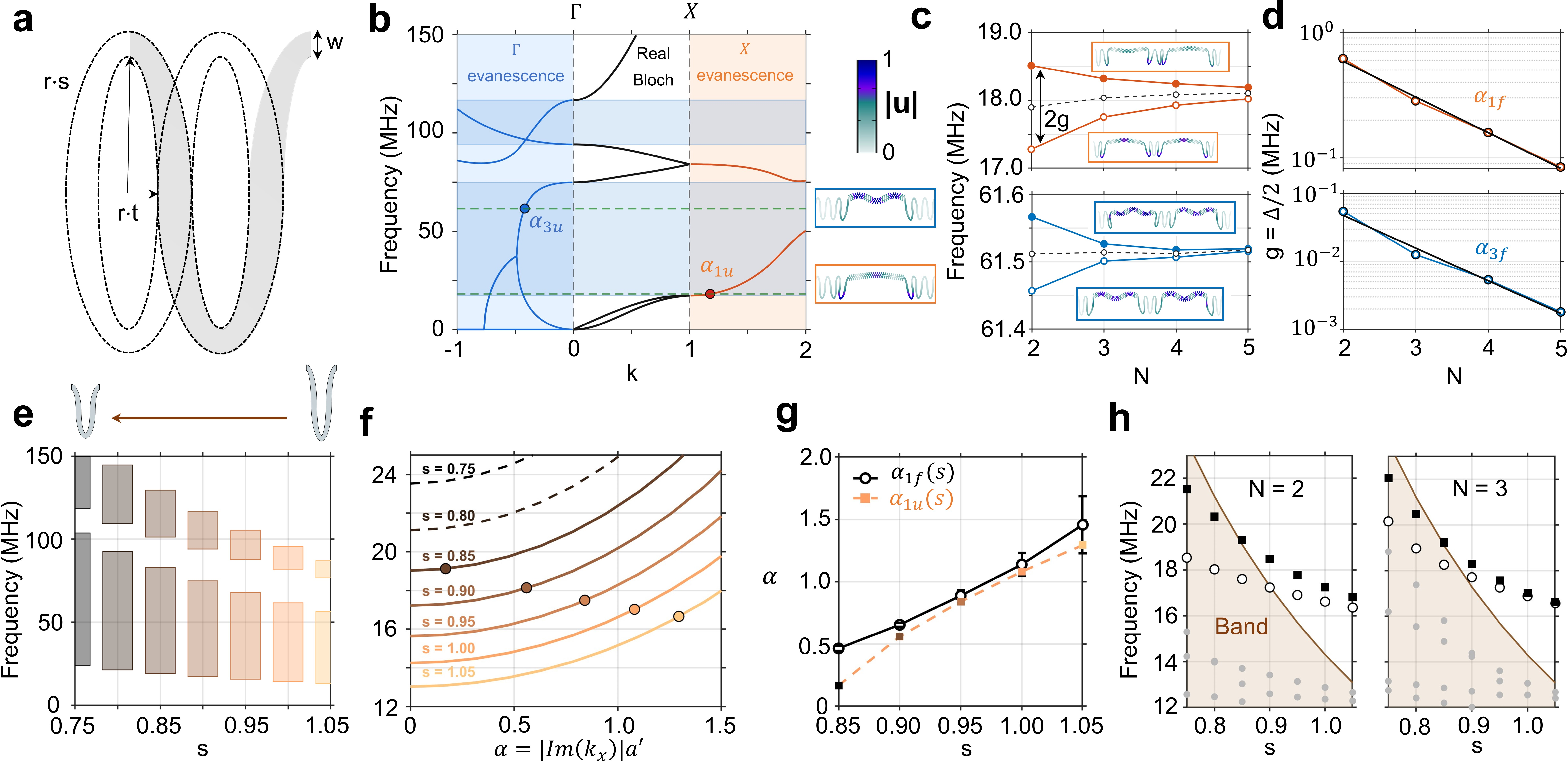
Figure 2: Band structure, attenuation constants, and tunability of the serpentine interconnect, illustrating exponential decay and geometry-dependent coupling control.
Experimental Characterization and Validation
Single-cavity nanobeams terminated with serpentine mirrors exhibit RF spectra consistent with simulated stop-band confinement of flexural modes. Pressure-dependent quality factor measurements demonstrate that, upon evacuation, Q saturates predominantly due to internal dissipation mechanisms (surface, thermoelastic, and material losses), not clamping loss, as confirmed by low-temperature enhancement of Q.
Mechanical coupling in double-cavity geometries (nanobeams bridged by g0,1a=29.0 kHz≈5.2g0,1s0 serpentine cells) is experimentally determined via optomechanical spectroscopy. The measured attenuation constant g0,1a=29.0 kHz≈5.2g0,1s1 matches simulated predictions, establishing the serpentine link as a lithographically calibrated evanescent mechanical barrier that supports exponential tuning of inter-resonator coupling.
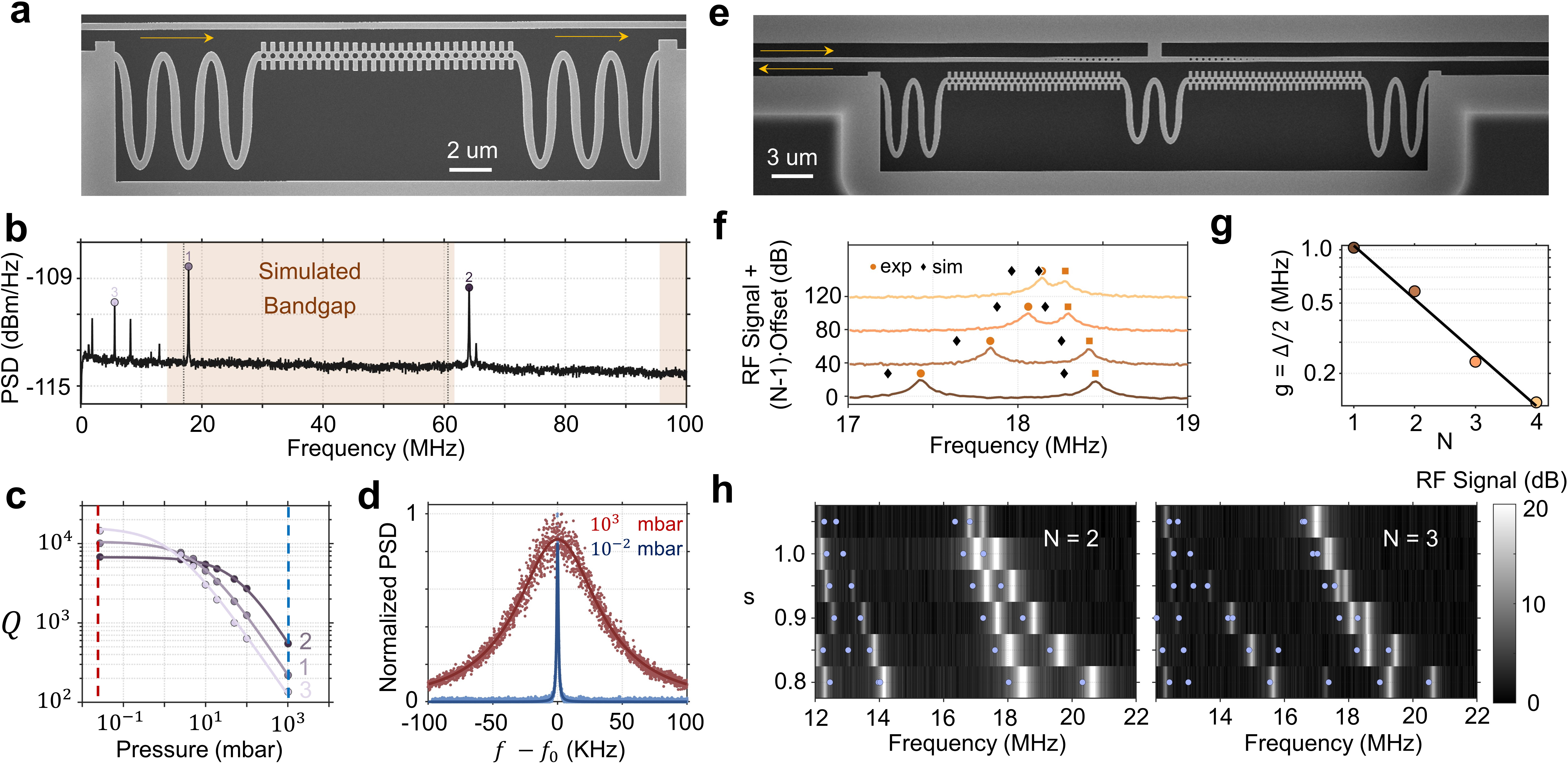
Figure 3: SEM images and RF spectra of serpentine-clamped nanobeams and coupled-cavity molecules, with quality factors and coupling rates mapped as a function of g0,1a=29.0 kHz≈5.2g0,1s2 and cell geometry.
Practical and Theoretical Implications
This platform delivers a design-controlled optomechanical readout for MHz flexural modes, enabling deterministic engineering of both optical and mechanical connectivity for integrated nanomechanical circuits. The compact, passive serpentine interconnects translate stop-band theory into practical, scalable mechanical mirrors and couplers, directly supporting circuit-level architectures such as arrays, rings, and lattices for phonon routing, multimode dynamics, and topological mechanics. The generic transferability of the complex-band approach—independent of material platform or frequency—makes it suitable for hybrid photonic-phononic systems, extending the reach of optomechanical integration.
The findings also highlight the prospect of achieving clamping-loss-limited regimes in future devices with improved material quality and surface engineering, facilitating noise-free isolation akin to GHz bandgap shields. Realization of controlled, locally engineered mechanical coupling will enable exploration of nonlinear dynamics, synchronization, intermodal interactions, and programmable lattice behaviors at scale.
Future Directions
Further development of this platform is likely to involve: (1) optimizing defect asymmetry for MHz-range g0,1a=29.0 kHz≈5.2g0,1s3 in slot-less nanobeams, (2) scaling out to larger circuit topologies with engineered coupler geometries for strong/weak coupling regimes, (3) leveraging both static and optically programmable mechanical interaction layers for reconfigurable dynamics, and (4) integrating low-loss material and advanced fabrication to observe true clamping-loss-limited quality in MHz resonators.
Conclusion
This work establishes a lithographically defined optomechanical nanobeam platform utilizing transverse cavity asymmetry and complex-band-engineered serpentine mechanical interconnects to achieve strong optical transduction and calibrated evanescent coupling of MHz in-plane flexural modes (2606.16887). The central result—exponential suppression and tunability of mechanical coupling via interconnect design—validates the use of complex band structure as a quantitative, predictive tool for scalable optomechanical circuit engineering. These advances position the platform for implementation in larger, multifunctional phononic-photonic architectures, with broad implications for nonlinear dynamics, sensing, and hybrid programmable networks in nanomechanics.