- The paper demonstrates that introducing a small, non-zero pressure with a polytropic index n>3 leads to robust nonlinear stability and homogenization in the Einstein-de Sitter universe.
- It employs advanced numerical schemes, including Lax-Friedrichs, fifth-order WENO, and fourth-order Runge-Kutta, to validate the decay rates of inhomogeneities in Sobolev norms.
- The results imply that pressure prevents shock formation in a single-fluid model, contrasting with the instability of dust models and informing improved cosmological simulations.
Non-linear Stability of the Matter Dominated Universe: Analysis and Implications
Introduction
The paper "Non-linear stability of the matter dominated universe" (2606.16879) presents a comprehensive numerical investigation into the future behavior of non-linear perturbations of the Einstein-de Sitter (EdS) universe as governed by the Einstein-Euler system with a polytropic equation of state. Specifically, the study explores the role of matter pressure in stabilizing the FLRW universe during the matter-dominated epoch—contrasting sharply with the classic scenario where pressureless dust leads to dynamical instability and large-scale structure formation.
Physical and Mathematical Background
The EdS spacetime provides the standard cosmological model for the matter-dominated era, constructed under the assumption of dust (pressureless fluid) and vanishing spatial curvature. It is well established that, under small perturbations, the EdS universe is nonlinearly unstable in the Einstein-dust system: density perturbations generically grow, a mechanism often invoked to explain cosmic structure formation.
This investigation revisits this paradigm by considering a minimal yet physically motivated generalization: a perfect fluid following a polytropic equation of state p=Kρ1+1/n with n>0, which induces a non-zero, albeit possibly small, pressure. In the large-t (late time) limit, polytropic fluids recover dust-like behavior, making this regime a natural candidate for cosmological modeling. Crucially, for n>3, the system exhibits a stabilizing coupling between velocity and energy density through pressure—a mechanism that is absent in dust.
Numerical Methodology
The model is formulated in Gowdy-symmetric settings with T3 spatial topology, reducing the general problem to a $1+1$ dimensional system through symmetry. The Einstein-Euler system is discretized using a local Lax-Friedrichs finite volume scheme with fifth-order WENO reconstruction and fourth-order Runge-Kutta evolution, achieving formal second-order accuracy for sufficiently smooth solutions. Convergence tests confirm this accuracy in both metric and matter variables.
To quantify nonlinear stability, the authors investigate the forward-in-time behavior of small but generic perturbations around the background FLRW solution in areal coordinates, as well as various geometric and energetic diagnostic quantities. The perturbation size is parameterized, and the influence of the polytropic index n and parameter K systematically explored.
Key Results
Homogenization and Decay
The principal finding is robust evidence of homogenization: for sufficiently small and generic initial inhomogeneities with n>3, scalar fluid velocity and modified density variables rapidly decay in Sobolev norms, aligning with theoretical predictions:
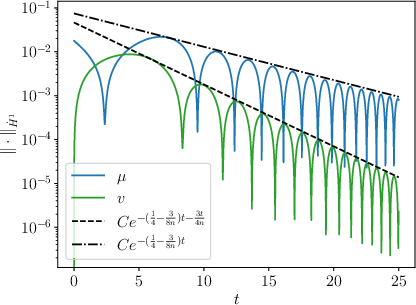
Figure 1: Asymptotic behavior of the H˙1 norms of the modified density n>00 and velocity n>01 showing rapid decay consistent with analytic rates.
Additionally, metric perturbations homogenize, and the geometric invariants (spatial Ricci and Kretschmann scalars) asymptotically approach zero, signaling a return to spatial flatness:
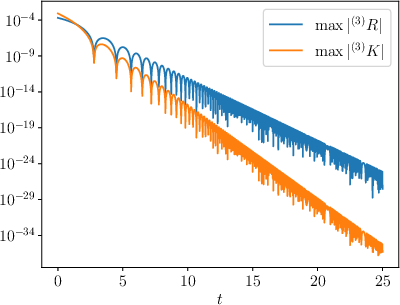
Figure 2: Maximum of the absolute value of the spatial Ricci and Kretschmann scalars indicating asymptotic spatial flatness.
This late-time homogenization demonstrates that the EdS universe becomes a dynamical attractor when the matter pressure, however small (n>02), is present—contradicting the instability seen in dust cosmologies.
Sharp Stability/Instability Threshold
A critical phenomenon observed is the existence of a threshold n>03 for the polytropic index, separating stable and shock-forming (unstable) regimes under fixed perturbation amplitude and n>04. The transition is characterized by a logarithmic scaling of stabilization or shock-formation times as n>05 approaches n>06 from above and below, respectively:
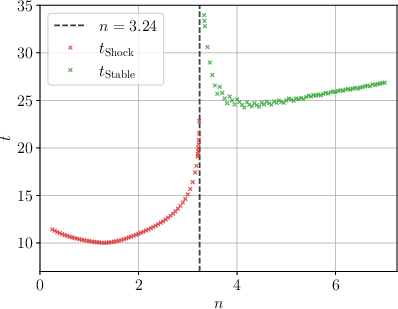
Figure 3: The transition between stable and shock forming solutions; n>07 is numerically identified as the boundary value for stability.
Decreasing the perturbation amplitude shifts n>08 closer to the theoretical lower bound n>09, consolidating the analytical conclusion that t0 is necessary and sufficient for nonlinear stability in this setting.
Analytic Understanding: Monotone Fluid Energy and Homogenization
Analytical analysis of a simplified asymptotic model corroborates the numerics. The authors introduce an appropriate high-order energy t1 capturing spatial inhomogeneities, and derive a differential inequality establishing monotonic decay at the rate t2 for t3. This links the numerical decay of Sobolev norms to the structure of the Einstein-Euler coupling, confirming that pressure acts as a damping mechanism for inhomogeneities.
Contrasts with the Einstein-Dust Model
The introduction of non-zero pressure fundamentally alters the fate of the matter-dominated universe. While the Einstein-dust system generically develops shocks and inhomogeneities even for infinitesimal perturbations, the polytropic model (t4) suppresses such instabilities—leading to a future attractor with large-scale homogenization:
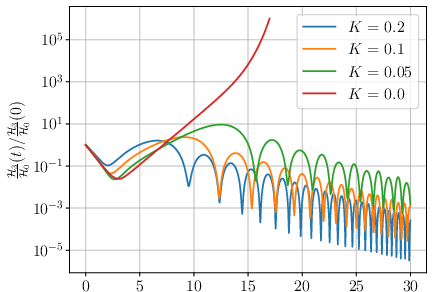
Figure 4: The behavior of the norm ratio relevant for shock detection: unlike dust, the polytropic fluid avoids shock formation for t5.
Implications for Cosmology and Theoretical Developments
This work elucidates a new stable regime for the Einstein-Euler system in cosmological contexts. The absence of nonlinear structure formation in a single-fluid, sufficiently stiff (t6) polytropic model has both practical and conceptual consequences:
- Cosmological Modeling: The findings provide justification for using polytropic fluids with t7 as effective large-scale models for the matter-dominated epoch, explaining the observed large-scale flatness and homogeneity of the universe.
- Stability Theory: The work sets a precedent for identifying stable regimes in the absence of positive cosmological constant or curvature domination, extending analytic techniques for nonlinear stability to the decelerated expansion phase.
- Structure Formation: While the single-fluid model robustly homogenizes, this does not rule out structure formation in multi-component systems, where subdominant components with linear or more compressible equations of state may still drive local instabilities (e.g., via shocks), as discussed in related analyses.
- Future Analytical Advances: The monotone energy technique for polytropic fluids with t8 points to the possibility of rigorous proofs of nonlinear stability for this class. The phase transition across t9 invites further study of critical exponents and universality in cosmological hydrodynamics.
Numerical Validation
To guarantee the credibility of the findings, convergence tests for key evolved quantities (e.g., n>30) clearly demonstrate second-order convergence across resolutions, confirming the reliability of the results.
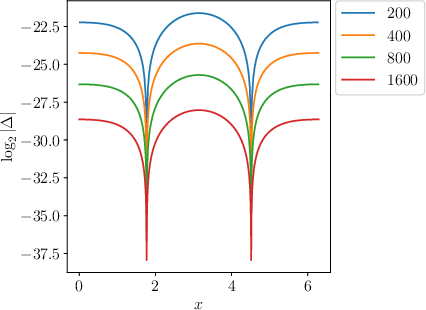
Figure 5: Convergence plot of n>31 at fixed time, confirming second-order numerical accuracy.
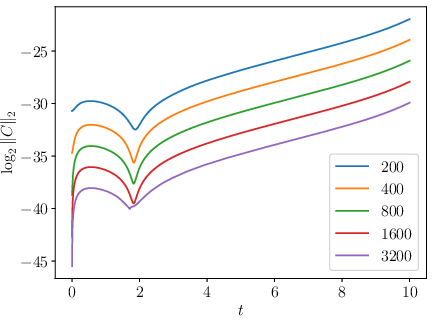
Figure 6: n>32 norm of the momentum constraint violation, evidencing robust constraint preservation and numerical scheme reliability.
Conclusion
This study provides compelling numerical and analytic evidence that the Einstein-de Sitter universe is a nonlinearly stable attractor for the Einstein-Euler system with polytropic index n>33, provided perturbations remain in the small data regime. These results close a significant gap in the understanding of cosmological stability during the matter era and lay the groundwork for further analytical and multi-fluid investigations. The identification of a critical polytropic index for stability has practical relevance for cosmological modeling and theoretical implications for the nonlinear dynamics of coupled Einstein-matter systems.