- The paper experimentally demonstrates enhanced parameter sensitivity at the exceptional point using a dissipation-free PT-symmetric quantum simulation.
- It maps conventional gain-loss dynamics to a four-mode superconducting circuit via precise parametric driving, ensuring accurate coupling calibration.
- The study shows that sensitivity peaks arise from amplified signal response rather than noise suppression, offering new insights for quantum metrology.
Enhanced Sensitivity near a Quantum Exceptional Point without Engineered Dissipation
Introduction
This work addresses the experimental realization of enhanced parameter sensitivity near a quantum exceptional point (EP) in a system engineered to emulate parity-time (PT)-symmetric non-Hermitian dynamics, yet without relying on artificial gain and loss dissipation channels. By implementing a closed four-mode quantum system via superconducting circuit QED and parametric driving, the platform realizes a mapping to the canonical PT dimer with balanced gain and loss, opening a controlled avenue to study non-Hermitian physics in the quantum regime while preserving quantum coherence. The paper provides both experimental protocols and quantitative analysis, demonstrating operational regimes with enhanced sensitivity in the vicinity of an EP and establishing connections to fundamental metrological limits and the trade-off between signal response and added noise in quantum sensing.
The conventional PT dimer Hamiltonian is defined for two coupled modes, one with gain and one with balanced loss, and underpins a broad class of non-Hermitian effects including the emergence of exceptional points, where both eigenvalues and eigenvectors coalesce. The equations of motion
idtd(α1 α2)=(iγ/2g g−iγ/2)(α1 α2)
describe the amplitudes α1, α2 of the gain and loss supermodes, with coupling g and non-Hermitian gain/loss parameter γ. The exceptional point occurs at g=γ/2.
Instead of engineering incoherent gain and loss, the authors realize a Hamiltonian-equivalent four-mode closed quantum system, where gain and loss are encoded as pairs of parametric two-mode squeezing processes, and the coherent coupling is mapped via mode-swapping:
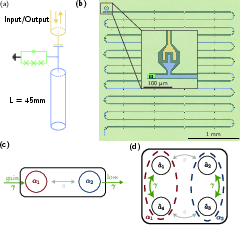
Figure 1: Device and experimental setup—parametric drives and associated four-mode mapping on a superconducting CPW resonator and SNAIL.
The QMFS (quantum mechanics-free subsystem) protocol is employed to reconstruct effective supermode observables:
α1↔⟨a^1+a^4†⟩α2↔⟨a^2+a^3†⟩.
Under this mapping, the effective non-Hermitian evolution is accessed without introducing dissipative noise, allowing unambiguous probing of sensitivity enhancements associated with the EP under parametric-only driving.
Device Implementation and Parametric Interaction Calibration
A SNAIL-shunted λ/4 superconducting coplanar waveguide resonator is engineered to support multiple spectroscopy-verified modes and equipped with static flux-bias for Kerr-free operation, ensuring only three-wave mixing persists. Four distinct resonator modes—a^1 through a^4—serve as the basis for the effective PT dimer analog.
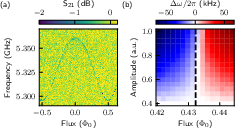
Figure 2: Basic characterization of mode α10, showing flux-bias dependence of frequency and Kerr-free condition.
Careful pump calibration ensures precise control of both swapping (beam splitter) and two-mode squeezing (parametric amplification) rates, which are required to implement the Hamiltonian in the effective PT-symmetric model. Accurate matching of interaction strengths and phase calibration are crucial for performance at the exceptional point.
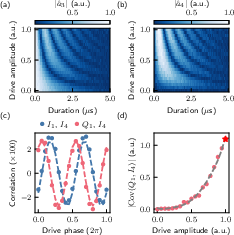
Figure 3: Calibration of parametric couplings via mode population oscillations and two-mode squeezing correlation amplitudes.
Ringdown and drive calibrations verify individual mode decay rates and readout gain, allowing modeling and compensation of asymmetries and residual initialization errors.
Observation of Enhanced Sensitivity at the Exceptional Point
Time-domain measurements of the reconstructed supermode amplitudes reveal the characteristic dynamics of both the PT-unbroken (α11) and PT-broken (α12) regimes. Below threshold, modes exhibit exponential amplification with relative amplitudes controlled by the balance of gain/loss and population transfer; above threshold, coherent oscillations (Rabi-like chevrons) manifest, reflecting the real parts of the spectrum in a Hermitian regime.
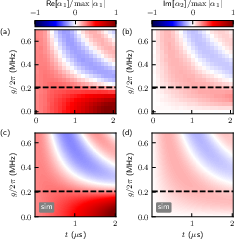
Figure 4: Time-domain evolution of normalized supermodes α13, α14 across a sweep of coupling strength and parametric drive duration, with fit to dissipative mean-field model.
Quantitative analysis of the system’s sensitivity to small variations in the coupling parameter α15, as measured via the derivative of supermode readout signal normalized by corresponding noise, demonstrates a pronounced maximum in parameter sensitivity as the system is tuned to the EP. The sensitivity
α16
is maximized by choice of pulse duration α17, and plotted as a function of normalized coupling α18.
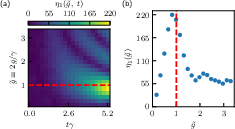
Figure 5: (a) Sensitivity to coupling parameter in supermode readout as function of α19 and α20; (b) Maximum observed sensitivity versus α21 with clear peak at the exceptional point (α22).
In this setting, the enhancement in sensitivity is a consequence of the signal response’s square-root divergence with respect to parameter perturbation at the EP, not of any suppression of intrinsic or technical noise. The measurements are classical-noise dominated, in contrast to the regime where quantum noise sources (shot noise, parametric vacuum fluctuations) determine SNR. The results are fully consistent with prior theoretical restrictions on sensitivity enhancement at non-Hermitian degeneracies, which show that SNR enhancement must be analyzed with respect to the interplay between signal amplification and system noise [e.g., Loughlin and Sudhir, Phys. Rev. Lett. 132, 243601 (2024)].
Implications and Future Directions
This implementation constitutes a dissipation-free quantum simulator for non-Hermitian Hamiltonians, allowing the investigation of PT symmetry breaking, exceptional points, and their impact on metrological sensitivity in a setting compatible with quantum coherence and QND measurement. The explicit absence of engineered gain/loss channels is significant, both practically (no quantum-limited amplifier noise penalty) and fundamentally (separating dynamical and noise effects at the EP without ambiguity).
From a theoretical perspective, the results reinforce that enhanced response near an EP is generically linked to non-normal dynamics, but practical SNR improvement depends on detailed noise models specific to the realization. This platform makes it possible to probe the quantum-noise-limited regime, where subtle deviation from classical behavior may be detected, and to test analytic predictions for multiparameter sensing or Heisenberg-limited enhancements under non-Hermitian extensions (2606.16060).
Experimentally, the architecture can be scaled to higher mode numbers and more complex non-Hermitian topologies. Adding detuning and time-dependent parametric drives enables the exploration of chiral mode switching, optimal control near degeneracies, and robust quantum information applications leveraging non-Hermitian topology.
Conclusion
The paper demonstrates a parametric superconducting quantum circuit that emulates exceptional point physics and enhanced parameter sensitivity near a PT-symmetric non-Hermitian degeneracy, all without recourse to engineered gain and loss. In the absence of quantum-limited dissipation, the system’s behavior and sensitivity peak at the EP is dominated by signal response, establishing a reference point for future studies operating deeper in the quantum regime. This platform serves as a powerful test-bed for non-Hermitian quantum simulation, with broad relevance to quantum metrology, sensing, and dynamical control in synthetic open quantum systems (2606.16060).