- The paper demonstrates experimental observation of both first- and second-order dynamical phase transitions in a dephased photonic quantum walk by precisely controlling dephasing and synthetic gauge flux.
- It employs quantum process tomography and spectral analysis to identify diabolic crossings and exceptional points, directly linking spectral topology with relaxation dynamics.
- The findings pave the way for engineered dissipation and enhanced sensing in scalable non-Hermitian open quantum systems.
Experimental Observation of Dynamical Phase Transitions in Dephased Photonic Quantum Walks
Overview
The paper "Experimental Observation of Dynamical Phase Transitions in a Dephased Photonic Quantum Walk" (2606.15935) presents a comprehensive experimental investigation of dynamical phase transitions (DPTs) in open quantum systems, specifically leveraging a discrete-time photonic quantum walk (OQW) on a minimal three-node graph. Through precise control of dephasing and a tunable synthetic gauge flux, the authors realize both first- and second-order DPTs mediated by the spectral properties of the associated Floquet–Liouvillian superoperator. This work characterizes the phase transitions by their spectral signatures—either eigenvalue crossings (diabolic points, DPs) or eigenvalue/eigenvector coalescences (exceptional points, EPs)—and quantitatively benchmarks the transition behavior via state tomography and detailed Floquet eigenmode analysis.
Theoretical Framework
The studied system is a three-site OQW described by a discrete-time evolution: coherent unitary propagation controlled by a parameter β and a phase ϕ (synthetic gauge flux), interleaved with local dephasing of calibrated strength q. The interplay between these components determines whether the effective Markovian dynamics obeys or breaks detailed balance. Under time-reversal symmetry (TRS, ϕ=0), Q is symmetric, enforcing real spectra and DPTs by eigenvalue crossings (FOPTs). Breaking TRS (ϕ=0) introduces complex spectra, thus enabling EPs and second-order DPTs (SOPTs).
The open-system Floquet map,
ρ(s+1)=(1−q)Uρ(s)U†+qn∑KnUρ(s)U†Kn†,
interpolates between fully coherent evolution (q=0) and classical population dynamics (q=1), allowing spectral signatures of relaxation to be probed across regimes. The paper emphasizes that in the q=1 Markovian limit, analytical identification of DPTs is possible via the eigenvalue structure of the transition matrix ϕ0; for ϕ1, the full superoperator is reconstructed and analyzed.
Experimental Implementation
The experiment employs a reconfigurable photonic network, with three modes encoded in combinations of polarization and spatial state. The network synthesizes the desired unitary step operator ϕ2 using waveplate and beam displacer arrangements, followed by controlled dephasing. Heralded single photons are injected, and after each step, mode-resolved detection yields stepwise population data. Full quantum process tomography is performed to reconstruct ϕ3 or the Liouvillian superoperator as required.
This setup enables precise control of dephasing and phase flux, facilitating direct observation of the change in relaxation dynamics. The protocol distinguishes between monotonic and oscillatory relaxation, directly correlating relaxation patterns with underlying spectral physics.
(Figure 1)
Figure 1: Schematic of the interferometric OQW apparatus, highlighting the implementation of coherent evolution and stepwise dephasing via single-photon optics.
Observation of First-Order Dynamical Phase Transitions
Under TRS, the spectrum of ϕ4 is strictly real and diagonalizable, so DPTs manifest as abrupt crossings of the relaxation rates of non-stationary modes (i.e., FOPTs). Experimental population measurements reveal a discontinuous switch in the slow relaxation mode as ϕ5 traverses a critical point ϕ6. This is quantified by constructing a relaxation order parameter from the relevant eigenmode; a sharp jump in this order parameter at ϕ7 characterizes the first-order nature of the transition.
The experimentally extracted Floquet exponents show a clear diabolic crossing, with the order parameter shift matching theoretical expectations and confirming the abrupt change in relaxation behavior.
Observation of Second-Order Dynamical Phase Transitions and Exceptional Points
With broken TRS (ϕ8), the Markov generator ϕ9 becomes non-symmetric, and its non-stationary eigenvalues can coalesce at an EP. Near the EP, the spectrum exhibits the characteristic square-root branch point: the splitting between non-stationary eigenvalues,
q0
vanishes as q1, scaling as q2.
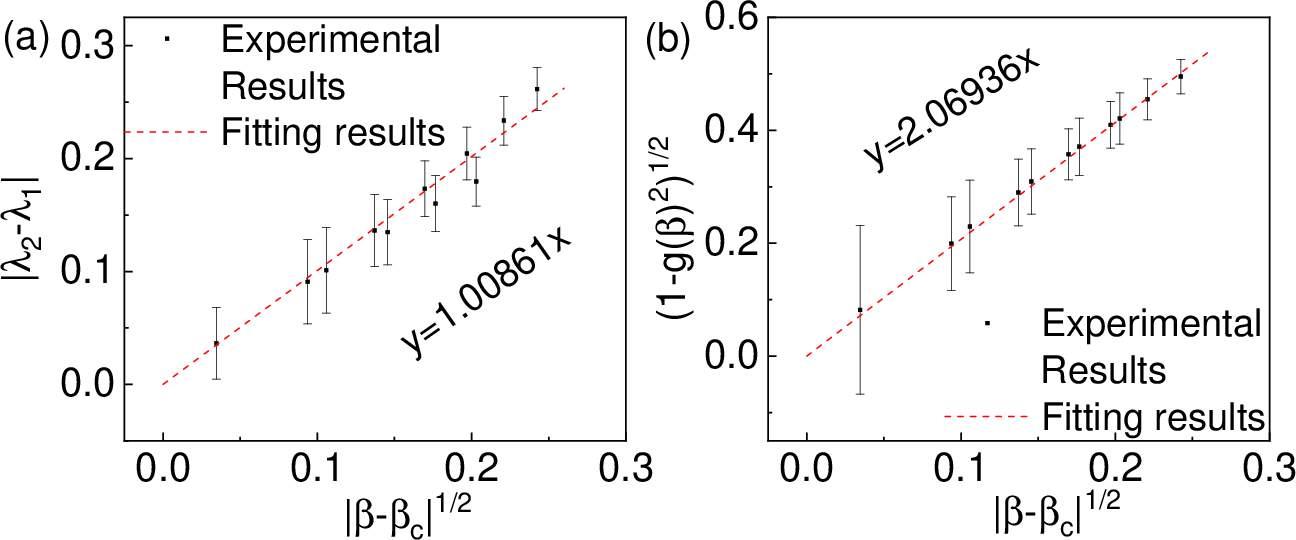
Figure 2: Square-root scaling of eigenvalue (a) and eigenmode (b) splitting near the EP, establishing the critical behavior associated with SOPTs.
Experimental relaxation data exhibit a crossover from non-oscillatory to oscillatory population dynamics, marking the emergence of a conjugate pair of complex exponents above the EP. Simultaneous coalescence of eigenvectors (quantified by a normalized overlap parameter q3 approaching unity) further validates EP formation. This non-analytic behavior in the spectral and eigenmode structure rigorously identifies the SOPT as an EP-driven critical phenomenon.
Influence of Quantum Coherence: Transition Persistence and Suppression
Beyond the fully classical (q4) regime, the authors systematically reduce dephasing, reconstructing the full evolution superoperator for intermediate q5. The DPTs—the FOPT under TRS and the SOPT under broken TRS—persist for moderate q6, with the critical point q7 shifting as q8 varies. As quantum coherence dominates (q9), signatures of DPTs, such as spectral crossings and EP features, become indistinguishable due to spectral smearing and non-analyticity suppression.
These observations demonstrate that DPTs, as defined here, are not restricted to the strict classical (Markovian) limit, but persist deep into the quantum regime, up to a finite coherence threshold.
Implications and Future Directions
The demonstration of controlled DPTs and EP phenomena in a minimal-size open quantum system has multiple ramifications:
- Spectral Topology in Open Systems: The experiment links the topology of the Floquet–Liouvillian spectrum (diabolic points and EPs) to macroscopic relaxation dynamics, positioning OQWs as an accessible testbed for non-Hermitian criticality and spectral topology.
- Engineered Dissipation and Relaxation Engineering: The ability to switch between FOPT and SOPT by tuning synthetic gauge flux allows for programmable control of system relaxation, relevant for quantum simulators and future dissipation-based state-preparation protocols.
- Sensitivity Enhancement via EPs: Operation near EPs is known to enhance parametric sensitivity; optical quantum walk systems may thus offer robust platforms for sensing applications leveraging non-Hermitian degeneracies.
- Scalability and Topological Phenomena: Extending the architecture to larger graphs could enable exploration of phenomena such as the Liouvillian non-Hermitian skin effect and dissipative bulk-boundary correspondence, with implications for topological classification in open quantum systems.
- Non-Markovian Effects and Quantum Enhancements: The flexibility of the setup enables probing routes to non-Markovian DPTs, quantum Mpemba effects, and non-Hermitian speedup in relaxation—a direction of increasing current interest.
Conclusion
This work provides the first experimental observation of both first- and second-order dynamical phase transitions in a dephased OQW controlled by a tunable gauge flux. The results rigorously connect the topology of the Liouvillian spectrum to observable critical behavior in relaxation, validate the persistence of these transitions into the quantum-coherent regime, and position discrete-time photonic OQWs as versatile platforms for investigating fundamental and applied aspects of non-Hermitian physics and engineered dissipation (2606.15935).

