- The paper demonstrates that superconducting fluctuation transport directly relates to the quantum Fisher information and mean Uhlmann curvature of fluctuating order parameters.
- It employs a time-dependent Ginzburg–Landau framework to derive explicit expressions for longitudinal paraconductivity and anomalous Hall conductivity in multicomponent systems.
- Geometric bounds and critical scaling behaviors near the transition temperature provide actionable insights into pairing symmetry and band topology in superconductors.
Overview
The paper "Quantum Information Geometry of Multicomponent Superconducting Fluctuation Transport" (2606.15928) establishes a direct connection between fluctuation-mediated transport in multicomponent superconductors and quantum information geometry. It generalizes the geometric interpretation of transport phenomena from pure-state electronic systems to mixed-state many-body collective fluctuations, specifically analyzing the paraconductivity and anomalous Hall effect arising from superconducting fluctuations above the transition temperature. Employing a time-dependent Ginzburg–Landau (TDGL) framework, the authors demonstrate that the longitudinal paraconductivity is governed by the quantum Fisher information (QFI) matrix of fluctuating order parameter modes, while the fluctuation-induced anomalous Hall conductivity reflects the mean Uhlmann curvature (MUC). These results yield new geometric inequalities and bounds, with implications for emergent transport signatures in chiral multiband superconductors such as rhombohedral multilayer graphene.
The analysis begins by formulating fluctuations of the superconducting order parameter Δ in the Gaussian regime above Tc via a multicomponent TDGL action. The central mathematical object is the pair propagator L^0(p), a positive-definite matrix in internal component space, whose eigenvalues and eigenfunctions encode the statistics and structure of thermally excited Cooper-pair fluctuations. The equilibrium pairing fluctuation density matrix coincides with L^0 and forms a mixed-state manifold parametrized by momentum.
Applying the symmetric logarithmic derivative formalism, the quantum Fisher information (QFI) tensor and the mean Uhlmann curvature (MUC) are constructed for this momentum space manifold. In this setting, the QFI quantifies the sensitivity of the fluctuating pair density matrix to momentum variations, decomposed into classical (eigenvalue) and coherent (eigenvector) contributions. The MUC, a direct analog of the Berry curvature for mixed states, measures geometrical quantum incompatibility between parameter estimations.
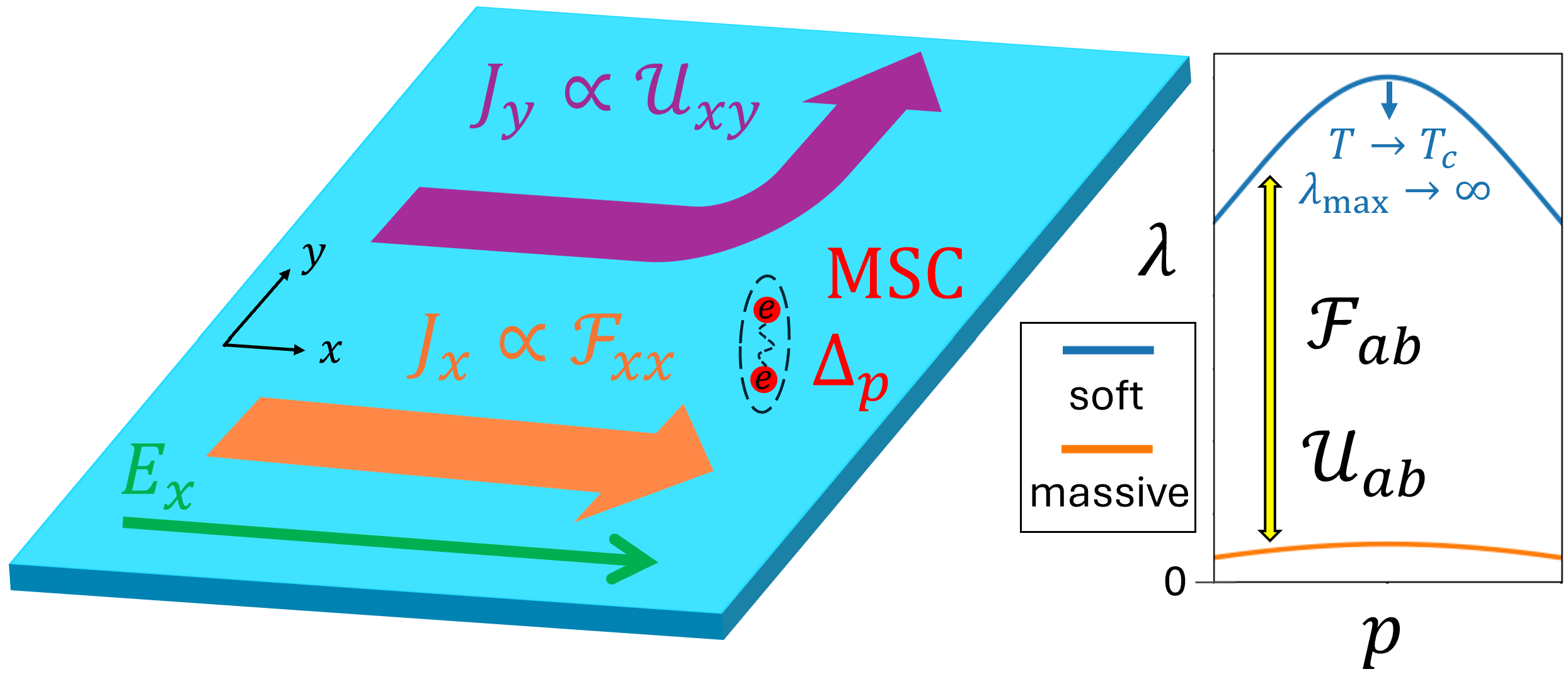
Figure 1: Schematic of electric-field-driven Cooper pair fluctuations in a multicomponent superconductor; the longitudinal and transverse currents are determined, respectively, by the pairing fluctuation QFI and MUC tensors.
The utility for transport arises because both the current operators and the fluctuation kinetics can be expressed in terms of derivatives of this pair-propagator manifold with respect to momentum. This correspondence directly relates measurable linear response quantities—paraconductivity (longitudinal) and anomalous Hall conductivity (transverse, in the absence of time-reversal symmetry)—to the QFI and MUC, respectively.
The authors derive kinetic equations for the pairing fluctuation density matrix under an applied electric field, treating the TDGL relaxation and stochastic drive via a Langevin framework. The steady-state response yields recursion relations for field-induced corrections to the density matrix, whose expansion provides explicit formulas for the induced current at each order. Critically, in the eigenmode basis, the longitudinal component (symmetric in response indices) of the linear paraconductivity is given by an integral over the QFI of the pair-propagator manifold:
σ(ab)para=2Ve∗2TΞ′p∑Fab(p),
where e∗=2e is the Cooper pair charge, and Ξ′ is the dissipative kinetic coefficient.
The transverse (antisymmetric) component, which produces the fluctuation-induced anomalous Hall effect, is governed by the integrated MUC:
σ[ab]para=Ve∗2TΞ′′p∑Uab(p),
with Ξ′′ being the reactive (precessional) part of the kinetic coefficient. This result demonstrates that the geometrical content of paraconductivity extends beyond the quantum metric to the full information-geometric tensor structure of the fluctuating many-body state. The MUC provides a rigorous mixed-state generalization of the Berry curvature's role in anomalous Hall phenomena for fluctuating order parameter branches.
Further, the analysis yields universal geometric bounds between the longitudinal and Hall conductivities, encoding constraints between QFI and MUC contributions; for 2D systems, the fluctuation-induced Hall conductivity is explicitly bounded by coherent QFI contributions.
Critical Behavior and Application to Chiral Multicomponent Superconductors
The formalism is applied to a minimal model of chiral superconducting fluctuations inspired by rhombohedral multilayer graphene, relevant for recent experiments indicating chiral order and quarter-metal normal states. The model contains two internal order parameter components labeled Δ+ and Tc0, with a symmetry-allowed Lifshitz invariant (Tc1 term) that couples to time-reversal and inversion symmetry-breaking.
The critical scaling of geometric response functions is interrogated analytically and numerically. Both the classical and coherent QFI contributions to the longitudinal paraconductivity are evaluated:
- Classical QFI Channel: Dominates close to Tc2 and displays the Aslamazov–Larkin Tc3 divergence typical of Gaussian fluctuation theory.
- Coherent QFI Channel: Enhanced by the Lifshitz invariant, yields a subleading Tc4 divergence.
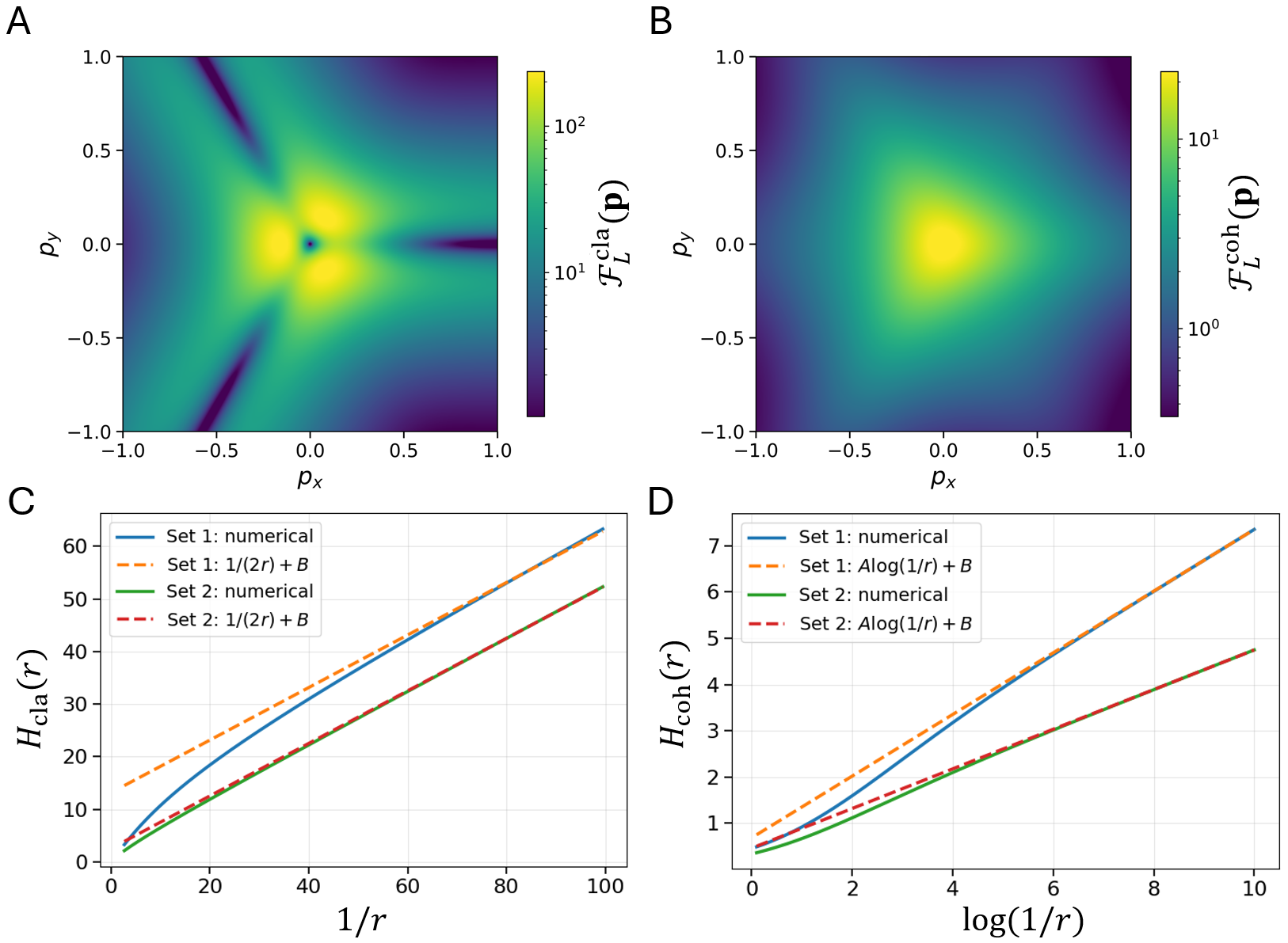
Figure 2: Critical scaling of longitudinal paraconductivity: classical contribution diverges as Tc5, while the coherent contribution scales logarithmically with Tc6 (Tc7).
The MUC-driven Hall conductivity also shows a leading Tc8 enhancement, which becomes experimentally significant near Tc9 due to proximity to the quantum critical point. The sign structure and magnitude of the fluctuation-induced Hall response are controlled by microscopic details such as the pairing mechanism (attractive vs repulsive) and Fermi surface geometry.
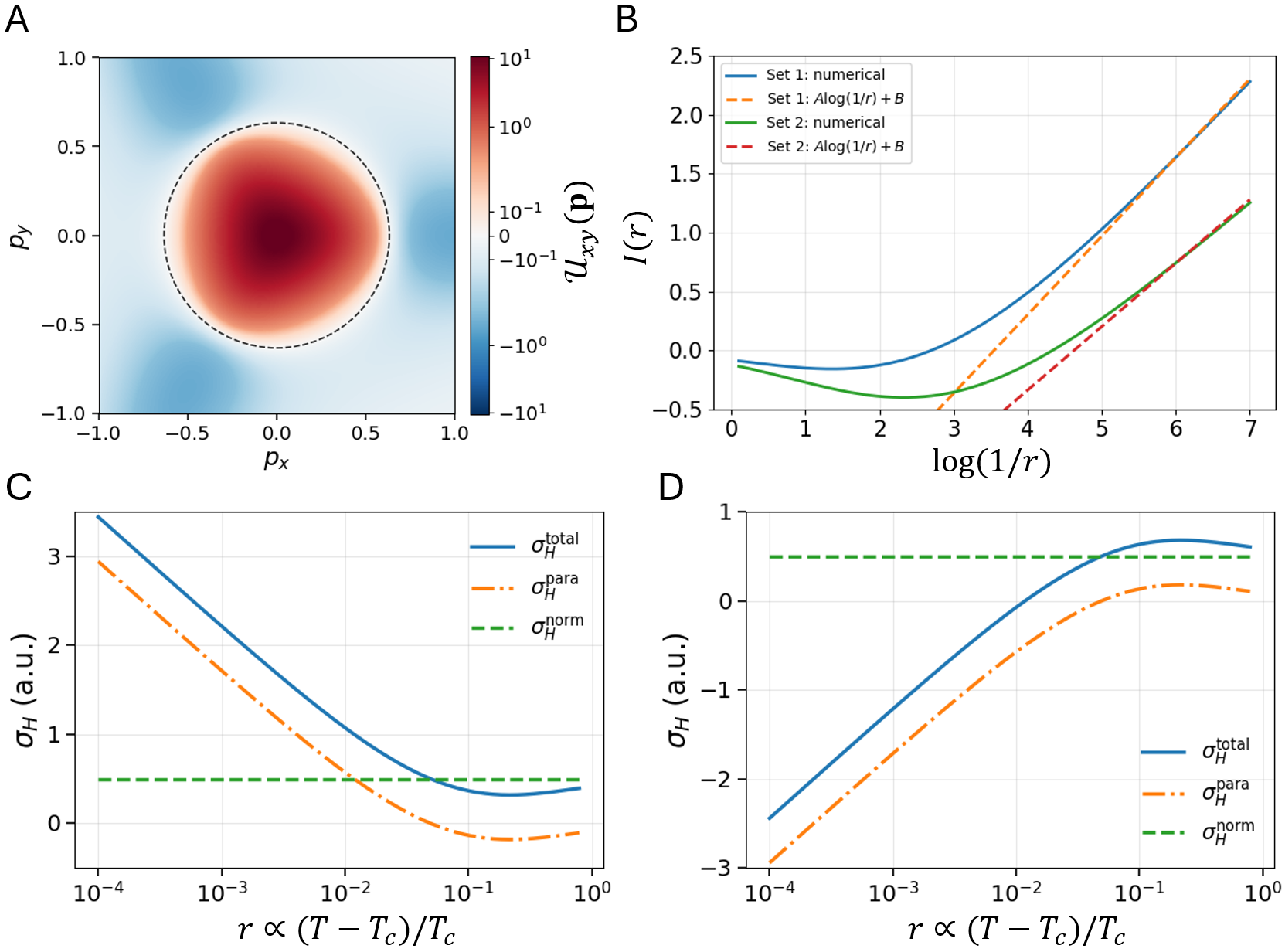
Figure 3: (A) Momentum-resolved MUC distribution; (B) Scaling and sign structure of anomalous Hall conductivity from superconducting fluctuations, with Hall response sign reversals possible depending on competing interactions.
The authors discuss scenarios in which the fluctuation Hall response either reinforces or competes against the normal-state background, possibly reversing the net signal near L^0(p)0. These contrasting behaviors can serve as direct probes of the pairing symmetry and underlying band topology in multicomponent superconductors.
Theoretical and Experimental Implications
This work provides a rigorous extension of quantum geometry concepts to fluctuation-driven transport, establishing superconducting fluctuation paraconductivity and Hall response as direct probes of mixed-state quantum geometry. In particular:
- Transport Measurements: Extract the QFI and MUC of fluctuation manifolds via linear response, offering new routes to probe geometric information in collective many-body states.
- Geometric Bounds: Impose universal constraints on correlation between longitudinal and Hall responses, absent in conventional normal-state transport.
- Critical Phenomena: Predict subleading, but strong, logarithmic divergences in fluctuation-induced Hall conductivity near quantum criticality, with sensitivity to interaction sign and symmetry.
On the theoretical side, these results motivate the systematic study of information geometry in other many-body fluctuation phenomena including density wave, nematic, magnon, and phonon systems. For nonlinear and nonequilibrium response—such as higher-order paraconductivities or geometric contributions to heat transport—the formalism is extensible, and the authors conjecture that similar geometric signatures should arise.
Conclusion
By establishing direct formulas connecting fluctuation-mediated paraconductivity and anomalous Hall effects to the QFI and MUC of the Gaussian fluctuation manifold, this paper advances the geometric interpretation of superconducting transport far beyond the pure-state Bloch electron paradigm. The presence of strong, experimentally accessible, geometric signatures in fluctuation-dominated regimes opens avenues for direct metrological and spectroscopic access to mixed-state geometry in quantum materials. The predicted geometric bounds and critical behavior are testable in moiré and topological superconductors, motivating further experimental and theoretical investigation.

