- The paper demonstrates a predictive, ML-assisted adaptive DD protocol that triggers pulses based on short-term coherence forecasts.
- It introduces an analytic predictor using a Taylor expansion alongside a neural network trained on qubit coherence time-series data.
- The ML-guided approach improves integrated coherence by 18–23% over traditional periodic decoupling in non-stationary settings.
Noise-Adaptive Predictive Dynamical Decoupling: Technical Summary
Introduction
The study addresses the critical challenge of maintaining quantum coherence in the presence of realistic, potentially non-stationary environmental noise—a bottleneck for scalable quantum technologies. The work develops and analyzes a predictive, machine-learning-assisted dynamical decoupling (DD) framework for a prototypical qubit subjected to random telegraph noise (RTN), encompassing both Markovian and non-Markovian, stationary and non-stationary regimes. The protocol integrates analytical open quantum system modeling with data-driven short-time coherence forecasting, adaptively triggering DD pulses at optimal times rather than using fixed periodic schedules.
Open Quantum System Model and RTN Dynamics
The qubit is modeled with standard pure dephasing coupling to a fluctuator environment. The stochastic Hamiltonian formalism,
H(t)=2ω0σz+ξ(t)σz,
captures the RTN-induced decoherence. ξ(t) is a dichotomic stochastic process switching with rate κ and coupling v.
The dynamics of the transverse coherence observable, X(t)=⟨σx(t)⟩, is governed, in the stationary regime, by a second-order ODE:
X¨(t)+2κX˙(t)+4v2X(t)=0,
with the Markovian regime (2v<κ) yielding monotonic decay, and the non-Markovian regime (2v>κ) yielding damped oscillations and revivals due to environmental memory effects (Figure 1).
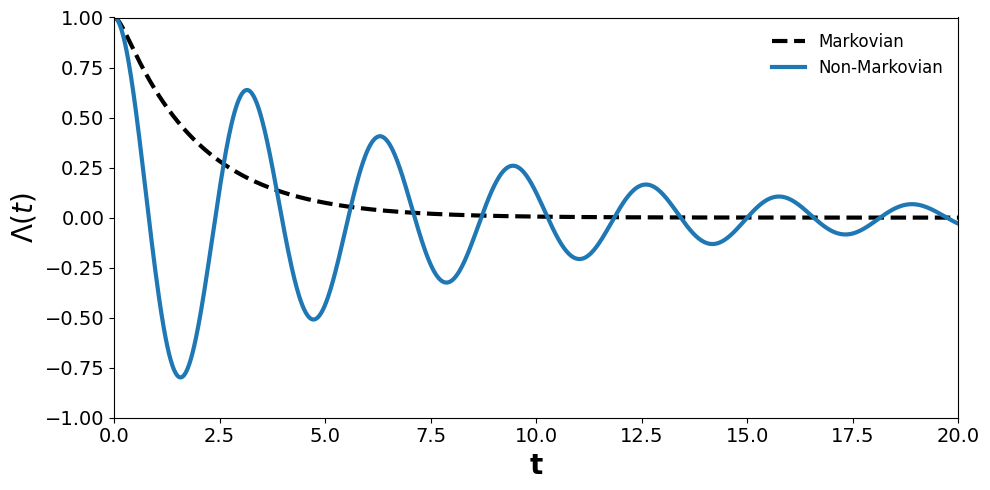
Figure 1: Decoherence function Λ(t) for a qubit subject to RTN, distinguishing between Markovian and non-Markovian regimes.
This framework is generalized to non-stationary environments via time-dependent parameters v(t),κ(t), representative of environmental drift or structured modulation (Figure 2).
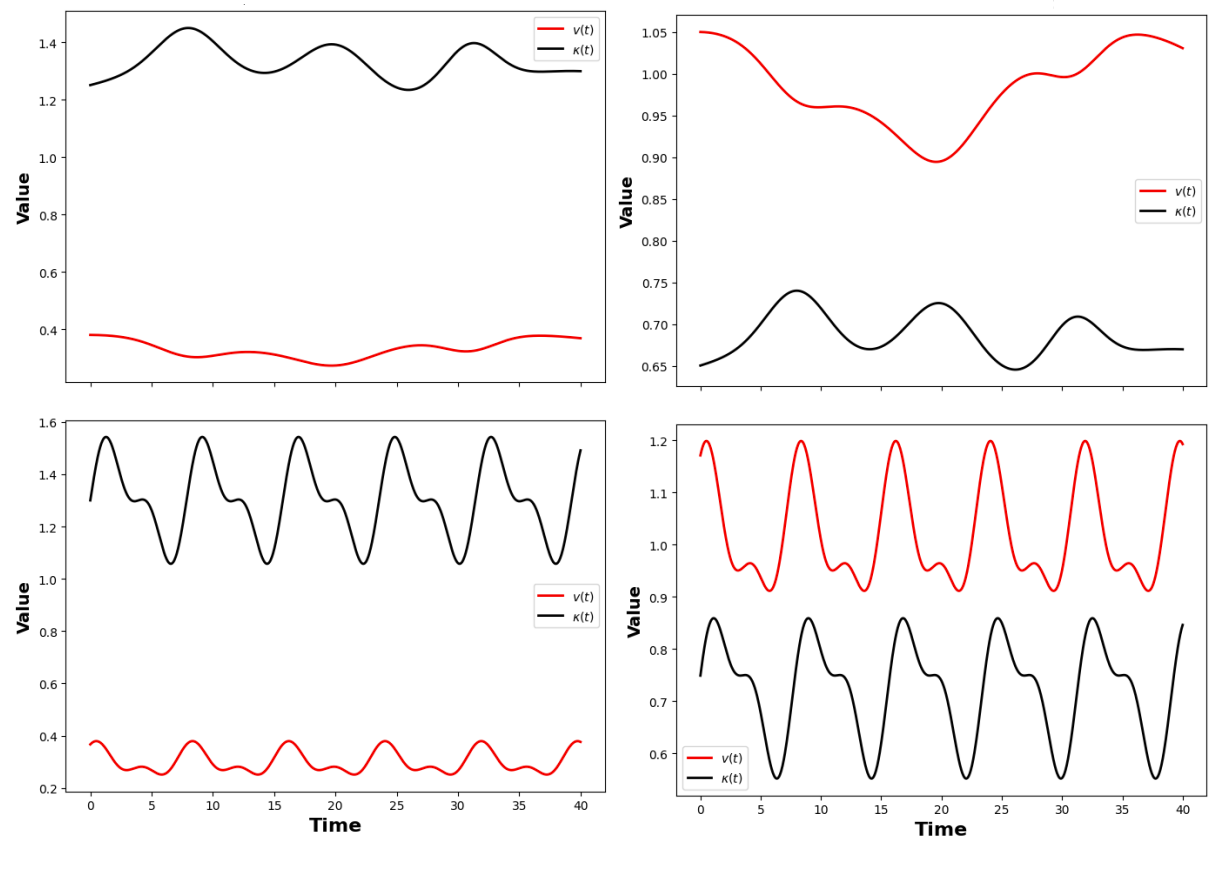
Figure 2: Time-dependent RTN parameters for two non-stationary noise models; modulation structure affects the emergence of non-Markovian dynamics and coherence revivals.
Predictive Coherence Forecasting
Analytical Short-Time Predictor
Given the ODE for ξ(t)0, a short-time Taylor expansion provides a local analytic predictor, leveraging instantaneous ξ(t)1, ξ(t)2, and the model parameters:
ξ(t)3
For non-stationary models, this expansion incorporates time-dependently modulated coefficients directly (see Figure 2 for the impact).
Machine-Learning Predictor
Parallel to the analytic method, a supervised feedforward neural network is trained to predict ξ(t)4 from a history window of ξ(t)5, using data generated from full open-system simulations (Figures 3 and 4).
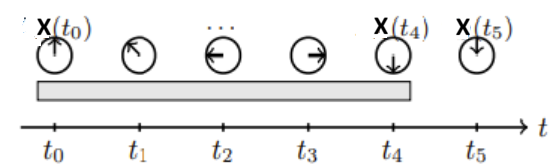
Figure 3: Sliding-window time series construction for neural network training data.
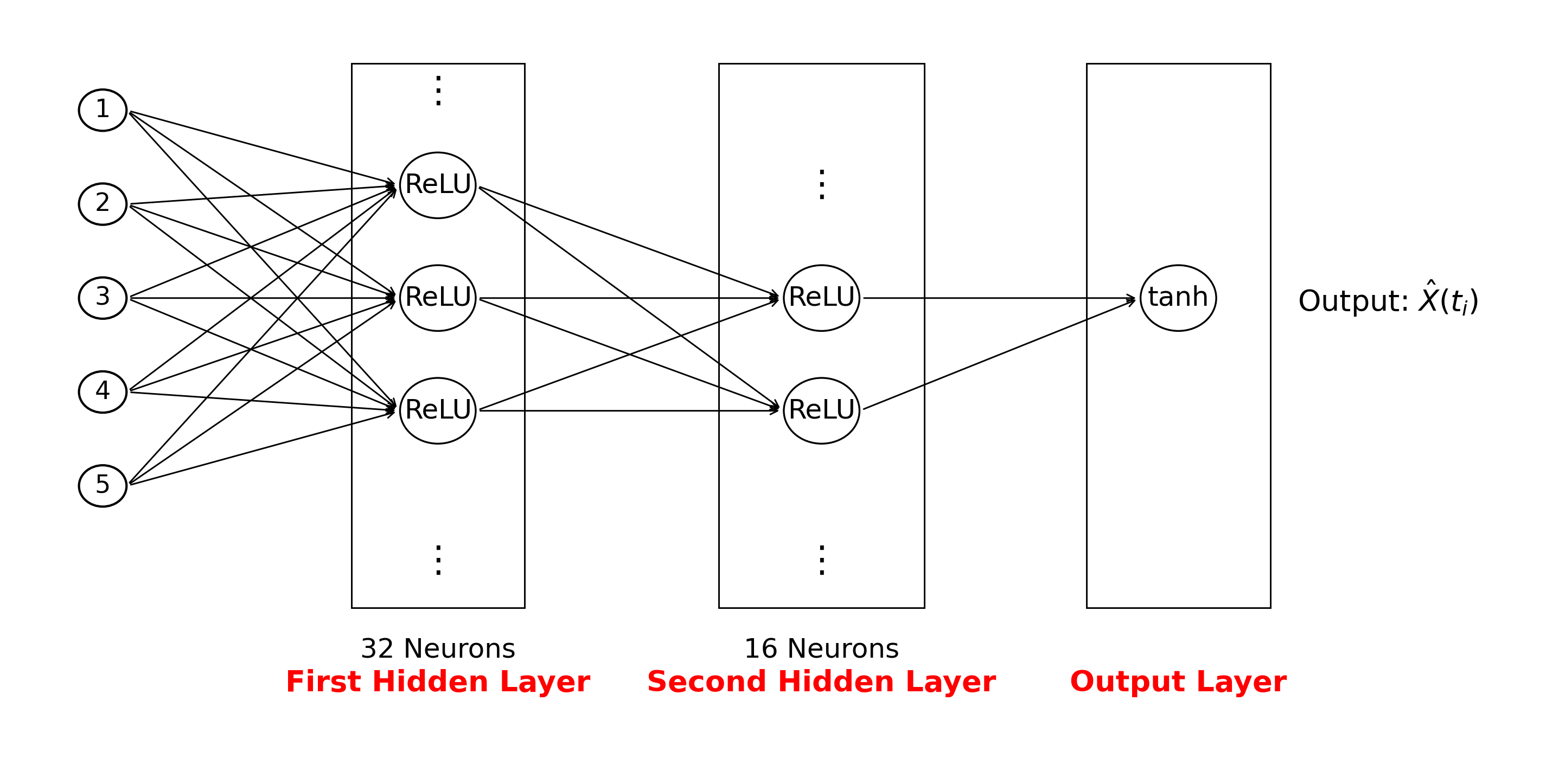
Figure 4: Feedforward NN architecture for near-term coherence forecasting from a short measurement window.
Mean-squared-error loss is minimized using Adam, and the model is benchmarked on both stationary and non-stationary noise trajectories.
Validation of Predictive Models
Benchmarking against exact, simulation-derived coherence dynamics (Figures 5–7), both predictors (analytical and ML) achieve excellent agreement in all considered noise environments, including regions with strong non-Markovian memory or significant non-stationarity.
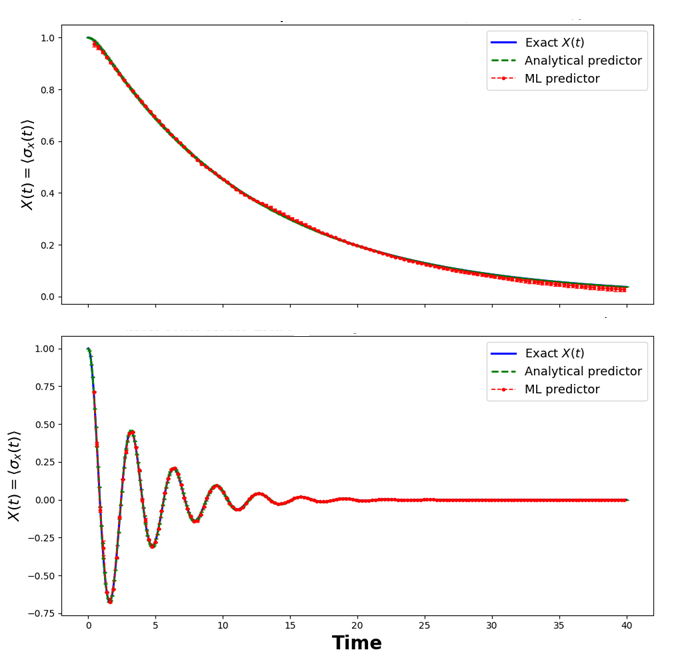
Figure 5: Markovian and non-Markovian stationary regime: ML and analytic predictors accurately track coherence decay and revivals.
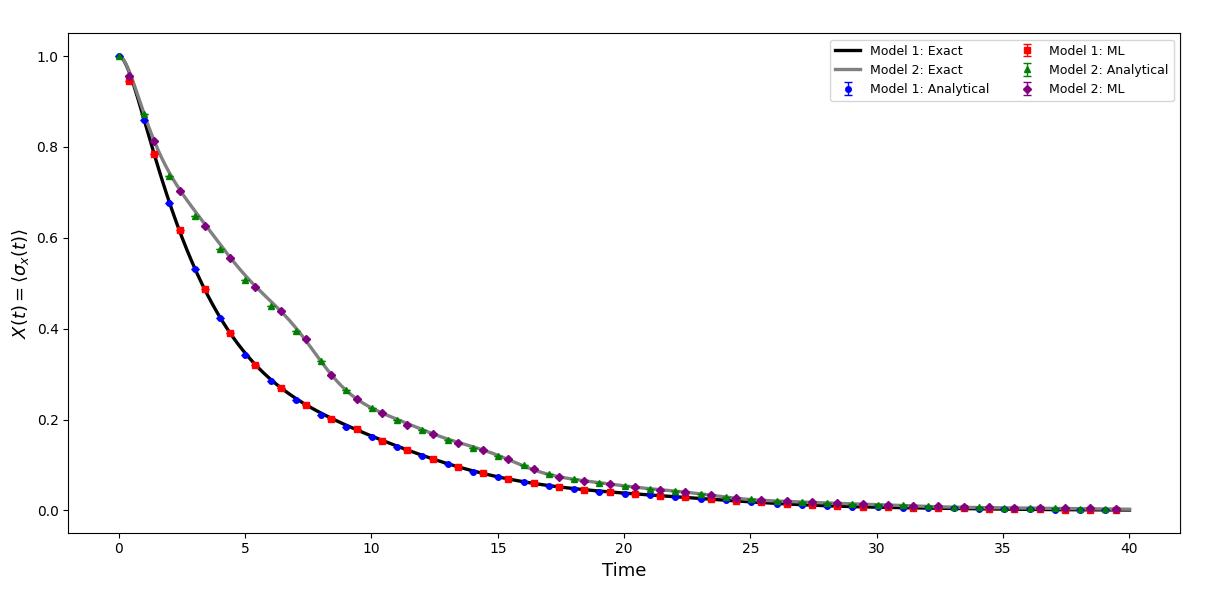
Figure 6: Non-stationary Markovian regime: predictors closely track time-varying coherence decay.
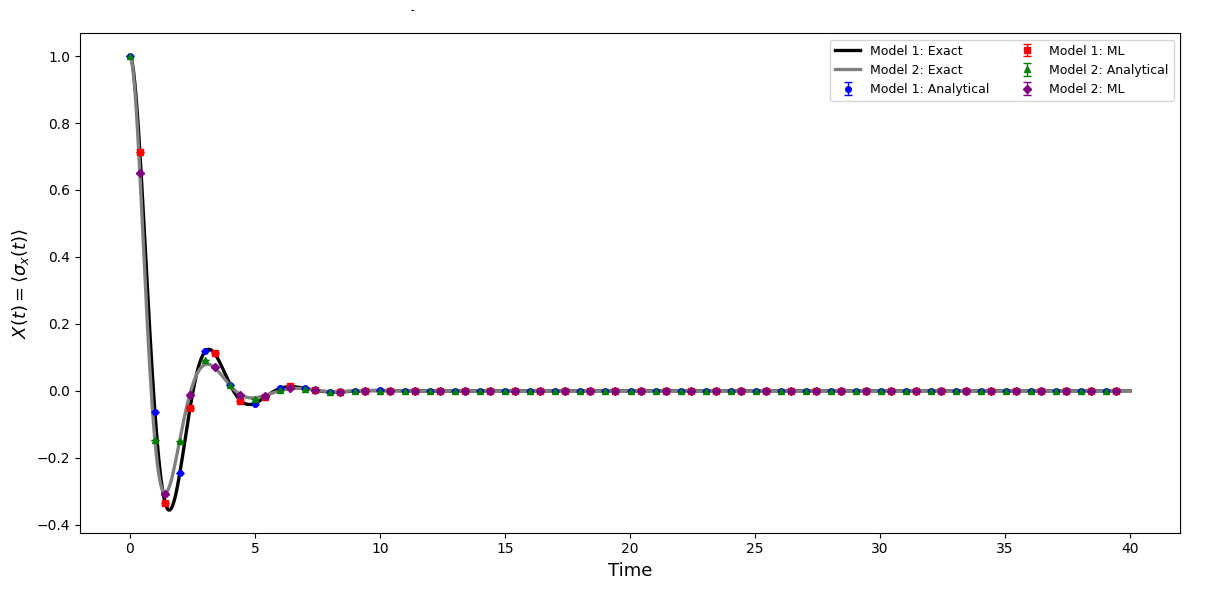
Figure 7: Non-stationary non-Markovian regime: predictors successfully reproduce both oscillation amplitude and the timing of revivals.
Adaptive Dynamical Decoupling Protocol
Conventional Periodic DD
Traditional DD consists of regularly timed ξ(t)6 pulses that reverse the qubit-environment interaction, suppressing decoherence proportional to pulse frequency and environmental correlation structure. Uniform schedules, however, are suboptimal in non-stationary and/or memory-bearing noise.
Predictive, ML-Guided Adaptive DD
The core advance is the deployment of adaptive control strategies where short-time forecasts of ξ(t)7 determine the pulse application. Pulses are triggered only when an imminent coherence loss is predicted (exceeding a tunable threshold), with both analytic and NN forecast models guiding the protocol. The result is a dynamically non-uniform, noise-adaptive pulse sequence.
Strong distinctions arise when comparing control protocols in different regimes (Figures 9 and 10).
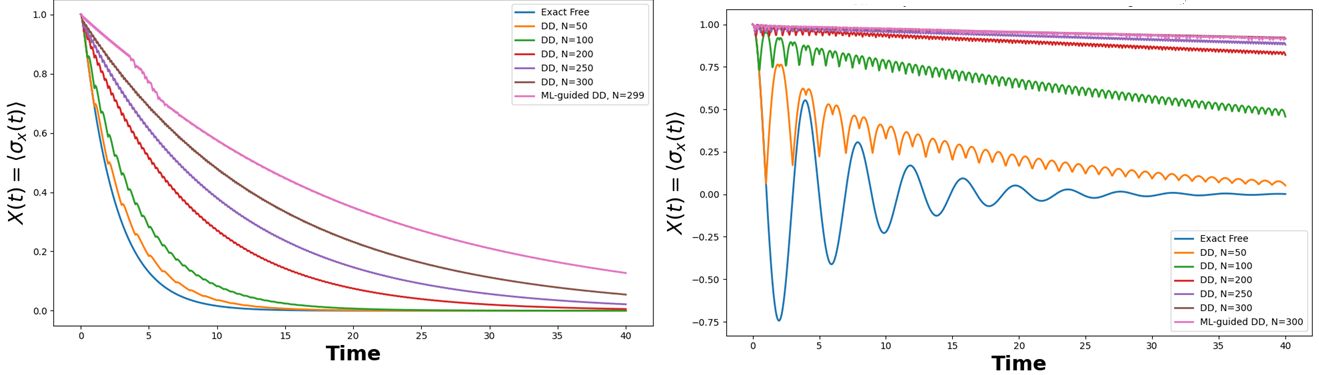
Figure 8: Stationary Markovian (left) and non-Markovian (right) environments: Periodic DD is already highly effective; adaptive (ML-guided) DD gives modest further gains.
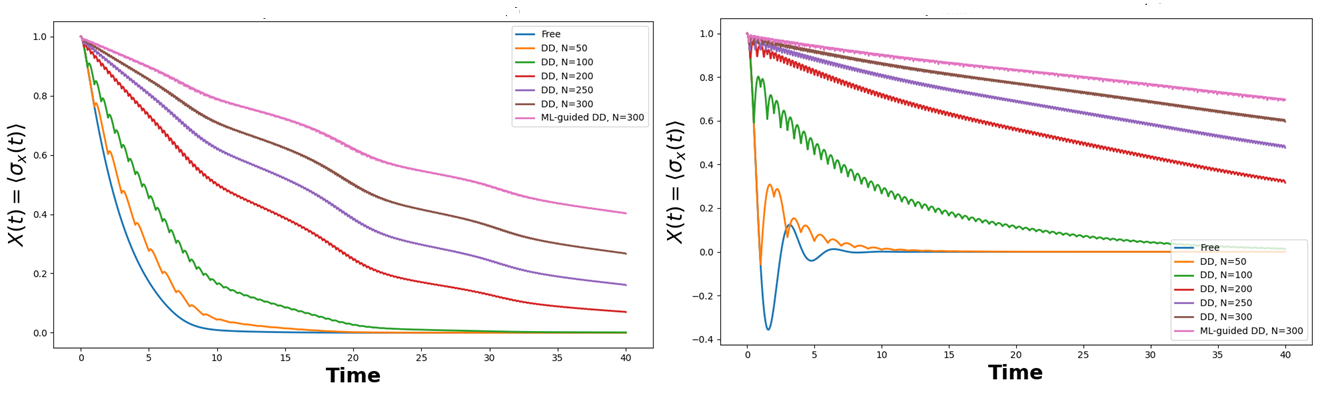
Figure 9: Non-stationary Markovian (left) and non-Markovian (right) regimes: Adaptive pulse placement outperforms periodic DD, especially as environmental parameters drift and coherence loss spikes become unevenly distributed.
In stationary settings, periodic DD can closely approach optimality; the ML-guided protocol yields only marginal improvements. In contrast, with environmental drift (non-stationary RTN), uniform pulse schedules cannot track rapid or localized coherence loss, and adaptive strategies substantially improve coherence preservation while using the same pulse budget.
Quantitative Coherence Preservation
The integrated coherence ξ(t)8 provides an operational figure of merit. The ML-guided protocol improves ξ(t)9 by 18–23% over periodic DD in non-stationary Markovian regimes and maintains a 7–8% advantage in the most challenging, fully non-stationary, non-Markovian environments.
Implications and Outlook
Practical Impact: The framework is implementation-oriented, with pulse numbers and control timescales compatible with current superconducting and semiconducting qubit experiments. The adaptive protocol requires only measurement of transverse coherence—no additional invasive system identification or microscopic noise spectroscopy. It extends directly to adaptive feedback control strategies in noisy intermediate-scale quantum processors.
Theoretical Implications: The results rigorously demonstrate that static, model-based pulse scheduling is fundamentally inadequate in realistic, time-varying environments, especially where memory effects and parameter drift are non-negligible. The analytic and ML approaches achieve high-precision short-term forecasting; the ML approach in particular is attractive for situations lacking detailed a priori noise models.
Future Directions: Integration of longer-memory time-series forecasting architectures (e.g., LSTM networks), real-time online learning to counter rapid drift, extension to higher-dimensional systems and multiqubit noise models, and hybridization with quantum error correction codes tailored to measured non-Markovianities are promising avenues. These advances would further extend the envelope of robust quantum information processing in the presence of heterogenous, complex, and evolving decoherence environments.
Conclusion
This work establishes data-driven, predictive adaptive DD as a scalable tool for quantum coherence protection in environments with arbitrary stationarity and memory structure. The integration of short-horizon forecasting with closed-loop pulse control unlocks substantial, quantifiable gains over periodic DD, particularly in experimental regimes where system-environment parameters fluctuate dynamically. Adaptive control harnessing real-time coherence trajectory data will be essential for fault-tolerant quantum operations beyond the static noise assumptions of classical DD protocols.
Reference: "Noise-Adaptive Predictive Dynamical Decoupling" (2606.15769)