Synthesizing Arbitrary Non-Hermitian Hamiltonian with Stochastic Floquet Engineering
Published 14 Jun 2026 in quant-ph and physics.optics | (2606.15664v1)
Abstract: The conventional Floquet engineering scheme synthesizes a given target Hamiltonian with a deterministic temporal periodic driving field. In this work, we introduce the stochastic Floquet engineering scheme that can synthesize an arbitrary non-Hermitian target Hamiltonian using a time-periodic driving field with noisy amplitude. Our method is rooted in the Hermitian dynamics taking noise as a valuable quantum resource with no need for loss or gain in prior. We apply our method to engineer a cavity Hamiltonian with dissipative coupling between Fock states, and to prepare a given quantum state from a generally arbitrary quantum state. The stochastic Floqut engineering also provides a way to generate non-unitary quantum gates, which take advantage in certain tasks compared to unitary quantum computing, without the need for ancillae or state-dependent updating.
The paper introduces SFE as a novel method to synthesize arbitrary non-Hermitian Hamiltonians by combining periodic Hermitian drives with calibrated stochastic noise and postselection.
It achieves high-fidelity tracking and robust state preparation in bosonic systems without requiring physical gain, loss, or ancillary systems.
The approach is experimentally viable with standard measurement protocols, opening new avenues for non-unitary quantum simulations and NH topology studies.
Synthesizing Arbitrary Non-Hermitian Hamiltonians via Stochastic Floquet Engineering
Introduction
Realizing arbitrary non-Hermitian (NH) Hamiltonians in quantum systems is a fundamental challenge with direct implications for quantum simulation, open quantum system dynamics, and non-unitary quantum information processing. Traditional Floquet engineering leverages deterministic periodic driving to generate target Hermitian Hamiltonians, but this approach cannot generally synthesize NH generators due to the fundamentally unitary character of closed quantum dynamics.
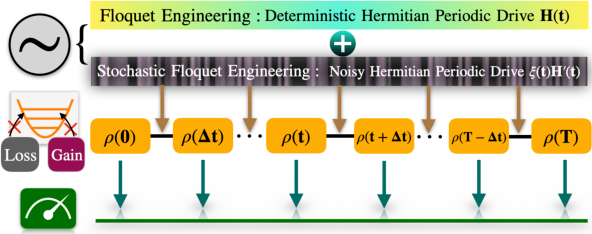
"Synthesizing Arbitrary Non-Hermitian Hamiltonian with Stochastic Floquet Engineering" (2606.15664) introduces a general framework—Stochastic Floquet Engineering (SFE)—that expands Floquet protocols to the non-Hermitian domain by exploiting engineered stochasticity. The authors demonstrate that by augmenting a periodic Hermitian drive with a calibrated stochastic Hermitian drive (generated by white noise), it is possible, after postselection on null-jump quantum trajectories, to simulate arbitrary target NH dynamics on a quantum system without imposing actual physical gain or loss or requiring ancillary degrees of freedom.
Figure 1: Schematic illustration of Stochastic Floquet Engineering (SFE), which augments a deterministic periodic Hermitian drive with a stochastic Hermitian component to achieve arbitrary non-Hermitian evolution via quantum trajectory selection.
Stochastic Floquet Engineering: Formal Approach
The central construct of SFE is a stochastic Hamiltonian of the form
Hs(t)=H(t)+ηξ(t)H′(t)
where H(t) and H′(t) are periodic Hermitian operators, and ξ(t) is a standard white noise process. The master equation for the time evolution of the system's density operator, after tracing over noise and to second order in the time-step, features both Lindblad and non-Hermitian contributions. For periodic H(t) and H′(t), the stroboscopic evolution over one period T can be cast as:
and the overline denotes temporal averaging over the driving period. The jump term can be eliminated by postselection on quantum trajectories that are null with respect to engineered jump operators, thus faithfully reproducing evolution under a target arbitrary NH HT in the absence of actual physical loss or gain.
Kraus Decomposition and Postselection
Each elementary time step is expressed via a Kraus sum, with primary focus on the null-jump operator:
H(t)0
The probability of a null-jump over the total evolution is close to unity for fast noise and weak stochastic driving, ensuring experimental viability. Postselection on null jumps (i.e., trajectories without quantum jumps during the interval) realizes the desired NH stroboscopic map.
This approach does not require ancillae, relies only on intrinsic quantum trajectory statistics, and the only measurements required are for postselection, not for real-time feedback.
Application: Bosonic NH Hamiltonian Engineering
The authors apply SFE to engineer arbitrary NH Hamiltonians for discrete bosonic modes in a cavity. They provide a constructive decomposition of the target NH generator H(t)1 and describe explicit periodic driving protocols using a combination of deterministic and noise-driven lattice potentials. The non-commutative Fourier Transform (NcFT) technique enables the construction of required operator-valued drives for both the Hermitian and anti-Hermitian target components.
To benchmark SFE, the paper demonstrates:
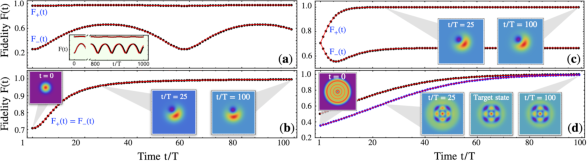
High-fidelity tracking of quantum trajectory ensembles: The time-evolved fidelities and Wigner functions of continuously monitored stroboscopic dynamics show quantitative agreement with exact non-unitary evolution under the target H(t)2 when postselection is enforced.
Robust state preparation: By designing dissipative NH Hamiltonians that remove all but a selected target state, SFE enables robust, model-independent, and initial-state-agnostic quantum state purification.
Figure 2: Stroboscopic time evolution of prepared quantum states and fidelity dynamics in a bosonic cavity under engineered NH Hamiltonians, demonstrating agreement between SFE and direct NH evolution.
Experimental Implementation and Practical Considerations
A crucial practical aspect of SFE is monitoring quantum jumps via an appropriately designed measurement scheme that does not disturb the null-jump subspace. The paper discusses protocols using, for example, cavity quadrature measurements in superconducting circuits coupled to a Josephson Bifurcation Amplifier (JBA) to discriminate quantum jumps from undisturbed evolution, without the necessity for high-efficiency real-time detection or feedback.
By engineering only Hermitian control fields, SFE is robust to many typical experimental imperfections such as uncontrolled external dissipation and does not alter the underlying system dimension as block encoding or ancilla-assisted schemes do.
Implications and Future Prospects
This work extends the operational toolkit for NH quantum simulation, opening routes to universal NH synthesis and non-unitary operations on quantum devices using only classical and quantum noise as a resource. It has direct consequences for:
Simulation of open quantum system dynamics with arbitrary decoherence and dissipative structures.
Quantum computation models incorporating non-unitary gates, with potential complexity-theoretic impact (e.g., simulating algorithms outside of the standard unitary paradigm).
Experimental studies of NH topology, exceptional points, and measurement-induced critical phenomena, unconstrained by microscopic loss/gain engineering.
Future research should address the interplay between SFE-engineered NH dynamics and genuine system-bath dissipation, the extension to many-body Hilbert spaces, and the use of SFE in quantum error mitigation and quantum thermodynamics.
Conclusion
Stochastic Floquet Engineering provides the first general, postselection-based protocol for synthesizing arbitrary NH Hamiltonians in controllable quantum systems using only Hermitian periodic and stochastic drives. This approach leverages engineered noise as a quantum resource, enabling efficient realization of non-unitary evolutions and state preparation in a manner that is compatible with current experimental platforms and scalable to high-dimensional and many-body settings.