- The paper demonstrates that quantum corrections from the Schwarzian and U(1) boundary modes yield opposing shifts in the Page curve, either advancing or delaying the transition.
- It employs a perturbative treatment in JT gravity, computing linear-in-temperature corrections to black hole energy and flux, with results validated both analytically and numerically.
- The analysis provides a framework for incorporating soft mode effects in quantum gravity, offering new insights into black hole thermodynamics and the information paradox.
Quantum Corrections to the Page Curve of Charged Near-AdS2 Black Holes
Introduction and Context
The black hole information paradox, encapsulated in the non-unitary behavior of Hawking's semiclassical radiation entropy calculation, has motivated developments in quantum gravity, most notably the formulation of the Page curve and its calculation using quantum extremal surfaces ("islands"). The paper "Quantum Corrections to Page Curve of Charged Near-AdS2 Black Holes" (2606.15562) targets a specific extension: the explicit incorporation of quantum corrections arising from the Schwarzian reparametrization mode and the U(1) boundary phase mode in the low-energy, near-AdS2 regime of charged black hole evaporation. This model enables analytic tractability and isolation of the soft mode effects, in contrast to higher-dimensional or more involved setups.
The central result is that while both Schwarzian and U(1) boundary soft modes modify the evaporation dynamics and subsequent entanglement structure, their effects on the Page transition are opposite in sign: the U(1) mode delays Page time, the Schwarzian mode typically advances it. The overall Page time shift thus encodes a nontrivial competition between these quantum channels.
Charged Near-AdS2 Gravity and Boundary Effective Theory
The technical foundation is Jackiw-Teitelboim (JT) gravity in two dimensions, extended with a U(1) gauge sector. In the near-horizon, near-extremal regime, spacetime is locally AdS2, and all propagating dynamics reduce to boundary modes: the Schwarzian reparametrization F(t), encoding boundary graviton fluctuations, and the global 20 phase mode 21, encoding charge and chemical potential fluctuations. The system is coupled to a non-gravitating bath at fixed temperature 22 and chemical potential 23, enabling controlled open-system dynamics and explicit access to the radiation sector.
The equilibrium black hole solution corresponds to 24 giving the thermal AdS25 frame and 26, where the system's temperature and chemical potential are fixed. The thermodynamic dictionary links the effective temperature 27 and chemical potential 28 to macroscopic energy and charge.
Real-Time Evaporation and Quantum-Corrected Dynamics
The crux of the analysis is the interplay between energy/charge fluxes across the black hole-bath interface and their quantum corrections. In classical evaporation, energy and charge loss are governed by ordinary balance equations involving the stress tensor and current expectation values. When quantum corrections from the Schwarzian and 29 sectors are incorporated, the black hole energy and outgoing fluxes become replaced by soft-mode averages, inducing nontrivial linear-in-U(1)0 corrections:
- The black hole energy is shifted by linear terms in U(1)1, reflecting quantum heat capacity corrections.
- The outgoing flux acquires linear-in-U(1)2 dissipation terms, from both sectors.
This alters both the evaporation rate and the possible occurrence of charge-driven transient heating (i.e., non-monotonic temperature evolution under chemical potential mismatch), with the threshold for such phenomena modified by quantum effects.
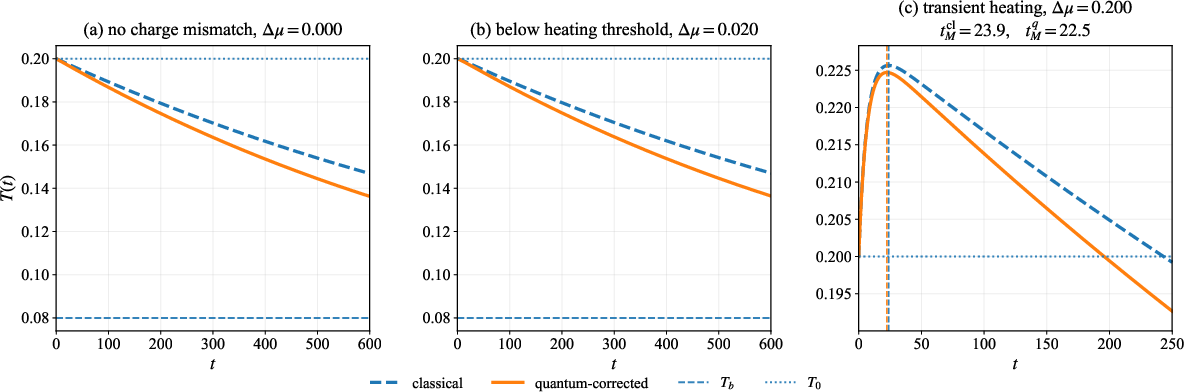
Figure 1: Classical and quantum-corrected black hole temperature evolution, comparing regimes with and without chemical potential mismatch. The quantum regime displays shifted transient heating and cooling times.
The controlled perturbative solution presents the quantum-corrected temperature to first order in U(1)3 and U(1)4, which is highly accurate in the semiclassical, low-temperature hierarchy.
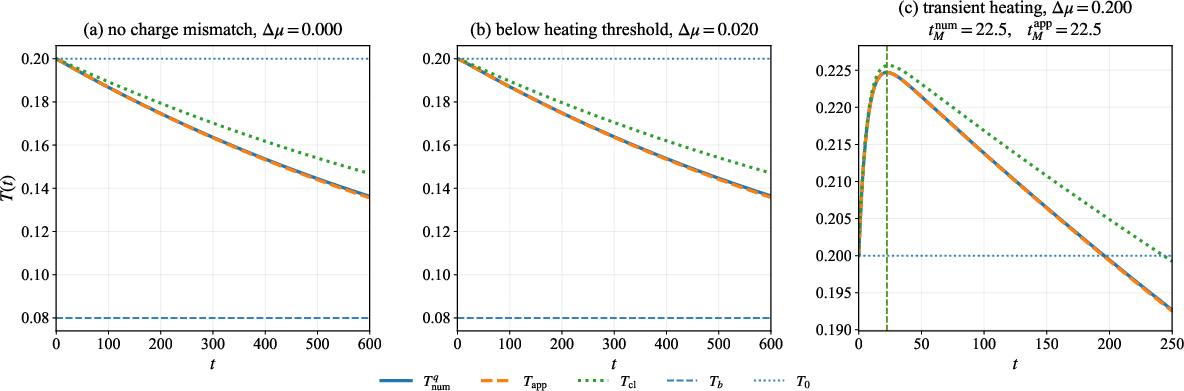
Figure 2: Validation of first-order perturbative quantum corrections vs full numerical solution for temperature evolution, confirming the analytic treatment.
Island Formula, Entropy Branches, and Quantum-Corrected Page Curve
The computation of the Page curve follows the now-standard island formula in the gravitating AdSU(1)5 + bath setup. Two candidate saddles compete: the no-island saddle (CFT entropy across the bath), and the island saddle (entropy with a quantum extremal surface contribution inside the black hole region). The soft-mode quantum effects are injected not by changing the island prescription itself, but by evolving the entropic functionals on the quantum-corrected, time-dependent background.
The shift in the entropy branches arises through two channels:
- The time-dependent temperature alters the map between boundary/bulk and bath coordinates.
- The quantum-corrected effective dilaton profile is evaluated via the modified Schwarzian dynamics.
The first-order Page time shift therefore reduces to a correction in the location where U(1)6 crosses U(1)7, which can be computed analytically given the quantum-corrected background. Importantly, the sign and magnitude of this shift are separable into explicit U(1)8 (Schwarzian) and U(1)9 (20 mode) contributions.
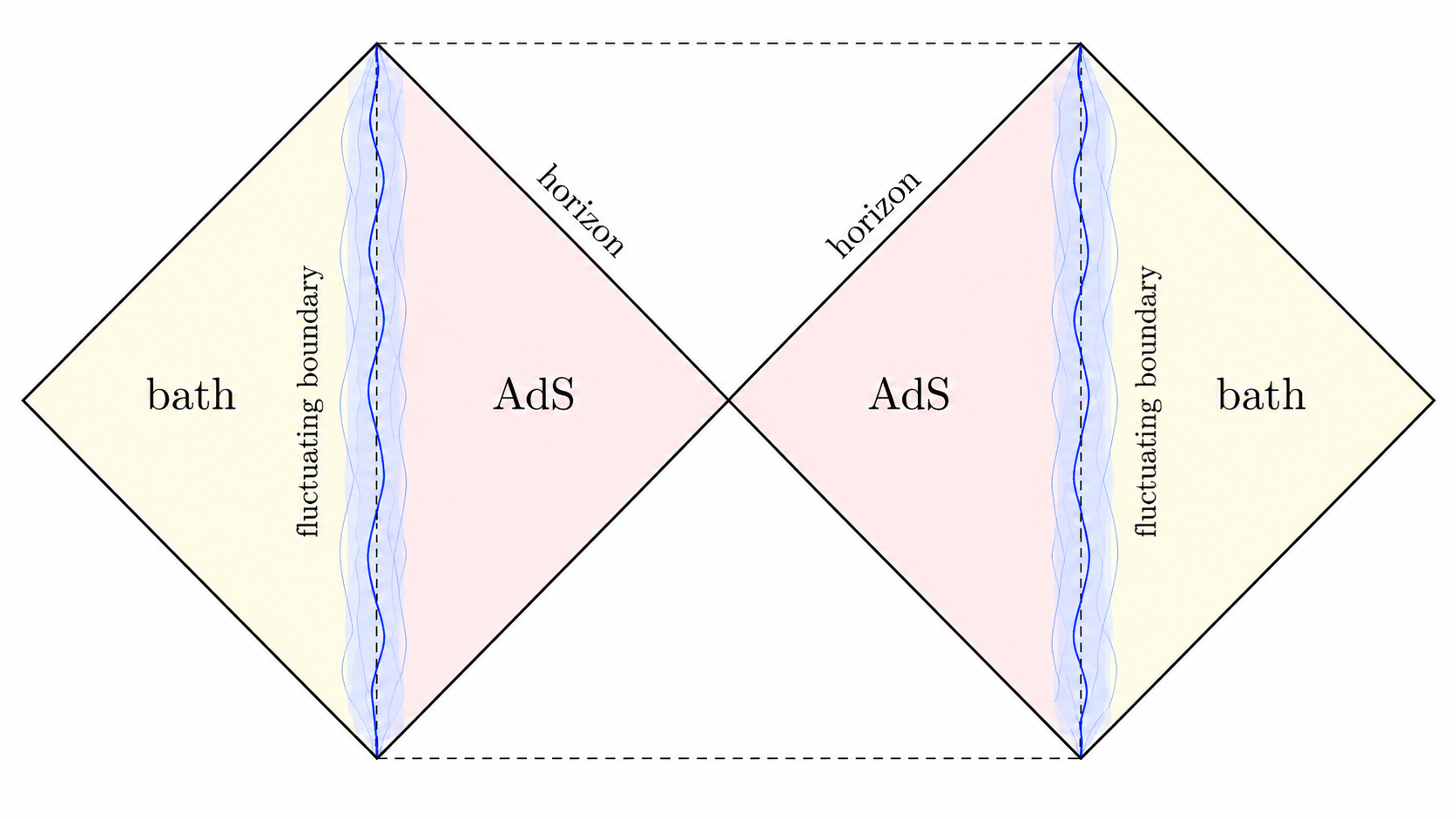
Figure 3: Geometry of the entropy computation with two-sided AdS21 coupled to baths; the quantum-corrected boundary trajectory incorporates soft-mode fluctuations.
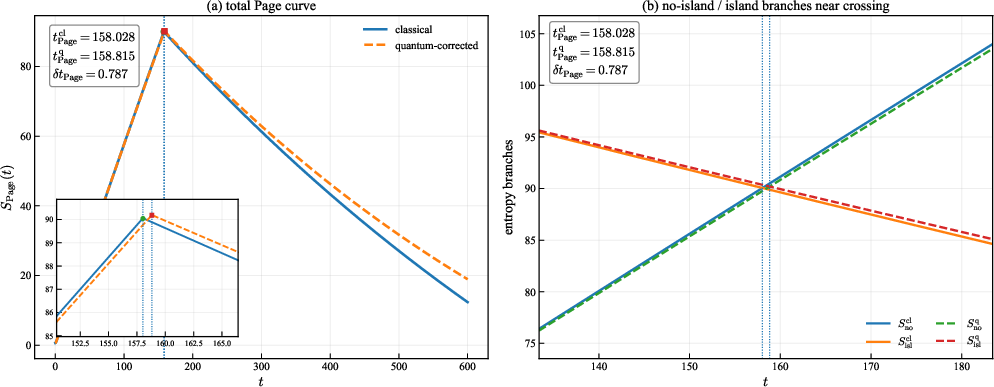
Figure 4: Page curves and entropy branches on the quantum-corrected background, showing explicit shifting of the crossing point due to quantum corrections.
Decomposition of Page Time Shift and Parameter Dependence
A core result is the analytic decomposition of the total Page time shift into Schwarzian and 22 phase mode components. The 23 correction, governed by 24, always delays the Page time when the temperature is above the bath; the Schwarzian 25 correction generally advances it but can, in principle, change sign depending on parameter-dependent integral criteria.
This interplay is mapped numerically and analytically across parameter space: decreasing 26 enhances the magnitude of Schwarzian corrections, making it more likely for the Page transition to occur earlier; decreasing 27 enhances the 28 delay. At large chemical potential mismatch, the interplay is further complicated by quantum-modified transient heating, but parameter regions where the semiclassical effective theory breaks down are explicitly excluded.
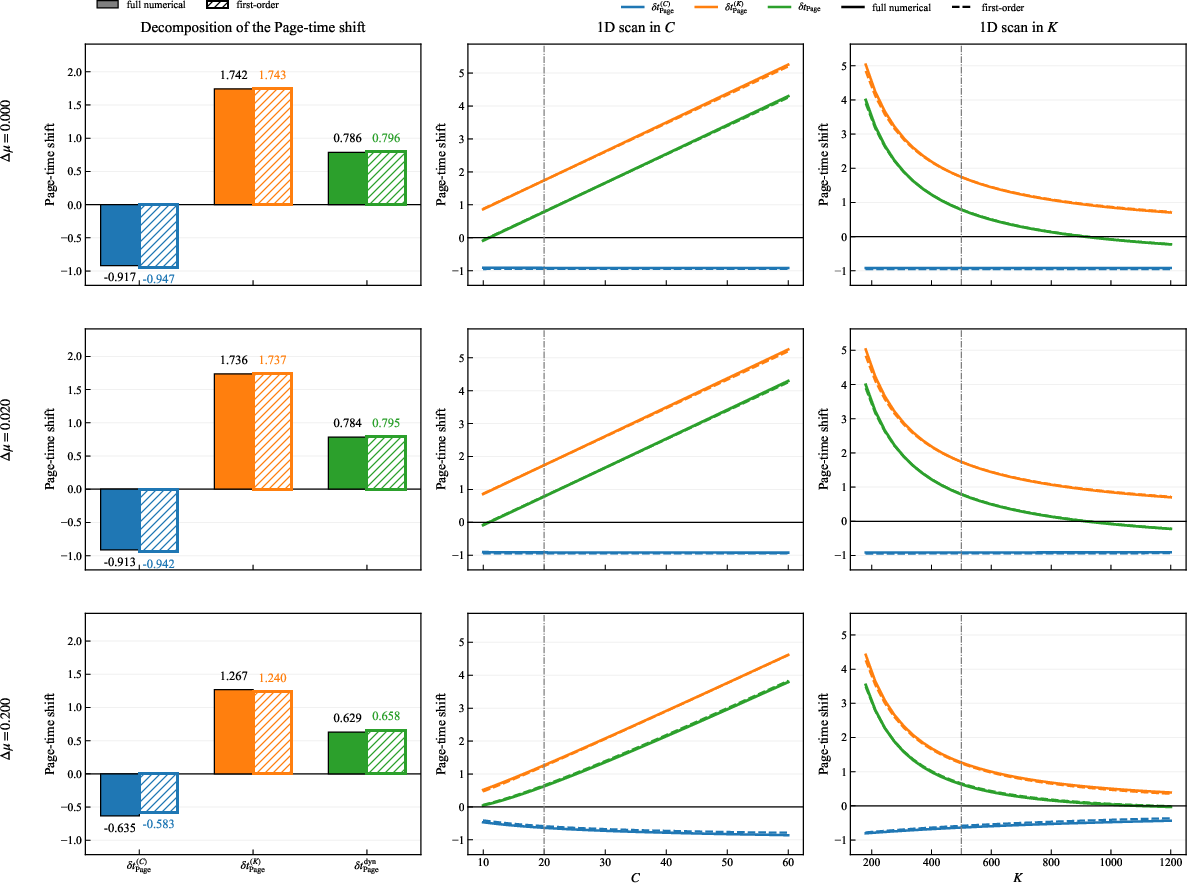
Figure 5: Decomposition of Page time shift into Schwarzian and 29 components and their scan over U(1)0 and U(1)1. Positive (delaying) and negative (advancing) contributions are observed, with analytic predictions matching numerics.
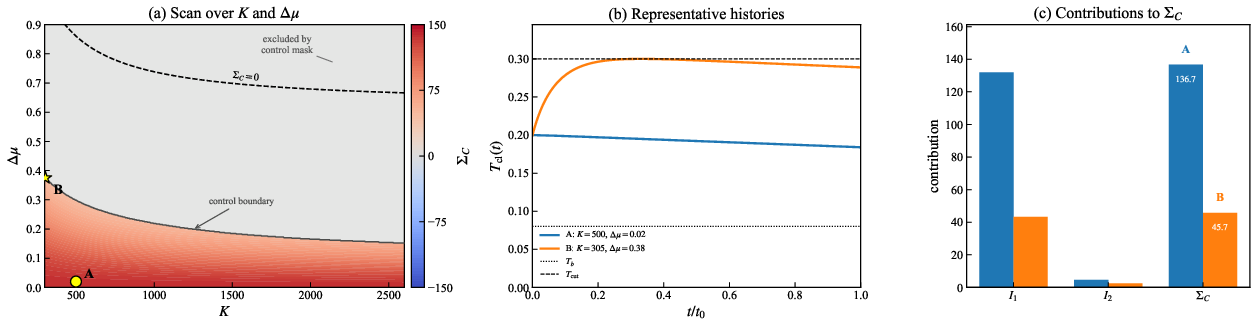
Figure 6: Sign analysis for the Schwarzian sector in U(1)2 space; the region of reliable (controlled) semiclassical approximation is highlighted, showing where the Schwarzian contribution advances the Page transition.
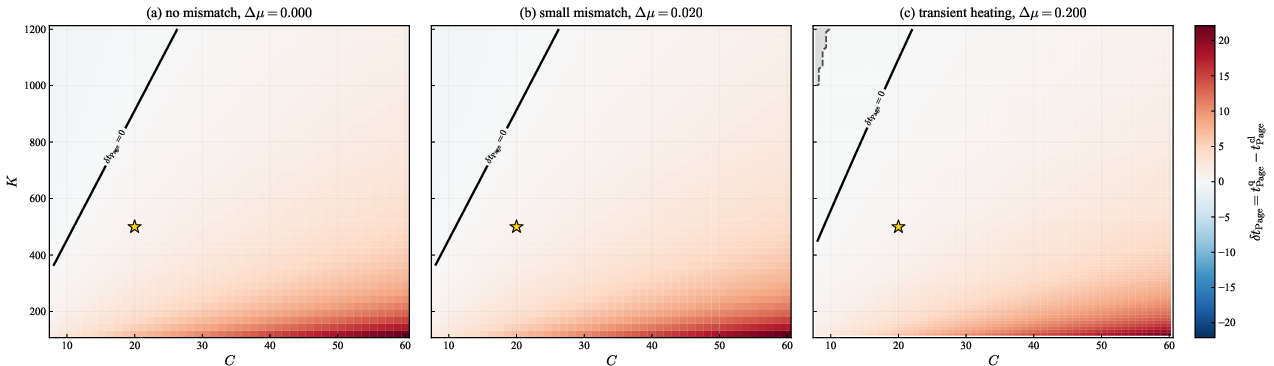
Figure 7: Phase diagram of the total Page time shift on the U(1)3 plane at several values of chemical potential mismatch, showing the competition and regimes where the total shift is positive or negative.
Implications and Directions
Theoretical Implications
The analysis demonstrates that in near-AdSU(1)4 charged black holes, the inclusion of quantum fluctuations of the universal boundary soft modes fundamentally alters the fine-grained entropy and its time dependence. The impact is not only quantitative but qualitative, as contributions from different quantum sectors can compete or even cancel, implying a much richer structure than classical gravity or leading semiclassical quantum extremal surface predictions alone.
The formal techniques developed—perturbative quantum corrections to evaporation, analytic control over entropy branches on dynamical backgrounds, and Page time shift decomposition—provide a template for further studies in higher-dimensional analogues and for systematically incorporating soft mode quantum effects in entanglement calculations.
Practical and Phenomenological Outlook
While the analysis is rooted in a highly symmetric two-dimensional model, the essential message carries to broader settings, especially for near-extremal, low-temperature black holes where near-horizon AdSU(1)5 physics dominates. Similar soft sector competition can be anticipated in more general charged or rotating black holes, and potentially in models relevant to quantum information transport and holography.
Future developments include tackling the non-perturbative resummation of soft-mode effects (including full replica wormhole path integrals), their influence on the entanglement structure in higher dimensions, and the connection to black hole microstate counting where soft mode and gauge sector dynamics are pivotal.
Conclusion
This work provides the first detailed account of how quantum corrections from both the Schwarzian and U(1)6 boundary modes in near-AdSU(1)7 charged black holes impact the real-time evaporation process, the entanglement entropy (Page curve), and the location of the Page transition. The U(1)8 and U(1)9 corrections have parametrically distinct and often competing effects, reflecting the intricate quantum structure of low-dimensional gravity. The formalism and results here set the stage for future analysis of quantum-corrected black hole thermodynamics and information dynamics in open quantum gravitational systems.