Probing ΛCDM-mimicking f(Q) gravity model using gravitational waves from compact binary coalescences
Published 13 Jun 2026 in gr-qc | (2606.15295v1)
Abstract: The direct detection of gravitational waves (GWs) is a very significant achievement in the history of physics and has opened a new window to probe the possible deviations of physics from that of general relativity (GR). In this work, we forecast constraints on the free parameter of an f(Q) gravity model that mimics a ΛCDM background at the level of cosmic expansion. We consider modified gravitational wave signals from inspiraling of compact bianry systems such as binary black holes (BBH), binary neutron stars (BNS)and black hole neutron star binary (BBHNS) systems in the context of the f(Q) gravity model and perform parameter estimation for two future third-generation ground-based GW detectors, namely Einstein Telescope (ET) and Cosmic explorer (CE), respectively. Our results show that both detectors can give tight constraints on the model parameter up to a significantly high redshift. These results show the potential of future GW observations to probe the deviations of the nature of GWs from that of GR within the framework of f(Q) gravity.
The paper demonstrates that waveform-level analysis of compact binary coalescence signals can constrain the f(Q) gravity parameter (β/H0) to levels of 10⁻⁴–10⁻³.
It employs a Fisher matrix approach and simulations from third-generation detectors like ET and CE to probe beyond-GR effects in gravitational wave propagation.
The study shows that modifications in the GW friction term lead to distinct amplitude changes, offering a promising method to test deviations from General Relativity.
Probing ΛCDM-Mimicking f(Q) Gravity Models with Gravitational Waves from Compact Binary Coalescences
Introduction
This work systematically investigates the potential of next-generation gravitational wave (GW) detectors to constrain a class of f(Q) modified gravity models designed to exactly mimic ΛCDM in terms of background cosmological expansion. The motivation arises from the necessity to explore deviations from General Relativity (GR) due to observational tensions (e.g., the Hubble tension, cosmological constant problem) and theoretical limitations of GR on quantum and cosmological scales. In the f(Q) framework, gravity is dictated by the non-metricity scalar Q, distinguishing itself from curvature-based and torsion-based alternatives.
Of particular interest is the model with
f(Q)=−2Λ+Q+β−Q
where β parameterizes deviations from STEGR (Symmetric Teleparallel Equivalent of General Relativity), reducing to ΛCDM when β=0. Although the model remains degenerate with f(Q)0CDM at the background level, significant differences can arise at the perturbative level, motivating the use of GWs—especially from compact binary coalescences—as probes for beyond-GR signatures.
Modified GW Propagation in f(Q)1 Gravity
Compact binary coalescence events, including binary black holes (BBH), binary neutron stars (BNS), and black hole–neutron star binaries (BBHNS), generate strong GW signals. In f(Q)2 gravity, GW propagation is affected by modifications to the friction term in the GW propagation equation, which manifests as an explicit redshift (f(Q)3) and f(Q)4 dependence.
The deviation from GR is quantified by the function f(Q)5:
f(Q)6
where f(Q)7 is the Hubble parameter. This modification causes the GW luminosity distance f(Q)8 to deviate from its electromagnetic (EM) counterpart f(Q)9:
f(Q)0
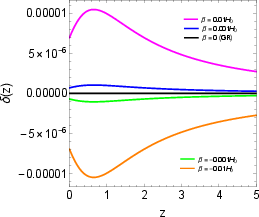
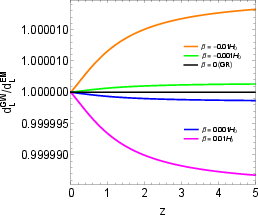
Notably, for positive (negative) f(Q)1, GWs appear brighter (dimmer) than in GR at fixed redshift.
Figure 1: Evolution of the characteristic quantities associated with the modified gravitational wave propagation as a function of redshift f(Q)2 for various f(Q)3. Left: friction term deviation f(Q)4 from GR. Right: luminosity distance ratio f(Q)5.
The magnitude of f(Q)6 peaks at intermediate redshifts consistent with the cosmic acceleration transition, while vanishing at both very low and high f(Q)7, emphasizing the importance of observing events at f(Q)8–1.
Analysis Strategy and Waveform Modeling
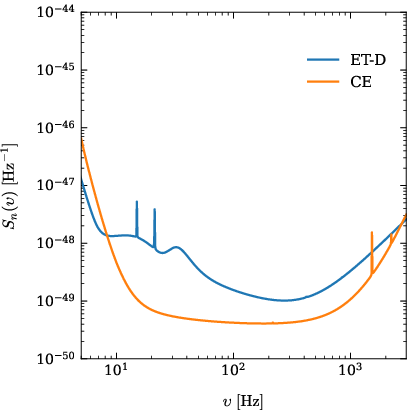
The primary methodological innovation is constraining f(Q)9 at the waveform level, fully leveraging amplitude modulation effects in the observed GW strain. The TaylorF2 post-Newtonian (PN) approximant is adopted for the inspiral phase. The detection and parameter estimation capabilities of two third-generation detectors—Einstein Telescope (ET) and Cosmic Explorer (CE)—are considered, both of which offer extended redshift reach and enhanced sensitivity compared to current facilities.
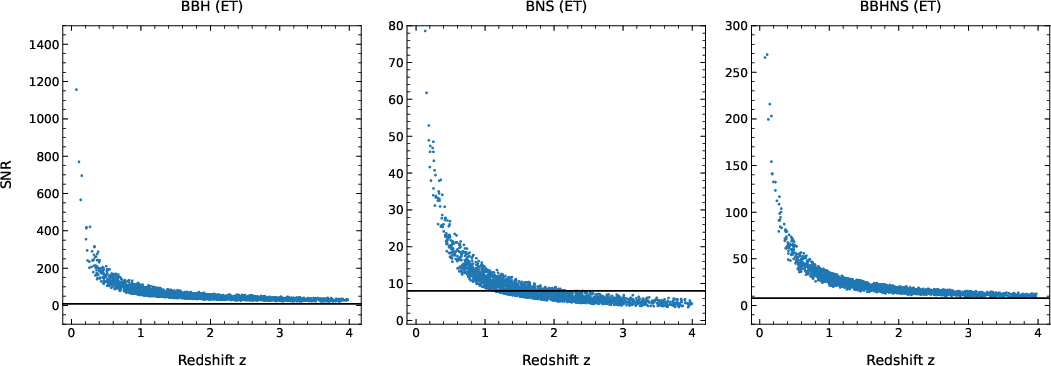
The Fisher information matrix approach is employed to estimate achievable constraints on Λ0. The SNR threshold for inclusion is set at Λ1.
Figure 2: Power Spectral Density comparison between ET and CE, highlighting their sensitivity curves.
Simulated populations assume uniform mass and spin distributions compatible with current astrophysical estimates, with redshifts drawn from realistic merger rate models.
Detector Reach and SNR Distributions
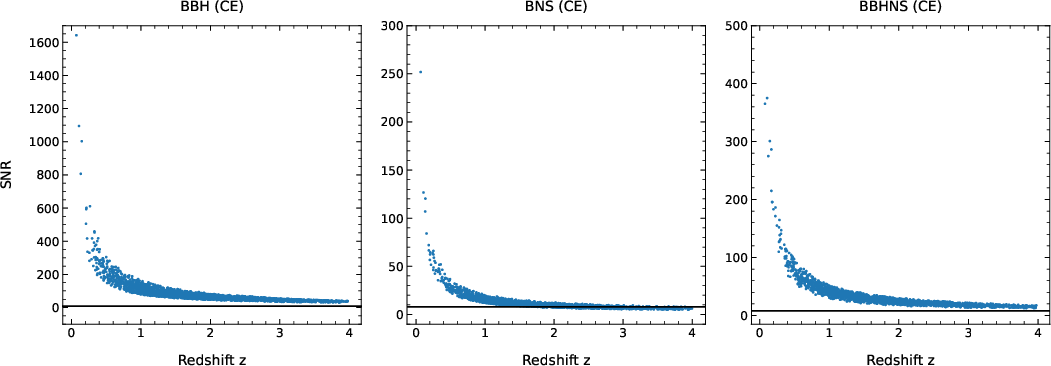
The increased sensitivity of ET and especially CE allows for the detection of BBH and BBHNS out to Λ2. BNS signals are detectable to Λ3 for ET and much higher for CE, reflecting the impact of detector sensitivity on science reach.
Figure 3: Variation of SNR with redshift for simulated BBH (left), BNS (center), and BBHNS (right) sources as observed by Einstein Telescope.
Figure 4: Variation of SNR with redshift for simulated BBH (left), BNS (center), and BBHNS (right) sources as observed by Cosmic Explorer.
Parameter Constraints: Redshift Dependence and Detector Comparison
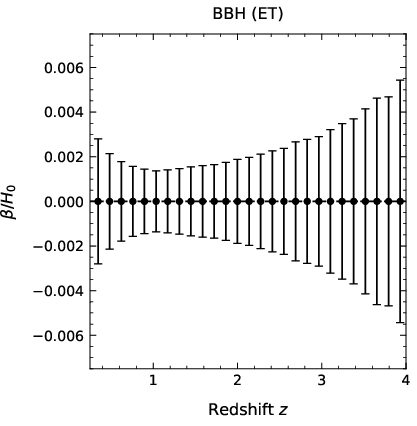
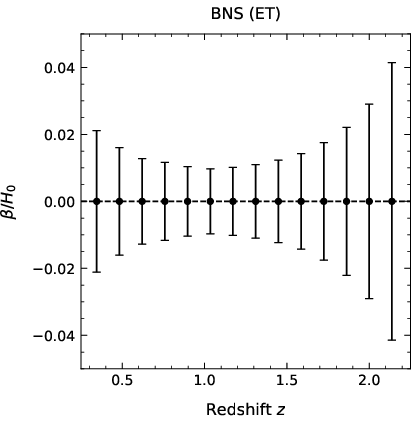
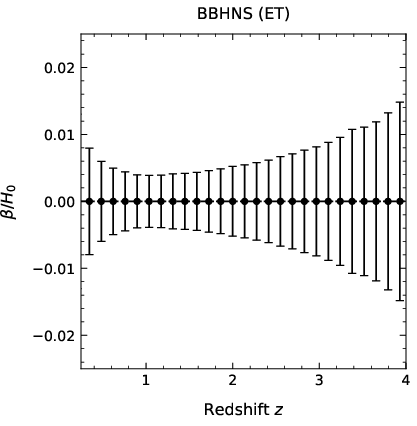
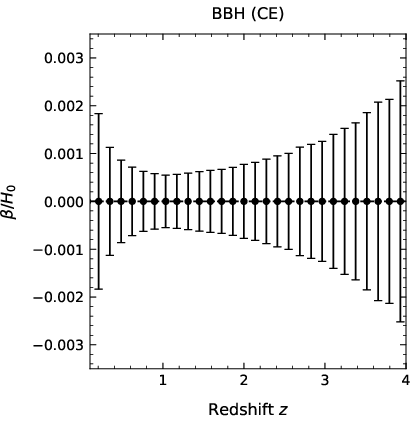
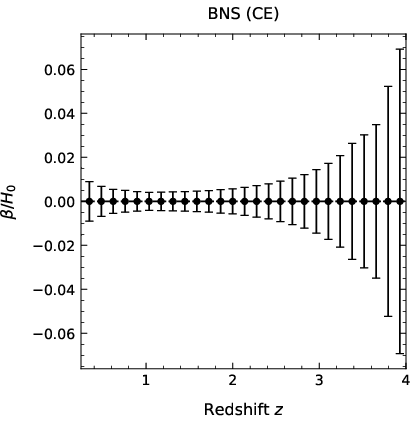
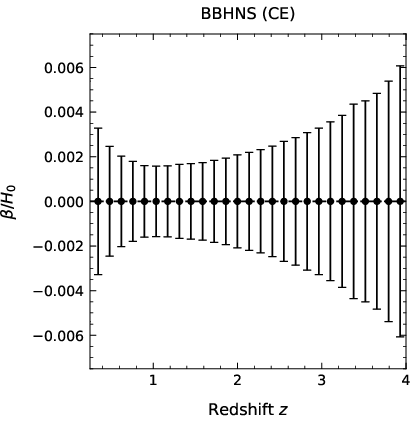
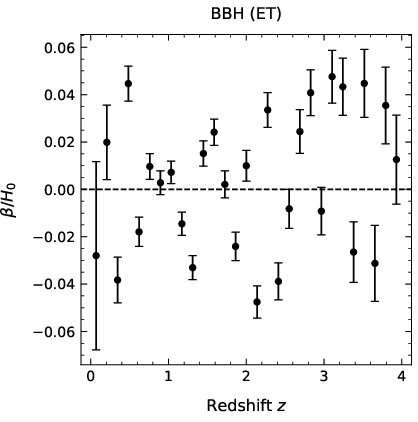
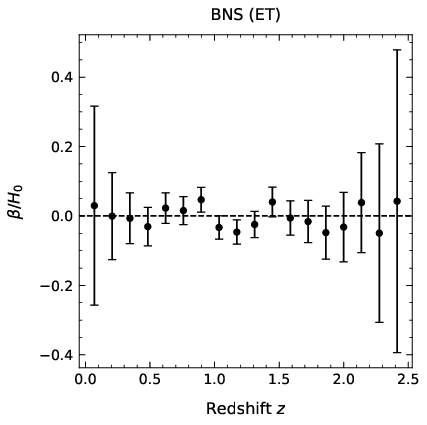
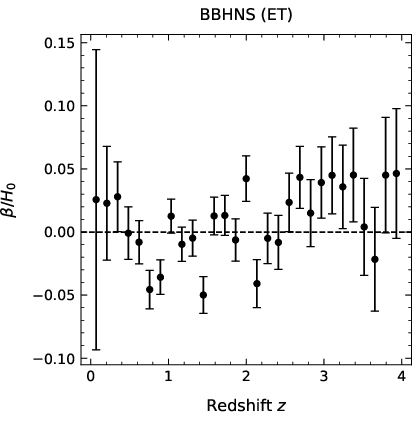
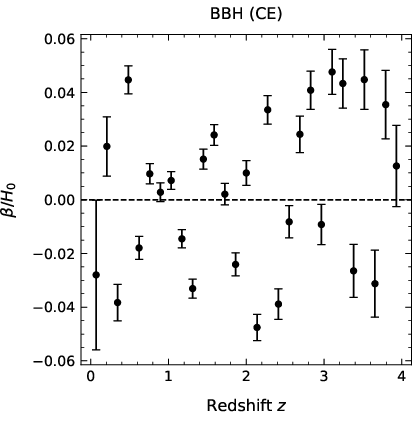
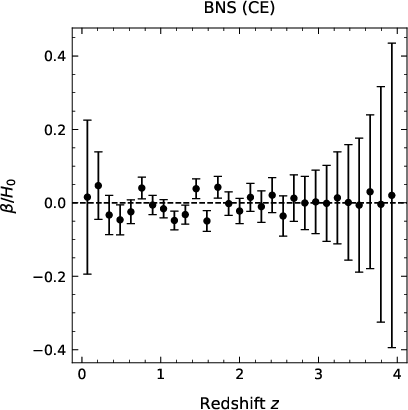
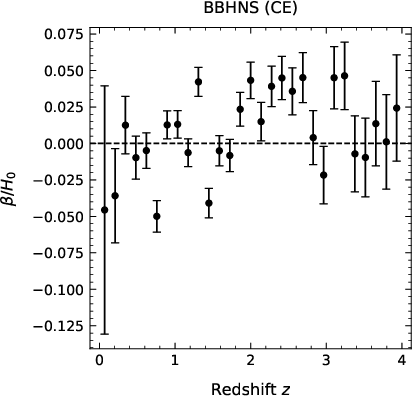
The model parameter Λ4 can be constrained at the Λ5–Λ6 level, depending on the source class and redshift, with BBH events providing the tightest bounds. ET's constraints degrade at low and high Λ7 due to statistical limitations (few events at low Λ8, reduced SNR at high Λ9), but are tightest in the intermediate redshift range. CE outperforms ET due to superior sensitivity and extended redshift coverage; all source classes benefit from higher SNR, with BNS constraints especially improved.
Figure 5: Redshift-binned f(Q)0 constraints on f(Q)1 for BBH (left), BNS (center), and BBHNS (right) under ET sensitivity.
Figure 6: Redshift-binned f(Q)2 constraints on f(Q)3 for BBH (left), BNS (center), and BBHNS (right) under CE sensitivity.
Sensitivity to Beyond-GR Deviations
Allowing for a fiducial nonzero f(Q)4, the study demonstrates that both ET and CE could discriminate nonzero f(Q)5 values with strong statistical significance, especially for BBH observations. For BBHNS and BNS, degeneracies and reduced SNR complicate discrimination, but consistency with f(Q)6 is still testable.
Figure 7: Constraints on f(Q)7 from a random f(Q)8 sample in simulated BBH (left), BNS (center), BBHNS (right) events for ET.
Figure 8: Constraints on f(Q)9 from a random Q0 sample in simulated BBH (left), BNS (center), BBHNS (right) events for CE.
Implications and Future Prospects
The results substantially strengthen the case for waveform-level GW analysis in testing beyond-GR models. Compared to standard siren analyses (i.e., using only the EM-calibrated luminosity distance), waveform-based constraints on Q1 are significantly improved due to full exploitation of amplitude information, reduced parameter degeneracy, and the vast event statistics achievable with third-generation GW observatories.
Practically, future detections by ET and CE can probe Q2CDM-mimicking Q3 gravity down to unprecedented precision, limiting the space for deviations that would masquerade as GR on the background but manifest in propagation effects. This framework is extensible to additional alternative gravity models, and future directions include incorporating merger and ringdown phases, multi-band GW observations with LISA, and joint constraints with independent cosmological observations.
Conclusion
This study provides a comprehensive forecast of constraints on Q4CDM-mimicking Q5 gravity using GW signals from compact binary coalescences, focusing on amplitude modifications in the GW propagation. Both ET and CE are found to have strong discriminatory power, especially for BBH events, with CE providing the overall best performance due to its superior sensitivity and sky coverage. The waveform-based approach yields much tighter bounds than standard siren analyses, paving the way for precision tests of modified gravity in the upcoming GW observational era.