- The paper introduces a multi-view deep learning model combining feature-level attention and DS-theory-driven decision fusion to reliably classify fetal congenital heart disease.
- The framework leverages ResNet50 backbones and SE attention to integrate five echocardiographic views, achieving 95% accuracy and superior sensitivity and F1-scores.
- The integration of uncertainty quantification through DS evidence theory provides actionable metrics, enhancing diagnostic confidence and clinical decision support.
Trusted Multi-View Deep Learning for Fetal Congenital Heart Disease Classification
Introduction
The paper "Trusted Multi-View Deep Learning Classification of Fetal Congenital Heart Disease with Feature-level and Decision-level Fusion" (2606.15265) introduces a robust multi-view deep learning framework for binary classification of congenital heart disease (CHD) leveraging feature-level attention fusion and decision-level uncertainty integration. The work addresses two core challenges: the complementary nature of multi-view echocardiographic images and the impact of image quality inconsistency, both of which substantially affect diagnostic precision and trustworthiness.
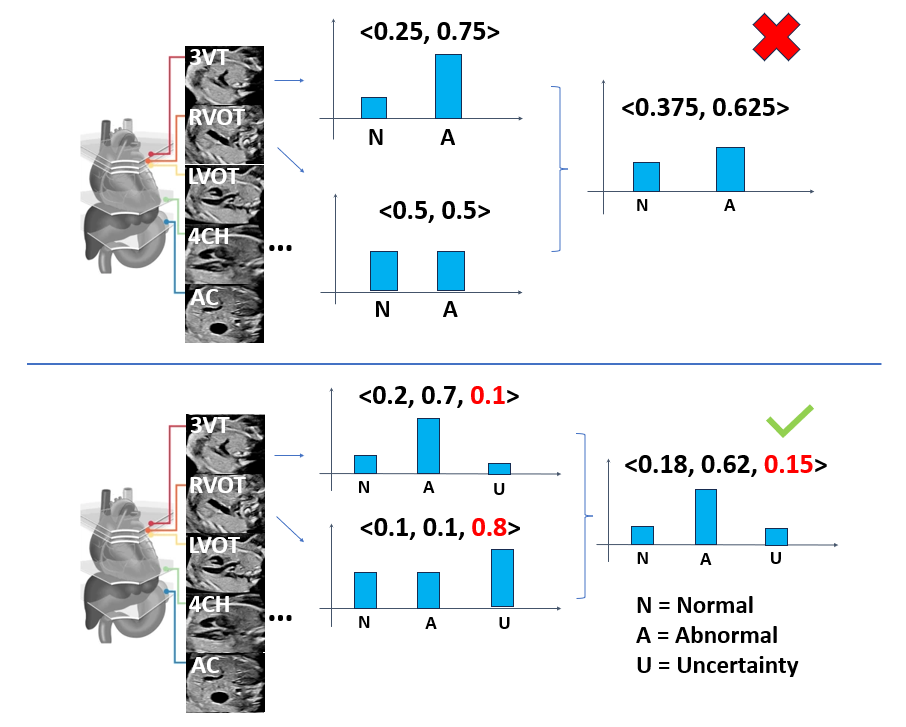
Figure 1: The method's motivation: leveraging uncertainty to optimize multi-view information for robust diagnostics even under inconsistent image quality.
Methodology
The authors constructed a unique large-scale fetal CHD dataset containing five key echocardiographic views per subject, encompassing both normal (1264) and abnormal (484) cases. The proposed framework, MVC-FDF, employs ResNet50 with weight sharing across views for feature extraction, an SE attention mechanism for inter-view fusion, and decision-level fusion based on Dempster-Shafer (DS) evidence theory.
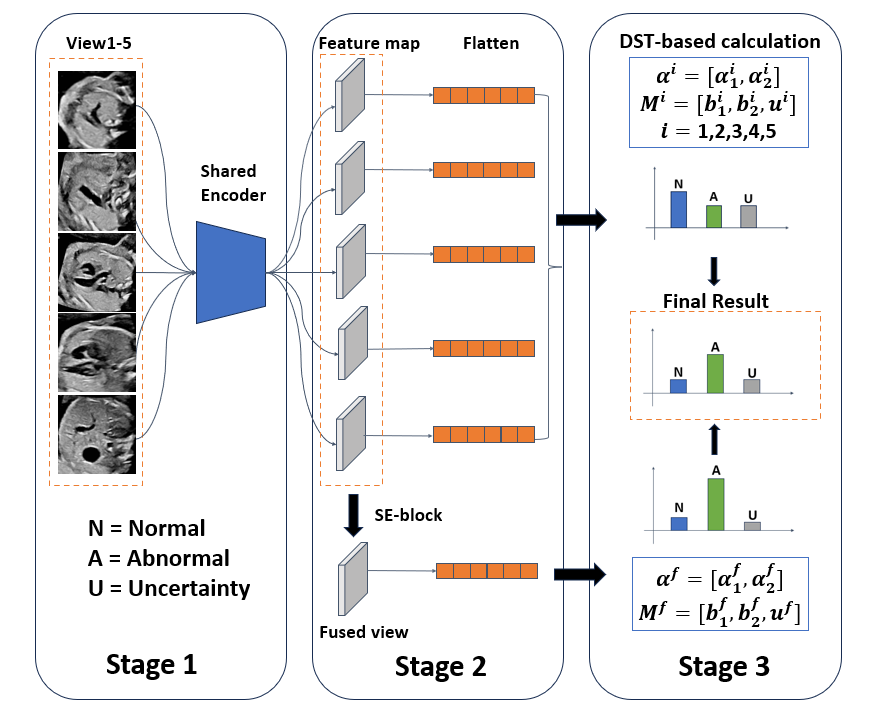
Figure 2: Overview of the MVC-FDF framework incorporating CNN-based feature extraction, attention-driven multi-view fusion, and DS evidence theory for final decision fusion.
Feature-Level Fusion
Each input view is processed independently through a ResNet50 backbone. The SE attention block aggregates and selectively amplifies discriminative features across views, exploiting inter-view complementarities. This mechanism addresses the inherent complexity of fetal cardiac structures by maximizing the utilization of unique spatial information offered in each perspective.
Decision-Level Fusion with Uncertainty Modeling
The decision-level fusion module utilizes DS evidence theory and Subjective Logic to quantify classification confidence via Dirichlet distributions. The belief masses and uncertainty mass parameterize the final diagnostic decision, enabling the system to distinguish between confident and ambiguous predictions, particularly in the presence of low-quality or noisy images. The fusion of independent and synthesized features ensures robust handling of multi-perspective data and mitigates the influence of suboptimal views.
Loss Function
The composite loss function encompasses three terms: individual view classification loss, fused-view classification loss, and combined all-view fusion loss. Each term incorporates KL-regularization scaled by an annealing factor λt, encouraging exploration of parameter space during early training and promoting generalization. The loss terms are computed using Dirichlet-based subjective logic, allowing joint optimization of classification fidelity and uncertainty quantification.
Experimental Results
The MVC-FDF model outperformed state-of-the-art multi-view and hybrid architectures on the custom CHD dataset. Key evaluation metrics—accuracy, sensitivity, specificity, precision, and F1-score—were consistently superior, with the method achieving an accuracy of 95%, sensitivity of 95%, and F1-score of 96%. These results demonstrate both strong diagnostic capability and robustness to dataset imbalance.
Ablation studies confirm the substantial benefit provided by DS-based decision fusion, which notably improved classification metrics in comparison to average fusion. Feature fusion via attention mechanisms had a smaller but measurable impact, primarily enhancing inter-viewpoint integration in complex scenarios.
Uncertainty Evaluation
The framework’s uncertainty estimation was validated by clinical experts across varied quality and pathology cases, revealing that the uncertainty output correlates strongly with image quality rather than pathology. This suggests practical utility for clinical workflows: the system not only provides a probabilistic diagnostic outcome but also flags uncertain predictions, recommending further review in cases of low-quality imaging.
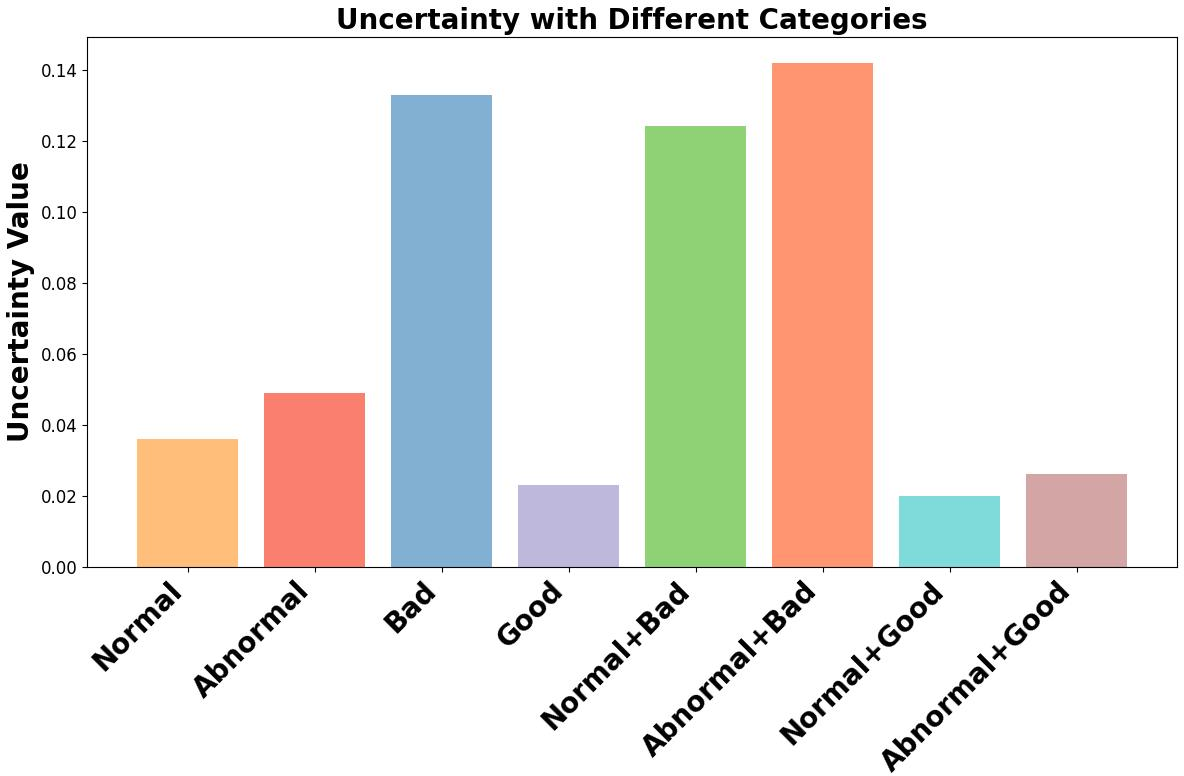
Figure 3: Bar chart quantifying uncertainty; higher bars indicate elevated uncertainty, strongly dependent on image quality rather than diagnostic category.
Practical and Theoretical Implications
The MVC-FDF framework constitutes a major advancement in trusted medical AI, particularly for echocardiographic classification tasks where data quality is highly variable. Its dual-fusion approach, combining feature-level attention and DS-theory-driven decision fusion, delivers competitive diagnostic accuracy while also integrating uncertainty awareness—a critical requirement for clinical adoption.
Theoretically, the integration of DS evidence theory and subjective logic into deep learning frameworks for medical imaging addresses longstanding challenges in multi-view learning and uncertainty quantification. It opens avenues for future development, such as uncertainty-aware video analysis, quality-aware segmentation, and integration into federated medical imaging systems.
Practically, the release of a high-resolution multi-view CHD dataset and accompanying source code upon acceptance will catalyze further research in automated diagnosis and trusted inference in fetal cardiology. This framework is extendable to other organs and imaging modalities, where multi-perspective information fusion and robust uncertainty modeling are essential.
Conclusion
The paper presents a trusted multi-view deep learning methodology for fetal CHD classification, combining advanced feature-level attention fusion and DS-theory-based decision fusion to achieve high accuracy and reliable uncertainty quantification. The approach demonstrates empirical superiority over contemporary methods and provides actionable uncertainty metrics essential in real-world medical settings. Future work will emphasize dynamic modeling of image quality uncertainty at the individual view level and extension to echocardiographic video analyses.

