- The paper introduces AudEdit, an inversion-free text-guided audio editing framework that bypasses noisy inversion using pretrained rectified flow models.
- It demonstrates superior semantic alignment and audio preservation, improving CLAP similarity and reducing FAD compared to inversion-based methods.
- The method enables precise, controlled audio edits for creative workflows while noting limitations in broad semantic rewrites and complex transformations.
AudEdit: Inversion-Free Text-Guided Editing with Pretrained Audio Flow Models
Introduction and Motivation
Inversion-based zero-shot editing with pretrained diffusion or flow-based audio generation models has become de facto in text-guided real-audio editing. However, these approaches, including SDEdit and ODE inversion, intrinsically suffer from a trade-off between semantic prompt adherence and temporal, timbral, or structural preservation. The central bottleneck emerges from the requirement to invert the source signal into a high-noise regime, then sample conditioned on the new prompt, which leads to either under-editing or loss of fine-grained details. Motivated by recent inversion-free editing advances in rectified flows for images, AudEdit proposes a direct, inversion-free, and training-free text-guided audio editing scheme tailored for continuous latent spaces in pretrained rectified-flow models, with a focus on Stable Audio 3.
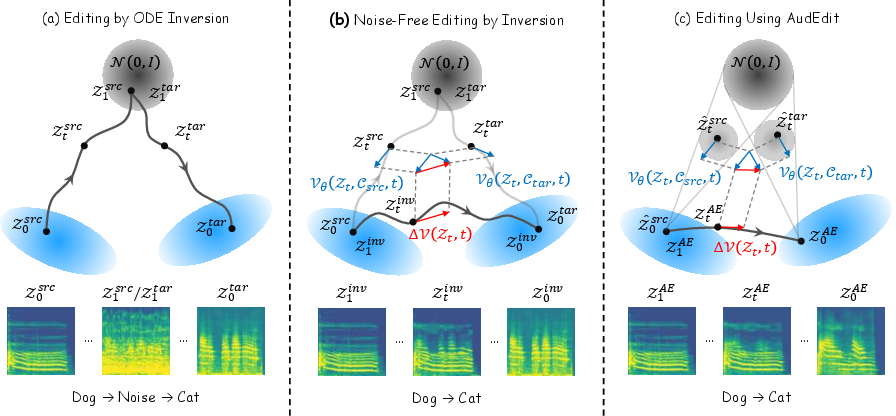
Figure 1: Editing by inversion vs. AudEdit. Inversion and SDEdit detour through noise; AudEdit integrates a direct source-to-target path through the velocity difference.
Methodology
Rectified Flow Foundation
AudEdit operates in the SAME latent domain of Stable Audio 3, leveraging rectified-flow transport. In these models, samples are transitioned from Gaussian noise towards data via integration in latent space under a time-dependent, text-conditioned velocity field. Prior editing frameworks invert the source audio into a noisy state and then sample back under the desired prompt. Not only does this approach require paired source inversion and isospectral integration, but the inherent loss of low-level information at high noise levels renders precise preservation difficult.
Direct Velocity-Difference Editing
The chief conceptual innovation in AudEdit is the avoidance of explicit source inversion. Instead, at each integration time step along a schedule, a batch of stochastic noise instances are drawn to construct coupled source and virtual target states, maintaining identical noise structure. The update direction for the edited latent is obtained by averaging the difference between the target- and source-conditioned velocity fields (provided by the pretrained model) evaluated at these paired states. This velocity-difference is directly integrated, yielding an edit path that connects the source and target distribution without traversing the high-noise bottleneck.
Stochastic averaging across trajectories mitigates estimator variance and improves robustness, while the direct update cancels out irrelevant shared denoising dynamics, focusing the edit on prompt-conditioned semantic and structural changes. This framework is training-free, does not require paired edit data, and is agnostic to internal architecture features, depending only on the velocity fields of Stable Audio 3.
Quantitative and Qualitative Evaluation
AudEdit is evaluated on curated datasets for environmental sound effects (FSD50K derivatives) and music (Song Describer Dataset), using metrics for both semantic alignment (CLAP-T), source consistency (CLAP-A, LPAPS, PANNs), low-level fidelity (LSD, MCD), domain-specific structure (AudioBERTScore for SFX, MelodySim for music), and distributional similarity (FAD).
AudEdit achieves superior trade-offs between prompt match and preservation compared to SDEdit, ODE inversion, and FireFlow baselines.
- On sound effects, AudEdit lifts target CLAP similarity from 0.42 to 0.52 while reducing FAD from 65.70 to 50.37 compared to SDEdit.
- On music, CLAP-T improves to 0.59 and LPAPS drops to 0.19, evidencing stronger semantic fidelity and lower perceptual drift.
Subjective evaluation via MOS (Mean Opinion Score) confirms these findings, with AudEdit scoring highest on both preservation and overall edit quality.
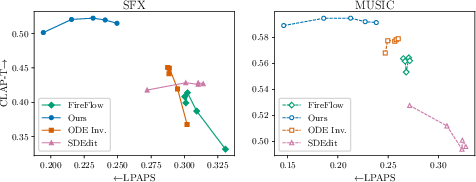
Figure 2: CLAP-T versus LPAPS under guidance/strength sweeps for sound-effect and music edits.
Analysis of direct path transport cost using model-generated sources further reveals AudEdit reaches the lowest latent MSE and spectral distortion, confirming the geometric and perceptual advantages of avoiding inversion across a spectrum of edit types (replacement, addition, deletion). Pareto front analysis (Figure 2) demonstrates an improved trade-off region, not just a different operating point.
Acoustic Structure and Flow Spectra
Detailed investigation into the decoded spectral content of the velocity-difference updates (Figure 3) demonstrates that, unlike naive noise perturbation, the edits are low-frequency dominated and structured across flow noise levels. This indicates that the method applies meaningful, prompt-related source-to-target modifications that are not mere stochastic corruptions but structured transport operations.
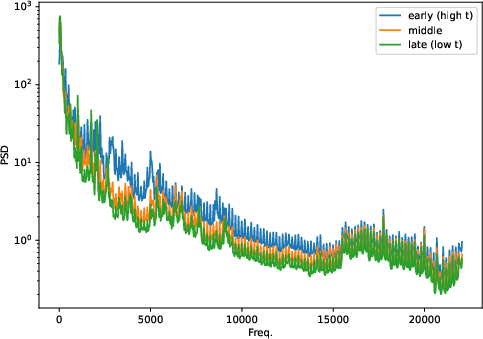
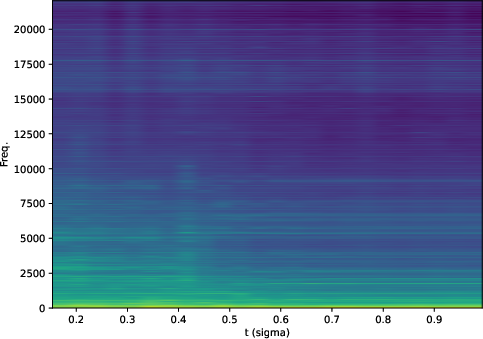
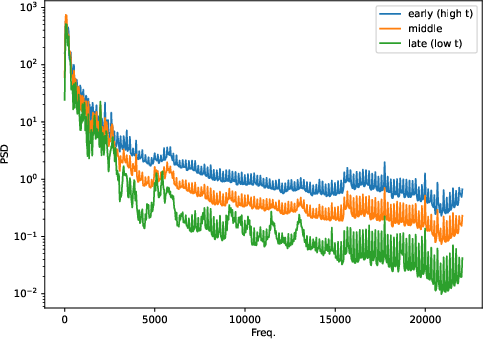
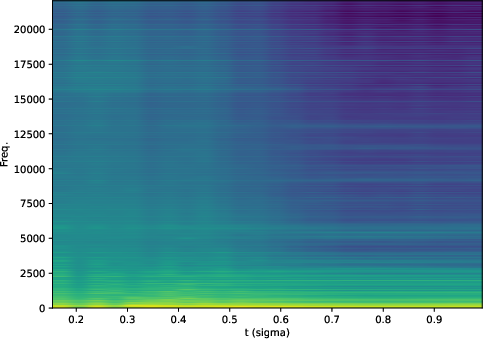
Figure 3: Velocity-difference power spectra.
Practical Implications and Limitations
The key implication of AudEdit is the demonstration that zero-shot, training-free, inversion-free text-guided audio editing with rectified flows is not only computationally feasible but empirically superior in preserving perceptual and structural details while robustly controlling prompt adherence. These results enable advanced creative workflows for music producers and sound designers who require fine-grained, controlled revisions of real recordings, far beyond what generation-from-scratch or inversion-based approaches offer.
However, the direct transport mechanism biases AudEdit toward source-preserving edits; broad semantic rewrites or out-of-distribution manipulations (e.g., cross-domain, multi-role swaps) can lead to incomplete edits or artifacts. The approach also inherits the manifold and generalization limits of the backbone (Stable Audio 3), and lacks explicit temporal or stem controls.
Theoretical Impact and Future Directions
The work demonstrates that direct transport in learned flow-latent spaces yields both practical and theoretical benefits—moving toward optimal edit paths in the model's geometry. This suggests promising directions in editing with normalizing flows, stochastic interpolants, and fine-grained control in continuous audio domains. Future advances may combine maskable, temporally localized editing, multimodal alignment, or hierarchical multi-scale paths, and relax the assumption that the source is always close to the model manifold.
Conclusion
AudEdit sets a new standard for text-guided editing in audio, showing that inversion-free, training-free rectified-flow transport provides significantly improved prompt-preservation trade-offs. This advancement is critical for both research and application in controllable, naturalistic, and semantically meaningful editing of real-world audio.