Stability analysis of de Sitter solution in the Einstein-Grisaru-Zanon gravity using the dynamical system method
Published 13 Jun 2026 in hep-th and gr-qc | (2606.15119v1)
Abstract: In this paper, we would like to investigate the stability of de Sitter solution in the Einstein-Grisaru-Zanon gravity, which is a novel fourth-order gravity model considered recently in a paper [Phys. Lett. B {\bf 855} (2024) 138811]. As a result, we are able to derive the corresponding field equations for the Einstein-Grisaru-Zanon gravity by using an effective method based on the Euler-Lagrange equations. Unfortunately, one of the obtained field equations does not coincide with that derived in the original paper of the Einstein-Grisaru-Zanon gravity due to a gap between higher-order derivative terms. However, our de Sitter solution is still identical to one solved in the original paper of the Einstein-Grisaru-Zanon gravity due to the vanishing of the gap. Furthermore, a stability analysis based on the dynamical system method is performed to indicate that the obtained de Sitter solution is always unstable, no matter it presents an inflationary phase or expanding phase of universe. This result confirms the validity of stability investigation carried out in the original paper of the Einstein-Grisaru-Zanon gravity.
The paper develops an autonomous dynamical system reformulation of the EGZ field equations to assess the de Sitter solution's stability.
Stability analysis shows the de Sitter fixed point acts as a repeller, confirmed by eigenmode calculations and phase-space trajectories.
Findings imply that the unstable de Sitter phase in EGZ gravity necessitates mechanisms for a graceful exit from inflation.
Stability Analysis of the de Sitter Solution in Einstein-Grisaru-Zanon Gravity via the Dynamical System Approach
Introduction
The analysis addresses the viability of the Einstein-Grisaru-Zanon (EGZ) model, a higher-order gravity theory characterized by a novel quartic curvature term inspired by superstring corrections, in admitting cosmological de Sitter solutions. Fourth-order gravities, such as Starobinsky and Bel-Robinson extensions, represent essential candidates for explaining both primordial inflation and late-time cosmic acceleration, while providing necessary modifications to general relativity for potential renormalizability. The EGZ model represents an explicit extension with the Grisaru-Zanon (GZ) term, constructed as a leading-order α′3 superstring correction, entering at quartic order in the Riemann tensor. The key target of this research is the existence, uniqueness, and dynamical (in)stability of the de Sitter phase in the EGZ framework as a necessary foundation for cosmological model building and phenomenology.
The EGZ Action, Field Equations, and de Sitter Solutions
The EGZ action is given by:
SEGZ=2Mp2∫d4x−g(R+Mp6γJ)
where J encodes the GZ quartic curvature contraction. The cosmological analysis proceeds in the flat FLRW metric, introducing the ansatz α(t)=ζt for the scale factor to isolate de Sitter (constant-Hubble) solutions. Variation using the Euler-Lagrange method yields a nontrivial field equation, ultimately reducing to an algebraic constraint:
12γˉζ6−1=0⟹ζ=[1/(12γˉ)]1/6
where γˉ=γ/Mp6. This result agrees exactly with the original EGZ construction and highlights a constraint on the allowed parameter γˉ>0, with the inflationary regime accessible for γˉ≪1.
Dynamical System Reformulation
Given the complexity and high order of derivatives in the EGZ field equations, the authors recast the system into an autonomous dynamical system using variables:
B=α˙21,Q=α˙2α¨,Q2=α˙3α(3)
This enables the rewriting of the original fourth-order ODE in terms of first-order, tractable flows:
B′=−2QB
SEGZ=2Mp2∫d4x−g(R+Mp6γJ)0
SEGZ=2Mp2∫d4x−g(R+Mp6γJ)1
where the prime denotes differentiation with respect to a reparametrized "dynamical time" SEGZ=2Mp2∫d4x−g(R+Mp6γJ)2 related to the e-fold expansion. Consistency constraints ensure the dynamical system encapsulates the full physics of the underlying field equations, especially for identifying fixed points corresponding to exact cosmological solutions.
Fixed Points and Stability Analysis
The fixed points of this dynamical system correspond to cosmologically significant solutions. The de Sitter fixed point is analytically identified as:
SEGZ=2Mp2∫d4x−g(R+Mp6γJ)3
corresponding precisely to the de Sitter solution obtained from the direct field equation analysis.
To analyze stability, the linearized perturbation equations about the fixed point are constructed, yielding a characteristic cubic equation for the eigenvalues SEGZ=2Mp2∫d4x−g(R+Mp6γJ)4 governing perturbation growth:
SEGZ=2Mp2∫d4x−g(R+Mp6γJ)5
The roots include a positive real eigenvalue,
SEGZ=2Mp2∫d4x−g(R+Mp6γJ)6
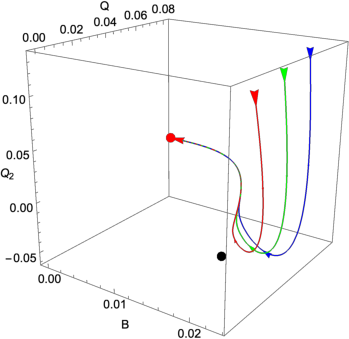
signaling that the de Sitter solution acts as a repeller in phase space. This instability is numerically corroborated by the time evolution of phase trajectories.
Figure 1: The fixed point equivalent to the de Sitter solution (black point, SEGZ=2Mp2∫d4x−g(R+Mp6γJ)7) is a repeller; phase-space trajectories converge instead to a non-de Sitter fixed point (red point, SEGZ=2Mp2∫d4x−g(R+Mp6γJ)8), as demonstrated for SEGZ=2Mp2∫d4x−g(R+Mp6γJ)9.
All initial conditions (trajectories in the J0 space) diverge from the de Sitter fixed point; instead, they converge to a non-de Sitter attractor. Thus, the de Sitter expansion is not future-stable, irrespective of parameter choice.
Implications and Theoretical Perspective
The instability of the de Sitter solution in EGZ gravity carries profound implications. First, it precludes eternal inflation within this model, thus avoiding the multiverse scenario endemic to models with stable de Sitter attractors. This is theoretically consistent with the necessity, for realistic inflationary cosmology, to realize a graceful exit from the inflationary phase. Furthermore, the universal independence of the instability from the value of J1 or J2 implies that the model's inflationary realizations, while admitting a de Sitter phase, are generically transient.
For late-time acceleration, the instability suggests the requirement of an additional dark energy component (e.g., a cosmological constant or quintessence) to produce a stable de Sitter-like expansion. The result also accentuates the interplay between higher-order corrections and the structure of (in)stabilities in modified gravities. Extension of this eigenmode analysis to other quartic (e.g., Einsteinian cubic or Starobinsky–GZ) models is a clear research direction, especially considering that the analytic structure of the EL-derived equations can serve for rapid checks and corrections absent in the direct variational tensorial approach.
Conclusion
The EGZ gravity model admits a unique de Sitter cosmological solution that is structurally unstable for all parameter regimes, as rigorously demonstrated via autonomous dynamical system analysis and confirmed by explicit eigenmode calculations. The de Sitter solution corresponds to a repeller in phase-space, with generic flows avoiding it in favor of nontrivial attractors. This precludes the possibility of eternal inflation in pure EGZ gravity, establishing it as a potentially viable model for inflation with a built-in mechanism for a graceful exit. The broader theoretical consequence is that higher-derivative corrections, even motivated by string theory, require careful stability analysis to ascertain their cosmological relevance. This framework invites further scrutiny of de Sitter stability in other quartic and higher-order models appearing in the quantum gravity landscape.