- The paper introduces a counterfactual generation framework to decouple error signals from context, thereby enhancing model robustness in grammatical error correction.
- It employs span-controlled perturbations and mutual information-based selection to simulate realistic context shifts while preserving key error patterns.
- Empirical results demonstrate significant F0.5 improvements across benchmarks, proving the method's effectiveness in mitigating context-induced performance drops.
CoCoGEC: Counterfactual Generation for Robust Grammatical Error Correction
Introduction
CoCoGEC introduces a counterfactual generation framework targeting robustness in the Grammatical Error Correction (GEC) task. Despite substantial advances in neural GEC, prevailing systems exhibit significant performance deterioration when subjected to context perturbations, including both local (word-level) and non-local (sentence-level) changes. This paper formalizes and applies counterfactual reasoning to GEC, arguing that current models overfit to superficial context cues and fail to generalize across realistic domain shifts.
A motivating example in the paper illustrates that while leading LLMs (e.g., GPT-4) can accurately correct errors under standard benchmarks, their predictions are brittle under context extension or minor perturbations. The observed drop in robustness is especially prominent on datasets mirroring complex real-world inputs, such as TEM-8, under perturbation regimes.
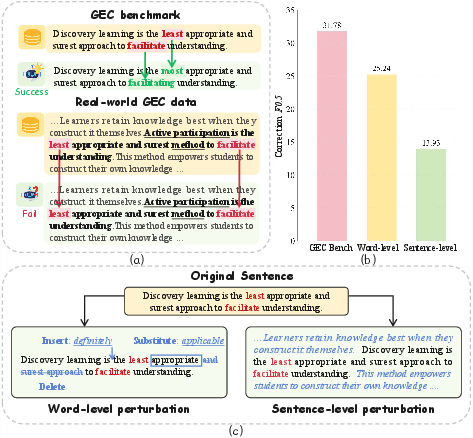
Figure 1: Contextual shift from benchmarks to real-world data (a), degradation in robustness under context perturbation (b), and examples of intra/inter-sentence counterfactuals illustrating the CoCoGEC approach.
Most prior work on data-centric robustness for GEC has relied on random noise injection, pseudo-corpus generation, or loosely controlled augmentations, typically with little interpretability and often causing performance regression due to semantic drift or noise artifacts. CoCoGEC advances the field by providing a formal, task-specific definition of counterfactuals for GEC:
- Intra-sentence counterfactuals perturb error-irrelevant spans at the lexical or phrasal level, holding annotated error patterns invariant with minimal syntactic drift.
- Inter-sentence counterfactuals append or prepend fluent, error-free prefix/suffix utterances to simulate discourse context shift while maintaining error span and correction alignment.
These counterfactuals meet three critical criteria:
- Minimal syntax-preserving noise within the error-free segments of the source.
- Semantic coherence in expanded context.
- The constraint that the new set of gold edits E′ forms a subset of the original E (no introduction of novel errors).
By doing so, CoCoGEC allows for systematic evaluation and training of models on hard negative examples that specifically decouple error phenomena from confounding context, thereby fostering context-invariant representation learning.
Counterfactual Generation Pipeline
The CoCoGEC pipeline comprises three sequential phases:
- Span-controlled counterfactual generation: Non-error-containing source spans are replaced with LLM-generated alternatives using masked [BLANK] templates. The process leverages targeted prompts and sampling constraints, preserving critical error signal and syntactic form.
- Contextual expansion: Prefixes and suffixes are constructed via LLMs to inject semantically coherent but error-free document-level context, simulating real-world long-form input structures.
- Edit-alignment and selection: Candidates violating the original edit mapping constraint (E′⊆E) are filtered using ERRANT; remaining candidates are ranked by a GEC Mutual Information (MI) criterion measuring the informativeness and 'confusability' of the instance.
By applying a neural scoring framework, high-MI, label-invariant, and semantically plausible counterfactuals are prioritized for augmentation to maximize model robustness gains.
Experimental Results
Empirical analysis uses the RobustGEC benchmark, measuring performance on BEA-19*, CoNLL-14*, and TEM-8* under both source and perturbed conditions (word-level, sentence-level, and combined shifts). Across multiple backbone architectures (GECToR, T5, Qwen3-8B), CoCoGEC yields substantial, consistent improvements over CPR, DISCO, and TypeDA augmentation schemes.
Key findings include:
- Absolute F0.5 improvements of +9.9 (BEA-19*), +11.3 (CoNLL-14*), and +20.8 (TEM-8*) on Qwen3-8B, demonstrating strong context-perturbation resilience.
- Significantly reduced F0.5 degradation under perturbation, especially for sentence-level and long-context settings (cf. breakdown on TEM-8).
- Robustness extends to compact parameter regimes: Qwen3-8B+CoCoGEC matches or outperforms larger LLMs (GPT-4o, LLaMA3-8B) in perturbed regimes with much lower computational footprint.
- CRS and P-CRS scores demonstrate superior context prediction consistency.
- No decrease in performance is observed on canonical GEC benchmarks (BEA-19, CoNLL-14).
Ablation and Analysis
Component ablation indicates that both intra- and inter-sentence augmentations are necessary, with MI-based selection being crucial to avoid dilution from suboptimal counterfactuals. Robustness holds across increasing numbers and spans of perturbations, with slower performance decay than all baselines.
Case studies underscore that CoCoGEC-trained models can consistently correct error phenomena even as semantic context is varied, whereas baseline models show erratic prediction drift. This effect is pronounced in high-noise, long-context settings, confirming the framework's value in practical application domains, including grammar checking in educational or real-world document editing tools.
Implications and Future Directions
The CoCoGEC framework bridges counterfactual reasoning with structured-generation tasks beyond binary classification, providing a general blueprint for data-centric robustness in sequence transduction. By decoupling error representation from context artifacts, the approach encourages more reliable and interpretable model behavior, aligns closely with human error correction, and reduces domain and input shift fragility.
Potential avenues of extension include:
Conclusion
CoCoGEC presents a robust, data-centric method for improving GEC systems under realistic, contextually variable settings. By leveraging targeted counterfactual generation and rigorous filtering via mutual information, it delivers state-of-the-art robustness on established perturbation benchmarks without sacrificing canonical performance. Its paradigm readily extends to broader sequence-to-sequence NLP tasks sensitive to contextual distributional shifts, marking a significant methodological advance in the systematic engineering of robust NLP systems.