- The paper identifies a first-order dynamical phase transition into SWSSB, observed via discontinuous jumps in fidelity and Renyi-2 correlators at a critical time t_c.
- Analytical and numerical results confirm that volume-law entangled thermal pure states, unlike area-law states, exhibit an abrupt transition marked by a nonanalytic entropy kink.
- The study provides experimental implications for observing SWSSB through randomized measurements and suggests rethinking error models in quantum devices.
Discontinuous Strong-to-Weak Symmetry Breaking Transition from Thermal Pure States
Overview and Motivation
This work presents a detailed analysis of the nonequilibrium dynamics associated with the emergence of strong-to-weak spontaneous symmetry breaking (SWSSB) in quantum many-body systems, focusing on decoherence processes that begin from generic thermal pure states with volume-law entanglement. The manuscript identifies and demonstrates, both analytically and numerically, that SWSSB—manifested as long-range order detectable only by nonlinear density matrix functionals—can emerge via a discontinuous dynamical phase transition at a sharply defined critical time. This sharply contrasts with previously studied scenarios, where transitions to SWSSB from area-law states or product states occur gradually or are absent in low-dimensional systems.
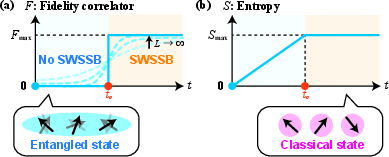
Figure 1: Schematic illustration of the dynamical emergence of SWSSB and a sharp discontinuity in the global entropy at a finite critical time tc.
Theoretical Framework
SWSSB Order and Its Diagnostics
In open quantum systems, symmetries are classified as either strong (each pure state in the ensemble obeys the symmetry operator) or weak (ensemble-averaged density matrix remains invariant). SWSSB describes the situation where global coherence is lost—destroying strong symmetry—while weak symmetry persists. Unlike conventional symmetry-breaking, SWSSB is not detectable via linear correlations; instead, one must use nonlinear diagnostics such as the fidelity correlator or the *R*enyi-2 correlator.
The system is governed by a Lindblad master equation with symmetry-invariant dissipators. The focus is on initial states ρ0=∣ψ0⟩⟨ψ0∣ with:
- Volume-law entanglement
- Absence of standard (linear) symmetry breaking
- Random (Haar-random or thermal) pure state character
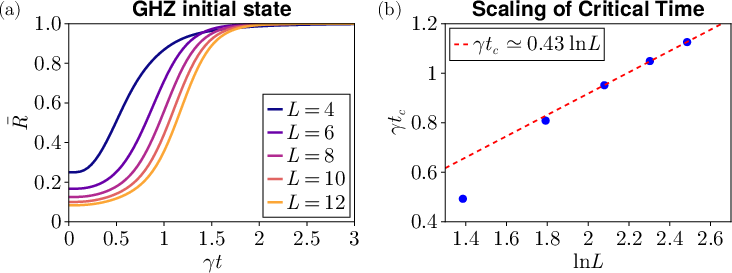
The paper conjectures and analytically substantiates that such a system exhibits a first-order dynamical transition (i.e., discontinuous in order parameter) into the SWSSB phase at a finite, system-size-independent critical time tc.
Analytical Results
Through an explicit calculation—using mean-field and cluster mean-field approximations in tractable models—the authors derive the scaling and sharpness of the transition. For both the fidelity and Renyi-2 correlators, in the thermodynamic limit:
- For t<tc: both correlators vanish at long range.
- For t>tc: both correlators jump discontinuously to finite values, signaling global SWSSB.
At tc, global entropy (including Renyi-2 and von Neumann) exhibits a nonanalytic kink, saturating to its maximal value.
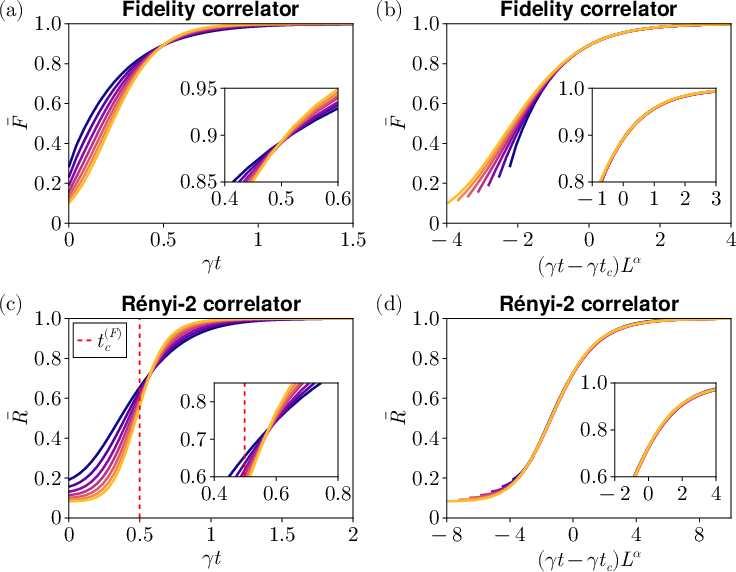
Figure 2: Dynamical phase transitions of the fidelity and Renyi-2 correlators; the crossing point for various system sizes determines the critical time tc.
Numerical Simulations and Universality
The numerical analysis spans two symmetry classes:
For both models, the critical time is extracted via finite-size scaling, showing robust, universal scaling collapse across increasing system sizes. The system’s entropy and nonlocal correlators verify the abruptness of the transition.
Notably, the dynamical transition occurs even in 1D, in contrast to earlier work where 1D systems initialized in product or area-law states did not display finite-time SWSSB phase transitions. This outcome is a direct consequence of starting from volume-law entangled, thermal pure states.
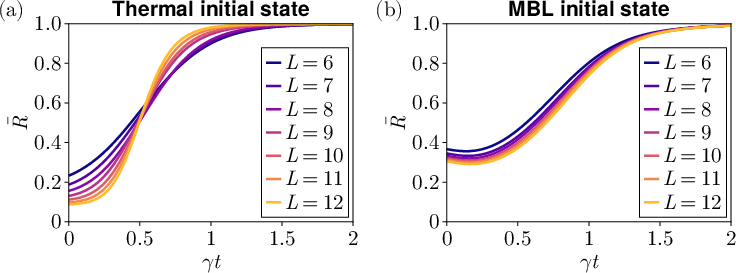
Figure 3: Time evolution of spatially averaged Renyi-2 correlator Rˉ highlights the transition for different initial states (thermal vs MBL); only thermal states support the discontinuous transition.
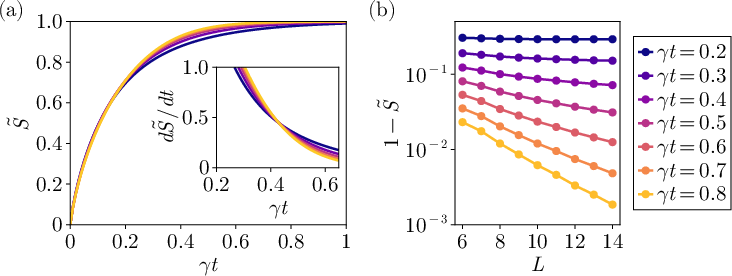
Figure 4: Saturation of global entropy and its derivative showing a sharp kink at ρ0=∣ψ0⟩⟨ψ0∣0, coinciding (up to finite-size corrections) with the discontinuous SWSSB transition.
Role of Initial States
The analysis stresses that both volume-law entanglement and macroscopic state randomness/typicality are required. When starting from:
Experimental Relevance
The theory provides actionable metrics for experimental diagnostics: the purity and Renyi-2 correlators, accessible via randomized measurements. The results suggest that current experiments with ultracold atoms or noisy quantum simulators should observe a nonanalytic jump in global entropy and nonlocal order when thermal pure states are decohered, provided sufficient system size and initial entanglement.
Implications and Future Directions
The discovery and characterization of a discontinuous, information-theoretic dynamical phase transition in open quantum systems underscores the nontrivial consequences of many-body entanglement for the fate of symmetry and order under decoherence. This phenomenon invalidates naive expectations of smooth decoherence dynamics and challenges conventional open-system scaling arguments.
Implications include:
- Fundamental: The universality of quantum information singularities tied to genuine internal entanglement, not reliant on all-to-all or infinite-range couplings.
- Practical: Provides reason to reconsider error models in quantum devices and the emergent nonequilibrium physics in quantum simulators or computation platforms.
- Theory: Suggests exploring mixed-state transitions via higher-order nonlinear correlators and connects to nonequilibrium criticality, monitored quantum dynamics, and robust quantum memory design.
Open questions for future research:
- How do interaction range, measurement protocols, and symmetry class alter the nature and universality class of such transitions?
- Can robust order persist or revive under repeated dynamical protocols or active error correction?
- What are the precise operator content and critical exponents associated with such dynamical mixed-state transitions?
Conclusion
This study establishes that the degradation of global quantum coherence in generic, highly entangled initial states under Markovian decoherence leads to a sharp, first-order dynamical phase transition into the SWSSB phase at a finite critical time, discernible in both entropy and nonlinear correlation diagnostics. The universality across symmetry classes and the dependence on both initial-state randomness and entanglement structure point to new paradigms in nonequilibrium open quantum system physics and underpin future explorations of dynamical criticality in realistic experimental settings (2606.15062).
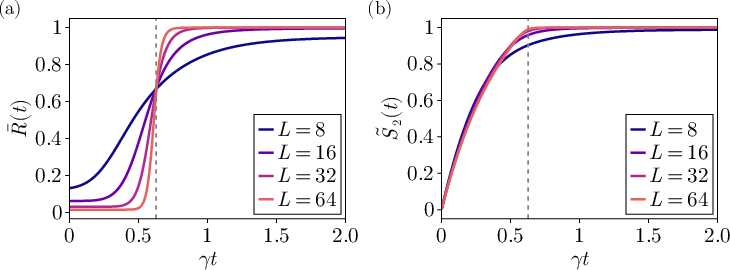
Figure 6: Cluster mean-field simulations capturing the discontinuous jump in the Renyi-2 correlator, corroborating the qualitative features obtained in the exact numerical treatment.